
Òyèkú Òfún is a mixed Odù in Ifá’s 256-part corpus. One story transfers Shango’s governance to Orunmila after a journey with other travelers; another has a young man find his absent father by confronting the hunger in the father’s territory. Both connect authority with people arriving from outside its immediate circle. The sign’s origin list also names transformations of the earth and of Eshu, giving a contextual theme of changed roles without deriving meaning from arithmetic combinations.
A question to carry through the study: What does a claim to authority mean if the people under it are not being fed?

This Academy reads the right column first, then the left. Each row carries a single or double mark.
Where this Odù belongs
Òyèkú Òfún belongs to the Òyèkú family in this Academy’s study sequence. It is a mixed Odù, distinct from Òfún Òyèkú. The order matters. Its teaching is approached through its own narratives, rather than by adding two general descriptions of the principal signs together.
Key Òrìṣà and sacred relationships
The figures below are selected for their roles in the accounts discussed here. They offer connected reading paths through the tradition.
-
Ọ̀rúnmìlà. He accompanies travelers to Oyo and receives Shango’s governing role, then separately equips a young seeker with food before the search for his father.
-
Ṣàngó. He welcomes Orunmila and leaves him to govern as a storm begins, making authority transferable rather than an unchanging possession of one ruler.
-
Ìbejì. The figures named as Ibeji meet the travelers at Oyo’s entrance and lead them toward hospitality; the passage unusually describes three youths, so the wording remains unresolved.
Key myths and their meanings
A journey that changes the governor
Orunmila travels toward Oyo behind a group of other travelers. Thunder alarms them, and the group seeks his counsel before continuing together. At the town entrance, youths identified as the Ibeji lead them toward a house, and Eshu directs them to the ruler. Shango receives Orunmila with honor and leaves him governing as rain and lightning begin.
The episode situates an appointment within travel, counsel, reception, and the cooperation of several figures. It does not explain the town’s consent or the duration of the transfer. Those absences matter: a prestigious welcome is not a complete account of legitimate governance. We should also preserve the source’s unusual number of youths instead of silently correcting it.
Narrative setting: Cuban/Lukumí-labeled patakín in the multilingual source compilation; individual narrator and publication history are not established.
The hungry people reveal the father
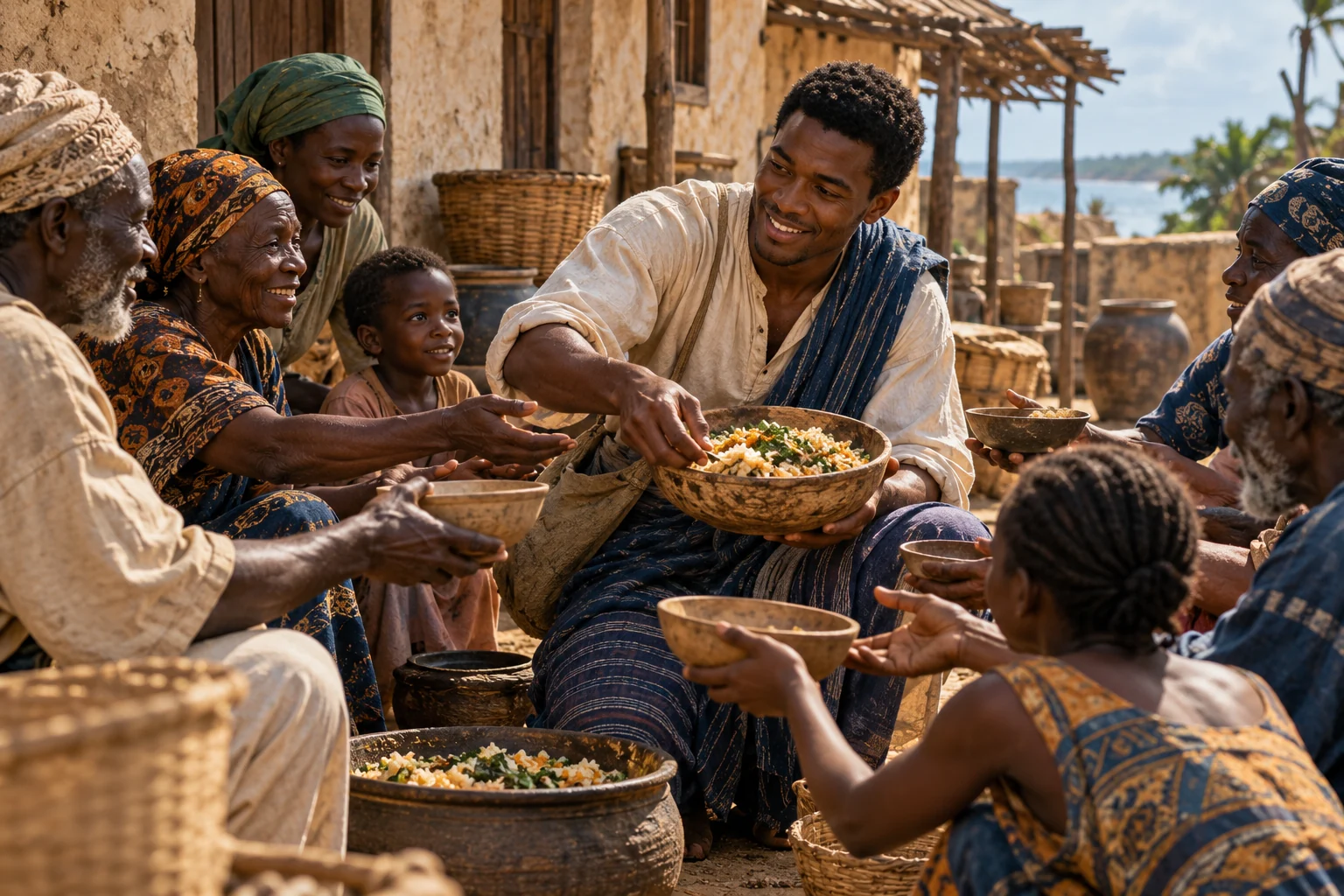
Raised by his mother with little information about his father, a young man repeatedly asks Orunmila for guidance. Finally given for the journey, he reaches a town where people have little to eat. He shares food and attracts the ruler’s attention. Facing the ruler, he identifies himself as the son and insists that the population must be fed, then remains to govern with him.
The father is found through an ethical confrontation rather than resemblance or a private reunion alone. The son’s first action is to feed strangers, so family discovery expands responsibility beyond the household. The ending leaves father and son together in power, but says little about how provision will change; the demand should remain more concrete than a promise of automatic harmony.
Narrative setting: Cuban/Lukumí-labeled patakín in the multilingual source compilation; individual narrator and publication history are not established.
Stolen yams travel beneath the appearance of a funeral
Ero’s yam harvest succeeds when surrounding farms produce poorly. Ijapa steals the yams in a rectangular container covered to resemble a funeral burden and announces deaths as it passes. People who avoid looking at corpses do not inspect it, allowing the theft to continue. Ero consults, completes a religious response involving Eshu and Osanyin, and returns to the farm’s problem. Osanyin conceals a presence near the store. Ijapa takes the small package as well as the yams and opens it, releasing the accusing power. The thief is escorted before elders and punished. The account adds a bodily origin motif whose interpretation is not needed to follow the exposure.
The disguise exploits a respected boundary rather than mere darkness. People refrain from looking because they believe the burden belongs to death, so an act of restraint becomes the means by which ordinary property is removed. Within the narrative, consultation and Osanyin’s intervention disclose what the human witnesses have not inspected. The sacred response does not simply abolish every boundary around corpses; it identifies a false use of one. Contemporary interpretation can ask how a community tests a claim of exception without treating every protected practice as a cover for wrongdoing.
The scarcity surrounding Ero’s successful field also matters: the story places theft amid unequal harvests, but does not make need an adequate justification for the deception. Its final punishment is severe and should not become a judicial recommendation. The appended body explanation remains a local religious origin claim, not zoology. The deeper issue is how an appearance borrows authority from a relation it does not actually carry.
Narrative witness and setting: Section explicitly headed revelations of Cromwell Osamaro; Yoruba/Bini-framed Ero and Ijapa narrative.
The stolen cloth contains a voice the robbers cannot silence
A cloth merchant consults about his livelihood and carries a small drum made through the prescribed religious response within his merchandise. Robbers take the goods and bring them to their hidden store. The drum begins naming them; an extraordinary serpent emerges, and the attackers die. Meanwhile the merchant accuses Orunmila of giving advice followed by loss. Consultation directs him home, where the drum returns, calls him, and leads him to the store. He recovers his cloth and takes the robbers’ accumulated wealth as well. The result makes him prosperous and publicly honored, while leaving the other victims’ relation to the recovered property unaddressed.
The protection acts while the beneficiary cannot see it, creating a gap between apparent failure and events unfolding elsewhere. The merchant’s complaint is therefore intelligible from his immediate knowledge even though the narrative later supplies another perspective. Orunmila’s renewed consultation does not shame him merely for asking; it directs him toward the outcome already being prepared. The drum’s voice is an active sacred instrument, not only an ingenious alarm, and its ability to identify the robbers belongs to the story’s religious reality.
Contemporary analysis can ask how one evaluates counsel before all relevant events are known, while refusing to promise that every loss hides a coming reward. The store’s contents also raise a separate ethical question: recovering one’s own goods is not identical to inheriting everything stolen from others. The account celebrates the merchant’s prosperity without narrating restitution to those people. A depth treatment should preserve that omission rather than infer that a successful religious intervention settles every property claim automatically.
Narrative witness and setting: Section explicitly headed revelations of Cromwell Osamaro; Yoruba/Bini-framed merchant and speaking-drum narrative.
What was born in this Odù
“Born” can name an explicit traditional origin association or what emerges through a story: a capacity, relationship, practice or order of life. Interpretations drawn from a narrative are labelled below, so their basis remains clear.
Transformation of earth and Eshu
Selected traditional source association.
The inventory explicitly pairs transformations of the earth and Elegbara. This is a local origin association, not permission to define all change through one sign or to supply a missing creation story from general knowledge.
Eshu Larufa’s named parentage
Selected traditional source association.
The source names Eshu Larufa as a child of Inle and Iku. Preserve this particular genealogical association without making it universal for Eshu or collapsing Inle into other healing figures; the two selected stories do not narrate the birth.
Correlations to life dimensions
These questions bring the selected stories into contemporary life. They are interpretive invitations for study.
Work and resources
The son carries food and shares it before claiming any office. Provision creates the encounter that reveals his father. This sequence supports examining leadership through a concrete response to need rather than through lineage or ceremonial recognition alone.
Reflect: What need can be addressed before a title is granted?
Relationships and family
The absent father is encountered as a ruler answerable for other people’s hunger. The son’s desire for family connection does not prevent criticism. The narrative makes recognition compatible with confronting a parent’s conduct, without specifying a universal duty to reconcile.
Reflect: Can recognition include a difficult truth?
Character and inner life
The young seeker persists after repeated deflection but prepares for the journey rather than leaving empty-handed. His provisions become useful to strangers. The story supports connecting personal purpose with a willingness to respond to needs encountered along the way.
Reflect: What might your preparation make possible for someone else?
Community and responsibility
The governance-transfer story leaves the people largely silent, whereas the father-search story makes their hunger central. Reading them together produces a question about authority’s basis: ceremonial welcome and family succession require scrutiny through the condition of those governed.
Reflect: How do people under an authority describe its effects?
A deeper reading of the sacred relationships
Sacred assistance continues beyond the beneficiary’s sight
Osanyin’s concealed intervention and the drum’s independent action make protection effective where ordinary inspection fails. The earlier Shango-to-Orunmila transfer and the father-search story likewise place a person’s changed role within named sacred guidance. These are not merely different metaphors for self-confidence. Consultation, Eshu, Osanyin, and an efficacious instrument actively shape what can happen in the narratives. A religious depth treatment can explain that continuing relation while distinguishing it from a guarantee that every person’s goods or authority will be restored. Contemporary interpretation may then ask how uncertainty is lived when the full scene is unavailable, without treating every unanswered question as a failure of faith.
A protected appearance can be borrowed falsely
The disguised funeral container uses people’s restraint around death as cover for theft. The drum’s hidden presence reverses the advantage of concealment, making the stolen bundle carry a witness rather than only merchandise. The earlier governance welcome and father’s position supply other appearances whose legitimacy must be examined through actual relations: appointment does not describe all consent, and paternity does not excuse hunger among those governed. Contemporary analysis can ask what makes an appearance authoritative and what evidence or obligation should accompany it. The comparison should preserve sacred boundaries rather than conclude that every such boundary is fraudulent. The source’s point is a particular false claim within a living religious order.
Recovery and rightful distribution are separate questions
The merchant recovers cloth but also takes goods stolen from unnamed others. Ero exposes a thief, while the father-search episode makes food distribution the concrete test of a ruler’s responsibility. The transfer of governance supplies yet another form of received power whose obligations are not fully narrated. These differences prevent prosperity from being treated as self-explanatory justice. A depth study can honor the sacred protection given in the stories while asking who should benefit from what returns and who remains unnamed. The source does not narrate a restitution process for the robbers’ store, so neither a just settlement nor an intentional refusal to provide one should be invented beyond that silence.
Questions that deepen the study
Does exposing the sham funeral mean the story rejects funerary restraint?
The narrative exploits the difference between a genuine boundary and a fraudulent claim to it. Ijapa’s container is effective because people believe the announcement and avoid looking, not because actual funeral obligations are shown to be meaningless. Osanyin’s intervention identifies the theft through a sacred relation rather than demanding that every protected burden be violated. Contemporary interpretation can ask how a community verifies an exception without treating all observance as suspicious. The account’s severe punishment remains its particular ending, not a modern judicial rule, and its appended bodily explanation is not evidence about the historical origin of an animal’s anatomy.
Is the merchant wrong to complain before the drum returns?
His merchandise has actually been taken, and he does not know what happens in the hidden store. The narrative later shows that the religious response remains active beyond his sight. A contemporary reading can acknowledge the reason for his question without promising that every apparent failure conceals success. Orunmila responds through renewed consultation and direction rather than an extended condemnation of doubt. The episode therefore permits a relation between inquiry and trust that is more specific than unquestioning confidence. It still leaves a separate property question after recovery, since the additional wealth belongs to a store of other people’s stolen goods.
How do the new accounts deepen the sign’s concern with feeding people?
The father-search episode makes a ruler’s neglect visible when a young stranger distributes food. The yam theft and cloth recovery ask related but different questions about possession, appearance, and distribution. A successful harvest does not justify stealing, and sacred recovery does not automatically explain who may keep every recovered object. The earlier governance transfer adds responsibility received through a prestigious welcome. Together the four stories connect authority and resources without reducing religious assistance to an economic lesson. Contemporary reflection can ask who is actually sustained by a changed possession or office, while preserving Eshu, Osanyin, and divination as active in the sources.
What the four narratives reveal together
The original Cuban pair concerns transferred governance and a son who finds his father by confronting hunger in the father’s town. The Osamaro-headed additions place sacred protection inside agricultural theft and stolen cloth. Together the four distinguish receiving authority, recognizing kinship, exposing a false appearance, and recovering property through an active religious relation. None makes successful possession a complete measure of justice. The father must feed people, the welcome leaves questions of consent unspoken, the yam thief is punished severely, and the merchant’s new wealth includes goods taken from unnamed victims.
A depth treatment can explain the efficacy of consultation, Eshu, Osanyin, and the speaking drum while developing contemporary questions about accountability and distribution separately. That preserves spiritual reality without using a favorable ending to erase every remaining claim or presenting each gain as evidence of a universally deserved reward.
Living with this Odù
A continuing life or initiatory relationship
For someone whose received life or initiatory Odù is Òyèkú Òfún, authority may require attention to those encountered beyond the immediate household. The young man finds his father through feeding hungry strangers and confronting the ruler’s responsibility. The journey to Oyo makes appointment dependent on counsel, reception, and several figures, while leaving the town’s own consent unexplained. Long development can involve asking what governance actually provides rather than treating honorable reception as sufficient legitimacy.
The disguised yam theft and speaking drum add questions about evidence and recovery. A respected funerary boundary can be misused as cover without making the boundary itself false. A protective response can continue beyond the beneficiary’s immediate knowledge, while recovered wealth may include claims belonging to other victims. Relief does not automatically settle every property relation.
A received sign does not promise spectacular recovery or identify a universal genealogy of Eshu Larufa. The religious field includes Orunmila, Shango, the unusually numbered Ibeji youths, Eshu, and Osanyin-related intervention in distinct arrangements. Across changing circumstances, a person can ask whose needs make authority answerable, which claim of exception needs examination, and what restitution remains after personal loss has been repaired.
A particular consultation and its question
In consultation, Òyèkú Òfún can distinguish public authority from an adequate response to the people living under it. The son’s first act toward hungry strangers makes the father’s identity a question of provision as well as reunion. The Oyo appointment asks what remains unknown when a transfer is narrated through welcome but not the population’s consent. A practitioner can examine responsibility without inventing a completed policy of feeding or a constitutional arrangement.
The false funeral burden asks how a community can test a claim of protected exception without dismissing every respected boundary. The stolen cloth asks how a person evaluates counsel when relevant events are unfolding beyond their present knowledge. Its later prosperity also requires a separate question about goods taken from other victims. Recovering one’s own loss is not identical to acquiring an uncontested title to everything found alongside it.
The actual result belongs to the visitor’s question and religious relation. It does not predict theft, guarantee a hidden reward, or transmit funerary restrictions from a public summary. Consultation can clarify provision, delegated authority, evidence, and restitution while preserving the difference between a favorable narrative reversal and an ordinary process accountable to everyone whose interests are involved.
Constructive and adverse possibilities
Constructively, a newcomer can make a ruler’s responsibility visible through actual provision, and several helpers can support an arrival without making the appointed person self-created. A false use of a protected boundary can also be exposed, while a threatened livelihood can receive continuing religious assistance beyond the beneficiary’s immediate view. These possibilities connect recognition with care, evidence, and relation.
Adversely, an honorable appointment can be treated as complete legitimacy, a funerary appearance can make theft uninspectable, and personal recovery can absorb other victims’ goods without considering restitution. The merchant’s immediate complaint may also be judged too quickly if later knowledge is projected backward onto what he could know then. Iré and adverse conditions remain particular findings. The motifs ask whether a favorable return makes responsibility more inclusive or simply transfers authority and property to a new possessor without answering the people affected.
An illustrative situation in everyday life
Hypothetically, a relief organizer enters a town seeking a family connection but first notices that officials’ relatives receive food while ordinary residents wait. The hungry-people motif makes authority answerable to public provision rather than private recognition alone. Later, missing supplies are recovered from a fraudulent carrier who had claimed an exemption from inspection. The yam burden asks how to test the false claim without abolishing legitimate respect for protected practices. The organizer must also return goods intended for other neighborhoods, rather than treat the entire recovered stock as a reward. This hypothetical example concerns provision, evidence, and restitution; it does not reproduce the stories’ protective devices, establish a historical origin, or guarantee that a disputed appointment will become just.
Sources and reading context
The first two narrative witnesses
Two Cuban narratives are selected with direction preserved as Oyeku-Ofun. The Ibeji passage describes three youths, an unresolved textual oddity explicitly retained. Eshu Larufa’s parentage is a local association; no universal genealogy or equation between Inle and other powers is inferred.
Narrative motifs are summarized independently. The life-dimension reflections are contemporary interpretation. How these reference studies are built explains the wider source approach and the distinction between a reference article and personal divination.
Additional named witnesses
- Cromwell Osamaro. An explicit section heading governs the sham-funeral yam theft and the merchant’s speaking-drum recovery.
The Osanyin/Osun-nake wording is unstable and not collapsed into Oshun or Cuban Osun. The source’s bodily etiology and personal funerary restrictions are not adopted. The drum’s violent protection remains narrative; no practical device, curse, lifespan claim, or exact unverified edition/page is supplied.
Bibliographic identification
- C. Osamaro Ibie. Ifism: The Complete Work of Orunmila. Lagos; multivolume publication beginning 1986. Library catalogue record. Related bibliographic record for the named narrative witness. Exact volume, edition and page of the transmitted account have not been independently matched.
Read the source method and wider scholarly context.
The catalogue links identify published works and their authors. They are separate from proof of an individual episode’s wording or attribution. Contemporary comparisons and the synthesis above are editorial interpretation. The author’s books and Academy companions below provide further study; their sales links are separate from the source references.