
Òfún Òyèkú is a mixed Odù in Ifá’s 256-part corpus. Òfún Oyeku’s selected passages contrast a mother’s persistent effort to help an overlooked child with a marketplace in which the acceptability of goods is manipulated. In one, Ọ̀sányìn’s assistance and maternal recognition enable a family reversal; in the other, Èṣù changes buyers’ perceptions after a seller refuses religious counsel. Together they ask how support and reputation work, while leaving difficult questions about coercion, unequal care, and the cost of acceptance.
A question to carry through the study: Who is doing the quiet work that makes another person’s progress possible, and are they being recognized?

This Academy reads the right column first, then the left. Each row carries a single or double mark.
Where this Odù belongs
Òfún Òyèkú belongs to the Òfún family in this Academy’s study sequence. It is a mixed Odù, distinct from Òyèkú Òfún. The order matters. Its teaching is approached through its own narratives, rather than by adding two general descriptions of the principal signs together.
Key Òrìṣà and sacred relationships
The figures below are selected for their roles in the accounts discussed here. They offer connected reading paths through the tradition.
-
Òsanyìn. Ọ̀sányìn responds to the mother’s repeated appeals and brings an abundance of material fragments that the son begins to gather; the story connects aid with remembered relationship.
-
Ọ̀rúnmìlà. Òrúnmìlà counsels the coconut seller before she goes to market and receives her again when sales fail; the account frames acceptance of counsel as part of the outcome.
-
Èṣù. Èṣù discourages buyers by announcing that the woman’s coconuts are unsuitable for religious use, making reputation and mediated acceptance central to the marketplace episode.
Key myths and their meanings
The mother gathers possibility from the mud
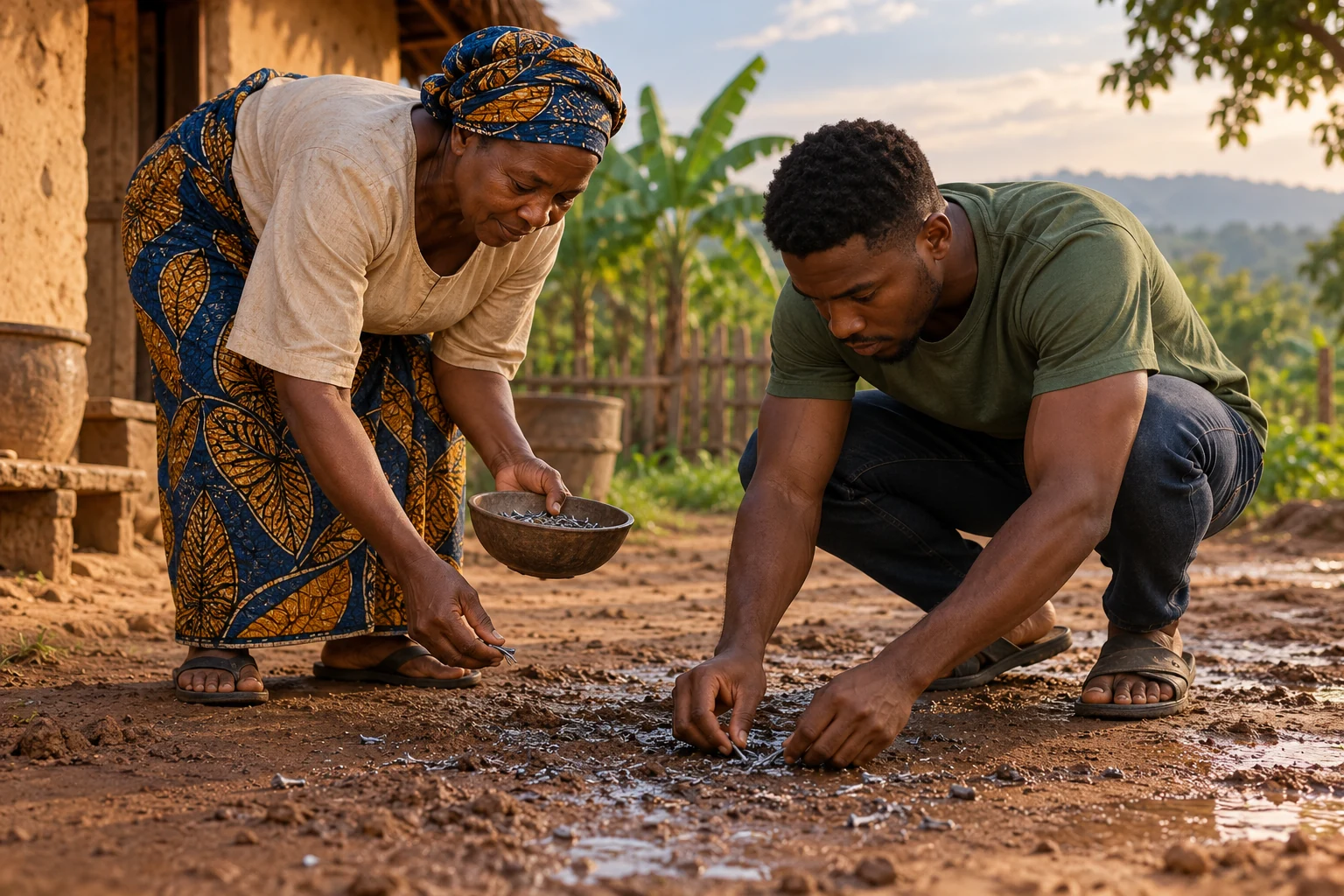
Mayeku Fun raises several children in a poor home on muddy ground. One son is distracted while his siblings consume his food. Rather than beat him, she grieves and seeks a way for him to prosper. Ọ̀sányìn hears her and brings many kinds of filings, more than her hands can hold. The son gathers what falls, receives her blessing, and becomes prosperous, while his siblings draw closer afterward.
The mother’s response is distinguished from punishment: she searches for conditions in which the child can act. The muddy ground and scattered fragments make overlooked material part of the reversal. Yet the later attachment of siblings raises a question about recognition arriving only after prosperity. This should remain a religious tale of maternal advocacy and aid, not a claim that particular objects or maternal emotion produce financial outcomes or treat developmental differences.
Narrative setting: Cuban/Lukumí patakín identified in the selected account; no individual narrator is named.
The coconuts buyers are told to reject
A woman preparing to sell coconuts consults Òrúnmìlà but rejects the proposed religious response, believing that ordinary sales require no such action. Èṣù goes ahead to the market and tells people not to buy her goods for the Òrìṣà. The resulting lack of sales drives her back to seek the previously refused help. Only afterward does her trade resume successfully in the account.
The story makes reputation a material force: buyers do not independently discover a defect, but receive a message from an influential intermediary. That feature complicates a simple lesson about listening to advice, because the failure is actively produced. Later writing should preserve the tension between religious obligation and coercive gatekeeping, asking how authority is exercised without presenting manipulated commercial exclusion as a model for dealing with dissent.
Narrative setting: Cuban/Lukumí patakín identified in the selected account; no individual narrator is named.
A received rite is carried into another generation
The Salami unit presents Òfún performing a religious action called Enà for Òyèkú, with favorable life affirmed for both. Its opening explanation emphasizes preserving a family’s ancestral practice rather than allowing it to lapse. The verse links younger people’s participation with elders continuing to receive sustenance, then develops a sequence of changing cloth and religious observance. It compares its own account with Christian, Muslim, Oyá, masquerade, and Òòsà practices. These comparisons are part of the witness’s argument, not independently established equivalences. The passage does not identify a dated ceremony or give a stable definition sufficient to reconstruct Enà as a public procedure.
The central relation is continuity through received responsibility. Within the witness, an ancestral practice remains spiritually consequential even when the next generation might regard it as an optional remnant. Younger participants do not merely commemorate elders as absent historical figures; their actions sustain a religious relation in which the living and ancestral are connected. The cross-religious comparisons make a claim about the importance of observance from the narrator’s position, but should not be adopted as proof that different religions perform the same rite or share identical doctrines.
A contemporary reading can ask how a community transmits a meaningful practice without reducing it to an empty repetition. That question should preserve the source’s sacred reality rather than translate ancestry into cultural memory alone. The unresolved tension concerns what counts as faithful continuation when circumstances or convictions change, because the verse insists on continuity but does not narrate a dispute over how an inherited obligation should be understood.
Narrative witness and setting: Passage explicitly labeled Ayo Salami, with Yoruba verse and Spanish translation in the supplied compilation.
A dialogue seeks a sweetness beyond comparison
The second Salami unit develops through repeated questions rather than an extended adventure. Òrúnmìlà and a responding voice explore what could equal a particular sweetness, moving through animal and other forms of nourishment before settling on the delight associated with one’s own child. The introductory explanation seeks a benevolent child, and the conclusion gives affection a force greater than the comparisons previously offered. The translated images include impossible biological combinations, showing that the passage should be read as a poetic religious dialogue rather than a feeding account. No named parent’s history, birth event, or later behavior by a child is narrated.
The repetition changes the scale of value by making each proposed comparison inadequate. The desired good is not only the possession of a child but a relation experienced as deeply good, framed by the opening wish for benevolence. This is a devotional and poetic witness, not a universal claim that every person must become a parent to know fulfillment. Its unusual nourishment images also should not be corrected into a realistic menu; their work is comparative intensity within the dialogue.
Read beside the earlier mother who advocates for an overlooked son, the unit gives an affective language to a relation that the prose shows through practical effort. Yet the maternal story’s unequal distribution of food remains a difficulty rather than being dissolved by sweetness. A contemporary reading can ask how love becomes care, while preserving the religious verse’s own affirmation of a desired bond and the limits of the unreported family history surrounding it.
Narrative witness and setting: Passage explicitly labeled Ayo Salami, with Yoruba verse and Spanish translation in the supplied compilation.
What was born in this Odù
“Born” can name an explicit traditional origin association or what emerges through a story: a capacity, relationship, practice or order of life. Interpretations drawn from a narrative are labelled below, so their basis remains clear.
The lifting of plates
Selected traditional source association.
The explicit beginning list includes the lifting of plates. Without further explanation in the selected passages, this remains a limited ceremonial association, not an invitation to invent a funeral sequence or a universal interpretation of the gesture.
Sacred stones and departure
Selected traditional source association.
The source connects taking Òrìṣà stones to the river with their owner’s departure. It supports a source-specific motif of transition and changing custodianship; the wording does not justify general instructions for disposal or a single universal mortuary rule.
Correlations to life dimensions
These questions bring the selected stories into contemporary life. They are interpretive invitations for study.
Work and resources
The son uses material that others might overlook, while the seller discovers that a market depends on shared judgments of suitability. Both stories invite close attention to the social and practical conditions that allow resources to become usable.
Reflect: What barrier prevents available material from supporting a livelihood?
Relationships and family
The mother notices a son whose food and needs are being displaced by siblings. Her advocacy can prompt examination of unequal distribution within a household, without assuming that any child’s difficulty must be solved by a mother acting alone.
Reflect: Who receives less than they need because others reach it first?
Character and inner life
The seller’s confidence is challenged, yet the plot does not prove that every refusal of advice is pride. Thoughtful reflection requires distinguishing a useful warning from a demand backed by the adviser’s power to make noncompliance costly.
Reflect: How do you decide whether advice deserves trust?
Community and responsibility
Both the family and the market affect someone’s ability to participate. Communities should examine whose reputation is shaped by intermediaries and whether support recognizes people before success makes them valuable to everyone else in both settings.
Reflect: Who is welcomed only after becoming successful?
A deeper reading of the sacred relationships
Ancestral relation is sustained through present action
The Enà witness explicitly treats a family practice as something whose lapse has spiritual consequences. The living do not stand outside ancestral relation as spectators; participation helps continue the exchange through which elders and later generations remain connected. The earlier mother’s appeal to Ọ̀sányìn gives another active relation, in which concern becomes religious address and material possibility. These scenes should not be reduced to heritage management or emotional reassurance, although contemporary reflections may follow. The source’s own logic includes beings who hear, obligations that endure, and responses that change a situation. The short sweetness dialogue adds a desired benevolence within the parent-child bond, giving continuity an affective as well as an observant form.
Affection, nourishment, and access are distinct
The earlier mother’s concern arises partly because siblings consume the overlooked son’s food. The sweetness dialogue celebrates a cherished child relation, while the coconut seller faces buyers whose perception of religious suitability is redirected. These scenes involve nourishment or exchange, but they should not become one vague theme of abundance. Affection does not guarantee fair distribution, and possessing goods does not ensure that a market accepts them. The Enà account adds another form of sustenance, a continuing relation between younger participants and elders. A contemporary synthesis can ask what love, resources, access, and observance each contribute, without assuming that success in one dimension automatically supplies the others.
Comparison can illuminate without making traditions identical
The Enà verse compares religious observances across several communities, while the sweetness dialogue repeatedly rejects proposed equivalences before affirming a particular bond. Together they offer different uses of comparison inside one named witness. One argues for the importance of observance through analogies; the other intensifies affection by finding analogies insufficient. A contemporary researcher should preserve those rhetorical purposes rather than convert either into a universal fact. The cross-religious passage does not independently establish identical theology or ritual, and the parent-child dialogue does not rank every possible human relationship. Their specificity contributes depth by showing how a source reasons, praises, and locates significance rather than merely listing correspondences.
Questions that deepen the study
Does the Enà passage prove that all religions perform the same rites?
It makes that comparison from within its own explanatory voice, naming several practices as analogies for the importance of observance. That is evidence about how this witness understands continuity, not independent proof that Christian baptism, Muslim pilgrimage, and different Òrìṣà rites are equivalent. A reference should state the comparison as the source’s position while preserving each tradition’s distinct claims and practices. Within the witness, ancestral responsibility remains spiritually real rather than merely a rhetorical device. Contemporary reflection can ask how meaningful observance is transmitted without making a universal map of religion from one translated passage.
Does the sweetness dialogue make parenthood compulsory for a fulfilled life?
It celebrates a desired bond and opens with a wish for a benevolent child, but it does not describe every form of human fulfillment or address people who do not seek children. Its comparisons intensify the relation being praised within a religious verse. A responsible contemporary reading can honor that affirmation without turning it into a measure of everyone’s worth. The earlier mother story also makes clear that a family relation requires concrete care and fair access to food. Sweetness is therefore not a substitute for responsibility, nor does the verse guarantee a particular child’s future character or a reader’s reproductive outcome.
How can a received practice remain meaningful rather than automatic?
The Enà account emphasizes continuity, but it does not narrate the full process of teaching or a later disagreement about adaptation. A contemporary answer can therefore begin with careful understanding of what the practice acknowledges: a relation among living participants, elders, and ancestral presence within the religious setting. That meaning cannot be reduced to copying an outward sequence. The sweetness dialogue and maternal advocacy story also suggest different ways a bond is felt and enacted. These comparisons can support questions for qualified community learning, while a public reference should not supply the procedure or claim authority to settle a family’s particular religious obligation.
What the four narratives reveal together
The additional Salami witnesses deepen Òfún Oyeku through continuing observance and a poetic affirmation of benevolent kinship. They do not repeat the earlier mother’s advocacy or the seller’s blocked market. Instead, they place practical support beside the religious maintenance of an ancestral relation and the affective language of a desired parent-child bond. The four accounts therefore distinguish care, recognition, access, and observance rather than treating them as one interchangeable gift. Their sacred realities remain central: Ọ̀sányìn responds, Èṣù changes a market relation, ancestral responsibility endures, and Ifá’s dialogue gives a bond devotional significance.
Contemporary analysis can ask how these relations are sustained while stating its own applications clearly. The synthesis should preserve uneven translation, rhetorical comparison, and the limits of a verse that celebrates affection without narrating a complete family history or a doctrine shared identically by every religious community named.
Living with this Odù
A continuing life or initiatory relationship
For someone whose received life or initiatory Odù is Òfún Ọ̀yẹ̀kú, the witnesses distinguish affection, fair access and continuing responsibility. Mayeku Fun responds to an overlooked son by seeking possibility rather than punishing him, while siblings’ later closeness raises the question of recognition tied to prosperity. Love is not complete merely because it feels deeply; it must also notice who receives nourishment and a chance to act.
The coconut seller adds a difficult contrast: Èṣù actively shapes the market’s refusal, so the story cannot become a simple celebration of neutral advice. Salami’s Enà witness places ancestral continuity within present religious action, while the sweetness dialogue intensifies a cherished parent-child bond without making parenthood compulsory for every life. Across changing circumstances, a person can examine what is inherited, what must be supported and where authority controls access. Ọ̀sányìn, Èṣù, Ifá and the ancestral relation retain agency beyond emotional reassurance or heritage management. The sign guarantees neither prosperity through maternal care nor children through observance. Its continuing task is to make support effective and acknowledgment durable without erasing coercion, unequal distribution or the particularity of a desired bond.
A particular consultation and its question
In consultation, Òfún Ọ̀yẹ̀kú can help distinguish a person lacking capacity from a setting that fails to support it. The son’s food is taken and his possibilities overlooked; his mother seeks another relation through Ọ̀sányìn. That cannot diagnose developmental differences or make scattered materials a modern remedy. The actual issue may instead involve a resource whose acceptance is controlled, as in the coconut seller’s market.
An interpreter should preserve that Èṣù produces the exclusion rather than recasting failure as automatic proof that the seller was wrong. The Enà witness presents another question about received religious responsibility, but its cross-religious comparisons are the narrator’s argument, not established equivalences among traditions. The sweetness dialogue likewise celebrates a particular bond without proving every reader must seek it. A result encountered for one question is not permanent identity or a compulsory family forecast. Reflection can ask what support, recognition, access and observance each contribute, and whether success in one has been mistaken for completion of the others. The actual consultation supplies sacred interpretation; contemporary analysis should not fill the short witnesses’ unreported family histories or reconstruct the rite from a summary.
Constructive and adverse possibilities
Constructive possibilities include advocacy that opens usable capacity, affection becoming fair nourishment and inherited practice remaining a living relation rather than empty repetition. The sources attribute change to responsive sacred beings and Ifá, so their confidence cannot be translated entirely into improved mood or resourcefulness.
Adverse possibilities include valuing a relative only after prosperity, treating love as sufficient despite unequal distribution or manipulating access to compel religious agreement. Continuity can also become difficult when its meaning is no longer understood, although the Enà verse does not narrate that dispute. Its analogies cannot prove identical doctrines across religions. Nor does the sweetness dialogue rank every human bond beneath parenthood. These distinctions help consider constructive and adverse relationships in a real inquiry without declaring its state or using a favorable ending to excuse all the conditions that preceded it.
An illustrative situation in everyday life
Hypothetically, a parent notices that one adult child’s contributions are routinely overlooked at a family workshop. Rather than scolding the child for falling behind, the parent seeks a task and support through which their ability can become visible. Mayeku Fun’s structure helps distinguish enabling action from punishment. When the child later succeeds, siblings suddenly become attentive, raising the separate question of whether respect depends on profitable usefulness. A constructive family response would change recognition and resource access before another crisis, not simply celebrate the outcome. This illustration concerns advocacy and fair participation. It does not equate a modern workplace with the sacred filings account, diagnose the child or claim that maternal emotion or particular objects cause financial improvement.
Sources and reading context
The first two narrative witnesses
These selected Cuban/Lukumí accounts include miraculous prosperity and a deliberately obstructed market. Neither is converted into a financial promise or ethical endorsement of coercion. The origin catalog offers local ceremonial associations whose practical meaning is not fully explained here.
Narrative motifs are summarized independently. The life-dimension reflections are contemporary interpretation. How these reference studies are built explains the wider source approach and the distinction between a reference article and personal divination.
Additional named witnesses
-
Ayo Salami. The Enà ancestral-continuity unit and the sweetness dialogue are selected from the explicitly named bilingual source block.
-
Cuban/Lukumí compilation witness. The earlier maternal-prosperity and coconut-seller accounts remain separately attributed Cuban narratives.
Enà is not reconstructed as a public rite from the unstable translation. Cross-religious equivalences are reported as the source’s rhetorical position. The sweetness unit is a poetic dialogue, not an extended adventure or biological account, and its affectionate affirmation is not generalized into a requirement of parenthood.
Bibliographic identification
- Ayo Salami. Ifá: A Complete Divination. Lagos: NIDD, 2002 catalogue record. Library catalogue record. Bibliographic identification of the named author and work; the edition behind the transmitted account remains to be matched.
Read the source method and wider scholarly context.
The catalogue links identify published works and their authors. They are separate from proof of an individual episode’s wording or attribution. Contemporary comparisons and the synthesis above are editorial interpretation. The author’s books and Academy companions below provide further study; their sales links are separate from the source references.