
Before a choice becomes visible, a person already stands within conditions they did not choose. Àjàlá opens a narrative field in which destiny, selection and the formation of the inner head can be considered together. The subject is not a biological account of personality. It is a way of thinking about the relationship between a life’s orientation and the work of living it.
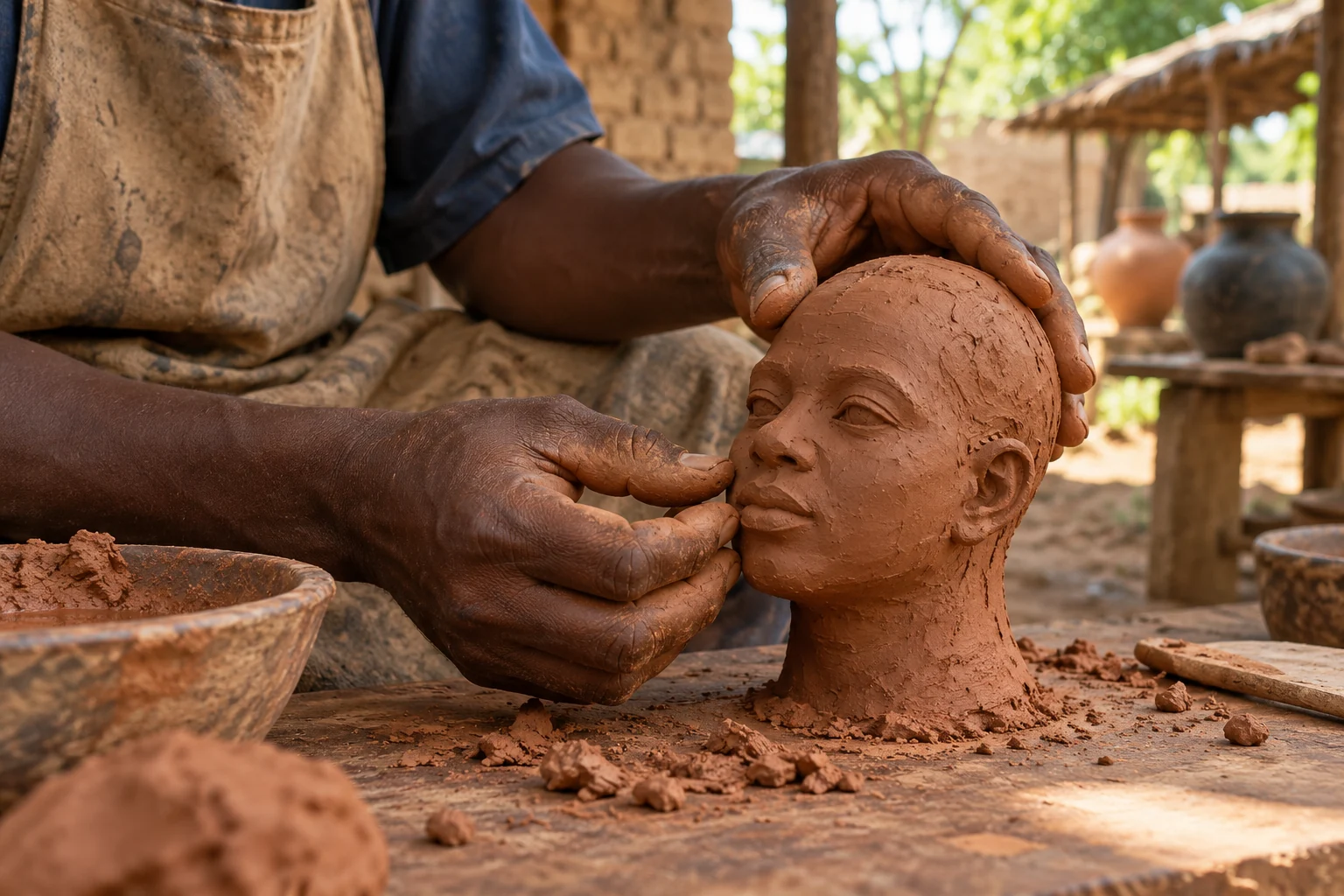
The made head connects received form with the responsibility of carrying a life.
1. The maker of heads in a particular narrative
Accounts of Àjàlá describe a shaper or maker of heads associated with the choice of Orí before earthly life. Original research on Yorùbá discussions of work and success provides a scholarly route into this narrative setting.
The story should not be converted into a claim that a person’s present difficulty proves they selected a defective destiny. Nor does it supply a method for calculating a received initiation Odù from a birthday. Different religious and interpretive procedures must retain their own identity.
2. Key narrative question: what does choosing mean before experience?
The image of choosing a head before entering life places intention beside uncertainty. A person may be asked to choose without yet possessing the experience through which the choice will be understood. This creates a serious question about the limits of preference: wanting something is not the same as knowing what it will require.
In contemporary reflection, many major decisions have a similar structure. A profession, partnership or responsibility can be chosen sincerely while its meaning develops only through time. The task is not always to prove that the first choice was perfect. It may be to understand what faithful, responsible living now asks within the conditions that followed.
3. Destiny does not remove conduct
Belief in a life’s orientation can support steadiness, but it can also be misused to explain away every harm. If a person’s action injures someone, calling the event destiny does not by itself answer the injured person’s claim. A serious interpretation leaves room for character, correction and practical responsibility.
Orí and Ọ̀rúnmìlà provide important connected studies. They allow a reader to explore guidance and selfhood without imagining that one introductory story has resolved every tension between choice and circumstance.
4. Religious identity and the scope of this study
Àjàlá belongs to narratives of the making and receiving of the head before earthly life. The head in this field is not merely anatomy or a modern personality profile. It carries questions of destiny, orientation, capacity and the conditions through which a life becomes particular. Augustine Agwuele's study of everyday Yorùbá discourse supplies an independent scholarly account of the head-maker within discussions of effort and fortune.
The supplied book has no dedicated Àjàlá chapter, but it gives substantial sections within Orí and Obàtálá. Those sections support a careful framework application centered on formed capacity and finite embodiment. Their placement does not establish that every community regards Àjàlá as a simple quality of Obàtálá, nor that Orí and its maker are identical.
The opening discussion's distinction between choosing and understanding a choice is psychologically fertile. A person may enter a path sincerely without knowing what it will require. The more exact question is then how desire relates to the capacity to carry a life. This must never become a verdict that disability, poverty or suffering proves a defective primordial choice. The narrative can challenge fantasies of unlimited self-creation while leaving dignity, social causes and present responsibility intact.
5. Knowledge that gives the figure depth
5.1 What does the image of a made head add to destiny?
The head-maker narrative gives destiny a material image. A life does not receive only an abstract list of desired outcomes; it receives a form through which possibility must be carried. The book reads this as a crucial relation between vocation and capacity. That is an authorial interpretation of the mythic material, not an independently established account of how every Yorùbá community explains the head's formation.
Agwuele's article situates Àjàlá within ordinary discourse about work and success. It explicitly describes its method as discourse analysis rather than a final philosophical solution to determinism. The source matters because it shows people negotiating the gap between effort and outcome through inherited narratives. It does not require the reference to declare that every hardship was permanently sealed before birth.
The contemporary application is to separate wanting from bearing. Someone can desire authority without being ready for sustained exposure, or want freedom while struggling with the uncertainty it brings. Capacity is not fixed by the person's current confidence alone; it can involve preparation, support and learning. The head image therefore asks a double question: what has a life received, and what conditions help it carry what is asked? Holding both avoids reducing destiny either to unrestricted preference or to helpless submission.
Evidence: Augustine Agwuele, “Exertion is not connected to success”: everyday Yoruba discourse of work and success — Original discourse analysis, Àjàlá head-maker account and everyday tension between effort and fortune; not a universal philosophical resolution.
5.2 How can unequal outcomes be discussed without blaming the sufferer?
Unequal outcomes pose a moral problem because effort is visible while many conditions affecting results are not. A person may work carefully and still fail; another may flourish with apparently less effort. Agwuele investigates how everyday language handles that disparity. Its relevance lies in the lived tension between merit, fortune and received possibility, rather than proof that all social inequality has one metaphysical cause.
The book's account of Àjàlá can deepen the question without turning it into blame. Its interpretation of unequal beginnings is explicitly intended to resist cheap moral judgment. A person does not begin as an unlimited self-author who can secure every outcome through sufficient desire. Yet recognizing limits does not make conduct irrelevant. The chapter also connects a favorable head with work, character and patience.
For a contemporary article, these positions should remain in tension. Acknowledging circumstance can free someone from global self-condemnation after failure. It can also become resignation if it removes every present possibility of response. An adequate interpretation asks which conditions can change, which require support and which must be mourned or accepted. It does not decide those questions from the outcome alone. Àjàlá's narrative field can make inequality thinkable without making the suffering person responsible for having supposedly chosen it.
Evidence: Augustine Agwuele, “Exertion is not connected to success”: everyday Yoruba discourse of work and success — Original discourse analysis, Àjàlá head-maker account and everyday tension between effort and fortune; not a universal philosophical resolution.
5.3 What does choosing before experience reveal about commitment?
The narrative of choosing before birth contains an unusual tension: the choice is profound, yet ordinary life does not include transparent memory of its full meaning. The book treats earthly forgetfulness as a source of estrangement from one's orientation. It also describes counsel and preparation in the journey to Àjàlá. These details make choice more demanding than selecting the most attractive possibility.
The contemporary application concerns commitments made before their experiential meaning is available. A profession, partnership or public responsibility can be chosen honestly and still exceed the chooser's initial understanding. Later difficulty does not prove the first choice insincere. It may reveal a requirement that only became visible through participation. Conversely, reverence for the original choice cannot justify continuing a harmful arrangement indefinitely.
The question is how a person learns from time without rewriting every past decision as stupidity or perfect destiny. An illustrative practitioner may discover that a vocation they imagined as recognition requires long periods of unglamorous care. Another may find that a prestigious path does not fit the life they can sustain. The head-maker image asks them to examine both orientation and carrying capacity. It does not calculate a birth-derived Odù, reconstruct a private prenatal event or identify an initiation through symbolic resemblance.
6. A depth-psychological reading
Interpretive basis: A contemporary application of the wider interpretive framework in Babá Tilo de Àjàgùnnà’s The Orishas and the Human Soul, especially “Orí”, “Obàtálá / Òṣàlá”, “Before the Òrìṣà Become Archetypes”, “Metals, Tools, Fire, Cloth, Stones, and the Crafted Body of Power”. No dedicated Àjàlá chapter. Substantial named subsections in Orí and Obàtálá support finite form, head-making and carrying capacity. New psychological application distinguishes the figure from both Orí and Obàtálá; external scholarship independently anchors head-maker narrative.
6.1 What must ambition stop demanding before a life can carry it?
Ambition can be a genuine movement toward vocation and a defense against shame at the same time. The person may want to serve, create or lead while also needing an achievement to prove they are finally beyond rejection. If the defensive demand remains hidden, no accomplishment can be sufficient. The life is asked to carry not only its actual work but an impossible promise of permanent emotional repair.
The book's question of what a head can bear gives this tension a concrete form. Capacity includes more than technical competence. It can involve tolerating visibility, waiting, dependence, conflict and the ordinary limitations of success. A person capable of doing the work may still need support in bearing what the role activates. This is a contemporary psychological reading, not a diagnosis attributed to Àjàlá or a claim that current capacity is an immutable destiny.
An illustrative leader pursues a larger office hoping that authority will end the feeling of being overlooked. Once appointed, every criticism becomes unbearable because it threatens the role's hidden promise. The developmental task is to separate the vocation from the demand that it cure the entire self. Doing so may preserve the ambition while changing its scale, timing and support. Reading beside Àjàlá asks what form could carry the genuine desire without requiring a human life to become limitless. That question is more useful than either praising all aspiration or recommending the abandonment of difficult aims.
6.2 How can finite form be acknowledged without turning it into global defectiveness?
The image of flawed making can deepen compassion or intensify shame depending on how it is interpreted. A person already convinced of being fundamentally wrong may hear the head-maker narrative as religious confirmation that they arrived damaged beyond repair. The book's wider account of embodiment opposes this conclusion: finitude and uneven form do not remove sacred dignity. The interpretive task must keep that principle explicit.
Psychologically, there is a difference between having limitations and organizing identity around defectiveness. A limitation can be named, accommodated or worked with. Global defectiveness turns every difficulty into evidence that the whole person should not exist as they are. It often makes help hard to receive because needing support seems to confirm the original accusation. The narrative should not be used to reinforce that structure.
An illustrative person who struggles with a demanding profession may assume the difficulty proves a bad destiny. A more exact inquiry asks about conditions, fit, skill, resources, health and the meaning of the chosen aim. Some of those can change; some may require grief or a different path. None establishes the person's lesser worth. A contemporary application of Àjàlá can therefore make form more honest without making it punitive. The head is a way to think about carrying a life, not a device for ranking lives or explaining disability as spiritual failure.
6.3 How can agency develop when a person has not authored all their conditions?
The fantasy of complete self-authorship can make ordinary dependency feel like defeat. Someone may believe that a meaningful choice must be generated alone, understood completely and maintained without revision. Advice then becomes interference, limits become humiliations and an unforeseen demand proves that the choice was somehow false. The book's Àjàlá field places counsel, preparation and received form before that fantasy of autonomous selection.
The psychological development is not simple obedience. A person must still judge, act and accept consequences. What changes is the understanding of agency: it becomes a capacity exercised within conditions rather than the power to eliminate all conditions. This can make support easier to receive and error easier to examine. A revised commitment need not mean that the earlier life was meaningless.
An illustrative student chooses a field largely for family approval. Later dissatisfaction may tempt them either to blame the family entirely or to deny the dissatisfaction because changing would feel disloyal. A more developed response can acknowledge both the influence received and the responsibility now available. They can ask what remains meaningful, what has become unsustainable and which resources make a transition possible. Read beside Àjàlá, the question concerns the relation between received orientation and present carrying. It resists the two extremes of controlling everything and answering for nothing. The sacred narrative remains larger than this reflective use, which does not claim access to anyone's primordial choice.
7. What this relationship means for a person
7.1 In an established devotional or initiatory relationship
For a person in a tradition where Àjàlá has a recognized religious place, that relationship must be described through its actual teachers and obligations. The selected narratives do not establish a universal personal head initiation into Àjàlá. A relationship with Orí, an initiation involving another sacred presence and the study of the head-maker narrative should not be merged simply because they share the language of destiny.
The book's relevant sections can accompany established practice by making reflection more specific. A practitioner may ask what a commitment is requiring beyond the prestige or relief initially imagined, how support is received and whether an interpretation of destiny has become an excuse for neglecting conduct. Another may need to distinguish genuine limits from the punitive conviction that they are badly made. These inquiries deepen the human response to the religious field without determining its ritual content.
The distinction between figure and psychological resemblance remains important. Being a craftsperson does not establish affiliation with the head-maker, and difficulty choosing does not prove a damaged Orí. Nor does devotional seriousness promise unlimited success. The author's framework treats destiny as an orientation requiring character and action. An established religious relationship can sustain that work through recognized forms of accountability; a public essay can supply questions and context while leaving the actual relationship with its custodians. This gives the practitioner a companion for thought without inventing an institution from metaphor.
7.2 When the figure becomes relevant in consultation
When Àjàlá is encountered in consultation or a diviner introduces the head-maker narrative, preserve the exact relation to the question. The narrative may illuminate preparation, choice, capacity or another concern identified within that setting. It does not by itself reveal that the client selected a defective destiny or require a new initiation. The public interpretation should never turn a difficult period into a verdict on the person's primordial worth.
The psychological contribution is to examine how destiny language functions for this client. Does it reduce shame by acknowledging conditions beyond control? Does it deepen responsibility for what can be done now? Or has it become a complete explanation that prevents attention to practical causes, support and change? Those functions cannot be inferred from the vocabulary alone. The same phrase can bring steadiness to one person and hopelessness to another.
An illustrative consultation concerning an ambitious undertaking might invite reflection on whether the person has adequate preparation and support. That application follows the book's relation between desire and carrying capacity; it is not a standard prediction of failure. Clarification with the responsible diviner remains necessary to understand any religious recommendation. Personal Orí, received Odù and the circumstances of consultation should retain their distinct status. The goal is a more informed response to the present situation, not a speculative reconstruction of an invisible choice that no public article is qualified to certify.
8. Nature, materials and human knowledge
Clay and the formed head provide the strongest material language in the author's treatment. Clay is workable, vulnerable to conditions and capable of taking a durable shape. The head then becomes both received form and an image of the capacity through which a life is carried. This is not a biological theory or an explanation of bodily difference through divine manufacturing error.
The material framework adds an important distinction between formation and finished perfection. An object does not become useful merely by being desired; it passes through making, time and conditions appropriate to its substance. A life likewise requires environments that support its particular capacities. The analogy is interpretive and has limits: human beings are participants with agency, not inert products whose value can be graded like vessels.
The ecology therefore includes counsel, preparation and a world of actual demands. A head bears responsibility through a body that needs rest, resources and relationship. Ignoring those conditions can make aspiration destructive even when its direction is meaningful. Applied beside Àjàlá, the question is what supports endurance without converting limitation into shame. The material image deepens respect for embodiment by acknowledging that a life can be sacred and finite, capable and vulnerable, shaped and still developing.
9. Diaspora, comparison and syncretism
The selected evidence does not establish a saint counterpart for Àjàlá or a universal identification with every divine potter in another religion. Clay is a widespread material, and making a human form is a recurring mythic image. These similarities can prompt comparison, but they do not prove shared identity, historical transmission or equivalent ritual obligations.
The book itself places Àjàlá within Orí and Obàtálá discussions while acknowledging fluid classifications around associated forms. A public reference should preserve that nuance. The head-maker's role can be studied distinctly without declaring that all traditions treat him as entirely separate or simply interchangeable with Obàtálá. Agwuele's discourse study supplies a specific narrative context, not a ruling on every lineage's theology.
Psychological equivalences require similar restraint. Àjàlá is not a synonym for personality formation, genetic endowment or a diagnostic category. The narrative can illuminate how humans think about received conditions and what they can bear. It cannot establish why a particular person is disabled, poor, ill or unsuccessful. Keeping comparison bounded protects both religious specificity and human dignity. It allows the material image to enlarge thought while preventing a familiar modern theory from pretending to have fully translated the sacred relation it has only begun to approach.
Evidence: Augustine Agwuele, “Exertion is not connected to success”: everyday Yoruba discourse of work and success — Original discourse analysis, Àjàlá head-maker account and everyday tension between effort and fortune; not a universal philosophical resolution.
10. Questions for a fuller understanding
10.1 Does a hard life prove that I chose the wrong head?
No public interpretation can establish such a conclusion. The narrative should not turn suffering into evidence of a person's spiritual inferiority. The book connects received form with finitude while preserving dignity, and it also insists that conduct and support matter. Begin with the actual difficulty and the conditions affecting it rather than a total verdict on your origin. A meaningful consultation may have specific guidance, which belongs to its own particular context. The head-maker image can help examine capacity and responsibility, but it cannot certify why a particular life has encountered illness, loss, inequality or an obstacle that remains unresolved.
10.2 If a choice was sincere, must I remain with it forever?
Sincerity at the beginning does not provide complete knowledge of what participation will reveal. The book's relation between choice, forgetfulness, counsel and carrying capacity allows a more demanding question: what does responsible fidelity require now? Sometimes that means preparation and patience; sometimes a path must be reconsidered because its real demands have become clear. A change is neither automatically betrayal nor automatically growth. Examine honestly what remains meaningful, who is affected and what present evidence supports continuing or revising the commitment. This is a contemporary reflective application, not a claim that Àjàlá's narratives decide every modern dilemma in one direction.
11. Correlations to life dimensions
| Dimension | A question for reflection |
|---|---|
| Choice | What could I not yet understand when I first chose this path? |
| Responsibility | Have I used destiny to avoid answering for my conduct? |
| Identity | Which orientation remains meaningful even as my explanation of it changes? |
| Growth | What does this decision ask of me now, rather than only at its beginning? |
12. A careful personal application
Your religious house and received teachings should guide any personal understanding of Orí and Odù. The public story supports reflection. It should not become a deterministic verdict that closes the future or makes another person’s suffering into evidence of a poor primordial choice.
13. Sources for the expanded interpretation
Interpretive basis: A contemporary application of the wider interpretive framework in Babá Tilo de Àjàgùnnà’s The Orishas and the Human Soul, especially “Orí”, “Obàtálá / Òṣàlá”, “Before the Òrìṣà Become Archetypes”, “Metals, Tools, Fire, Cloth, Stones, and the Crafted Body of Power”. No dedicated Àjàlá chapter. Substantial named subsections in Orí and Obàtálá support finite form, head-making and carrying capacity. New psychological application distinguishes the figure from both Orí and Obàtálá; external scholarship independently anchors head-maker narrative.
- Augustine Agwuele. “Exertion is not connected to success”: everyday Yoruba discourse of work and success. Original discourse analysis, Àjàlá head-maker account and everyday tension between effort and fortune; not a universal philosophical resolution. Africa91(5),2021,pp.810–831; DOI10.1017/S0001972021000590; open-access full text verified.
No personal prenatal choice, biological explanation, disability judgment, birth-derived Odù calculation or universal initiation is supported. Named book subsections are not a dedicated chapter.