
Ògbè Ògúndá is a mixed Odù in Ifá’s 256-part corpus. The head-selection narrative distinguishes an impressive-looking choice from one tested for durability. It also complicates strict obedience: stopping to help, consult, cook, and settle a debt enables Afuwake’s successful journey. A separate flood narrative presents Orunmila negotiating survival with Olokun. Together they invite reflection on limits, preparation, and the relationships that make a future inhabitable rather than merely desirable.
A question to carry through the study: Which apparently inconvenient act of care could improve the decision you are trying to reach?

This Academy reads the right column first, then the left. Each row carries a single or double mark.
Where this Odù belongs
Ògbè Ògúndá belongs to the Ògbè family in this Academy’s study sequence. It is a mixed Odù, distinct from Ògúndá Ògbè. The order matters. Its teaching is approached through its own narratives, rather than by adding two general descriptions of the principal signs together.
Key Òrìṣà and sacred relationships
The figures below are selected for their roles in the accounts discussed here. They offer connected reading paths through the tradition.
-
Ajala. The head maker tests the available heads and gives Afuwake a sound one after receiving help with his debts and hunger; appearance alone proves unreliable.
-
Èṣù. Disguised as a gatekeeper, he delays Afuwake, receives his help, and then guides him to Ajala; access develops through reciprocal attention.
-
Olókun. In a separate compilation narrative, the sea power agrees to spare humanity after Orunmila’s appeal, making survival dependent on an acknowledged relationship with water.
Author’s further study: The Myths and Revelations of Odù Ògbè Ògúndá develops this sign at book length. The inherited accounts discussed here retain their named witnesses and religious settings.
Key myths and their meanings
Heads that endure the rain
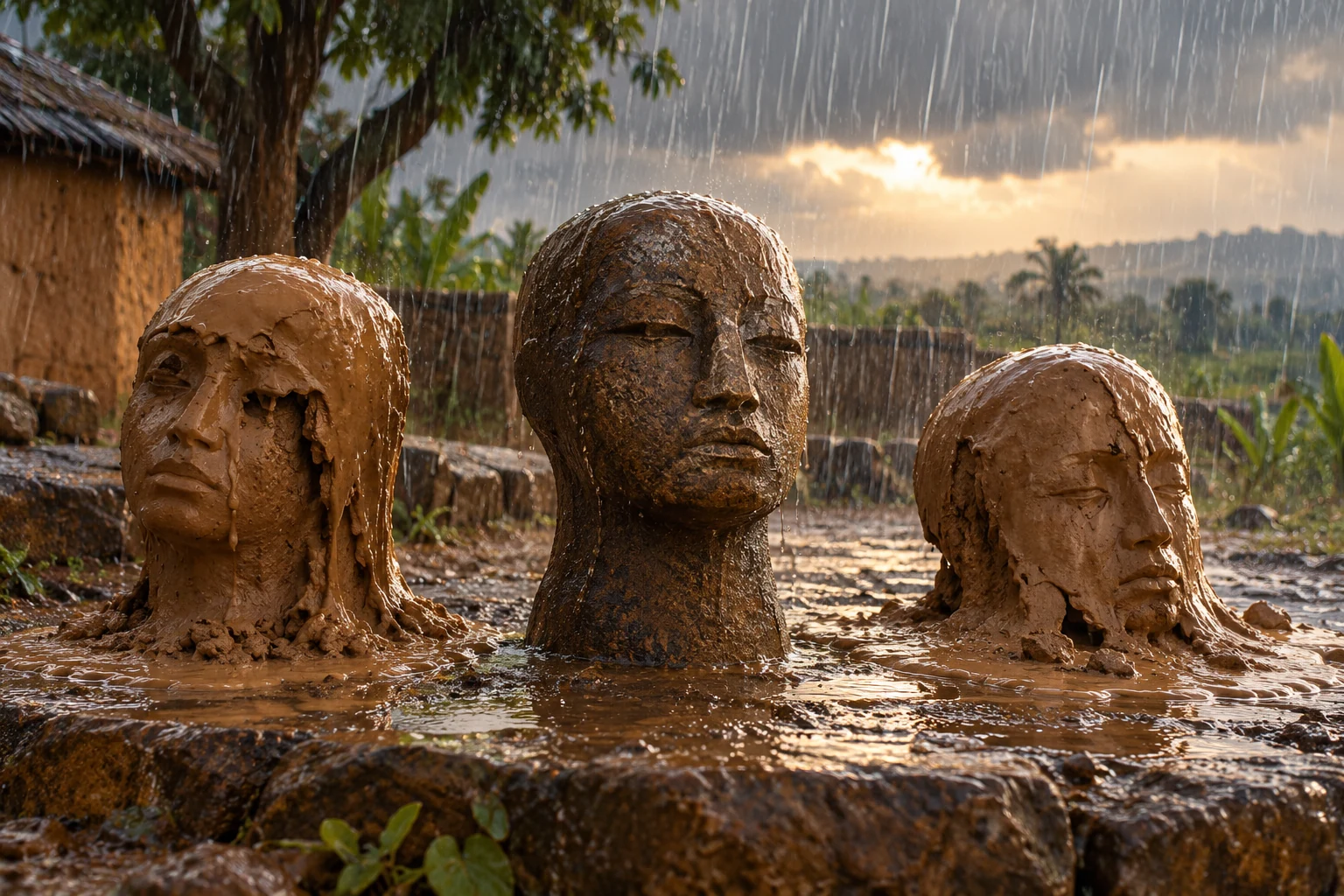
Three companions travel to obtain heads from Ajala. Two eventually choose for themselves while the maker is absent, selecting unfinished or damaged heads that rain deforms. Afuwake instead consults Orunmila, helps the gatekeeper, pays Ajala’s debt, and waits for a tested choice. His head survives the same weather, and his friends later seek a repair.
The plot questions speed and surface appearance, but its richest tension concerns the route itself. An initial warning favors proceeding directly; the successful traveler nevertheless benefits from pauses devoted to other people. A careful reading preserves this friction: patience is not passive waiting, and a good choice emerges through assistance, expert testing, and responsiveness to circumstance.
Narrative setting: Cuban-labeled narrative in the accounts considered here; no independently established narrator or publication history.
A negotiation after the flood
A second passage describes Olokun descending in a devastating flood, with few survivors. Orunmila approaches the sea power as waters recede and pleads on humanity’s behalf. He promises a continuing relationship of honor, and Olokun agrees to spare the survivors. The episode turns survival into a negotiated relationship with a force that cannot simply be mastered.
The account supplies a useful contrast to the head story: even a carefully prepared individual must live among powers larger than individual judgment. Yet its geographical and cosmological claims are not independently sourced within the excerpt. The safe analytical focus is reciprocal obligation after catastrophe, retaining the passage as a compilation narrative rather than an authoritative universal creation account.
Narrative setting: Cuban-labeled narrative in the accounts considered here; no independently established narrator or publication history.
A mother’s gift rejected until its packaging changes
Alara, Ajero, and Orangun receive counsel not to refuse something that will be sent to them. Their mother sends a package wrapped in dried leaves. Alara rejects it as an unworthy-looking gift, and Ajero does the same. Orangun accepts the package and discovers valuable beads. He turns a portion into an attractive necklace and sends it to Alara, who now purchases it. Another necklace reaches Ajero and is also bought. Orangun keeps the remaining beads. The same underlying resource travels through gift and market relations, receiving different judgments once its presentation makes a kind of value the brothers already recognize visible.
The maternal origin matters because rejection is directed not only at an object but at a relationship of provision. The two brothers assume the wrapping is sufficient evidence of what the giver has sent, then pay for part of the contents when the wrapping has been replaced by skilled presentation. Orangun’s acceptance therefore contains several kinds of work: receiving without contempt, inspecting, making, and marketing. The narrative does not explain whether the brothers later learn what they refused or whether the mother expects any return.
Those absences leave room to question how freely given value becomes a commodity and who receives credit for it. The story should not be generalized into a promise that every unattractive offer conceals wealth. Its concrete analytical force is the stability of the beads across unstable judgments. An audience can ask what changed materially, what changed perceptually, and why a buyer respects a purchased necklace more readily than an unexpected family gift.
Narrative witness and setting: Compilation attribution to Afolabi Epega; narrative of Alara, Ajero, and Orangun.
The undefeated wrestler meets an altered courtyard
Gbe-Guda consults before traveling and then defeats ruler after ruler, refusing the water or food offered as a welcome. News reaches another king, who seeks his own diviner’s counsel. The townspeople eat distributed bananas, leaving peels in the courtyard. When the challenger arrives, the king insists that hospitality precede the contest. Gbe-Guda eats and drinks before renewing the challenge. At his first effort in the fight he slips, falls, and flees into the royal quarters under the crowd’s ridicule. His earlier victories do not preserve him against a place whose ordinary ground and reception have been deliberately rearranged.
The challenger treats every city as an identical opportunity to prove strength, rejecting the practices through which a newcomer becomes related to a particular place. The defending king changes that pattern by delaying combat through a welcome the visitor can accept. Hospitality is not innocent here: it is part of a strategy, and the crowd’s leftover peels become the decisive instrument. The outcome therefore complicates any simple moral that respectful manners necessarily produce fairness. Collective preparation defeats a violent individual, but it does so through an engineered disadvantage rather than a transparent comparison of ability.
The geographic procession should remain part of the Fon narrative’s political imagination, not a record of historical conquests or a character judgment about present-day cities. Its value for a depth study lies in how repetition produces overconfidence: the traveler believes each new setting has already been understood because the earlier ones yielded to the same action.
Narrative witness and setting: Fon Fá narrative explicitly attributed to Bernard Maupoil; the text names regional kingdoms and a bokono.
What was born in this Odù
“Born” can name an explicit traditional origin association or what emerges through a story: a capacity, relationship, practice or order of life. Interpretations drawn from a narrative are labelled below, so their basis remains clear.
Ajala’s head-making knowledge
Selected traditional source association.
The origin inventory explicitly names the head builder’s secret. Read beside the selection story, this concerns the quality and testing of a future-bearing head; it does not justify attributing personal misfortune to a defective destiny.
A water reservoir
Selected traditional source association.
The list associates a dam or reservoir with this sign. This provides a separate image of managing water, but its connection to the selected flood story is contemporary interpretation, not a narrated technological origin or historical claim.
Correlations to life dimensions
These questions bring the selected stories into contemporary life. They are interpretive invitations for study.
Work and resources
Afuwake’s resources become useful through feeding a gatekeeper and settling a maker’s debt. These exchanges allow expert work to happen. The story depicts preparation as bringing enough capacity to assist others, rather than merely carrying a private demand for the best available object.
Reflect: What support lets an expert do good work?
Relationships and family
The companions begin with an intention to remain together but make different choices. Their friendship continues after unequal outcomes because the successful traveler explains his route and the others seek repair. Difference does not have to end shared belonging.
Reflect: Can you learn from a friend’s different outcome?
Character and inner life
The selection of a durable head requires waiting for tests that appearance cannot supply. The narrative supports attention to readiness and judgment while resisting a fatalistic reading: the damaged heads are later reconstructed, so an initial mistake does not exhaust the future.
Reflect: What evidence matters beyond an attractive appearance?
Community and responsibility
The gatekeeper, creditor, maker, counselor, and traveler form an interconnected chain of obligations. The flood account similarly imagines continuity through an acknowledged relationship. Both stories make a future depend on attending to the needs and limits of a wider world.
Reflect: Whose unmet need is blocking shared progress?
A deeper reading of the sacred relationships
Destiny is received through persons and sacred relations
The head journey concerns more than making a prudent consumer choice: Ajala’s craft belongs to the preparation of a person’s earthly destiny, and Afuwake’s encounters connect consultation, sacred provision, and a durable head. The bead narrative likewise frames its gift through prior divination and response, rather than a lucky bargain alone. In the Fon journey, both Gbe-Guda and the defending ruler consult and sacrifice, so ritual attention does not reduce the contest to a simple division between believers and nonbelievers. The flood narrative gives Olokun an active role in the terms of human continuance. These accounts sustain religious reality through different relationships; analysis of judgment and appearance is a contemporary lens on, rather than a replacement for, that reality.
A journey changes through the encounters it permits
Afuwake’s stops to feed, help, and settle a debt become conditions of obtaining a tested head. Gbe-Guda instead declines local welcome until a king makes it part of his defense. In both stories, the route is relational, not merely a distance between the traveler and the desired outcome. Yet the hospitality offered in the second story is strategic, so accepting an encounter does not automatically make it safe or reciprocal. The useful comparison asks what a traveler learns about a place, whether the people encountered can be treated as more than obstacles, and how one recognizes that a repeated method no longer fits the situation.
Value passes through hands before anyone claims achievement
The mother supplies the beads, Orangun turns some into necklaces, and his brothers pay for the new presentation. Ajala’s head likewise reaches Afuwake through counsel, a gatekeeper, a creditor, food, and testing. These chains reveal several contributors behind a final possession that could otherwise appear to prove an individual’s superior destiny. The comparison does not eliminate agency: accepting and using a resource still matter. It does require attention to the earlier labor and relationship that made the resource available. The flood narrative places a different kind of contribution at the boundary, where continued life depends on a negotiated acknowledgment that no one household can claim to have manufactured.
Questions that deepen the study
Does Orangun win because he is naturally worthier than his brothers?
The text gives actions rather than a complete character assessment. He accepts a package they refuse, opens it, and makes necklaces whose presentation they value enough to buy. Those choices explain the narrated difference without requiring a claim that he is permanently superior. The story also leaves the mother’s expectations and the brothers’ later understanding unknown. A contemporary interpretation can ask how one evaluates an offer before seeing its contents and how a new presentation changes that judgment. It should not promise that every modest-looking gift will contain wealth or treat market success as a complete proof of moral worth.
What does the wrestler’s defeat add to the head-selection story?
Afuwake’s successful choice comes through learning what he does not yet know. The wrestler’s failure follows confidence that repeated victories have already answered the next situation. Their contrast concerns responsiveness, not physical strength alone. It is important that the courtyard has actually been engineered against the challenger; the defeat is not merely a spontaneous lesson in humility. A contemporary reader can examine both overconfidence and the fairness of the conditions under which a test occurs. The stories do not require choosing between condemning the traveler’s violence and noticing that the king wins through a concealed arrangement.
Can these accounts support reflection without teaching that destiny is fixed?
Their plots repeatedly change what becomes possible through encounters. The damaged heads are repaired, the refused package becomes useful through another recipient, the apparently invincible traveler falls, and the survivors of the flood negotiate continued life. Those events do not establish a modern theory of free will, but they resist treating an initial appearance as the whole future. A contemporary interpretation can ask which action, relationship, or condition remains open to revision. It should avoid blaming actual hardship on a defective head or promising that the right ritual will always reverse it. The religious accounts provide images for inquiry, not a complete causal map.
What the four narratives reveal together
The four selected stories distinguish choosing, receiving, challenging, and negotiating. The earlier head journey makes preparation relational and the flood story places human life before a force larger than individual command. Epega’s bead-gift account adds the transfer between family provision and market recognition. Maupoil’s Fon challenger account adds the danger of treating each place as merely another stage for an established superiority. Together they make judgment depend on more than an object’s appearance or a person’s prior success.
They also resist one easy moral: helpful detours can matter, an unattractive package can contain value, and hospitality can be a strategic trap. The depth contribution is therefore a set of distinctions about evidence, contribution, and changed conditions. The African witnesses are explicitly named locally, but their differing narrative worlds remain separate rather than being presented as one universally agreed explanation of destiny.
Living with this Odù
A continuing life or initiatory relationship
For someone whose received life or initiatory Odù is Ògbè Ògúndá, a durable choice may depend on relations that initially look like interruptions. Afuwake’s help to others, counsel, and waiting distinguish his tested head from his companions’ impressive but unready selections. The maternal bead gift makes another distinction: valuable substance remains present even when its wrapping does not match an expected sign of worth. A life can repeatedly require attention to what appearance and urgency leave unexamined.
The flood and wrestler narratives prevent this from becoming a rule that patient virtue always produces fair conditions. Orunmila negotiates with a power that individuals cannot master. In the Fon account, an undefeated challenger encounters hospitality deliberately incorporated into an engineered disadvantage. Understanding the relationship to a place matters, but welcome itself is not proof of innocence.
Long development can therefore concern testing, receiving, and adapting rather than merely obeying one abstract instruction. A received sign does not grade the quality of somebody’s head or predetermine their future. It can ask how decisions endure changing conditions, what assistance they incorporate, and whether a familiar success has made a person assume that each new setting has already been understood.
A particular consultation and its question
In consultation, Ògbè Ògúndá can distinguish a desirable appearance from a choice able to withstand actual conditions. The head-selection narrative gives that distinction a concrete test: the same rain reveals different states of readiness. Its route also complicates a mechanical equation between speed and obedience, since assistance and waiting contribute to the successful choice. A practitioner can examine whether an apparent delay is relevant work rather than assume that all pauses are either wise or wasteful.
The bead episode asks whether an offer has been judged before its contents are known. The wrestler’s altered courtyard asks the opposite caution: an apparently familiar occasion may contain changed ground and strategic hospitality. A real question about an invitation therefore needs particulars, not a slogan that every humble package contains treasure or every welcome hides a trap.
The flood places human judgment within a religious relationship to Olokun’s magnitude. It does not supply a universal account of catastrophe or a forecast for the visitor. The consultation’s result may illuminate preparation, reception, negotiated limit, or overconfidence in repeated success. It remains an answer within that encounter rather than permanent identity as a patient chooser, gifted recipient, or defeated challenger.
Constructive and adverse possibilities
Constructively, a choice can become durable through tested knowledge and responsive assistance. An unattractive wrapping can receive enough attention for its contents to become known, and survival can develop into an acknowledged relation rather than an illusion of mastery. Afuwake’s route makes other people consequential to a future often imagined as entirely individual.
Adversely, speed can substitute for examination, presentation can determine value without inspection, and repeated victory can make a traveler inattentive to a particular place. The Fon courtyard also warns that correcting arrogance may involve manipulation rather than transparent fairness. Neither the defeated wrestler nor the rejected package establishes the condition of an unknown reading. Iré and adverse circumstances must be determined there. The narratives help ask whether preparation supports a habitable future and whether an apparent correction leaves questions about the means by which it was achieved.
An illustrative situation in everyday life
Hypothetically, a housing association must choose replacement equipment before winter. Two members prefer an impressive model immediately available; another spends time asking the maintenance worker about repair access and testing its fittings. Her pauses resemble Afuwake’s apparently inconvenient relations, which improve the eventual choice. A supplier also sends plain replacement parts that others dismiss until the worker inspects them. The maternal-gift motif distinguishes packaging from usable value. Yet she cannot assume that every delay helps or that every modest offer is sound. The choice requires evidence about these particular materials and conditions. This imagined situation illustrates durable selection and attentive reception, without turning a head narrative into a technical standard or promising that correct spiritual conduct prevents material failure.
Sources and reading context
The first two narrative witnesses
The head story is concrete but includes tensions about whether to stop on the route. The short Olokun flood account has only the compilation’s Cuban label, with unverified Ijeshaland framing. Treat both as local narratives and exclude any fatalistic or medical interpretation of head quality.
Narrative motifs are summarized independently. The life-dimension reflections are contemporary interpretation. How these reference studies are built explains the wider source approach and the distinction between a reference article and personal divination.
Additional named witnesses
-
Afolabi Epega. The leaf-wrapped maternal gift and subsequent sale of bead necklaces appear in an explicit source unit.
-
Bernard Maupoil; Fon Fá tradition. The Gbe-Guda regional journey names bokonos and includes a note clarifying the ruler’s title.
The Fon itinerary is a narrative geography, not verified political history or a generalization about current cities. No exact edition/page is supplied. The bead episode supplies one compact paragraph, whose concrete sequence supports analysis without inventing family dialogue, later remorse, or a universal hidden-wealth rule.
Bibliographic identification
-
Afolabi A. Epega and Philip John Neimark. The Sacred Ifa Oracle. San Francisco: HarperSanFrancisco, 1995. Library catalogue record. First-edition bibliographic record. The particular edition underlying the narrative witness has not been established.
-
Bernard Maupoil. La Géomancie à l’ancienne Côte des Esclaves. Paris: Institut d’ethnologie, 1943. Library catalogue record. Historical bibliographic context for the Fon Fá witness; Fon and Yorùbá traditions retain their distinct settings.
Read the source method and wider scholarly context.
The catalogue links identify published works and their authors. They are separate from proof of an individual episode’s wording or attribution. Contemporary comparisons and the synthesis above are editorial interpretation. The author’s books and Academy companions below provide further study; their sales links are separate from the source references.