
Òkànràn Méjì is a principal Odù in Ifá’s 256-part corpus. Okanran Meji places human speech alongside the risks of boastful disclosure. A palace gatekeeper turns privileged access into a display of importance, while a cricket neglects preparation before entering an exposed world. The motifs differ: one concerns another person’s confidence, the other anticipation of danger. Both ask how present ease can conceal vulnerability. Their punitive endings should not become claims that misfortune or bodily difference proves moral failure.
A question to carry through the study: What confidence or preparation deserves attention before you seek public recognition?

This Academy reads the right column first, then the left. Each row carries a single or double mark.
Where this Odù belongs
Òkànràn Méjì is the principal, doubled Odù of the Òkànràn family in the Academy’s study order. It sits beside fifteen mixed combinations. A doubled name identifies the sign’s structure; its teachings unfold through particular verses, stories and the circumstances in which they are interpreted.
Key Òrìṣà and sacred relationships
The figures below are selected for their roles in the accounts discussed here. They offer connected reading paths through the tradition.
-
Èṣù. He draws out the gatekeeper’s boastful disclosures and reports them to Olofin. His strategic role exposes both the entrusted official’s misconduct and the severity of court punishment.
-
Ọ̀rúnmìlà. He advises the cricket before its descent into the world. The account frames counsel as preparation for a future environment, without establishing a literal means of preventing fire.
Key myths and their meanings
The gatekeeper’s borrowed prestige
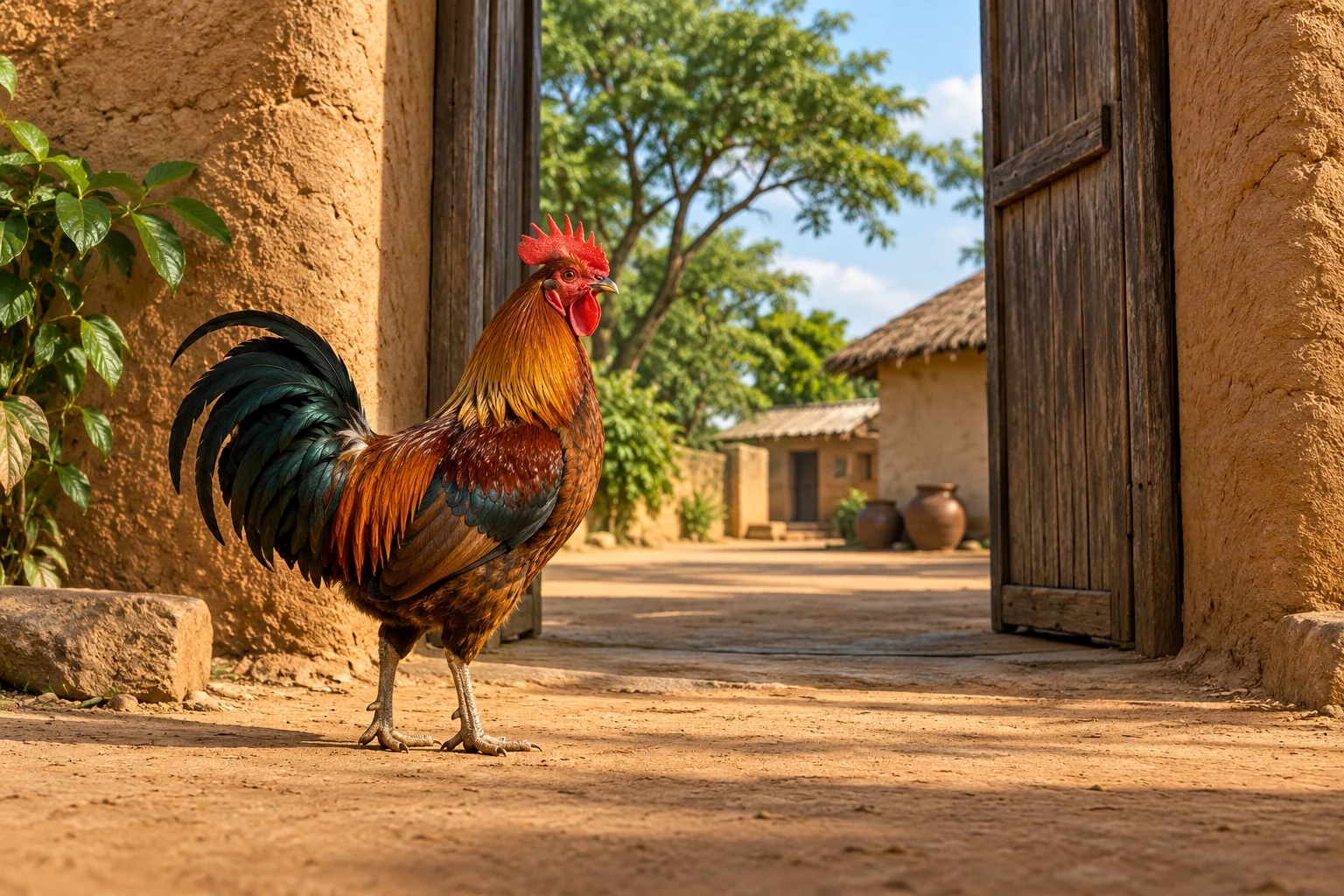
A rooster entrusted with Olofin’s entrance becomes contemptuous toward Esu. During a later encounter, he boasts about private knowledge of the ruler. Esu uses the disclosure to demonstrate the breach, and the court responds with a lethal punishment. Access that once supported the rooster becomes the source of his exposure.
The important distinction is between carrying responsibility and displaying proximity to power. Confidentiality is compromised before the public punishment occurs. A critical reading should also note Esu’s opportunism and the ruler’s disproportionate response; the story does not require readers to accept severe retaliation as an appropriate way to repair a breach of trust.
Narrative setting: Cuban/Lukumí patakín in a multilingual source compilation; no individual narrator is established.
The cricket enters unprepared
Before entering the world, a cricket receives counsel concerning what awaits it. It does not follow through and arrives amid dense vegetation that catches fire. Unable to find an exit, it emerges altered and becomes an object of ridicule. The narrative explains its form through a sequence of exposure and escape.
Preparation and escape routes are the useful analytical themes. The account’s bodily etiology and ridicule need a clear limit: actual differences are not evidence of neglected duty. Nor should a literal fire-safety procedure be extracted from the ritual frame. The story asks about anticipation while leaving the ethics of the onlookers’ mockery open to challenge.
Narrative setting: Cuban/Lukumí patakín in a multilingual source compilation; no individual narrator is established.
A rescued catch becomes a field of livelihood
Preparing to leave the celestial setting, Okanran Meji obtains counsel and follows a different route from his proposed companions. At a boundary farm he finds a trapped antelope beginning to spoil and starts preserving the meat. The owner first confronts him, then understands the action and grants him a share. In his later earthly farming, animals threaten the crops until renewed consultation brings Esu’s assistance. Protected production and the use of the captured animals give him a more secure livelihood. This bounded sequence concerns provision, permission, and sacred protection; the longer surrounding biography contains other episodes not developed as part of this motif.
The owner’s change of response is important because an apparently intrusive act becomes intelligible only after its purpose is explained. Okanran’s resourcefulness does not automatically establish his right to everything found on the farm; the narrated share follows recognition by the owner. In the later field, cultivation and protection remain joined rather than treating labor as sufficient by itself. Within the witness, Esu actively changes the conditions under which work can yield a return. The earlier palace rooster also occupies a position of entrusted access, but uses it to boast rather than preserve another person’s goods.
The cricket’s ignored preparation adds a third relation between a coming environment and what is done beforehand. These comparisons support precise questions about permission and anticipation without emptying the story into a modern work ethic. The religious route, counsel, and divine assistance remain part of how the livelihood comes into being, and its success does not promise that every farmer’s effort will be rewarded similarly.
Narrative witness and setting: Translated excerpt in the multilingual compilation’s expressly attributed Cromwell Osamaro sequence, with Yoruba/Bini-facing material. The compilation’s language is not evidence of a Brazilian tradition.
The farmer called to a drought-stricken city
Ife suffers an extended drought, and established rain specialists have not changed the condition. The people hear of Okanran Meji, who is still primarily farming rather than broadly practicing his religious art, and invite him. Before accepting, he consults and prepares. On his arrival, Esu releases rain from its heavenly restraint, and rain continues while the city responds with praise. The account makes public recognition follow a sacred intervention by someone whose visible occupation had not announced the full extent of his capacity. Its weather sequence is religious testimony, not an authenticated historical drought or a procedure for influencing climate.
The invitation does not turn the farmer into an isolated miracle-worker. He seeks counsel, enters a relation of preparation, and acts within a field in which Esu is responsible for the restrained rain and its release. This preserves a religious explanation that a modern summary about confidence would miss. The witness also separates existing reputation from available capacity: the specialists are recognized but unsuccessful here, while the farmer has not yet expanded his public practice. That does not establish a general ranking of trades or invalidate every earlier expert.
It describes a particular call and response. Compared with the rooster’s borrowed prestige, public standing here follows a contribution rather than a boast about proximity to power. The story’s praise also leaves a question about how recognition credits the divine and preparatory agencies that precede arrival. A contemporary reading may ask how overlooked abilities become visible, while avoiding the assumption that personal status or spiritual merit determines real rainfall.
Narrative witness and setting: Translated excerpt in the multilingual compilation’s expressly attributed Cromwell Osamaro sequence, with Yoruba/Bini-facing material. The compilation’s language is not evidence of a Brazilian tradition.
What was born in this Odù
“Born” can name an explicit traditional origin association or what emerges through a story: a capacity, relationship, practice or order of life. Interpretations drawn from a narrative are labelled below, so their basis remains clear.
Human speech
Selected traditional source association.
The origin list identifies speech as an emergence associated with this sign. Beside the gatekeeper story, language appears as both social capacity and a responsibility toward people whose information one carries.
Porous stones for filtering water
Selected traditional source association.
The specific material association suggests separation and practical mediation. It is a local sacred-origin claim, not an archaeological account of water filtration or evidence for the safety of a particular stone.
Wound closure
Selected traditional source association.
The list includes healing of wounds. This remains an origin association rather than a medical mechanism; a writer may explore repair symbolically without claiming that the sign predicts or controls recovery.
Correlations to life dimensions
These questions bring the selected stories into contemporary life. They are interpretive invitations for study.
Work and resources
The gatekeeper possesses access, not ownership of the ruler’s private life. A role’s prestige can obscure the limits of the authority it confers.
Reflect: Where are you treating entrusted access as personal property?
Relationships and family
Disclosure affects absent people who cannot respond in the moment. Trust depends on considering those indirect consequences before speaking.
Reflect: Who else would be exposed by your story?
Character and inner life
The cricket’s preparation is unfinished before the journey begins. An intention to prepare does not create an available exit.
Reflect: What practical step remains incomplete?
Community and responsibility
The court and onlookers punish or mock vulnerability. A community can demand accountability while refusing cruelty.
Reflect: How can your group correct a mistake without humiliating someone?
A deeper reading of the sacred relationships
Preparation enters an already active sacred world
The farm and drought episodes begin with consultation before a journey into conditions the protagonist does not fully control. Esu’s assistance is not an extra label for successful effort; inside the witness it changes protection and rain themselves. The cricket’s refusal and the rooster’s breached confidence provide different relations to that order, rather than one uniform story of obedience. Sacred preparation concerns acknowledgment and alignment with agencies that remain effective beyond a person’s reputation. A contemporary lens on readiness can follow this logic, but should not replace it with a claim that religious action merely improves confidence. Nor does the witness provide a universal procedure that guarantees safety or weather outcomes.
Recognition follows different kinds of evidence
The farm owner understands Okanran’s action after an explanation and then shares the preserved catch. Ife recognizes a contribution after relief, while the rooster claims prestige before exposing entrusted information. The cricket’s later mockery supplies a harsh and unreliable public judgment. These are distinct social responses, not a single impartial court. A reference study can therefore ask what each recognition is based on: observed usefulness, a narrated sacred event, a self-report of access, or ridicule after vulnerability. The comparison helps explain why public approval cannot be treated as a general test of wisdom. The stories provide grounds for examining reputation without claiming that every celebrated result proves virtue.
A livelihood requires more than one opening
The boundary encounter produces a share, but the earthly farm still needs conditions that let crops survive. The city’s rain opens another field of responsibility and reputation. These different gains should not be collapsed into a single sudden enrichment. They are staged transitions involving resources, relationships, and recognition. The earlier cricket and gatekeeper accounts also warn that one favorable condition can be lost or can conceal a vulnerability. A contemporary analysis may distinguish an opportunity from a sustainable arrangement, while the religious narrative explains why continuing relations matter. The protagonist’s initial cleverness does not eliminate the later need for counsel, and an invitation does not make preparation unnecessary.
Questions that deepen the study
What distinguishes the rescued antelope from simple taking?
The account gives the farmer-owner a response and a resulting decision. Okanran explains that the catch was deteriorating, and the owner recognizes the action by assigning a share. That sequence matters because usefulness alone would not establish unrestricted ownership. The religious journey provides the setting in which the encounter occurs, while its human terms include explanation and recognition. A contemporary reader can ask what permission or acknowledgment is needed around a helpful intervention. The story does not authorize taking another person’s resources merely because one believes they could be used better, and it does not make property the only value at stake.
Why does the city invite someone whose main work is farming?
The narrative allows capacities to exist beyond a person’s dominant public role. Okanran’s reputation reaches the city, but he still consults before responding, and Esu’s agency remains decisive within the account. The episode is therefore more exact than a general message to believe in hidden talents. A community recognizes a possible source of help, an individual acknowledges the limits of unaided action, and a sacred relationship becomes effective in a particular situation. None of those elements supplies evidence that an unfamiliar person is always wiser than established specialists or that a celebrated intervention settles the truth of every later claim.
Do the new stories contradict the earlier warnings about speech and preparation?
They broaden the conditions under which those warnings matter. The owner needs an explanation rather than silence, the city’s invitation requires a prepared answer, and public praise follows a contribution. The rooster’s disclosure instead turns privileged information into self-display, while the cricket ignores advice about an environment it has not yet entered. The issue is therefore not that speaking or acting is dangerous in itself. It is whether the act fits the relation and condition at hand. Within the religious accounts, divination contributes to that discernment; contemporary interpretation can compare the cases without turning them into one command to remain passive.
What the four narratives reveal together
The new witness gives Okanran Meji a constructive complement to the earlier gatekeeper and cricket episodes. A boundary encounter turns preservation into a recognized share, and a farmer’s prepared journey becomes relief for a city through Esu’s effective agency. These accounts do not erase the earlier dangers of borrowed prestige or entering an unfamiliar world unprepared. They show several routes by which action, explanation, and recognition become appropriately related. Sacred order remains an active field rather than a decorative frame: counsel precedes movement, and divine persons participate in what the material world permits.
Contemporary questions about permission, overlooked capacity, and sustainable livelihood follow from those details. The four stories should not yield a guarantee of agricultural success, public fame, or immunity from loss. They make the responsibilities of a particular opening more intelligible while preserving the different scales and unresolved costs of their outcomes.
Living with this Odù
A continuing life or initiatory relationship
For a person whose received life or initiatory Odù is Òkànràn Méjì, access can become an ongoing responsibility rather than proof of personal importance. The palace rooster uses proximity to display prestige, while the farm visitor preserves something belonging to another and must explain his action before receiving a share. Across changing roles, these accounts distinguish knowing, entering and being authorized to use what one encounters. They also ask whether a person's public standing follows contribution or a performance of closeness to power.
Preparation has several scales. The cricket's exposure differs from the farmer's later need to protect cultivation, and the invitation to drought-stricken Ife does not remove the need for renewed counsel. Within the attributed witness, Esu changes protection and rain, so the religious world cannot be reduced to confidence. Long-term character can include readiness to respond without making an earlier opening into permanent security. The sign does not make bodily difference evidence of neglected duty or a harsh court's punishment morally proportionate. It offers enduring questions about speech, permission and sustainable livelihood, while preserving the difference between an available capacity and the reputation that has or has not announced it.
A particular consultation and its question
In an actual consultation, Òkànràn Méjì can help distinguish entrusted access from ownership and preparation from mere intention. A question involving confidentiality might be illuminated by the rooster, while one involving a useful intervention could require the farm owner's recognition of what the visitor has done. The latter share follows an explanation; resourcefulness alone does not establish unlimited rights. A practitioner needs the particular question before describing the result as either an invitation to act or a warning to remain silent.
The cricket and drought accounts also place readiness before an environment the protagonist cannot fully control. The religious preparation and Esu's agency remain effective within their witnesses, without providing a weather technique, medical mechanism or fire procedure. The farmer's new public role follows a contribution, but does not invalidate every earlier specialist. Consultation can ask whether a capability is overlooked, whether its conditions have been established and what continuing responsibility an invitation creates. It cannot determine that an unknown client's misfortune proves refusal or that the client is permanently a boastful gatekeeper, exposed creature or successful rain-bringer. One result remains situated within its actual religious encounter.
Constructive and adverse possibilities
Constructive relations could let useful action become intelligible through explanation, establish permission and connect a first opportunity with the conditions needed for continuing provision. In the attributed farm and rain accounts, sacred counsel and Esu participate in what becomes possible. The protagonist's response remains necessary rather than being replaced by protection.
Adverse unfolding may involve displaying confidential access as status, entering a threatening setting without an available response or mistaking early recognition for complete readiness. The court's lethal punishment and the cricket's ridicule also require judgment; neither establishes that cruelty repairs a breach or that bodily difference reveals spiritual failure. These contrasts leave the state of a real consultation undetermined. They ask what each recognition rests on and whether a relationship can sustain its contribution beyond the dramatic moment when it first becomes visible.
An illustrative situation in everyday life
In a hypothetical workplace, an employee gains access to a senior office and begins using private information to impress colleagues. Another employee quietly prevents a valuable resource from being lost but needs to explain why they entered a restricted area. The rooster and preserved-catch narratives distinguish borrowed prestige from an intervention whose permission remains to be clarified. A later invitation to lead a project should still include preparation rather than treating recognition as sufficient competence. This is an illustrative interpretation, not a prediction of punishment or a claim that the employees reproduce sacred protagonists. It asks what authority access confers, whose property is involved and what evidence makes a useful action accountable to others.
Sources and reading context
The first two narrative witnesses
The selected episodes are Cuban/Lukumí materials, not a universal account of Okanran Meji. Origin claims about speech, filtration, and bodily processes are contextualized rather than historicized or medicalized. The punitive endings and disability-related imagery are treated critically.
Narrative motifs are summarized independently. The life-dimension reflections are contemporary interpretation. How these reference studies are built explains the wider source approach and the distinction between a reference article and personal divination.
Additional named witnesses
- Cromwell Osamaro Ibie. The surrounding sequence is expressly attributed to Cromwell Osamaro. These selected episodes are read through the multilingual compilation’s translated renderings; exact edition and original translation chain remain unverified.
The new motifs are bounded portions of an attributed biography and rain narrative. Later gendered accusations and clinical applications are not adopted. No historical drought date, universal agricultural claim, ritual method, or weather guarantee is inferred from the Portuguese rendering.
Bibliographic identification
- C. Osamaro Ibie. Ifism: The Complete Work of Orunmila. Lagos; multivolume publication beginning 1986. Library catalogue record. Related bibliographic record for the named narrative witness. Exact volume, edition and page of the transmitted account have not been independently matched.
Read the source method and wider scholarly context.
The catalogue links identify published works and their authors. They are separate from proof of an individual episode’s wording or attribution. Contemporary comparisons and the synthesis above are editorial interpretation. The author’s books and Academy companions below provide further study; their sales links are separate from the source references.