
Òtúrúpòn Méjì is a principal Odù in Ifá’s 256-part corpus. Òtúrúpòn Méjì’s selected narratives concern a challenge to Shangó and a test of his attachment to Obatalá. In the first, an animal coalition hides weapons and seeks to replace its master; in the second, news of Obatalá’s supposed death becomes an occasion for proving love. The explicit origin list includes dreams, ostracism, sacred hierarchy, and a benevolent falsehood. These images make appearances, allegiance, and exclusion more specific concerns than a fixed moral profile.
A question to carry through the study: What does this demand for proof of loyalty require somebody else to risk or conceal?
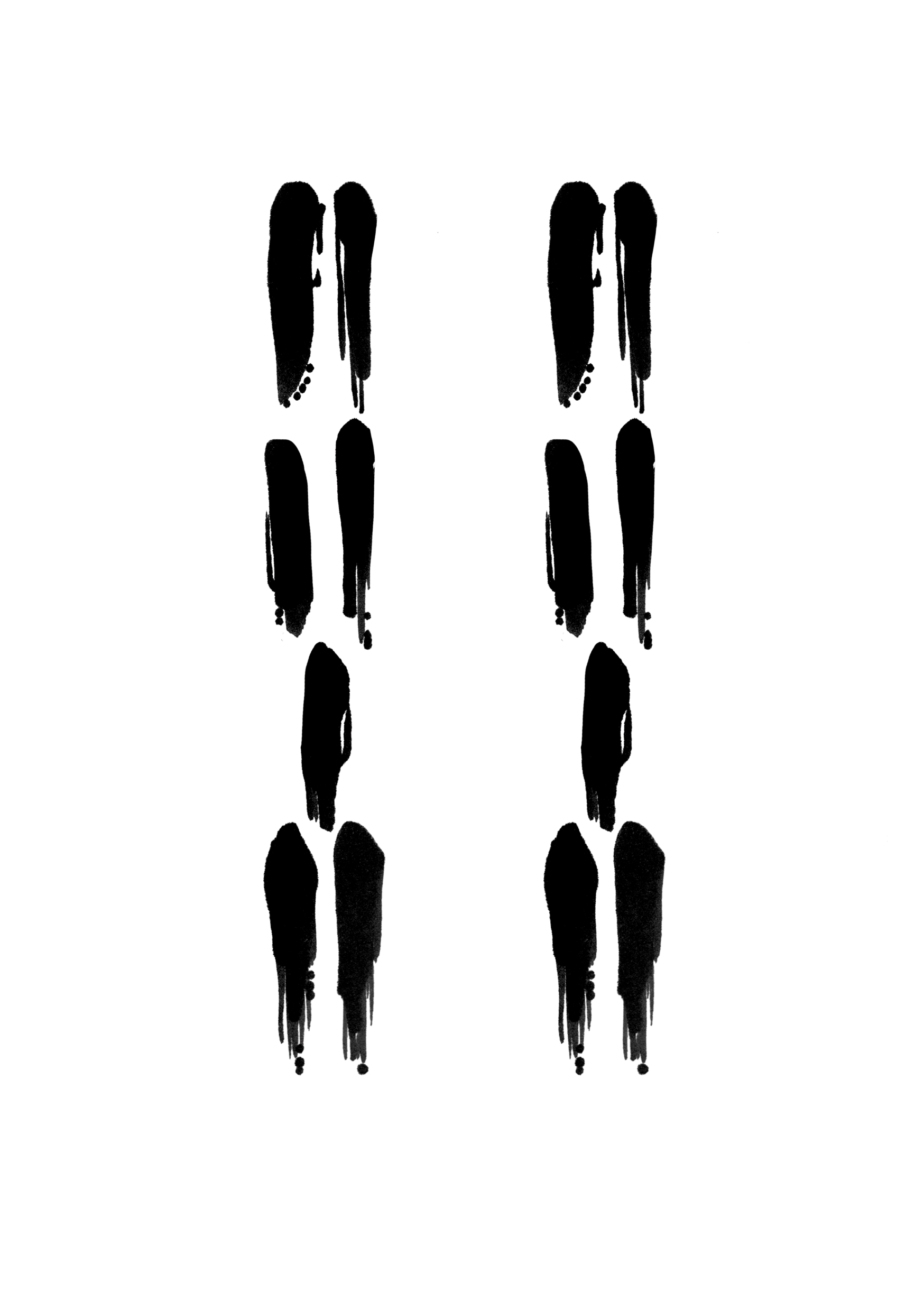
This Academy reads the right column first, then the left. Each row carries a single or double mark.

Where this Odù belongs
Òtúrúpòn Méjì is the principal, doubled Odù of the Òtúrúpòn family in the Academy’s study order. It sits beside fifteen mixed combinations. A doubled name identifies the sign’s structure; its teachings unfold through particular verses, stories and the circumstances in which they are interpreted.
Key Òrìṣà and sacred relationships
The figures below are selected for their roles in the accounts discussed here. They offer connected reading paths through the tradition.
-
Ṣàngó. Shangó is challenged after his weapons are hidden, then participates in a separate test of affection toward Obatalá; both accounts place his response under pressure from others’ expectations.
-
Èṣù. Eshu disrupts the challengers’ communication and helps Shangó recover his position; the action supports one side in a conflict rather than representing neutral arbitration.
-
Obàtálá. Obatalá seeks a demonstration of Shangó’s love and interprets his startling arrival as proof; his authority is shown as emotionally demanding as well as protective.
Key myths and their meanings
A coalition hides the weapons
A ram who has served Shangó conspires with a goat and a she-goat. They hide his weapons, equip the ram with sharper horns, and arrange hidden support for a duel. Shangó consults Orunmila and fights with an old club. Eshu obstructs the coalition’s messenger, and Shangó overcomes the conspirators. The story provides a local explanation of food and divine alliance through a struggle over service and command.
The account makes concealed coordination more important than the visible duel. Yet its master-servant language and consumption of defeated opponents require contextual care. A useful analysis can examine trust, unequal allegiance, and control of resources without turning the victor’s punishment into an ethical ideal. Eshu’s intervention also demonstrates that successful loyalty in this story is partisan and strategic, not evidence that every means used is universally just.
Narrative setting: Cuban/Lukumí narrative in the accounts considered here; no individual author established for this passage.
A father asks for proof of love
Obatalá says that Shangó must demonstrate love for him. When he becomes gravely ill, a report spreads that he has died. Shangó examines the ordinary state of the natural world, eats, and then goes to Obatalá’s house. At the bedside he produces a great thunderous disturbance that startles Obatalá into movement. Obatalá interprets the episode as assurance of Shangó’s affection.
The narrative combines discernment of a report with a relationship organized as a test. Shangó does not accept the death announcement at face value, but the eventual demonstration uses a shock rather than ordinary conversation. The story can prompt questions about how love is recognized and why proof is demanded. It should not become advice to frighten a sick person or an assertion about how illness can be reversed.
Narrative setting: Cuban/Lukumí narrative in the accounts considered here; no individual author established for this passage.
Ogbo retreats while honoring a dangerous brother
Ogbo, the wildcat, seeks divination after a terrifying dream. Òrúnmìlà warns that his brother Ekun intends to eat him and counsels protection of his own head, vigilance, and refusal to serve another’s head. Ekun separately consults about the intended killing but refuses the advised offering. A leopard then persuades Ogbo to attend the supposedly dying brother. Ogbo detects the deception in Ekun’s eyes and participates from a retreating distance, using the sacrificial animal’s head while praising Òrúnmìlà. He escapes. Ekun turns on some gathered animals. The narrator explicitly explains the opposed outcomes through the offering Ogbo made and the one Ekun refused.
Ogbo’s response is more complicated than perfect obedience to every instruction. He remembers the warning but still approaches because the plea comes through kinship and apparent illness. Protection operates alongside renewed perception and an improvised distance that prevents the intended capture. The narrative explicitly attributes survival to sacred response, so practical vigilance is not a rival explanation that cancels sacrifice. At the same time, its detailed choreography makes vigilance concrete: Ogbo reads the brother’s eyes and keeps retreating rather than allowing the ceremony to fix him in reach.
Ekun’s own consultation adds a difficult religious feature. The sacred counsel appears within an aggressor’s project as well as a potential victim’s need; the account does not simplify consultation into a guarantee of moral innocence. Its stated contrast concerns accepted and refused obligation. A contemporary interpretation may examine kinship as a channel through which coercion can pass, while preserving the narrative’s stronger claim that Òrúnmìlà’s disclosure and Ogbo’s response make the escape possible.
Narrative witness and setting: Portuguese rendering in the explicitly headed Cromwell Osamaro revelations; an African Ifá witness mediated by the compilation, not a Brazilian provenance established by language alone.
Egherun reverses a coerced marriage through a second accusation
Ugun, the vulture, traps the beautiful bird Egherun by placing attractive palm fruit beside the road and accusing her of theft when she gathers it. Facing public disgrace and a threatened capital penalty, she accepts his demand for marriage. After sleepless distress, she consults Òrúnmìlà and responds to his counsel. A sacred deposit at a crossroads attracts Ugun, who eats and carries some away. Egherun witnesses his action and accuses him of taking what was not intended for him. She makes release from the imposed marriage the condition of settlement. Ugun publicly frees her, and she retrieves her belongings and leaves.
The two accusations have deliberately parallel forms but different narrative purposes. Ugun uses apparent theft to manufacture control over someone who rejected suitors; Egherun uses his taking of a specifically directed sacred deposit to dismantle that control. The account explicitly identifies coercion in the marriage, so a summary should not turn it into an amusing romance or a lesson about a woman’s vanity. Her initial attraction to fruit does not erase the vulture’s calculated entrapment. Religious consultation is decisive in the reversal: Òrúnmìlà discloses a way forward and the sacred exchange creates the situation through which release becomes possible.
A modern legal analysis can note accusation, threatened punishment, negotiated conditions, and public acknowledgment, but the narrative does not provide evidence of an actual historical court system or a reusable legal strategy. The public declaration matters because private permission alone would leave the imposed status uncertain. Her removal of her own possessions supplies a concrete exit, giving the story a completed liberation that should not be softened into mere reconciliation.
Narrative witness and setting: Portuguese rendering in the explicitly headed Cromwell Osamaro revelations; an African Ifá witness mediated by the compilation, not a Brazilian provenance established by language alone.
What was born in this Odù
“Born” can name an explicit traditional origin association or what emerges through a story: a capacity, relationship, practice or order of life. Interpretations drawn from a narrative are labelled below, so their basis remains clear.
Dreams
Selected traditional source association.
Dreams are explicitly named in the origin list. This establishes a religious association with experience beyond ordinary waking observation, without authorizing an interpretation of every dream as a message or personal prediction.
Exclusion and ostracism
Selected traditional source association.
The list associates the sign with blocking and ostracism. The selected conflict narratives allow reflection on who is included in an alliance, but do not establish a universal rule about banishment.
A benevolent falsehood
Selected traditional source association.
The origin list names the pious or compassionate lie. That association raises a question about motive and consequence; it is not permission to conceal whatever a powerful person judges beneficial.
Correlations to life dimensions
These questions bring the selected stories into contemporary life. They are interpretive invitations for study.
Work and resources
Shangó’s opponents remove the tools through which he normally exercises authority. The episode supports assessing dependencies and access to resources, including whether a role remains viable when its usual instruments are unavailable. An old club remains after the other weapons disappear.
Reflect: What capacity remains if the normal tools or privileges are withdrawn?
Relationships and family
Obatalá’s test makes love something another person must perform under uncertainty. The story opens a question about whether reassurance can be sought directly instead of through alarming reports or staged demands. The report creates uncertainty before Shangó reaches the bedside.
Reflect: What assurance could be requested without creating a test?
Character and inner life
Shangó pauses to compare the report with what he observes. This specific act of discernment can be retained without endorsing his later shock, distinguishing careful assessment from automatic belief in dramatic news. The surrounding world does not match the dramatic report he hears.
Reflect: What observable context should I consider before reacting to this report?
Community and responsibility
The coalition’s hidden helpers and Eshu’s intervention make outcomes depend on people outside the visible contest. Communities should ask whose participation has been concealed when a conflict is presented as a fair encounter between two parties.
Reflect: Who else shapes this outcome without being publicly acknowledged?
A deeper reading of the sacred relationships
Religious protection remains active within practical perception
Ogbo’s escape is explicitly credited to his response to divination, while the narrative also shows looking, recognizing, maintaining distance, and running. Egherun’s release similarly joins sacred counsel with watching, speaking, and requiring a public declaration. These accounts do not separate spiritual efficacy from embodied action. Their practical details express how protection takes shape inside the narrated world. An article should preserve that relation rather than making the rituals decorative additions to cleverness or treating human agency as irrelevant beside divine action. The specific sacred response is explained sufficiently to establish its place in the sequence, while procedural quantities and instructions remain unnecessary to understanding why each protagonist’s circumstances change.
Kinship and marriage can transmit danger rather than guarantee care
Ekun invokes fraternal need through intermediaries while planning to consume his brother. Ugun creates a marriage through threatened accusation rather than Egherun’s free wish. Familiar relationship names therefore do not settle whether an encounter is protective. This deepens the earlier Obatalá test of filial love, whose children respond differently to a father’s apparent death. The analytical question concerns what a relationship actually demands and permits, not whether it bears a prestigious label. The sources do not make all families dangerous; they identify particular acts that violate or exploit an expected bond. Maintaining that specificity allows the article to examine betrayal and coercion without treating mistrust as a universal religious obligation.
Public performance can conceal violence or establish release
The animals’ staged mourning makes Ekun’s false illness appear credible, while Ogbo’s sung praise accompanies his retreat from the trap. Ugun’s accusation uses threatened public judgment to constrain Egherun; her eventual release requires a public acknowledgment that the marriage no longer binds her. Performance therefore has several functions within the paired episodes. It can manufacture an appearance, carry grateful sacred speech, or make changed status socially legible. The comparison should not collapse these functions into a single claim that all ceremonies deceive. It can instead ask who controls the gathering, what an audience is made to believe, and whether the represented action narrows or restores another participant’s freedom.
Questions that deepen the study
Does Ogbo simply refuse to visit Ekun after the warning?
He does not. The plea through a relative and the appearance of serious illness draw him into the encounter despite his remembered instruction. His survival then depends on recognizing the deception and maintaining distance while the narrative’s sacred protection remains effective. Reporting only that he stayed away would erase the episode’s central difficulty: obligations toward kin make a warning hard to enact. The account does not recommend that every reader disregard relatives in distress. It presents one specifically disclosed threat and one escape, with attention to both the prior consultation and the protagonist’s perception inside a dangerous scene. Those details make the religious protection active rather than mechanically automatic.
Is Egherun’s eventual departure described as mutual reconciliation?
The account describes release from a marriage imposed through coercion. Egherun demands a public declaration, receives it, and removes her belongings. Nothing in that ending says that the pair reconcile romantically or choose a more harmonious version of the same union. Preserving the departure matters because it is the successful outcome the protagonist seeks after distress. The narrative’s sacred counsel supports that change rather than simply preserving marriage at all costs. An article can discuss the reversal of accusation and the role of public acknowledgment without treating the account as a present legal procedure or blaming Egherun for the trap that Ugun deliberately constructed around her known attraction to fruit.
How do these episodes change the comparison with the earlier weapon plot?
The earlier conspiracy hides weapons against Shangó, whereas Ekun hides predatory intention behind illness and Ugun disguises coercion through an accusation. These are different forms of concealed threat. The new narratives also locate agency with those placed at risk: Ogbo recognizes and escapes; Egherun consults, witnesses, speaks, and secures departure. The comparison should not imply that threatened people always have equivalent resources or that failure to escape proves deficient discernment. It shows how these particular accounts represent disclosed danger and effective response. Their sacred mediation remains central, while the practical forms of escape differ enough to resist a single technique offered as applicable to every situation.
What the four narratives reveal together
The earlier Shangó conspiracy and Obatalá’s test of filial love ask how apparent relationships conceal or reveal intention. The Ibie episodes deepen that concern through an endangered brother and a woman trapped in a coerced marriage. Ogbo confronts a staged appeal to kinship, while Egherun reverses an accusation that has converted threatened punishment into marital control. Their outcomes differ from the earlier tests, yet all four require attention to represented acts rather than relationship names alone.
Sacred disclosure and response make protection effective in the new narratives, alongside concrete perception, distance, witnessing, speech, and public acknowledgment. A contemporary reading can examine betrayal and freedom without stripping those actions from their religious world. It should also preserve Egherun’s actual departure and the troubling consultation of Ekun, which prevent the family from becoming a seamless moral in which every sacred participant already occupies an uncomplicated ethical position.
Living with this Odù
A continuing life or initiatory relationship
A received life relationship with Òtúrúpòn Méjì can make claims of loyalty and love recurring questions about freedom. The animal coalition changes the conditions of a duel while presenting service beneath a challenge to command. Obatalá's demand for proof of affection establishes another test, whose dramatic outcome should not become a universal model for care. Ogbo's retreating participation distinguishes honoring a relation from surrendering oneself to its threat. Egherun's escape exposes a marriage imposed through staged theft and public disgrace, rather than freely chosen agreement.
Over time, character may develop through discerning what an invitation, proof or accusation actually requires one to relinquish. The inward tension may include fear that distance signals disloyalty or shame that makes coercive terms appear unavoidable. These witnesses do not predict hostile siblings or prescribe deception as an ordinary response. Eshu's intervention, Òrúnmìlà's counsel and the account's sacred contrasts remain active. Carrying the sign can invite a changing responsibility to one's head and agency within relationship. A person may honor a bond from a viable distance, or recognize that a demanded demonstration has ceased to be evidence of love and become a means of controlling participation.
A particular consultation and its question
In consultation, the actual question can distinguish a concealed change in conditions, an ambiguous test of affection, a dangerous invitation and an agreement made under coercive accusation. Ogbo's recognition and retreat ask whether participation can occur without granting the access demanded by another party. Egherun's second accusation releases her within the story, but it should not become a practical instruction to entrap someone. A practitioner cannot infer that a client's sibling intends harm or that a marriage has been obtained by fraud. The coalition narrative asks what has been hidden from the apparent contest, while the bedside narrative asks who defines adequate proof of care.
Contemporary reflection can examine what was freely agreed, what evidence has been staged and whether a person's fear of public shame has displaced genuine consent. A temporary result is not a lifelong identity of mistrust. Its sacred meaning depends on the actual reading, including the explicit role of counsel and response in Ogbo's different outcome. These witnesses can sharpen the difference between loyalty, compelled participation and a viable boundary without reducing their religious agency to ordinary vigilance or making every dramatic act of affection a recommended model.
Constructive and adverse possibilities
Constructive unfolding can include a hidden coalition being interrupted, a threatened person preserving retreat and a coerced union being publicly ended. Adverse movement appears where a contest is rigged, a claim of love requires surrender of agency or disgrace becomes leverage for an imposed relationship. Egherun's distress must not be treated as a failure to bargain well, and Ogbo's escape does not make family affection inherently dangerous. Iré and osogbo require contextual religious interpretation rather than a verdict from public loyalty alone. The witnesses give counsel and Eshu particular efficacy while retaining morally difficult tests and reversals. Their comparison asks whether a bond permits a person to remain answerable to their own head and whether the apparent agreement can bear truthful examination of the conditions under which it was obtained.
An illustrative situation in everyday life
Hypothetically, a family member insists that attending a private meeting is the only acceptable proof of affection, despite a history of intimidation. A separate dispute has made another relative fear public disgrace and accept terms they would otherwise refuse. Ogbo's structure distinguishes respectful distance from abandonment; Egherun's account asks whether apparent agreement arose under coercion. The bedside test adds a question about who is authorized to define proof of love. This is an illustrative interpretation, not a finding of hidden murderous intent or a recommendation to manufacture a counteraccusation. The inward conflict is fear of appearing disloyal. The external task is to clarify whether the invitation permits safe, voluntary participation or uses the relationship itself to remove meaningful choice.
Sources and reading context
The first two narrative witnesses
The selected Cuban-labelled Spanish stories offer local explanations of alliance and affection. Their food origins, violent consequences, and illness reversal remain religious narrative elements. Dreams and benevolent falsehood are reported from the origin list without turning them into personal divination or a general license to deceive.
Narrative motifs are summarized independently. The life-dimension reflections are contemporary interpretation. How these reference studies are built explains the wider source approach and the distinction between a reference article and personal divination.
Additional named witnesses
- Cromwell Osamaro Ibie. Explicit Osamaro division supplies Ogbo/Ekun and Egherun/Ugun. Portuguese is a mediated African witness and does not establish a Brazilian lineage.
Animal names and kinship follow this rendering rather than zoological taxonomy. Ekun’s consultation is morally difficult and retained. The coercive marriage ends in departure, not reconciliation. No historical court code or personal divinatory prediction is inferred.
Bibliographic identification
- C. Osamaro Ibie. Ifism: The Complete Work of Orunmila. Lagos; multivolume publication beginning 1986. Library catalogue record. Related bibliographic record for the named narrative witness. Exact volume, edition and page of the transmitted account have not been independently matched.
Read the source method and wider scholarly context.
The catalogue links identify published works and their authors. They are separate from proof of an individual episode’s wording or attribution. Contemporary comparisons and the synthesis above are editorial interpretation. The author’s books and Academy companions below provide further study; their sales links are separate from the source references.