
Ìká Òtúrúpòn is a mixed Odù in Ifá’s 256-part corpus. Ìká Òtúrúpòn’s selected passages set a threatened visitor in a tree beside Itú’s openly expressed wish for companionship. Orunmila survives released wild animals through temporary shelter, a messenger, and Eshu’s intervention. Itú seeks counsel rather than treating loneliness as a reason to seize another person. The origin list includes a named Obatalá form and a food-safety prohibition. Sexualized and medical origin claims elsewhere are excluded from this focus.
A question to carry through the study: What need can I communicate clearly, and who can help without turning it into a contest?

This Academy reads the right column first, then the left. Each row carries a single or double mark.
Where this Odù belongs
Ìká Òtúrúpòn belongs to the Ìká family in this Academy’s study sequence. It is a mixed Odù, distinct from Òtúrúpòn Ìká. The order matters. Its teaching is approached through its own narratives, rather than by adding two general descriptions of the principal signs together.
Key Òrìṣà and sacred relationships
The figures below are selected for their roles in the accounts discussed here. They offer connected reading paths through the tradition.
-
Ọ̀rúnmìlà. Orunmila is the vulnerable traveler who shelters in a tree after animals are released against him; another creature communicates his need before Eshu intervenes.
-
Èṣù. Eshu responds to the messenger and disperses the attacking animals, allowing Orunmila to leave his refuge; the story emphasizes timely assistance rather than solitary invincibility.
-
Obàtálá. A form named Yalumo Arishogun is explicitly associated with the sign in the origin list. No unrecorded intervention by that form is added to the selected stories.
Key myths and their meanings
The traveler waits above the danger
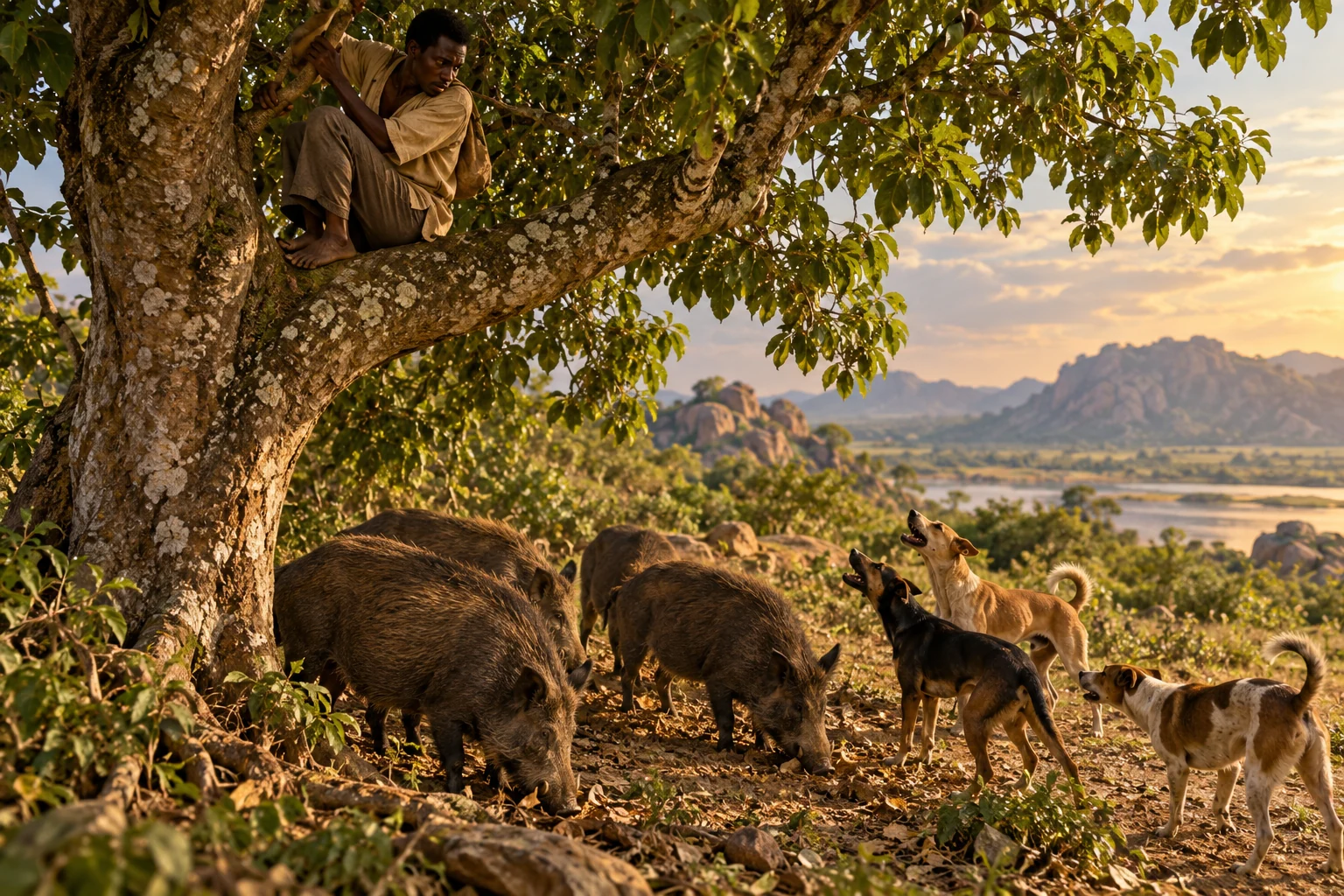
Orunmila enters a land where his arrival provokes hostility. A local figure releases wild pigs and dogs to destroy him, and he climbs into a leafy tree. A creature above him asks what has happened and carries the report to Olofin and Eshu. Eshu quickly reaches the scene and drives the animals away, allowing Orunmila to descend safely. Survival requires refuge and a chain of communication.
The tree provides time, but not a complete solution. The messenger transforms an isolated emergency into a situation others can act on. This makes vulnerability and cooperation central even for a revered figure. The story’s surrounding claims about desire and harmful substances should not be carried into practical guidance. Its useful issue is recognizing when temporary shelter must be followed by contact with capable assistance.
Narrative setting: Cuban/Lukumí narrative in the accounts considered here; no individual author established for this passage.
Itú asks for companionship
Itú laments having no wife and seeks divination early in life. The account places counsel and religious acknowledgment before a later scene of satisfaction and public thanks. Itú praises the diviner, who in turn praises Ifá. Rather than a developed courtship narrative, this is a compact movement from an expressed relational need toward participation in a community of acknowledgment and gratitude.
The excerpt does not describe a prospective partner’s perspective, so it cannot establish an ideal model of marriage or guarantee companionship. Its more limited value is that need is articulated and received without a battle narrative. Public gratitude distributes acknowledgment beyond the beneficiary. A careful use also avoids the passage’s literal promises about partners’ survival and does not reproduce its ritual materials or actions.
Narrative setting: Spanish translation of an additional Ifá revelation in the selected account; the selected excerpt does not establish an individual author.
Two dogs refuse to disengage
In the town named Ìhanrín, Ìká and Ìpòn receive divinatory counsel about their entanglement. One is told to release a hand and the other to disentangle a leg; both refuse. The account identifies the pair with dogs and uses their mating condition to give the refusal an enduring visible form. Its prose application urges restraint, listening, and avoidance of fighting. The verse also evokes biting before communication. No mediator successfully separates the pair in the supplied narrative, and no reconciliation scene follows. The episode represents a refusal of counsel becoming a bodily predicament, with its animal imagery remaining inseparable from its particular warning.
This is not a general veterinary explanation, and an article should not present it as one. The dogs’ condition belongs to the narrative’s sacred and etiological imagination: their refusal makes a consequence visible in the world the verse addresses. The corresponding human application concerns restraint before conflict becomes self-binding. That interpretive connection should remain distinct from the account’s explicit sexual imagery, which need neither be sensationalized nor erased. The paired commands matter because neither participant can claim that only the other has something to release.
Yet the text gives no account of consent, injuries, or the distribution of power between actual human partners; those details cannot be invented to make the fable a complete modern case study. Its strongest contribution to the larger sign study is the difference between holding firm and becoming held. The client is asked to hear counsel while release remains possible, rather than treating continued involvement as proof of victory, entitlement, or the righteousness of the original quarrel.
Narrative witness and setting: African Ifá verse in the explicitly named Ayo Salami division, transmitted with Yoruba text and a Spanish rendering in the compilation.
The partridge’s lament becomes a gathering with children
Aparo Ohehe, identified as the partridge, laments being unable to have a child while setting out for the annual cultivation. The diviners advise a sacred response, which she makes. The brief verse then changes register from solitary sorrow to an invitation to join her among children. It gives no biological account of conception, named spouse, family genealogy, or detailed intervening events. The prose introduction interprets the outcome as a blessing sought through Ifá. Its agricultural setting and its movement into a communal gathering are explicit, while the length of the wait and the circumstances of the children’s arrival remain unspecified.
The story’s brevity does not justify manufacturing an extended reproductive biography. Its decisive contrast is between lament on the way to recurring work and the later invitation into an abundant family scene. The temporal phrase signals fulfillment without establishing a calendar that could be applied to readers. Within the verse, the response to divination is efficacious; the conclusion belongs to a religious account of blessing, not an empirically demonstrated treatment. The partridge’s animal identity also keeps the passage within a larger repertoire where nonhuman beings consult and acknowledge Ifá.
A contemporary interpretation can attend to the social importance of moving from solitary longing into shared joy, but should not imply that childlessness proves spiritual failure or that everyone must desire parenthood. The account represents one protagonist’s voiced wish and received answer. Its annual cultivation suggests a life continuing in the presence of sorrow, although it does not narrate how she felt on every working day or whether others assisted her before the outcome.
Narrative witness and setting: An African-style Yoruba verse and English translation in the numbered Ìká Oturupon collection following a Fategbe Fatunmbi Fasola heading; that surrounding attribution is reported without asserting independently verified authorship of the numbered verse.
What was born in this Odù
“Born” can name an explicit traditional origin association or what emerges through a story: a capacity, relationship, practice or order of life. Interpretations drawn from a narrative are labelled below, so their basis remains clear.
Yalumo Arishogun
Selected traditional source association.
The list names this Obatalá form as arising here, with spelling variations in repeated statements. The source supports the association but does not supply enough explanation for a fuller identity, genealogy, or universal equivalence.
A prohibition concerning diseased animals
Selected traditional source association.
The origin list places a prohibition on eating animals that die of illness here. It is reported as a historical religious association in the compilation, without giving dietary instructions or claiming this text originated public-health knowledge.
Correlations to life dimensions
These questions bring the selected stories into contemporary life. They are interpretive invitations for study.
Work and resources
Orunmila’s refuge prevents immediate harm but cannot disperse the threat. The tale supports identifying which part of a difficulty can be contained temporarily and which requires another person’s capacity or access. The leaves conceal the traveler while the message travels outward.
Reflect: What can I stabilize now while the right help is contacted?
Relationships and family
Itú’s desire is voiced before a listener rather than hidden behind aggression. The excerpt remains one-sided, reminding an editor to distinguish someone’s longing from a reciprocal relationship that another person also chooses. The Itú excerpt does not describe a partner’s own decision.
Reflect: How can this need be expressed while preserving another person’s freedom to respond?
Character and inner life
The threatened traveler accepts assistance, and Itú acknowledges the counsel he received. Both accounts make dependence speakable rather than treating need as evidence of inadequacy or a reason for boasting. Both selected accounts allow need to be expressed before others.
Reflect: What would become easier if I could name the help I need?
Community and responsibility
The messenger’s question is a small act with a decisive effect. Community care can begin with noticing an unusual situation and conveying accurate information to someone equipped to respond, rather than assuming a respected person needs nothing.
Reflect: Who could act if the situation were described clearly enough?
A deeper reading of the sacred relationships
Listening and sacred response have different narrative outcomes
The dog episode shows counsel refused by both named participants; the partridge’s verse shows counsel heard and enacted. That contrast belongs to the narratives’ religious explanation rather than simply to a contrast between good and bad attitudes. Divination communicates a response appropriate to each situation: release and restraint in one, sacred exchange in the other. The resulting predicament or blessing is represented within that order. The article should retain this causal grammar without projecting it onto an unknown person’s conflict or fertility. It can explain what the tradition says happens in these accounts while keeping a clear boundary between narrated efficacy, contemporary interpretation, and claims that would require other forms of evidence.
Companionship and parenthood are distinct desires
The earlier Itú passage concerns a request for companionship and the favorable life associated with a spouse. The partridge’s request concerns children. Their proximity within a single Odù should not merge them into one compulsory family sequence. The supplied sources voice different protagonists’ wishes, and neither verse establishes a universal obligation for every person to marry or reproduce. This distinction also guards against padding the second story with a spouse it never names. The article gains depth by comparing the forms of longing actually expressed and the sacred responses actually represented. A gathering with children is the partridge’s conclusion; the means and social configuration of that gathering beyond the stated response remain open.
Release differs from desertion and from delayed movement
The earlier traveler remains above danger until help and an appropriate route become available. That delay protects movement rather than abandoning it. In the dogs’ episode, refusing release prolongs the predicament itself. The partridge continues toward annual cultivation while carrying a desire not yet fulfilled, then responds to counsel. These distinct temporal patterns prevent the study from celebrating either relentless persistence or immediate withdrawal in every case. The analytical question is what a continued action sustains: protection, necessary work, or an entanglement. The source narratives answer through their own events and sacred counsel. Contemporary readers can consider the distinction without receiving a personalized instruction to leave, remain, or wait in circumstances the text does not describe.
Questions that deepen the study
Does the dogs’ episode prove a biological explanation for their mating?
It gives a traditional narrative explanation within a divinatory and etiological register. Its actors receive counsel, refuse it, and acquire a condition identified with dogs. That is what the article can faithfully report. It should not convert the episode into a scientific explanation or turn its human application into a clinical claim about sexual injury. The meaningful textual movement concerns failed release and resistance to advice, accompanied by biting before communication. The prose warning supplies the connection to restraint. Preserving both the animal narrative and that situated application allows the account’s religious imagination to remain intelligible without assigning it a type of evidence it does not claim to provide.
What is actually known about the partridge’s children?
The verse ends by inviting others into a scene with children after Aparo Ohehe responds to the advised sacred exchange. It does not name them, count them, describe a delivery, identify a father, or narrate their later lives. The prose treats the scene as fulfillment of a desire for parenthood. An article can preserve that conclusion while refusing to invent the missing domestic history. The difference matters for respectful interpretation: the power of the passage lies in the voiced lament and transformed communal scene, not in reproductive details supplied by an editor. The fulfilled account also does not furnish a timetable or guarantee for someone reading it today.
Can the numbered partridge verse be assigned securely to a named author?
Its surrounding division carries a Fategbe Fatunmbi Fasola heading, and the compilation repeats that attribution in its source apparatus. However, a propagated heading is weaker evidence than an independently identified publication containing this numbered sequence. The responsible description is therefore an African Yoruba verse in the compiled section, with the surrounding attribution reported as a limit. It should not be described as Brazilian because English or Portuguese appears nearby, nor reassigned to a different contemporary author on stylistic resemblance alone. The actual episode remains usable with that caveat: its protagonist, lament, cultivation setting, response, and concluding children are all directly present in the selected paragraphs.
What the four narratives reveal together
The earlier traveler and Itú passages distinguish protected passage from desired companionship. The two new episodes extend that range without repeating either request. The dogs’ refusal turns continued involvement into a predicament; Aparo Ohehe’s response moves her voiced longing toward a shared scene with children. Together they make listening more specific than passive agreement. It can require waiting above danger, receiving a companion, releasing an entanglement, or answering a particular sacred instruction.
Their common reliance on consultation should remain visible without flattening their different wishes and outcomes. Contemporary reflection can compare persistence, restraint, and receptivity, while the article preserves the religious efficacy asserted inside each account. The evidence also sets limits: the dogs’ etiological imagery is not biological proof, and the partridge’s fulfilled wish is not a promise about an unknown reader’s fertility, family structure, or proper life course.
Living with this Odù
A continuing life or initiatory relationship
For someone carrying Ìká Òtúrúpòn through a received life or initiatory relationship, need and disengagement can become sustained questions. Orunmila's refuge is effective because a creature carries his report to powers able to intervene. Itú's compact account makes a relational lack speakable before its later acknowledgment. The two dogs present a contrary movement, each refusing the release that counsel identifies. The partridge's verse moves from solitary lament into a gathering with children through a particular sacred response. Over time, character may develop through distinguishing protective waiting from immobilized entanglement, and asking for help from demanding that another relation supply a guaranteed outcome.
The inward difficulty may include shame about need, fear of leaving a conflict unfinished or pride that interprets release as defeat. These narratives do not promise a spouse or children, nor explain an actual person's fertility. Their distinct witnesses and uncertain attributions remain visible. Sacred agency matters in the refuge: Eshu acts after communication, not merely as a name for courage. Carrying the sign can invite a more accurate relation to who can hear, what can be released and what form of participation the present stage of life actually permits.
A particular consultation and its question
A consultation can distinguish a danger requiring refuge, a need requiring expression and a conflict sustained by mutual refusal to disengage. The traveler does not overcome the released animals alone; communication to Olofin and Eshu is part of the religious explanation. The dogs' condition supplies a specific animal fable whose imagery should not become an intimate procedure or a diagnosis. Itú's need and the partridge's lament remain compact accounts, without the missing courtship or biological histories being invented. A practitioner should not infer that an unknown client must marry, will have children or is responsible for an unresolved relational outcome.
The actual question may concern access to support, the continuation of a fight or a wish that has become difficult to voice. Contemporary reflection can ask whether waiting provides safety, whether the message has reached someone able to respond and what each party is refusing to release. A situational result is different from a received life identity. Its useful distinction may be between protection, patience and fixation, while preserving the sacred participants and the fact that the witnesses do not all narrate the same route from difficulty to communal acknowledgment.
Constructive and adverse possibilities
Constructive movement can include a report reaching effective help, a sorrow becoming speakable and a person entering a wider field of acknowledgment through Ifá. Adverse movement appears when both participants refuse the specific disengagement named in counsel and the predicament continues without reconciliation. The traveler also shows that waiting can be active protection rather than avoidance. Iré and osogbo cannot be inferred from stillness or movement alone. The partridge's joyful gathering is a religious outcome in that verse, not a promise of conception or a judgment against someone whose lament remains unanswered. The sources distinguish kinds of need and response while retaining their different attributions. Contemporary interpretation can clarify the relation a person is sustaining, but cannot replace the actual consultation or make desired family outcomes a measure of spiritual worth.
An illustrative situation in everyday life
Hypothetically, two partners in a community project continue arguing because each insists the other must concede first. Important messages about the dispute never reach the person able to mediate, while one member is too ashamed to admit that practical support is missing. The dogs' structure asks what each is refusing to release; the refuge story asks whether the report has reached effective help. Itú's account makes expression of relational need a different act from winning the quarrel. This is an illustrative interpretation, not a finding that mediation will succeed or a prediction of family outcomes. The inward conflict is fear that disengagement means defeat. The external question is whether a safe pause and a clear message could alter the configuration that keeps both parties fixed.
Sources and reading context
The first two narrative witnesses
The refuge story is Cuban-labelled Spanish; Itú’s passage comes from a separate translated revelation with uncertain authorship. Their traditions are not merged into one authorial voice. Medical and sexualized material is excluded, and the named Obatalá form remains limited to explicit source association.
Narrative motifs are summarized independently. The life-dimension reflections are contemporary interpretation. How these reference studies are built explains the wider source approach and the distinction between a reference article and personal divination.
Additional named witnesses
-
Ayo Salami. Explicit Ìká Òtúrúpòn B provides the two dogs and their refusal to release; A was already used in the earlier companion study and is not repeated.
-
Compiled Yoruba verse under the Fategbe Fatunmbi Fasola division. The numbered Aparo Ohehe/partridge verse is directly witnessed, but its individual authorship is not independently established by the surrounding heading.
The partridge verse has secure local sign placement but only a surrounding author attribution. Both source episodes are concise; missing domestic or bodily details are left unspecified. No clinical guarantee or personal reproductive instruction is inferred.
Bibliographic identification
-
Ayo Salami. Ifá: A Complete Divination. Lagos: NIDD, 2002 catalogue record. Library catalogue record. Bibliographic identification of the named author and work; the edition behind the transmitted account remains to be matched.
-
Fategbe Fatunmbi Fasola. The Holy Odu: A Collection of Verses from the 256 Ifa Odu with Commentary. CreateSpace Independent Publishing Platform, 2015; ISBN 9781508633044. Library catalogue record. Bibliographic identification of the named verse witness. The selected passage’s page and exact edition are not independently matched.
Read the source method and wider scholarly context.
The catalogue links identify published works and their authors. They are separate from proof of an individual episode’s wording or attribution. Contemporary comparisons and the synthesis above are editorial interpretation. The author’s books and Academy companions below provide further study; their sales links are separate from the source references.