
Òtúrúpòn Ìká is a mixed Odù in Ifá’s 256-part corpus. Òtúrúpòn Ìká’s selected passages link the need for housing with the vulnerability created when trees supply an axe handle. Obatalá’s children build fragile shelters from storm debris, while Ogún’s tool becomes effective only after a branch is provided. The versions differ over the ceiba’s fate, so this study retains the shared question rather than reconciling them: when does giving one useful part enable a larger transformation whose costs the giver has not understood?
A question to carry through the study: What larger action becomes possible if I supply this apparently small missing part?

This Academy reads the right column first, then the left. Each row carries a single or double mark.
Where this Odù belongs
Òtúrúpòn Ìká belongs to the Òtúrúpòn family in this Academy’s study sequence. It is a mixed Odù, distinct from Ìká Òtúrúpòn. The order matters. Its teaching is approached through its own narratives, rather than by adding two general descriptions of the principal signs together.
Key Òrìṣà and sacred relationships
The figures below are selected for their roles in the accounts discussed here. They offer connected reading paths through the tradition.
-
Obàtálá. Obatalá seeks housing for his children and rejects the adequacy of shelters that collapse; his frustration with Eleguá frames the human need behind the forest transformation.
-
Ògún. Ogún arrives with an axe lacking a handle and requests a branch; once the missing part is given, he can cut trees, including the tree that helped him.
-
Èṣù. Eleguá first obtains storm debris for shelter, then conveys Orunmila’s warning to the trees; his role shifts between improvising a solution and resisting the tool that might replace it.
-
Ọ̀rúnmìlà. Orunmila recognizes the destructive potential of the handleless axe’s request and warns the trees; a separate version has the ceiba seek his counsel directly.
Key myths and their meanings
Storm debris becomes an inadequate house
Obatalá wants homes for his children and repeatedly asks Eleguá how to reach Orunmila. After a coercive dispute about food, Eleguá goes into the forest and calls forth a storm. The children collect fallen branches and palm material to build shelters. Obatalá sees that the homes exist but remains dissatisfied with their quality. Another storm destroys them, bringing the need for more durable construction into the story’s conflict.
The difference between producing an immediate answer and meeting the actual need is material: a shelter must withstand the conditions in which people live. The narrative also exposes coercion in Obatalá’s withholding of food from an intermediary. An interpretive use should not turn either party into a simple hero. It can ask whether a solution has been judged by its existence alone rather than by its reliability for those who depend on it.
Narrative setting: Cuban/Lukumí narrative in the accounts considered here; no individual author established for this passage.
The branch completes the axe
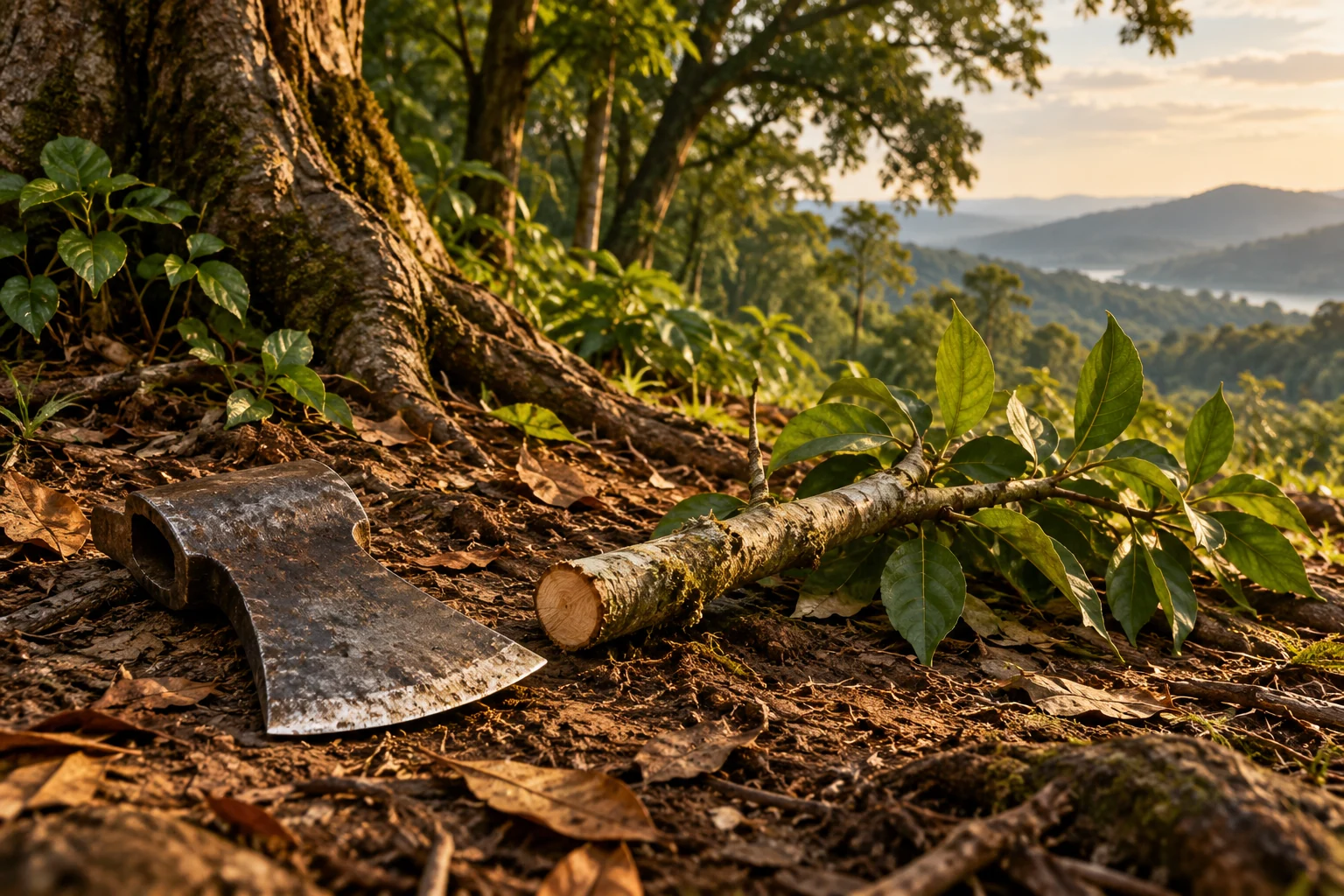
Ogún seeks a branch for an axe that has no handle. Orunmila warns the trees that supplying the missing part will enable their destruction. Several refuse, but majagua provides what he asks, relying on its own strength or moved by his appeal. The finished axe is tested on its benefactor and then used against other trees. A separate ceiba-and-axe account repeats the warning and preserves ceiba because it does not supply the branch.
The tale makes a small contribution decisive within a larger system. Good intention or confidence in one’s own strength does not establish control over what a tool will do after receiving the missing part. Yet the housing need remains in the background, preventing an easy claim that all transformation is illegitimate. The versions disagree over the ceiba’s consequences, which should remain an acknowledged variation rather than an invented harmonization.
Narrative setting: Cuban/Lukumí narrative in the accounts considered here; no individual author established for this passage.
The nursing dog’s received children require a return home
Dog consults while longing for children and asks whether offspring will make its life recognizable on earth. The diviners assure many children, Dog responds, and the verse describes repeated large litters. A striking line says the children can no longer recognize their mother, without supplying an explanatory scene. Celebration and praise follow. The final refrain says a nursing female dog does not stay away from home for long and calls for a return to embrace the child. The introduction likewise permits travel but emphasizes returning soon. No completed journey, abandoned litter, or later punishment is narrated in this unit.
The account does not let the desired good end the question of relationship. The closing return joins received offspring with continuing bodily presence, while the introductory counsel distinguishes travel itself from an absence that lasts too long. Within the religious sequence, consultation and response bring the named good; continued attention is then voiced through the nursing dog’s homeward movement. A contemporary interpretation can consider how receiving a responsibility differs from sustaining it. It should not explain the recognition line by inventing neglect, because the source does not give that causal scene.
Nor does a personified animal precedent establish that human mothers alone must carry every form of care or surrender all mobility. The particular image concerns nursing, return, and embrace. Its religious and poetic form can remain intact while contemporary readers ask how care is shared and what forms of presence a new good requires, without turning the verse into a universal domestic rule.
Narrative witness and setting: Passage explicitly attributed to Ayo Salami, presented with Yoruba verse and Spanish translation; African testimony, not Brazilian provenance inferred from language.
Òpè sègì sègì speaks truth and brings forth sacred descendants
The verse contrasts incessant animal cries with Òpè sègì sègì, identified as the chief truth-teller. Òpè speaks truth and gives birth to Ikin for Alárá, Òdùsò for Ajerò, and Eríwo Osìn for Àjàlá. The account affirms that these declarations are not found false and points to the Ikin now honored throughout the world. Praise returns through diviners to Ifá, and the closing lines call for truthful speech with divine support. The unit does not provide an ordinary human pregnancy story or identify a particular liar whose punishment the reader is asked to observe.
Truth is presented through enduring sacred descendants and reliable declaration, not only through a rule against everyday dishonesty. Ikin’s continuing place in devotion gives the speech a material and communal extension: what is brought forth remains available for religious relations beyond the initial speaker. The other named descendants and recipients should not be erased merely because Ikin is more familiar to readers. A contemporary interpretation can ask how speech becomes dependable through what it sustains, while keeping the verse’s actual sacred births and divine support explicit.
Its comparisons with animal cries do not justify diagnosing mental illness or claiming that repetitive speech makes a person spiritually defective. The supplied translation uses harsh descriptions for those animals, but the positive sequence concerns Òpè’s truthfulness and its enduring consequences. The name should remain as transmitted rather than being silently normalized into a human woman, a botanical species, or another figure whose identity the selected paragraphs do not establish.
Narrative witness and setting: Passage explicitly attributed to Ayo Salami, presented with Yoruba verse and Spanish translation; African testimony, not Brazilian provenance inferred from language.
What was born in this Odù
“Born” can name an explicit traditional origin association or what emerges through a story: a capacity, relationship, practice or order of life. Interpretations drawn from a narrative are labelled below, so their basis remains clear.
Carpentry and tree felling
Selected traditional source association.
The explicit origin joins construction with cutting trees. The selected stories make the relationship costly and interdependent: durable human shelter requires a material transformation that exposes the forest, rather than a creation without consequence.
Durability becomes a measure of shelter
Contemporary interpretation from the selected myth.
As a contemporary interpretation, the collapsed houses generate a distinction between immediate cover and a home that withstands its conditions. This is not a traditional origin of building standards; it frames a question about whose needs a proposed solution actually meets.
Correlations to life dimensions
These questions bring the selected stories into contemporary life. They are interpretive invitations for study.
Work and resources
The axe is ineffective until it receives one ordinary component. The story supports examining the whole operation enabled by a contribution, especially when a request is presented as too small to require scrutiny. The requested branch completes a tool unable to act alone.
Reflect: What can the completed system do that the requesting part cannot do alone?
Relationships and family
Obatalá’s children need homes that endure, while the forest is asked to bear the cost. A responsible reading considers dependents on both sides of a proposed solution instead of making one need erase the other.
Reflect: Who benefits from durability here, and who supplies its material cost?
Character and inner life
Majagua relies on sympathy or presumed superiority when deciding to help. The tale invites reflection on whether a person is assessing the request’s consequences or assuming their intention guarantees a safe outcome. Majagua’s strength does not prevent the finished axe harming it.
Reflect: What consequence have I not examined because I feel strong or generous?
Community and responsibility
The fragile shelters demonstrate why the existence of an intervention is insufficient evidence of success. Communities need to ask how it performs under actual conditions and whether its environmental cost has been openly considered. The housing solution must be assessed through those who inhabit it.
Reflect: What would count as a durable and accountable solution for those who must live with it?
A deeper reading of the sacred relationships
Received life and truthful declaration extend into continuing relations
Dog’s desired children lead into a refrain about returning to nurse and embrace. Òpè’s truthfulness leads into named sacred descendants and Ikin’s continuing devotion. These are different forms of continuity, one voiced through care and the other through reliable sacred speech and its enduring material relation. Both keep the religious sequence active beyond the first favorable result. A contemporary comparison can ask what a received good calls forth afterward, while preserving the particular beings, descendants, and practices named by the sources. Neither account makes continuation an automatic possession. Nor do their favorable claims establish a personal reproductive forecast or a universal rule assigning every responsibility to one member of a household.
Recognition and reliability are not interchangeable
Dog asks for children whose presence will make its life recognized, yet the verse includes the unexplained line about children not recognizing their mother. Òpè’s declarations, by contrast, are explicitly said not to be found false. These details give recognition two different settings: a relation among living dependents and a religiously affirmed reliability of speech. A contemporary lens can ask whether being publicly known is the same as being dependably present, but it should not fill the dog’s unexplained line with a fabricated account of neglect. The evidence supports a question about continuity; it does not give enough narrative to judge a mother’s character or explain every child’s recognition.
The named recipients prevent a generic account of truth
The verse gives Ikin to Alárá, Òdùsò to Ajerò, and Eríwo Osìn to Àjàlá. That distribution matters because truthfulness becomes visible through particular religious relations rather than an abstract claim that honest people simply become prosperous. The dog account likewise names a particular desired good and a particular continuing action. Contemporary ethical reflection can value truthful speech while remembering that the sources are more specific than a moral slogan. A reference should retain unfamiliar names, refrain from supplying unsupported equivalences, and distinguish sacred personification from ordinary biography. Those choices allow the narrative’s religious depth to remain available without requiring invented genealogies or modern scientific explanations for its births.
Questions that deepen the study
Does the dog’s recognition line prove that it neglected its children?
The passage says the children no longer recognize their mother, but does not narrate an absence that causes this or a punishment for neglect. Its closing refrain urges a nursing dog to return home, and the introduction distinguishes travel from staying away too long. Those details support an interpretation about continuing presence, not an invented biography explaining the recognition line. A careful reference can preserve a difficult image without resolving it into blame. The animal precedent also does not assign all human care to mothers or establish that any particular family’s difficulty follows from travel. The source leaves that causal question open.
Is Òpè sègì sègì an ordinary human mother in the selected passage?
The unit gives Òpè a truth-telling role and births that include Ikin and other named sacred descendants. It does not supply the biography or physiological sequence of an ordinary human pregnancy. A responsible summary should preserve that personification rather than invent a domestic history or silently identify a botanical species from outside the selected evidence. The continuing devotion to Ikin is part of the religious claim made by the verse. Contemporary reflection on the consequences of speech can follow, but it should not replace those sacred relations with a purely figurative account in which the named descendants cease to matter.
Why retain Òdùsò and Eríwo Osìn beside the more familiar Ikin?
The source distributes the three named descendants among three named recipients. Omitting two because they are less familiar would falsely make the account concern Ikin alone. The passage does not explain every identity or later practice, so those limits should remain explicit rather than being filled with guesses. Its religious depth lies partly in a network larger than the reader’s existing knowledge. A contemporary reference can explain the demonstrated pattern of truthful speech and enduring relation while retaining unfamiliar terms. It need not establish a complete genealogy or claim that every tradition interprets these names identically to report the local witness accurately.
What the four narratives reveal together
The added Salami units deepen Òtúrúpòn Ika through the continuation of a received good and the enduring consequences of truthful speech. Dog’s numerous offspring lead into a call to return and embrace, while Òpè sègì sègì brings forth named sacred descendants whose relations extend beyond the initial declaration. These accounts add to the earlier inadequate storm-built house and the branch completing an axe by asking what makes a relation workable after its first possibility appears.
Their religious realities remain particular: counsel, response, Ikin’s devotion, named recipients, and divine support are not interchangeable with generic responsibility or honesty. Contemporary questions about presence, recognition, and dependable speech can develop from those scenes while retaining their unresolved features. The dog’s unexplained recognition line, Òpè’s unnormalized identity, and the full set of sacred descendants should remain visible rather than being replaced with a simpler moral plot.
Living with this Odù
A continuing life or initiatory relationship
For someone carrying Òtúrúpòn Ìká through a received life or initiatory relationship, a small contribution can alter a much wider configuration. The branch makes an incomplete axe effective against the very beings asked to supply it. The storm shelters show that obtaining a visible house does not settle durability or the conflict through which materials arrived. The nursing dog's verse adds a different question of return after a desired blessing, without narrating abandonment that can be invented. Òpè's truth then becomes a continuing sacred inheritance rather than a private declaration detached from what it brings into the world.
Over time, character may develop through tracing what a requested part enables and what a completed structure must still support. The inward temptation can include compassion that ignores the new capacity created by a favor, or relief at an initial result that obscures responsibility for return. These witnesses do not require universal suspicion or prescribe a style of construction. Their sacred counsel, truthful speech and honored ikin remain active. Carrying the sign can invite changing questions about enabling conditions, durable care and the relation between what one says, what one supplies and the life that follows from it.
A particular consultation and its question
In consultation, the actual question can distinguish an incomplete instrument, inadequate shelter, ongoing caregiving and speech that creates a durable relation. The axe asks what new capacity a seemingly small request would complete, without making every request for help hostile. The housing account asks whether existence of a structure has been confused with its ability to endure, while retaining the coercive food dispute and storm within that local narrative. The dog verse permits travel and calls for return; it supplies no abandoned litter or later punishment.
Òpè's sacred descendants do not become an ordinary pregnancy account or evidence against an imagined liar. A practitioner should not infer that a client's home will fail or that a beneficiary intends harm. Contemporary reflection can ask what the requested contribution permits, who depends on a return and whether a declaration can be sustained by the relation it establishes. A situational result is not a permanent identity of naïveté. Its religious meaning remains grounded in the actual consultation. The narratives clarify the outer consequences of parts, shelter and speech while preserving the fact that related axe versions disagree about the ceiba's fate.
Constructive and adverse possibilities
Constructive movement can include counsel making an enabling condition visible, a shelter becoming more durable and a caregiver returning to the relation that a received blessing requires. Truthful speech also gains continuing significance through sacred descendants and honored ikin. Adverse movement appears when a small supplied part permits a destructive capacity or the appearance of a completed house hides its fragility. The axe variants' different ceiba outcomes must remain distinct, and the dog verse does not authorize predicting neglect or punishment. Iré and osogbo require the actual religious situation rather than a judgment from the size of a favor or the visibility of a result.
The witnesses ask what a contribution completes and what its completion makes possible for others. Meaningful care concerns the continued relation, not merely the fact that an object, house or desired outcome has arrived.
An illustrative situation in everyday life
Hypothetically, a cooperative is asked to supply a minor technical component to a project advertised as harmless. That component would give an outside operator control over the cooperative's own essential system. Elsewhere, a rapidly built shelter looks complete but cannot support the people depending on it through changing conditions. The branch and storm structures distinguish the size of a contribution from the capacity it enables, and visible completion from durability. The nursing dog's return adds responsibility toward those who need continued presence after an initial benefit. This is an illustrative interpretation, not a prediction of sabotage or structural failure. The inward tension is reluctance to question a modest request. The external task is to understand the completed arrangement before treating the contribution as negligible.
Sources and reading context
The first two narrative witnesses
The selected Cuban-labelled Spanish narratives contain related housing and axe motifs in distinct passages. Tukantukoko and the longer version disagree about the ceiba’s fate, and no reconciliation is invented. Only one explicit origin is listed; ritual procedures and punishment claims are not transferred into practical guidance. Added emergence motifs are explicitly distinguished from traditional origins.
Narrative motifs are summarized independently. The life-dimension reflections are contemporary interpretation. How these reference studies are built explains the wider source approach and the distinction between a reference article and personal divination.
Additional named witnesses
- Ayo Salami. The explicitly named bilingual block supplies the nursing-dog account and Òpè sègì sègì’s truthful sacred births.
The dog unit has a close parallel elsewhere in the compilation, but is present under this exact directional sign. The recognition line has no explicit causal explanation. Òpè’s identity is not supplied through a cross-sign glossary, and the animal comparisons are not clinical descriptions of people.
Bibliographic identification
- Ayo Salami. Ifá: A Complete Divination. Lagos: NIDD, 2002 catalogue record. Library catalogue record. Bibliographic identification of the named author and work; the edition behind the transmitted account remains to be matched.
Read the source method and wider scholarly context.
The catalogue links identify published works and their authors. They are separate from proof of an individual episode’s wording or attribution. Contemporary comparisons and the synthesis above are editorial interpretation. The author’s books and Academy companions below provide further study; their sales links are separate from the source references.