
Ìrẹtẹ̀ Ògbè is a mixed Odù in Ifá’s 256-part corpus. The selected Ìrẹtẹ̀ Ogbè episodes contrast domination through spectacle with resilience through overlooked relationships. A child endangered by divine rivalry is rescued through ancestral power, after which Ọ̀rúnmìlà negotiates reconciliation with Ọ̀sányìn. A separate confinement story gives ants the decisive role in sustaining a ruler whom Death expects to starve. These narratives make power relational and leave a specific ethical question about how former aggressors are reintegrated after harm.
A question to carry through the study: What small, continuing form of assistance is sustaining you more than a dramatic intervention?

This Academy reads the right column first, then the left. Each row carries a single or double mark.
Where this Odù belongs
Ìrẹtẹ̀ Ògbè belongs to the Ìrẹtẹ̀ family in this Academy’s study sequence. It is a mixed Odù, distinct from Ògbè Ìrẹtẹ̀. The order matters. Its teaching is approached through its own narratives, rather than by adding two general descriptions of the principal signs together.
Key Òrìṣà and sacred relationships
The figures below are selected for their roles in the accounts discussed here. They offer connected reading paths through the tradition.
-
Òsanyìn. Ọ̀sányìn and his son intimidate a territory, then threaten Ọ̀rúnmìlà’s lost child; after their own power fails, the story moves toward a negotiated covenant rather than permanent exclusion.
-
Ọ̀rúnmìlà. Ọ̀rúnmìlà seeks his child, assists former aggressors and intercedes for a shared future; in the confinement tale he survives by recognizing the ants’ continuing contribution.
-
Baba Ẹ̀gún. Ancestral power appears through Orun and a rescuing goat representation, freeing the child and disrupting the intimidating authority that had threatened him; this is a particular Cuban configuration.
-
Èṣù. Elegbá’s anger at the father leads him to abandon the child, but he later joins the journey that brings reconciliation; the account includes his harmful conduct as well as mediation.
Key myths and their meanings
A lost child exposes a regime of fear
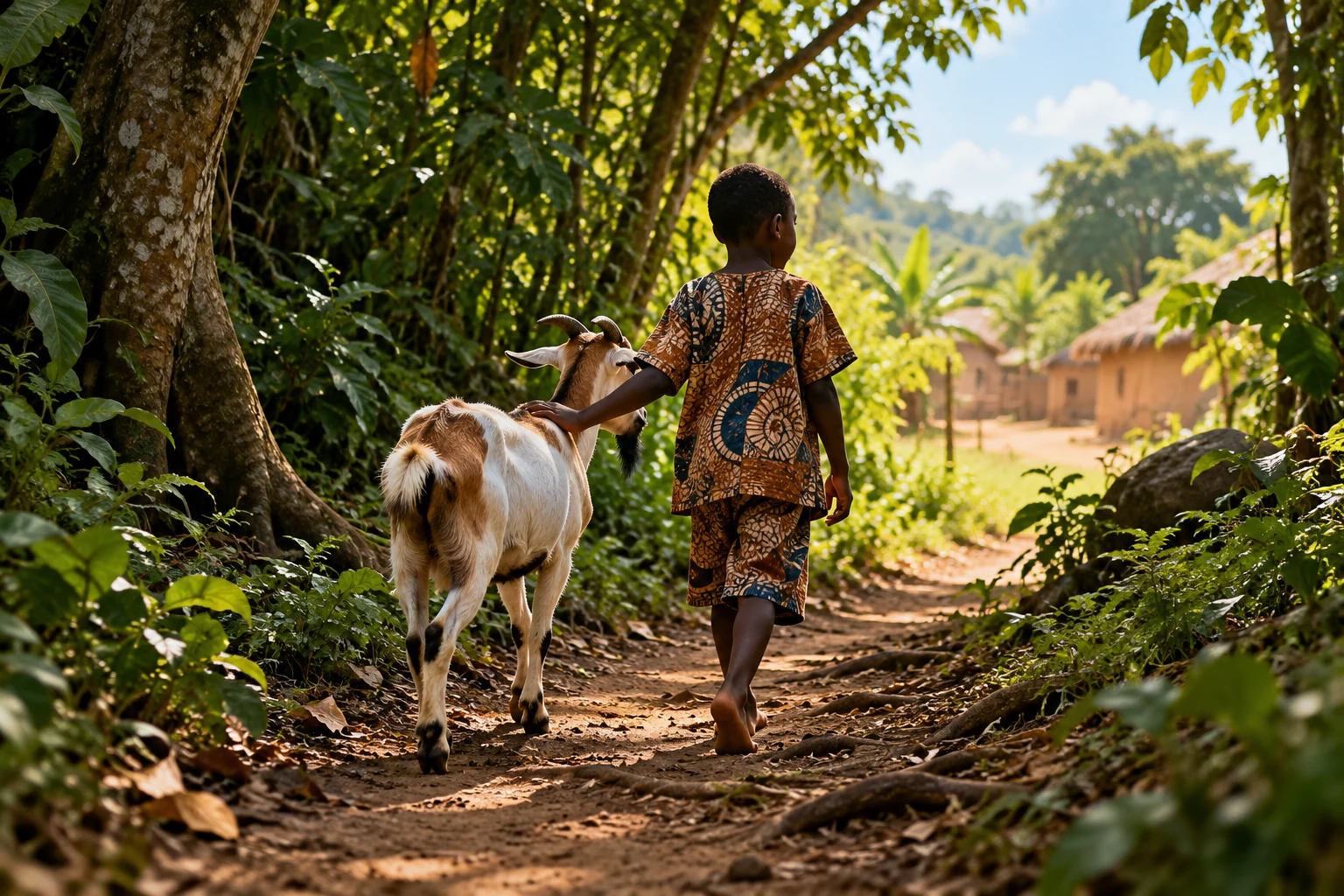
Ọ̀sányìn and his son govern through threatening performances. Elegbá, angry with Ọ̀rúnmìlà, leaves the latter’s child alone in the forest. The child reaches Ọ̀sányìn’s territory and becomes a target of the older rivalry. Ancestral power represented through a goat returns him home and disables the aggressors’ voices. Ọ̀rúnmìlà then participates in their recovery and negotiates a pact that allows continued service through mutual recognition.
The endangered child is not responsible for the conflict that surrounds him. That fact should remain visible rather than turning the plot into a lesson about his obedience. The ending also refuses a simple victory narrative: restoring the aggressors requires new terms and intercession. The difficult question is what accountability the compact contains and whose safety must be secured before reconciliation is praised.
Narrative setting: Cuban compilation, Añaña Inle and Orun episode.
Ants cross the boundary of confinement
Death challenges Ọ̀rúnmìlà’s rule by locking him inside his house and preventing ordinary help from reaching him. The expected outcome is death through deprivation. Inside, Ọ̀rúnmìlà notices ants repeatedly carrying food and takes small portions while allowing them to continue their journeys. Their steady movement sustains him through the imposed interval. When Death returns, the intended proof of helplessness has failed and the challenge is withdrawn.
The survival mechanism is repetition and attention to small agents, not superior physical force. Keeping the ants alive preserves the relationship that makes nourishment possible. The story’s supernatural contest does not guarantee survival in actual confinement; its grounded interpretive value concerns interdependence, resourcefulness and the danger of overlooking assistance because each contribution appears too modest to matter.
Narrative setting: Cuban compilation, Death’s five-day confinement episode.
The rivers return when Olókun’s decline seems final
Olókun lacks water and receives a discouraging consultation declaring that prosperity has ended. Another diviner opens a different possibility through sacred preparation. Even then, birds entrusted to Olókun fly away, and their later reappearance does not immediately resolve his despair. Èṣù summons the rivers and challenges their abandonment of an elder relation in difficulty. Their movement toward Olókun becomes enduring, restoring the sea’s fullness. The returning waters overwhelm the first diviners but spare the later benefactor at Olókun’s insistence. That diviner remains in his household, and the account links material presences in water with remembered assistance.
The episode refuses to equate an apparent setback with the failure of a sacred relation. The birds’ departure occurs after preparation, so the restored condition cannot be recognized simply by checking whether every immediate event looks favorable. Èṣù’s intervention instead reorganizes a network of kin-like waters that had ceased supporting Olókun. The religious logic is both relational and cosmological: the rivers’ direction becomes an enduring order rather than a one-time payment. A contemporary reading can value persistence while avoiding the claim that every negative forecast is malpractice or that optimism guarantees recovery.
The first diviners’ destruction also complicates an otherwise consoling ending. Compared with the earlier ants sustaining a confined ruler, continuity comes through many small or dispersed contributions. Compared with the ancestral rescue from Ọ̀sányìn’s territory, a beneficiary explicitly protects the person who helped him. The account makes gratitude effective within restoration, without establishing that every restored power uses its new abundance equally mercifully.
Narrative witness and setting: Portuguese African narrative in the section explicitly credited to Cromwell Osamaro.
A royal friend borrows the bird and refuses its return
The rulers of Owo and Benin receive counsel before their fortunes diverge. The Olowo follows it and discovers a speaking bird, whose instructions establish a private relation producing wealth. Benin’s ruler notices the change, investigates and visits. Invoking a friendship supposedly beyond ordinary restrictions, he persuades the host to reveal the source and lend the bird. The borrower then refuses to return it, and the dispute becomes a threat of war. Further divinatory preparation frames the coming conflict through an appeal about who has wronged whom. Owo’s forces prevail in the account, but the bird dies during the struggle.
The decisive pressure comes from a claimed exception to the boundary: the visitor insists that friendship means he should not count as anyone from whom the source must remain private. The host accepts that interpretation and then relinquishes control over a living relation that cannot be reduced to an interchangeable asset. Sacred knowledge and the bird’s own instructions establish its efficacy, while later preparation gives the conflict a further religious frame. The ending is not a clean recovery of what was lent.
Victory destroys the very being through which wealth had arrived, leaving the meaning of restored possession unresolved. A contemporary reference can examine trust, disclosure and proportionality without turning the source’s broad warning against lending into universal financial advice. Compared with the earlier hostile captivity, the danger here enters through an intimate visitor. Compared with the rivers’ return, abundance is not renewed through a restored network but lost within a contest over exclusive control.
Narrative witness and setting: Portuguese African narrative credited to Cromwell Osamaro, naming Owo and Benin within a sacred wealth and conflict account.
What was born in this Odù
“Born” can name an explicit traditional origin association or what emerges through a story: a capacity, relationship, practice or order of life. Interpretations drawn from a narrative are labelled below, so their basis remains clear.
The power of Egún and Ifá
Selected traditional source association.
The origin list explicitly associates the sign with the combined significance of Egún and Ifá. The rescue and reconciliation episode develops that relationship locally; it should not be expanded into a claim that every lineage organizes these powers identically.
Olókun’s vessel
Selected traditional source association.
The list associates Olókun with dwelling in a jar. This is a concrete object association, useful for identifying a local religious form while withholding preparation details and avoiding the assumption that all representations of Olókun share the same vessel.
A bell sounded for Obatalá
Selected traditional source association.
The origin entry names an agogo relationship to Obatalá. It establishes an association with sound and address, but the selected narratives do not explain its wider history or justify a universal ceremonial prescription.
Correlations to life dimensions
These questions bring the selected stories into contemporary life. They are interpretive invitations for study.
Relationships and family
The child is exposed through an adult’s resentment toward another adult. That displacement of conflict is specific and serious. The recovery narrative supports asking how children can be protected from rivalries rather than recruited as messengers, leverage or evidence of someone’s power.
Reflect: Where might a child be carrying the consequences of an adult disagreement?
Community and responsibility
Ọ̀rúnmìlà’s intercession lets former aggressors continue serving under a new compact. The unresolved task is ensuring that reconciliation changes conduct and protects those previously frightened, rather than merely restoring the influential actors to their old positions.
Reflect: What changed term would make reconciliation safer for people with less power?
Work and resources
The ants’ contributions are individually small but recurrent. The story supports examining supply over time and preserving its source, instead of treating a resource as a one-time object to be exhausted. Survival rests on continuity as well as quantity.
Reflect: Which small supply must remain renewable for your work to continue?
Character and inner life
Noticing the ants requires turning attention away from the overwhelming threat at the door. This offers an image of resourceful observation under pressure without blaming people who cannot find a route out of real deprivation or coercion.
Reflect: What ordinary process becomes visible when you pause your attention to the largest threat?
A deeper reading of the sacred relationships
Abundance is sustained through particular living relations
Olókun’s fullness comes through rivers whose connection to him is spiritually reactivated by Èṣù. The Olowo’s wealth comes through a speaking bird and the relation its instructions establish. Neither is simply a store that remains productive regardless of how it is addressed. The earlier ants also sustain life through continuing movement, while the ancestral rescue depends on a power that intervenes and later negotiates a compact. These witnesses make abundance and protection dynamic relationships among living, material and divine agents. A contemporary discussion of resource stewardship may illuminate them, but should not reduce their efficacy to economics or make a bird, river and ancestral presence interchangeable symbols of the same process.
The relation of help continues after the immediate rescue
Olókun stops the waters from sweeping away his benefactor and invites him to remain. Ọ̀rúnmìlà intercedes after the rescue of his child to establish a changed compact with the former aggressors. The ants must remain alive for their small deliveries to continue. The borrowed bird is denied a return and finally dies in conflict. These endings distinguish protection of a helper, reconciliation, preservation of a supply and destruction of a source. A contemporary interpretation can ask what a beneficiary owes after relief, while recognizing that the accounts locate those obligations within different sacred relationships. Gratitude is therefore not adequately described as a feeling voiced after an outcome; it changes what happens next.
Different pressures can make a boundary appear dispensable
The Olowo yields because the visitor claims a privileged friendship. The earlier child is exposed when an adult’s anger toward his father overrides care. Olókun nearly accepts a final declaration because diminished circumstances make it convincing. The confined ruler faces a boundary intended to exclude every ordinary source of assistance. These pressures differ: intimacy, resentment, despair and coercion. A reference can compare how each narrows attention without supplying one universal warning to distrust relationships. Sacred mediation opens different responses, from a changed route of waters to an overlooked stream of food. The question is which relation actually authorizes an action and what continuing need a seemingly small exception can compromise.
Questions that deepen the study
Why do the birds’ departures not prove the consultation failed?
The account places their departure inside a larger sacred sequence whose decisive movement has not yet become visible. Èṣù later calls the rivers into a renewed relation with Olókun, and their return establishes the sea’s fullness. The narrative therefore distinguishes immediate discouragement from the eventual efficacy of preparation. A contemporary reading can discuss patience without promising that every setback conceals success. The source supplies a particular cosmic explanation, and its benefactor receives protection only within that story’s unfolding relations. It does not authorize dismissing evidence of an actual failing intervention merely because a favorable outcome might still be imagined.
Is Owo’s military victory the same as recovery of the bird?
No. The source explicitly ends the confrontation with the bird’s death. The forces prevail, but the living source of the original prosperity is not restored to its previous relation. That distinction is central to interpreting the story rather than an incidental cost to omit. Within the religious account, further preparation frames the contest through an appeal about wrongdoing; a contemporary analysis can then ask whether winning a claim has destroyed the condition that made it valuable. The episode is not verified dynastic history, nor does it supply a general rule that every dispute over a loan deserves escalation.
What connects the rivers’ return with the earlier ants?
Both sustain a vulnerable figure through movement from beyond an imposed or experienced lack. The ants make modest repeated deliveries across a boundary; the rivers are summoned into an enduring cosmic relation with the sea. Their scale and religious mechanisms differ, but neither outcome comes from the principal actor’s isolated strength. The comparison supports attention to continuity and to the beings whose contributions are easily overlooked. It should not reduce Èṣù’s calling of the rivers to ordinary logistics or treat the ants as merely an abstract lesson: each account gives its particular agents an effective part in the event.
What the four narratives reveal together
The African-attributed additions turn the earlier Cuban focus on rescue and small helpers toward the maintenance of abundance. Olókun’s restoration becomes a renewed cosmic connection among waters, while the borrowed bird reveals how a living source of prosperity can be lost even when a dispute is won. The earlier ants sustain a confined ruler through continuing deliveries, and the ancestral rescue opens a compact rather than a simple destruction of the opponent.
Across the witnesses, help remains a relation after its first benefit appears. Divine mediation, ancestral agency and the capacities of small creatures are active realities in those relations. Contemporary questions about gratitude, boundaries and proportionality can deepen the comparison, but should preserve the difference between restoring a network, protecting a benefactor and destroying a source through conflict. None of the endings supports treating material victory as a complete account of repair.
Living with this Odù
A continuing life or initiatory relationship
A received life or initiatory relation with Ìrẹtẹ̀ Ògbè can invite sustained attention to the networks that keep a person or institution alive. Ants supply small repeated contributions under confinement, and Olókun's restoration comes through dispersed rivers returning to an elder relation. Neither story makes self sufficiency the condition of dignity. Across changing circumstances, a bearer can ask what help has been overlooked because it appears modest and what bonds have been allowed to lapse when a once powerful participant becomes vulnerable. The child's rescue exposes rivalry imposed on someone who did not create it, while the borrowed bird shows intimacy being used to demand an exception to a protective boundary.
These are distinct dangers, not evidence that every outsider or friend is unsafe. Ancestral power, Èṣù's interventions and the bird's own instructions retain their religious agency. Contemporary inner development can examine gratitude, care and the wish to prove independence without assuming that every immediate setback means a relation has failed. The endings also resist uncomplicated victory: restored aggressors need new terms, the first diviners are overwhelmed and the speaking bird dies during the conflict. Beneficial standing for one figure leaves further responsibilities and losses to be considered.
A particular consultation and its question
In consultation, Ìrẹtẹ̀ Ògbè can help distinguish hostile restriction, neglected support and an intimate breach of trust. Ọ̀rúnmìlà's confinement is an imposed condition, not a failure to think positively. Olókun's birds depart after preparation, so immediate appearance does not settle whether the religious relation is effective. The royal visitor instead invokes friendship to obtain access that later becomes refusal to return a living source of wealth. A practitioner can ask what kind of help is possible, who has been abandoned and whether an exception is being claimed without accountability.
The child's safety must also remain separate from the older powers' desire for reconciliation; a pact is not enough merely because influential adults agree. These distinctions require the actual question and result, not a prediction about an unknown client's enemies or resources. Religious causation remains explicit, including ancestral rescue and Èṣù's summons to the rivers. Encountering the sign once does not establish a permanent life identity. Its reflective value is to examine how interdependence operates under pressure and whether the proposed recovery preserves the relationships and living beings that made recovery meaningful, rather than counting victory while losing its very source.
Constructive and adverse possibilities
Constructive unfolding may involve noticing small sustaining agents, recalling dispersed obligations and protecting a benefactor within restored abundance. Olókun's insistence on sparing the helpful diviner makes gratitude consequential rather than merely spoken. Adverse unfolding includes abandoning a vulnerable relation, belittling contributions or using friendship to erase a boundary before refusing restitution. The bird's death prevents the military success from being called complete recovery. Actual iré or òṣogbo must remain tied to the consultation. Neither the ants' persistence nor the rivers' return promises survival in actual confinement or recovery after every discouraging forecast.
Sacred efficacy remains operative while contemporary interpretation asks about proportionality and bystanders: the first diviners' destruction and the endangered child cannot disappear behind restored principal figures. A favorable change becomes more exact when one asks what has been sustained, what has been damaged and whether the new compact contains real conditions for safety.
An illustrative situation in everyday life
In a hypothetical community institution, a once influential elder loses support while modest volunteers quietly keep essential services moving. An intimate ally asks to borrow the project's unique living collection, insisting friendship makes formal restrictions unnecessary, then refuses its return. The resulting campaign wins recognition but damages the collection itself. The narratives distinguish sustaining contributions, neglected bonds, pressured exceptions and victory that destroys the benefit contested. An organizer may feel that needing small helpers is humiliating, yet those helpers are already maintaining the work. This is a contemporary illustration, not a promise that unseen assistance always arrives. Its practical question is how restoration can protect both vulnerable participants and the relationships supporting them, rather than making an influential person's recovered status the only measure of the outcome.
Sources and reading context
The first two narrative witnesses
The card uses the Cuban compilation, including its Orun representation. Orun and Egún are described contextually without merging all ancestral traditions. No claim is made that confinement, illness or spiritual rivalry can be resolved by the story’s methods. Origin entries are associations, not universal historical beginnings.
Narrative motifs are summarized independently. The life-dimension reflections are contemporary interpretation. How these reference studies are built explains the wider source approach and the distinction between a reference article and personal divination.
Additional named witnesses
- Cromwell Osamaro. The named African section supplies Olókun’s declining fortune and the sacred speaking-bird account of Owo and Benin.
The Olókun material has an adjacent alternate version, but the selected motif follows the first rivers-return account rather than blending both. Portuguese mistranslations obscure some material names. Owo and Benin are narrative settings here, not verified historical claims. The bird’s death and the first diviners’ destruction remain unresolved costs rather than being erased from fortunate endings.
Bibliographic identification
- C. Osamaro Ibie. Ifism: The Complete Work of Orunmila. Lagos; multivolume publication beginning 1986. Library catalogue record. Related bibliographic record for the named narrative witness. Exact volume, edition and page of the transmitted account have not been independently matched.
Read the source method and wider scholarly context.
The catalogue links identify published works and their authors. They are separate from proof of an individual episode’s wording or attribution. Contemporary comparisons and the synthesis above are editorial interpretation. The author’s books and Academy companions below provide further study; their sales links are separate from the source references.