
Ìròsùn Ògúndá is a mixed Odù in Ifá’s 256-part corpus. Ìrosùn Ògúndá’s selected narratives contrast the unstable effects of wine with a collective effort to win freedom. Obatalá plants grapes for his children’s joy, but Alosi’s intervention gives the drink an escalating animal imagery of changed conduct. In another account, Arará people held by Ṣàngó consult and use drumming to change the terms of their labor. The pairing places pleasure inside questions of control, consent, and who benefits from a performance.
A question to carry through the study: When does another person’s enjoyment begin to depend on your lack of freedom?

This Academy reads the right column first, then the left. Each row carries a single or double mark.
Where this Odù belongs
Ìròsùn Ògúndá belongs to the Ìròsùn family in this Academy’s study sequence. It is a mixed Odù, distinct from Ògúndá Ìròsùn. The order matters. Its teaching is approached through its own narratives, rather than by adding two general descriptions of the principal signs together.
Key Òrìṣà and sacred relationships
The figures below are selected for their roles in the accounts discussed here. They offer connected reading paths through the tradition.
-
Obàtálá. Obatalá plants grapes intending to bring his children joy, then becomes apprehensive about what Alosi’s intervention will make the drink do. Intention and consequence are deliberately separated.
-
Ṣàngó. Ṣàngó rules over Arará servants and enslaved people in the selected story. Their drumming persuades him to free them so the performance can continue, exposing his dependence on their contribution.
-
Ọ̀rúnmìlà. Òrúnmìlà receives the enslaved Arará people and offers counsel before their collective musical action. His role is tied to that particular narrated effort toward freedom.
Key myths and their meanings
A drink changes the drinker
Obatalá cultivates grapes to gladden his children. Alosi offers help but intervenes at the roots using several animals. The resulting wine is described through their changing qualities: gentle at first, then forceful, and finally uncontrolled or ridiculous as consumption grows. Obatalá’s original wish for pleasure remains present, but the product carries effects he had not intended when planting it.
The animals give the account a memorable scale of changing conduct without providing a scientific theory of alcohol. The central distinction is between a beneficial intention and an outcome that changes with use and quantity. A careful reading can discuss restraint and responsibility while avoiding the suggestion that animal comparisons explain an actual person’s behavior or that all drinkers follow a fixed sequence.
Narrative setting: Account explicitly labeled Cuba.
The drumming that wins freedom
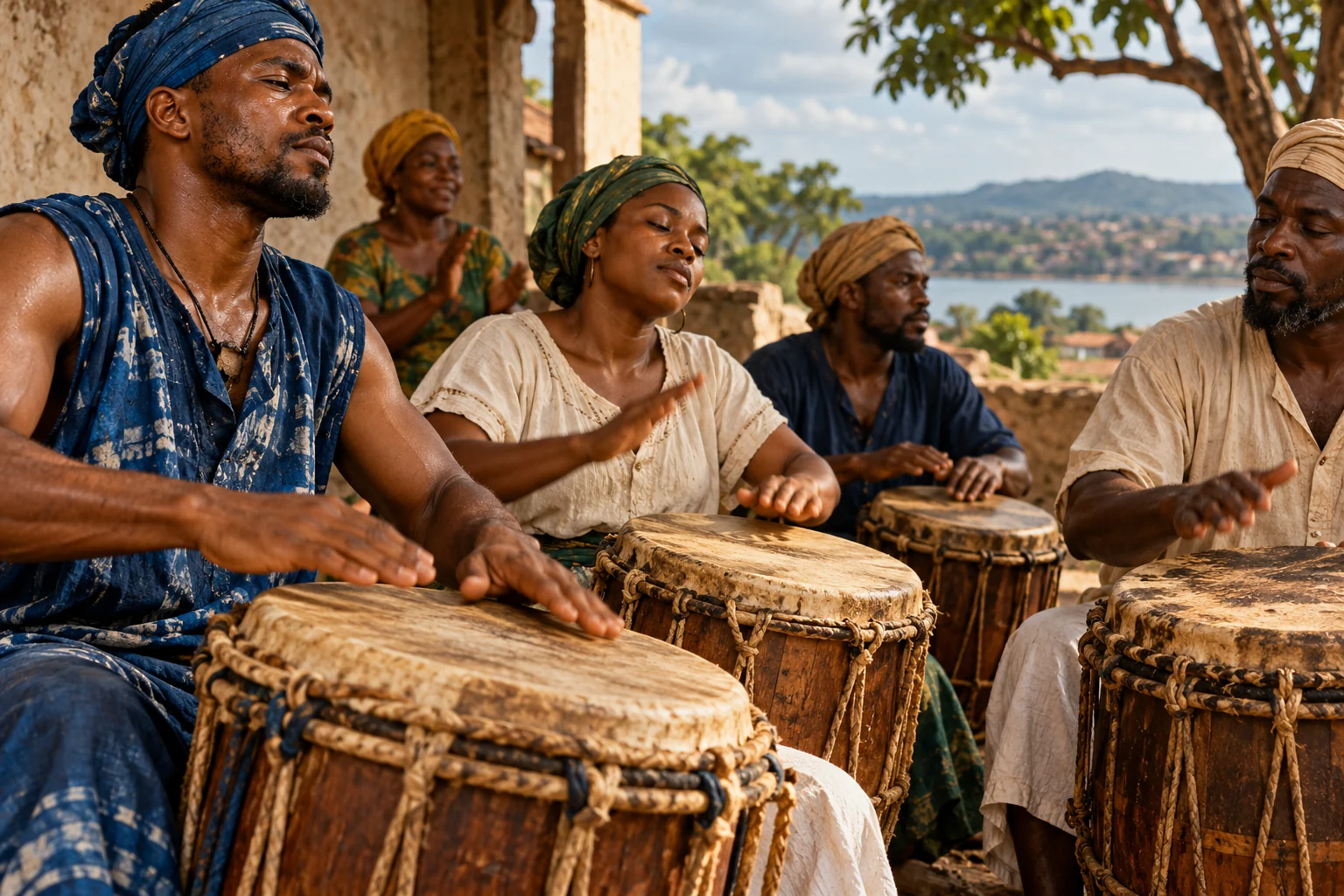
Ṣàngó rules in Dahomey and holds Arará people as servants and slaves. They seek Òrúnmìlà’s counsel and then begin drumming together. Ṣàngó leaves his throne to dance. While they play, the performers insist that they cannot work. Wanting the music to continue, he grants freedom to all of them. Their valued collective contribution becomes leverage against the labor arrangement that confines them.
The story locates leverage among people denied formal power. Their shared action matters because the ruler wants something only they provide. Yet freedom granted to preserve a ruler’s pleasure remains conditional in its narrated motive, even if the outcome is emancipation. The account can support reflection on collective bargaining without claiming historical documentation for an actual liberation event or romanticizing slavery as a benign dependency.
Narrative setting: Short Spanish Arará/Dahomey account.
A heavenly benefactor cannot enter earth without receiving help
A successful heavenly diviner decides to follow his colleagues to earth. God and his guardian warn that blessing does not replace consultation and the responsibilities of the journey. He leaves without completing them or carrying food for those he meets. Several powers request acknowledgment and receive none. On earth his work and family life deteriorate. In a forest crisis, Èṣù lets him experience a vision of the prosperous life he has missed, then returns him to difficulty. His guardian finally supplies what he lacks for an addressed response. He returns to consultation and initiation, after which the account gives him a more settled earthly life.
The protagonist has repeatedly assisted others but treats his own passage as though expertise and divine favor make further dependence unnecessary. The witness insists that a life is situated among powers encountered along the route, not only in the blessing received at its beginning. The forest vision is therefore more than a psychological fantasy of success: Èṣù controls what is disclosed and withdrawn, while the guardian remains capable of supplying help when the protagonist can no longer do so alone.
This religious logic should not become an explanation of actual poverty or grief as chosen spiritual fault. The earlier wine narrative similarly separates a good intention from what later happens through another power’s intervention. The Arará freedom story adds a contrasting relation in which people denied authority still act together to change their position. These differences allow a study to discuss dependence without equating it with helplessness or requiring every hardship to disclose the same neglected exchange.
Narrative witness and setting: Account explicitly headed Revelações de Cromwell Osamaro
Eyin-uwa’s independent prosperity becomes an unexpected inheritance
Aiye, identified by the source with the world, receives Òrúnmìlà’s assistance and later leaves property to three children. Eyin-uwa, a senior person held in her service, has already moved near the sea. When the children refuse the earlier helper a share, they assign him Eyin-uwa without knowing where he is. Òrúnmìlà consults and attends to his head by a road. A passing procession hears Eyin-uwa’s name in his prayer. Eyin-uwa recognizes the practitioner, descends from his horse, and offers the wealth he has independently accumulated. The intended empty allocation becomes a substantial gain through recognition and renewed relation.
The episode combines sacred inheritance with a social order that treats a person as transferable property. Both should remain visible. Eyin-uwa’s independent prosperity and act of recognition give him agency, yet they do not make the underlying enslavement ethically unproblematic. Within the religious account, Òrúnmìlà’s consultation, attention to his head, and Èṣù’s cooperation bring an unknown location into a meaningful encounter. The roadside prayer is not just a convenient announcement, because it follows a particular sacred response. Read beside the earlier Arará emancipation, the witness creates a real tension: one story narrates people obtaining freedom, while this one makes an inherited claim the route to a benefactor’s gain.
The two should not be artificially reconciled into one doctrine about labor. The wine account adds another example of an intended benefit acquiring consequences through a second agent. Contemporary interpretation can ask who controls a resource and whose contribution is recognized, while preserving Aiye’s personification and the spiritually consequential meeting.
Narrative witness and setting: Account explicitly headed Revelações de Cromwell Osamaro
What was born in this Odù
“Born” can name an explicit traditional origin association or what emerges through a story: a capacity, relationship, practice or order of life. Interpretations drawn from a narrative are labelled below, so their basis remains clear.
Grape harvest
Selected traditional source association.
The explicit origin list names the gathering of grapes for wine. This ties cultivated pleasure to agricultural labor in the source, without claiming a universal association or a historical origin for viticulture.
Jammed firearms
Selected traditional source association.
The origin list names the jamming of firearms. It provides a local image of force interrupted, but no operating explanation, method, or promise that a dangerous weapon will fail is warranted.
Correlations to life dimensions
These questions bring the selected stories into contemporary life. They are interpretive invitations for study.
Work and resources
The Arará performers use a contribution the ruler values to challenge compulsory labor. Their leverage is collective, making coordination and a shared statement of limits more consequential than an isolated request for favor. The music makes their shared refusal directly audible.
Reflect: What contribution gives a group legitimate negotiating power?
Relationships and family
Obatalá’s gift for his children changes through another person’s intervention. The account asks whether good intentions include continuing attention to effects, especially where a gift can alter the recipient’s judgment or capacity to choose. The later consequences exceed the original planter’s hopes.
Reflect: How do you learn whether a well-meant gift is actually helping?
Character and inner life
Wine’s changing imagery makes use and excess different questions. The narrative can support attention to the point at which sought pleasure changes conduct, without reducing a person to a moral type or treating shame as a reliable guide to care.
Reflect: What sign tells you that enjoyment is beginning to cost too much?
Community and responsibility
The liberation story names Arará and Dahomey in a Cuban compilation. Its ethical discussion should retain the enslaved people’s agency and collective demand, instead of allowing Ṣàngó’s eventual enjoyment to become the center of their freedom.
Reflect: Whose agency should lead the account of a successful change?
A deeper reading of the sacred relationships
A blessing does not erase relationships along the route
The heavenly diviner receives God’s blessing but is still told to attend to consultation, his guardian, and the powers he will meet. The inheritance episode likewise reaches fulfillment through Òrúnmìlà’s head and Èṣù’s cooperation rather than through a legal allocation alone. These accounts present spiritual responsibility as situated and continuing, not a single endorsement that makes every later relation unnecessary. The earlier wine and Arará stories name different powers and obligations, so their actions cannot simply be substituted for this route. Contemporary reflection can ask how experience coexists with receiving help, but should not convert the witness into a rule that actual suffering proves someone failed to recognize the right being before birth.
An unwanted allocation can conceal another person’s history
Aiye’s children treat Eyin-uwa as an empty share because they cannot locate him. The meeting reveals a history of independent prosperity they have not considered. This differs from the Arará performers, whose valued musical work becomes leverage toward freedom, and from the heavenly expert whose remembered self-sufficiency obscures the help he needs. In each, a person’s visible position fails to contain the whole account of their capacity. The source’s inheritance claim still belongs to an enslaving order, so discovery of wealth should not be made a moral vindication of ownership. Contemporary interpretation can instead hold agency and domination together, asking what becomes invisible when a person is described only as someone else’s resource.
A second agent changes the meaning of an intended benefit
Obatalá plants grapes for joy, but Alosi changes what their drink will do. The Arará performers give Ṣàngó pleasure while using the performance to alter their own status. Aiye’s children intend an unhelpful allocation, yet Eyin-uwa’s recognition changes its outcome. The heavenly diviner also receives a vision whose disclosure and withdrawal are governed by Èṣù rather than by his own intention. These are different religious and social mechanisms, not a single theory of unintended consequence. Their comparison nevertheless helps an editor avoid treating a protagonist’s stated aim as the whole moral or spiritual meaning of an act. Other powers and people retain agency, and that agency may enlarge, redirect, or expose the original plan.
Questions that deepen the study
Why is the successful heavenly expert still required to consult?
The source distinguishes helping others within one setting from entering another life among different powers and conditions. His knowledge and God’s blessing are real in the account, but they do not replace responsibilities to a guardian, Èṣù, or those encountered on the way. This makes consultation a relation rather than an admission that he knows nothing. The eventual help supplied by his guardian also shows dependence continuing after refusal. A contemporary reader can reflect on expertise with limits, while the prebirth causality remains specific to the sacred narrative. It should not become a method for blaming someone’s poverty, child loss, or distress on an imagined decision they cannot remember.
How can Eyin-uwa’s agency be retained without approving enslavement?
The account clearly gives him a life beyond the household’s knowledge: he moves, prospers, travels with a following, and recognizes Òrúnmìlà on his own initiative. Those actions should not be erased by describing him only as an inherited object. Equally, his generosity does not make the allocation of a person as property ethically harmless. The earlier Arará narrative provides an internal comparison in which collective action wins release from enslavement. A careful study can preserve both witnesses and their tension rather than invent a single historical doctrine. The religious meeting remains meaningful while the social order in which its reward is narrated remains open to scrutiny.
Is the vision of prosperity merely a promise that suffering will end?
No. In the account, the vision is controlled by Èṣù and is withdrawn before the protagonist is directed toward a renewed religious response. It exposes what has not become his earthly condition, rather than guaranteeing that imagining it will produce it. The later settlement follows further help, consultation, and initiation. A contemporary comparison with hope may be useful, but should not replace the active powers or treat the forest crisis as a desirable spiritual exercise. The witness gives a demanding narrative of dependence and change, not a general timetable for hardship or an instruction to seek an extreme experience in order to obtain insight.
What the four narratives reveal together
The additions give Ìrosùn Ògúndá a more difficult account of benefaction and dependence. A heavenly expert cannot make his own passage fruitful by relying on prior success, while Eyin-uwa’s independent life changes an allocation meant to deprive Òrúnmìlà of a useful inheritance. These episodes sit beside wine’s altered effects and Arará liberation without becoming one simple prosperity sequence. The powers and relations remain specific: divine blessing, guardian aid, Èṣù’s disclosure, attention to the head, and a roadside recognition each do work within the religious world.
Contemporary questions about ownership and omitted labor can be added without dissolving that theology. The stories also preserve a genuine tension around enslavement rather than settling it through a single favorable outcome. Depth comes from hearing the distinct agencies that redirect an intention, including those of people whom the source’s social order describes as transferable possessions.
Living with this Odù
A continuing life or initiatory relationship
For someone carrying Ìròsùn Ògúndá within a received spiritual history, a benefit may contain conditions its originator did not intend. Obatalá’s cultivation begins as a wish for pleasure, while Alosi’s intervention changes the drink’s effects as consumption develops. The Arará drummers face a different condition: enslavement and compelled service, whose injustice cannot be reduced to poor reciprocity. Their collective music becomes leverage for freedom rather than proof that domination was a legitimate bargain.
The heavenly diviner’s failed passage adds the distinction between having blessed others and being prepared to receive help oneself. Eyin-uwa’s independently accumulated prosperity then exposes the error of treating a person as an empty inherited allocation. His recognition of Òrúnmìlà is an act of agency within a relation that the children misjudge. Across a life, reflection may concern measured pleasure, collective capacity, the obligations of passage, or another person’s independent life beyond an imposed status. The sign does not promise reward for service or condemn those who cannot secure freedom through skill. It invites character able to examine what a desired benefit actually contains and to receive assistance without claiming ownership of the person who gives it.
A particular consultation and its question
In consultation, Ìròsùn Ògúndá can help distinguish enjoyment requiring measure from a structure requiring liberation. Obatalá’s wine changes the drinker through increasing consumption; the Arará account begins with people held as servants and slaves. Treating both as a simple matter of balance would erase unequal freedom. The actual question must establish whether the client is choosing a pleasure, negotiating a dependency, or confronting a condition in which consent is constrained.
The heavenly practitioner adds a configuration where prior blessing is mistaken for readiness, although God and the guardian direct attention toward consultation and journey responsibilities. Eyin-uwa’s later recognition introduces help arising from an independent life that others have ignored. Neither story guarantees a reversal of fortunes. A practitioner can examine what preparation has been assumed unnecessary, whose agency has been obscured, and whether the client’s account of benefit leaves another person’s condition unheard. The religious relations remain consequential in their specific narratives. Consultation does not identify Alosi in a present household, prescribe consumption, or make the sign a permanent identity of excess or liberation. It offers situated distinctions through which the actual result can be considered more truthfully.
Constructive and adverse possibilities
Constructive unfolding may include pleasure that remains proportionate to its effects, collective action that changes an unjust condition, and receiving help without reducing its giver to a dependent role. The Arará drummers’ freedom remains a release from domination, not a reward that makes their earlier enslavement morally acceptable.
Adverse unfolding can involve a product’s altered effects ignored, blessing treated as immunity from preparation, or inheritance spoken of as though another person’s independent agency did not exist. The heavenly guardian’s assistance retains religious force, while Eyin-uwa’s generosity belongs to recognition rather than ownership. These contrasts do not make every useful skill a route out of coercion or promise that an apparently empty gain will reveal wealth. They identify relationships through which benefit can widen freedom or conceal dependence, without determining an actual reading’s condition.
An illustrative situation in everyday life
In a hypothetical example, members of a cultural ensemble are tied to an organizer through obligations they cannot freely leave. Their growing public importance gives them a chance to demand genuine control of their work. The Arará drumming account helps distinguish liberation from merely receiving better praise within the same domination. Eyin-uwa’s independent prosperity adds the importance of seeing lives beyond the status others assign. Some members fear that asserting freedom will appear ungrateful, while the organizer calls their success proof of benevolent control. The narrative comparison asks whose choice has actually expanded. This illustration neither equates all employment with enslavement nor offers a guaranteed tactic; it preserves the structural question of freedom rather than converting coercion into ordinary reciprocity.
Sources and reading context
The first two narrative witnesses
The wine narrative is labeled Cuban; the liberation account names Arará and Dahomey within its sacred history. These details do not authenticate a historical event. Alosi is retained as named and is not assigned an unsupported figure key.
Narrative motifs are summarized independently. The life-dimension reflections are contemporary interpretation. How these reference studies are built explains the wider source approach and the distinction between a reference article and personal divination.
Additional named witnesses
-
Cromwell Osamaro. The explicit heading covers the heavenly diviner’s difficult earthly arrival and Aiye/Eyin-uwa inheritance.
-
Cuban/Arará sequence. The earlier wine account is marked Cuba and the emancipation account names Arará and Dahomey.
The translation contains harsh causal claims about grief and poverty, which are not generalized. Eyin-uwa’s status is reported without endorsing enslavement. The forest crisis is summarized without self-harm detail, and no visionary exercise or ritual prescription is offered.
Bibliographic identification
- C. Osamaro Ibie. Ifism: The Complete Work of Orunmila. Lagos; multivolume publication beginning 1986. Library catalogue record. Related bibliographic record for the named narrative witness. Exact volume, edition and page of the transmitted account have not been independently matched.
Read the source method and wider scholarly context.
The catalogue links identify published works and their authors. They are separate from proof of an individual episode’s wording or attribution. Contemporary comparisons and the synthesis above are editorial interpretation. The author’s books and Academy companions below provide further study; their sales links are separate from the source references.