
Ìròsùn Òsá is a mixed Odù in Ifá’s 256-part corpus. Ìrosùn Òsá’s selected narratives examine force from the position of those who gain it and those caught near it. Eleguá begins without weapons or followers and accumulates both through conflict. Òrúnmìlà, visiting a debtor’s house, must calm Ṣàngó’s indiscriminate anger by appearing as Obatalá. The pairing leaves a distinction between acquiring power and making its use accountable, especially when a dispute begins to include people who did not create it.
A question to carry through the study: Who is exposed to a conflict even though they have no part in its debt?

This Academy reads the right column first, then the left. Each row carries a single or double mark.
Where this Odù belongs
Ìròsùn Òsá belongs to the Ìròsùn family in this Academy’s study sequence. It is a mixed Odù, distinct from Òsá Ìròsùn. The order matters. Its teaching is approached through its own narratives, rather than by adding two general descriptions of the principal signs together.
Key Òrìṣà and sacred relationships
The figures below are selected for their roles in the accounts discussed here. They offer connected reading paths through the tradition.
-
Èṣù. Eleguá is the initially weaker participant whose growing capacity attracts followers. The story makes support responsive to visible power, rather than presenting a community already united around an agreed principle.
-
Ọ̀rúnmìlà. Òrúnmìlà advises Eleguá in one account and becomes an endangered visitor in the other, using Obatalá’s appearance to stop Ṣàngó from harming people at an exit.
-
Ṣàngó. Ṣàngó attempts to collect a debt through fire and threatened violence. The account explicitly makes a visitor vulnerable, so his anger remains open to criticism despite its religious setting.
-
Obàtálá. Obatalá’s mask carries enough authority to interrupt Ṣàngó’s attack. He is represented through borrowed appearance, not personally described as arriving in the selected scene.
Key myths and their meanings
The gathering around growing force
Eleguá is dissatisfied with Ògún but lacks the arms and followers needed for conflict. After consultation, he uses his surroundings to defeat better-armed opponents and takes their weapons. As his capacity becomes visible, people begin joining him. The narrative explains the growth of an armed following through a sequence in which material advantage attracts social support.
The sequence makes popularity an uncertain measure of justice: people join after power becomes evident, not after the account establishes a shared ethical cause. A responsible reading keeps the military method abstract and does not translate it into advice. The central question concerns how a community distinguishes protection from opportunistic alignment with whoever appears likely to win.
Narrative setting: Account explicitly labeled Cuba.
The visitor behind the debtor’s door
A household owes Ṣàngó a religious debt. He sets it on fire and waits outside ready to attack anyone emerging. Òrúnmìlà has been visiting and is also trapped. Seeing the danger, he puts on Obatalá’s mask and orders Ṣàngó to disarm. Ṣàngó obeys, then objects when he recognizes the disguise. Òrúnmìlà answers that he was a visitor with no responsibility for the debt.
The visitor exposes the disproportion of collective punishment. A dispute with one household becomes a threat to anyone present, so stopping the attack takes precedence over preserving the aggressor’s pride. The mask introduces an ethical tension about deception used to interrupt immediate harm. The account does not settle every use of disguise; its narrow setting concerns an otherwise indiscriminate act already underway.
Narrative setting: Account explicitly labeled Cuba.
Knife spends a day on hair that will not stay cut
Knife is engaged to shave Orisa’s head but omits a response advised before the task. On the way, Èṣù offers another opportunity and persuades Knife to attend to his hair first. Each cut is immediately undone by new growth. The work consumes the day without producing the condition on which payment would depend. At evening Èṣù refuses to pay for a head still covered in hair. Knife returns home, attends to the omitted obligation, and reaches Orisa the following morning. Asked why the commitment was missed, Knife recounts the unending task that intercepted the original journey.
The episode distinguishes effort from a completed result through a spiritually active obstruction. Knife works repeatedly, yet Èṣù changes the condition the work is meant to produce. The initial commitment to Orisa also remains a real obligation rather than disappearing because another paid opportunity appears. This gives the earlier armed-follower story a different view of capacity: having an implement and attracting action do not ensure the action reaches its purpose. The mask used to calm Ṣàngó offers another intervention in a dangerous passage, but there a borrowed sacred appearance interrupts violence rather than extending work indefinitely.
Contemporary interpretation can ask about distraction, completion, and competing commitments without reducing Èṣù to a modern metaphor for poor time management. The account’s final explanation to Orisa matters too: the practitioner does not simply reappear as though the missed day had no consequence. Narrating what happened is part of reentering the relation, though the witness does not describe a full negotiation of responsibility afterward.
Narrative witness and setting: Account explicitly headed Revelações de Cromwell Osamaro
Falcon receives new hunting scissors after a withdrawn trust
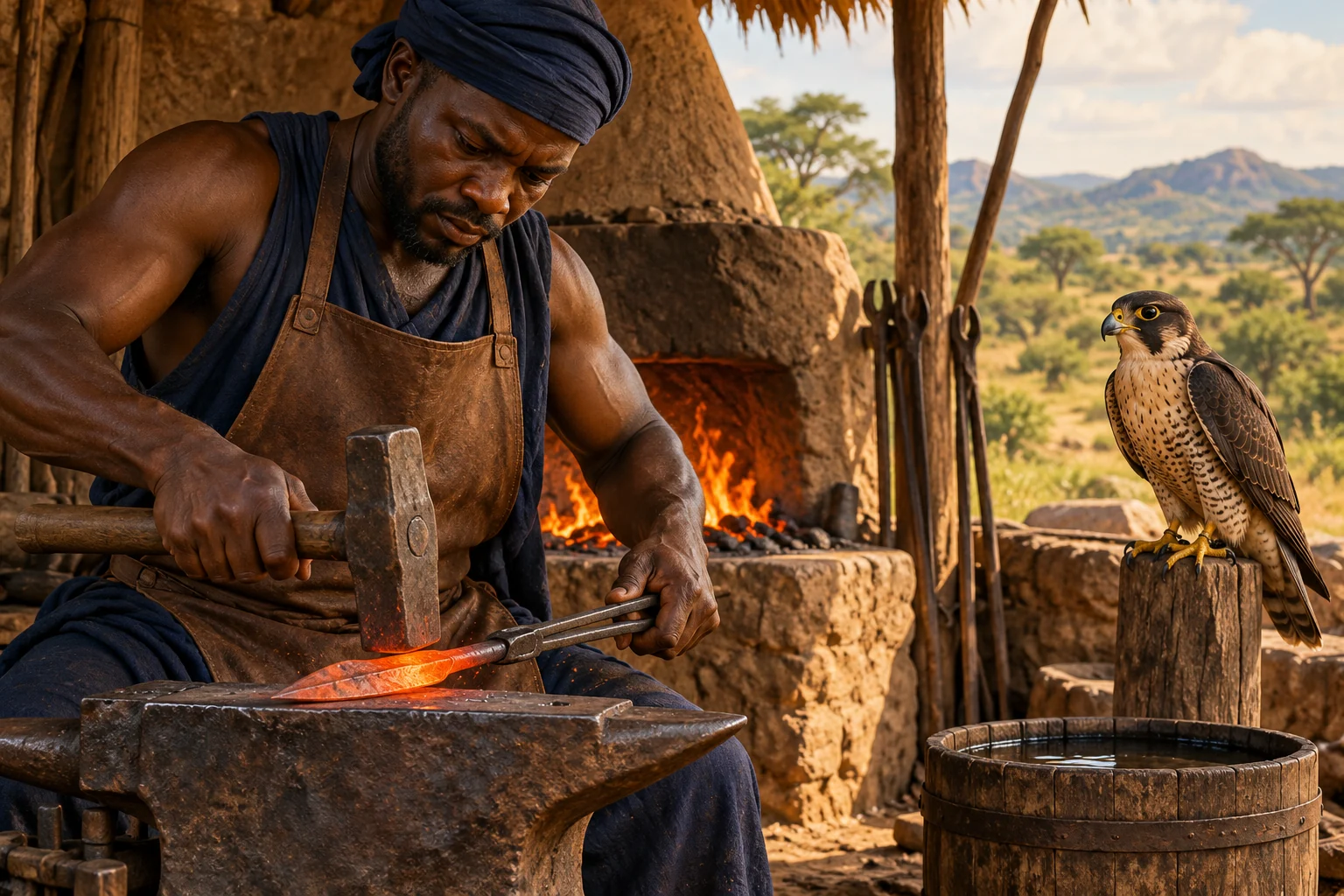
Orisa gives Falcon a hunting implement, but Falcon repeatedly reports failure in that service and then succeeds in hunting for itself. Discovering the deception, Orisa calls the implement back under the appearance of sharpening it and keeps it. Falcon becomes hungry and feels ashamed to return. Consultation directs another response. Òrúnmìlà brings the matter to Ògún, who produces a new implement, and the religious work gives it a particular capacity to retain what it catches. Falcon resumes hunting successfully. The sequence distinguishes the loss of entrusted equipment from the later establishment of another religiously supported means of action.
Falcon’s original dependence is not only technical. The implement belongs to a relationship of service and truthful reporting, which its private success has undermined. Withdrawal therefore changes both livelihood and standing. The new equipment is made by Ògún and prepared through Òrúnmìlà’s religious knowledge; it is not merely a replacement purchase that renders the earlier relation irrelevant. The account does not explicitly narrate apology or restitution to Orisa, leaving a real limit in its restoration.
Read beside Knife, the story offers two different interruptions of craft: an implement works endlessly without completion, while a worker loses the object through which work is possible. The earlier armed-followers account adds another acquisition of weapons, but the ethical context is different. Contemporary reflection can compare entrusted capacity, personal appetite, and reported results, while preserving the source’s divine craftsmanship and sacred efficacy rather than translating them into an all-purpose employment lesson.
Narrative witness and setting: Account explicitly headed Revelações de Cromwell Osamaro
What was born in this Odù
“Born” can name an explicit traditional origin association or what emerges through a story: a capacity, relationship, practice or order of life. Interpretations drawn from a narrative are labelled below, so their basis remains clear.
Cereals
Selected traditional source association.
The explicit origin list supplies cereals as its single item. This is a local sacred association with staple nourishment, not evidence for the historical origin of grains or a prescription concerning a reader’s diet.
The bystander’s claim to safety
Contemporary interpretation from the selected myth.
As a contemporary interpretation, Òrúnmìlà’s protest reveals an emerging distinction between a debtor and an endangered visitor. This is analytical emphasis on the mask narrative, not a traditional origin claim or general authorization for deception.
Correlations to life dimensions
These questions bring the selected stories into contemporary life. They are interpretive invitations for study.
Work and resources
Weapons and followers accumulate together in Eleguá’s story. The account can illuminate a feedback between resources and allegiance, while asking who evaluates the purpose of that growth rather than assuming increased capacity is self-justifying. The newly gathered followers have interests of their own.
Reflect: What standard guides growth besides becoming stronger?
Relationships and family
The debtor’s home includes a visitor whose presence is unrelated to the dispute. Relationships overlap in shared spaces, making indiscriminate punishment likely to reach people who have neither consented to nor caused the original obligation.
Reflect: Who else occupies the space affected by your decision?
Character and inner life
Ṣàngó’s anger treats the exit as a place of punishment for anyone who appears. The motif invites attention to how emotion collapses distinctions between responsible parties, bystanders, and people seeking simply to leave. The visitor is endangered by that collapsed distinction.
Reflect: What distinction disappears when you become angry?
Community and responsibility
Obatalá’s appearance carries an authority that can interrupt violence. The story can prompt a community to identify credible, accountable ways of de-escalating conflict before it must rely on improvisation or borrowed prestige at the last moment.
Reflect: Who can credibly interrupt a dangerous escalation?
A deeper reading of the sacred relationships
An implement’s power is established through divine relations
Knife is an acting being whose task is altered by Èṣù, while Falcon’s renewed implement comes through Ògún and Òrúnmìlà. The stories therefore locate craft in a sacred order of makers, obligations, and effective preparation. The earlier mask account similarly depends on Obatalá’s recognized authority even though he is represented through borrowed appearance; the armed-follower account begins with consultation rather than ordinary accumulation alone. A strong explanation should keep those religious relations intact before discussing commitments or truthful reporting. It cannot extract an implement’s special capacity as a technique for readers or presume that all tools associated with the same sign receive one identical sacred meaning.
Repeated action is not the same as a completed relation
Knife’s cuts do not accumulate into completion because the hair immediately returns. Falcon’s successful private hunting does not complete the service for which Orisa supplied the implement. The armed group’s growing weapons and the debtor-household’s unresolved obligation add different examples of activity that cannot be evaluated by quantity alone. What matters is the relation the action is supposed to serve and whether that relation has actually been met. Contemporary interpretation can ask about completion without reducing sacred exchange to a productivity measure. The source distinguishes spiritually effective response, a professional commitment, a delegated service, and a disputed debt, each with its own participants rather than one generic demand to work harder.
Borrowed capacity can be represented, diverted, or withdrawn
Òrúnmìlà’s Obatalá mask borrows recognized authority to halt immediate violence. Falcon diverts an entrusted implement toward private benefit, after which it is withdrawn. Knife is drawn away from an original commitment toward another task that cannot end. These are different relations between a capacity and the purpose it is given. Their comparison prevents a simple claim that all borrowed power is false or that effective action automatically makes its use right. The armed-follower narrative adds a further question about people joining after strength becomes visible. Contemporary reflection can examine responsibility across these arrangements while acknowledging that each source also gives a particular divine mechanism, not merely a social analogy.
Questions that deepen the study
Is Èṣù’s hair simply a lesson to refuse distractions?
The task’s endlessness is an active religious intervention in the witness, connected with an omitted response. It is not only a metaphor for an inconvenient client or poor scheduling. Contemporary reflection may ask how one commitment is displaced by another attractive opportunity, but that does not exhaust the source’s explanation. The episode also records Knife explaining the missed day to Orisa, so responsibility continues after the obstruction ends. A general article cannot infer that a reader’s unfinished work results from Èṣù or prescribe a response. Its useful role is to explain the particular relation among consultation, action, and completion that the story actually narrates.
Does Falcon’s new implement settle the earlier deception?
It restores hunting capacity within a new religiously supported arrangement, but the passage does not describe a complete repair with Orisa. Falcon’s hunger and shame explain the turn toward consultation, while Ògún’s making and Òrúnmìlà’s preparation explain the later effectiveness. That should not be rewritten as evidence that the original trust no longer mattered. A contemporary reader can distinguish a practical restoration from accountability for the conduct preceding it. The source’s silence on apology is a limit rather than proof that none was needed. Preserving it keeps the story from becoming a reassuring claim that success automatically resolves every damaged relationship.
How does the Obatalá mask differ from Falcon’s false reports?
Both involve a discrepancy between appearance and what an observer knows, but their purposes and immediate conditions differ. Òrúnmìlà’s borrowed appearance interrupts an attack endangering a visitor with no responsibility for the debt. Falcon uses false reports to retain private benefit from an implement supplied for service. These distinctions allow ethical analysis without announcing a universal verdict that every disguise is justified or every withholding is identical. The source also gives the mask a specific sacred authority, not generic intimidation. Contemporary reflection can ask what the action protects and whom it exposes, while retaining the theological reason the particular appearance can calm Ṣàngó.
What the four narratives reveal together
The added craft episodes give Ìrosùn Òsá a more precise account of capacity and purpose. Knife acts all day without completing the task, while Falcon loses an entrusted implement after separating public service from private success. The earlier mask and armed-followers accounts supply different relations to borrowed appearance and accumulating force. Their comparison cannot be reduced to one rule about effort, deception, or strength. Within the witnesses, Èṣù’s obstruction, Ògún’s making, Òrúnmìlà’s preparation, and Obatalá’s recognized authority remain effective religious realities.
Contemporary questions about commitments and truthful reporting can develop beside them. The endings also preserve limits: a halted attack does not settle the original debt, and restored hunting does not fully narrate repair of trust. Those distinctions contribute authority by keeping the actual scope of each outcome visible rather than treating every successful intervention as complete reconciliation.
Living with this Odù
A continuing life or initiatory relationship
A received relationship with Ìròsùn Òsá can sustain attention to how power gathers people and how anger widens a target. Eleguá’s increasing material force attracts followers, so popularity does not emerge independently of the resources others see. Ṣàngó’s attack on a debtor’s household exposes a visitor who does not owe the debt. The difference between a claim and indiscriminate consequence remains central even when force can compel compliance.
Knife’s endless task introduces another way a capacity can be consumed without advancing its actual commitment. Falcon’s lost implement adds a consequence rooted in deceptive use of entrusted equipment, followed by another religiously supported means of action through Òrúnmìlà and Ògún. Across a life, reflection may concern the basis of following, the boundaries of a grievance, diversion into unfinishable work, or the responsibility attached to tools. These are not a fixed temperament of conflict. The sign does not excuse a leader because people gather around them or establish that every deprivation was deserved. It invites character able to examine what one’s force actually protects, what an agreement was meant to accomplish, and how new capacity can be carried after trust has been damaged.
A particular consultation and its question
When Ìròsùn Òsá appears in consultation, the narratives help distinguish a growing following from legitimate authority. Eleguá’s material advantage attracts supporters, but that sequence does not settle the quality of their allegiance. The debtor’s door introduces a different distinction: the person exposed to retaliation may not be the person responsible for the claim. Òrúnmìlà’s disguise acts within the sacred account to interrupt that indiscriminate danger; it does not supply a modern tactic for a client.
Knife’s work raises the question of a task whose demands prevent fulfillment rather than lead toward it. Falcon’s account asks whether a lost resource followed a breach of entrusted service and what a genuinely changed means of action would involve. A practitioner may examine these possibilities without assuming that every delay is diversion or every missing tool proves wrongdoing. Èṣù, Ògún, and the addressed religious relations remain active within their witnesses. The actual consultation determines which configuration matters and what responsibility belongs to the client. It cannot announce an enemy, justify collective punishment, or turn this present result into a permanent identity as leader, debtor, or person whose capacity must remain restrained.
Constructive and adverse possibilities
Constructive unfolding may include force whose reach is examined, protection for those outside a disputed obligation, and a capacity redirected toward an intelligible task. Falcon’s new means of hunting depends on Òrúnmìlà, Ògún, and religious work rather than simple replacement of a lost object.
Adverse unfolding can involve followers attracted by advantage without considering purpose, anger treating everyone nearby as liable, or an unending task consuming the day while the original commitment fails. Falcon’s earlier deception also remains part of the account, so restoration need not erase responsibility. These contrasts do not make every successful following corrupt or every limitation justified. They ask how material power, entrusted service, and exposure interact in a particular configuration. No unknown debtor is identified, no modern coercive response is prescribed, and no actual reading’s direction follows from the sign alone.
An illustrative situation in everyday life
Imagine a hypothetical manager angry about a contractor’s missed payment who freezes access for an entire shared project, including people uninvolved in the debt. One worker is then assigned repeated revisions whose completion criteria continually change. The visitor behind the debtor’s door distinguishes liability from exposure; Knife’s task distinguishes demanding work from work that cannot reach an agreed end. The manager’s inner conviction of being wronged makes both measures feel justified. Clarifying who owes what and defining a finishable task would address separate external conditions. This example neither validates the contractor’s conduct nor equates delay with Èṣù’s intervention. It uses the narratives to keep the consequences of a grievance proportionate to the relationship in which it arose.
Sources and reading context
The first two narrative witnesses
Both selected narratives are explicitly Cuban. Tactical detail is not reproduced. The origin list supplies only cereals, so additional emergence commentary must be labeled interpretation and does not establish a traditional born association. Attributions remain locally bounded.
Narrative motifs are summarized independently. The life-dimension reflections are contemporary interpretation. How these reference studies are built explains the wider source approach and the distinction between a reference article and personal divination.
Additional named witnesses
-
Cromwell Osamaro. The explicit heading covers Knife’s endless shaving and Falcon’s replacement implement.
-
Cuban narrative sequence. Both earlier armed-followers and Obatalá-mask accounts are marked Cuba.
Implement terminology varies between knife, scissors, and hunting weapon; no technical reconstruction is attempted. Divine hair growth and special retention are religious narration. No operative preparation, violence tactic, or personal accusation is provided.
Bibliographic identification
- C. Osamaro Ibie. Ifism: The Complete Work of Orunmila. Lagos; multivolume publication beginning 1986. Library catalogue record. Related bibliographic record for the named narrative witness. Exact volume, edition and page of the transmitted account have not been independently matched.
Read the source method and wider scholarly context.
The catalogue links identify published works and their authors. They are separate from proof of an individual episode’s wording or attribution. Contemporary comparisons and the synthesis above are editorial interpretation. The author’s books and Academy companions below provide further study; their sales links are separate from the source references.