
Òdí Òbàrà is a mixed Odù in Ifá’s 256-part corpus. The two selected Òdí Òbàrà stories bring grandeur back into contact with overlooked relationships. Ṣàngó’s palace initially excludes Yemayá, while a separate account has Orisha Oko find the missing Ṣàngó through plowing. The first turns recognition toward a mother at the gate; the second gives agricultural work a role in recovering a hidden divine presence. Both challenge the assumption that power is sustained only by those most visible around it.
A question to carry through the study: Which sustaining relationship has your public success pushed to the gate?
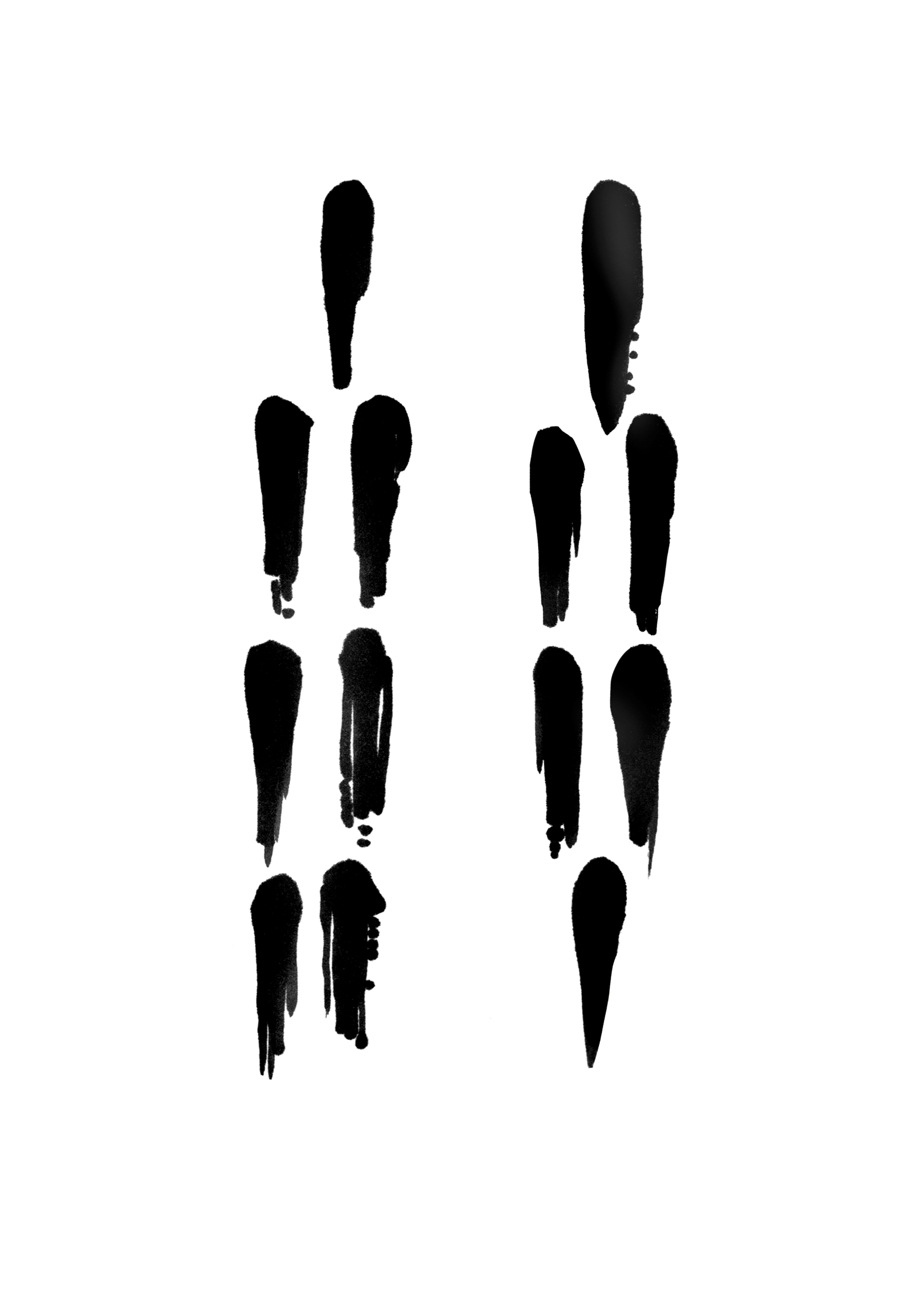
This Academy reads the right column first, then the left. Each row carries a single or double mark.
Where this Odù belongs
Òdí Òbàrà belongs to the Òdí family in this Academy’s study sequence. It is a mixed Odù, distinct from Òbàrà Òdí. The order matters. Its teaching is approached through its own narratives, rather than by adding two general descriptions of the principal signs together.
Key Òrìṣà and sacred relationships
The figures below are selected for their roles in the accounts discussed here. They offer connected reading paths through the tradition.
-
Ṣàngó. Ṣàngó appears both as a ruler who has forgotten his mother and as the hidden figure recovered from the earth. His visibility and dependence shift between the selected accounts.
-
Yemọja. Yemayá travels to find her son, is refused entry by his guards, and eventually receives a crown that publicly acknowledges the relationship wealth had obscured.
-
Òrìṣà Òkò. Orisha Oko discovers Ṣàngó while plowing and is rewarded with enduring authority over land; agricultural labor becomes an act of recovery and recognition.
-
Obàtálá. Obatalá is named in the unusual birth account of Ṣàngó. This particular parentage belongs to the given narrative and is not presented as common to every lineage.
Key myths and their meanings
The mother outside the palace
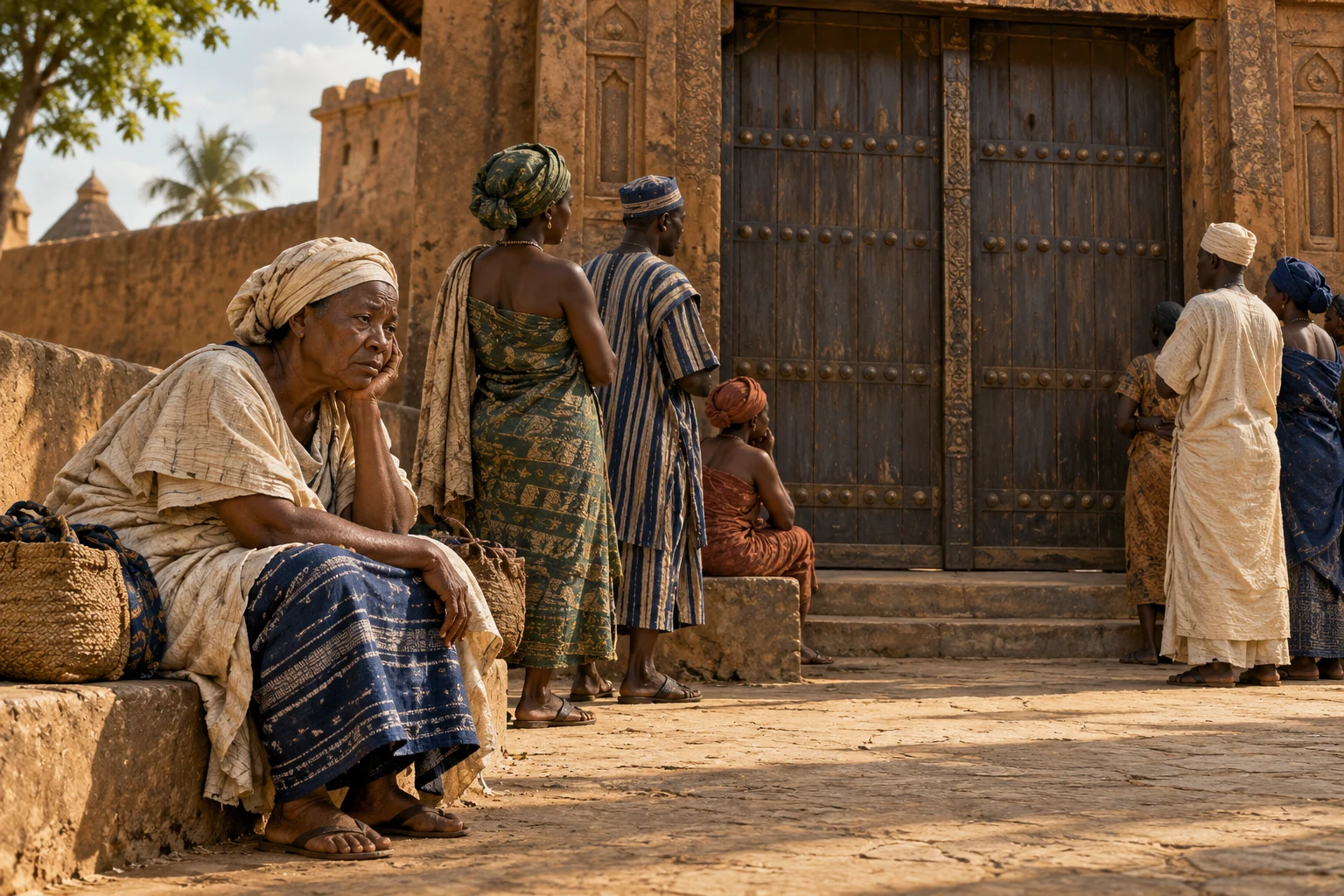
Ṣàngó rules a wealthy village and neglects his mother Yemayá. She searches for him, but palace guards deny her entry. Exhausted, she sleeps by the gate as other people also wait for an audience. When Ṣàngó notices her and recognizes who she is, he has a crown prepared and places it on her head. A public sign replaces her earlier exclusion.
The gate makes neglect institutional: the ruler’s household reproduces his distance even before he sees the visitor. Crowning the mother repairs recognition in the narrative, but does not describe sustained care afterward. The open question is whether an impressive gesture also changes access and everyday conduct, or whether someone can honor a relationship ceremonially while continuing to leave its practical needs unattended.
Narrative setting: Cuban-style account in English translation.
A plow uncovers the missing son
Ṣàngó disappears after growing up under divine care. Olofin seeks guidance from Òrúnmìlà and offers recognition to whoever finds him. While plowing, Orisha Oko hears a responding voice beneath the ground. Digging further, he uncovers a stone that becomes Ṣàngó and returns to stone. He brings this discovery to Olofin and receives authority over the land.
The hidden figure is found through an ordinary productive task rather than a courtly search. Orisha Oko listens to a response from the ground instead of treating the field as inert material. The motif gives cultivation a relationship with knowledge and recovery, but the reward also leaves a tension: recognition becomes land authority, raising questions about how discovery, labor, and entitlement are connected in sacred accounts.
Narrative setting: Adjacent translated Cuban-style account.
Birds receive a new way to leave the tiger’s reach
In a heavenly beginning, birds climb but cannot yet fly. A tiger kills them with little resistance. They seek divination and carry out the response, after which Òrúnmìlà gives them a sacred means of transformation and directs a period of withdrawal. Small feathers appear and develop while they remain sheltered. The birds extend the interval until flight becomes possible. When they finally emerge, the tiger is waiting, but they rise beyond its reach. The episode places a new bodily capacity inside a sequence of consultation, religious transformation, protected growth, and a decision about when to return to public space.
The birds do not defeat the tiger by becoming a larger predator or by proving that its appetite is illegitimate. Their response changes the field in which an encounter can occur. Within the account, this is an actual transformation enabled through Ifá and the sacred substance associated with divination, not merely a metaphor for education. The interval matters as much as the initial gift: a new capacity must develop before exposure to the old threat is resumed. The birds’ choice to remain sheltered longer than the first stated interval gives them some judgment within the religious process.
This complements the earlier story in which Orisha Oko discovers Ṣàngó beneath the earth: hiddenness can protect a becoming life or conceal an already existing presence. It contrasts with Yemayá waiting at a palace gate, where the problem is recognition rather than bodily capacity. These distinctions prevent the episode from becoming a universal injunction to hide, confront, or seek public approval.
Narrative witness and setting: Account explicitly headed Revelações de Cromwell Osamaro
The guide who keeps the offerings between guest and host
Òrúnmìlà knows Ifá but not the route to Ofa, while Osanyin knows the route and accompanies him. Near the town, Osanyin offers to announce the visitor. Instead, he repeatedly tells the ruler that new preliminary offerings are required, keeping what he receives and telling Òrúnmìlà that the audience is delayed. Each party begins to regard the other as insulting or extortionate. Eventually ruler and visitor approach one another angrily. An elder asks them to listen to both accounts. Direct comparison exposes the intermediary’s deception, and Osanyin leaves while the ruler receives Òrúnmìlà into his household.
The original partnership has a legitimate basis: neither specialist possesses everything needed for the journey. Knowing a route and knowing Ifá are complementary capacities, not competing claims that one should make the other unnecessary. The deception exploits precisely that dependence by monopolizing the channel through which each party knows the other’s intentions. Religious offerings become vulnerable to misuse because the intermediary claims authority to explain what the diviner requires. The eventual repair therefore does not imply that sacred exchange itself is fraudulent; it distinguishes a real obligation from a privately invented demand.
Read beside Ṣàngó’s neglect of Yemayá, the story also shows different kinds of failed access. Palace guards exclude a mother, while the guide keeps a visitor waiting through false messages. Orisha Oko supplies a contrasting intermediary whose discovery restores a relationship instead of exploiting it. The source does not explain how confidence in Osanyin is rebuilt afterward, leaving the legitimate partnership damaged beyond the immediate exposure of the scheme.
Narrative witness and setting: Account explicitly headed Revelações de Cromwell Osamaro
What was born in this Odù
“Born” can name an explicit traditional origin association or what emerges through a story: a capacity, relationship, practice or order of life. Interpretations drawn from a narrative are labelled below, so their basis remains clear.
Marriage
Selected traditional source association.
Marriage appears explicitly in the origin list. It establishes a local association with formal relationship, but the selected narratives emphasize parenthood and recovery rather than providing a single marriage rule or a universal theology of partnership.
Conflict between Obatalá and Death
Selected traditional source association.
The origin list also names a conflict between Obatalá and Ikú. Since the selected narratives do not recount that conflict, it remains a limited association and is not expanded into an invented third story.
Correlations to life dimensions
These questions bring the selected stories into contemporary life. They are interpretive invitations for study.
Work and resources
Orisha Oko’s plowing is both provision and discovery. The account gives a worker knowledge unavailable to the anxious divine household, making it useful for questioning whose practical familiarity with a place institutions overlook. The discovery depends on continued attention to the soil.
Reflect: What does a worker know that leadership has not asked about?
Relationships and family
Yemayá’s exclusion occurs in a palace supported by her son’s status. The story asks whether family recognition can survive prosperity and whether an institution’s gatekeeping reflects the care its leader claims to value. Yemayá’s exhaustion makes exclusion more than an abstract slight.
Reflect: Who can reach you when they need you?
Character and inner life
Ṣàngó recognizes a familiar person after she has become an overlooked stranger at his gate. The episode challenges a narrow field of attention shaped by luxury, distance, and the constant presence of attendants. The guards reproduce a distance the ruler has allowed.
Reflect: What has become hard for you to notice?
Community and responsibility
The crown makes recognition public because the earlier exclusion was public. We can examine how correction should reach the same social space in which someone’s standing was denied or diminished. The gesture also changes what witnesses see at court.
Reflect: Where should an acknowledgment be visible to others?
A deeper reading of the sacred relationships
Divination can change a body’s available relation to danger
The birds’ feathers and flight are narrated as consequences of a religious response, not a biological evolutionary account. Their withdrawal allows that new capacity to take form before the tiger can meet them again. The earlier discovery of Ṣàngó likewise involves actual transformation between stone and person, while Yemayá’s crown publicly establishes a relation that a palace had failed to acknowledge. These are different spiritual actions: bodily endowment, disclosure of a hidden presence, and ceremonial recognition. Explaining them within their settings gives Òdí Òbàrà more depth than a general message about empowerment. Contemporary interpretation can examine growth and access afterward, but should not substitute those abstract terms for the powers and transformations the narratives themselves affirm.
Complementarity creates responsibility for truthful mediation
Osanyin’s route knowledge makes the meeting possible, just as Orisha Oko’s familiarity with cultivated ground enables a hidden voice to be found. Neither contribution is trivial because it differs from the diviner’s or ruler’s more visible role. Their different conduct, however, shows that useful position does not guarantee faithful service. Osanyin invents demands and retains resources; Orisha Oko brings the discovery back to the party seeking it. An editorial comparison should therefore distinguish acknowledging a mediator’s indispensable skill from granting an unchecked right to speak for everyone. The birds add a different kind of reliance on another’s knowledge, where counsel is followed by a visible change they can eventually exercise themselves.
Intervals and thresholds make recognition uneven
Yemayá waits at a palace entrance, the birds wait through a period of transformation, Òrúnmìlà waits outside a town, and Ṣàngó remains hidden until cultivation uncovers him. Waiting therefore has no single meaning across the selection. It can express exclusion, necessary development, manipulation, or concealed presence. The source’s detail matters to judgment: the birds’ interval is connected with feathers growing, whereas the visitor’s delay has no agreed reason and is sustained by contradictory reports. A contemporary reader can ask what evidence makes an interval meaningful rather than simply being told that patience is virtuous. The stories also show that another party may hold information essential to evaluating why someone is being kept outside.
Questions that deepen the study
Is the guide story hostile to sacred offerings?
Its immediate target is the intermediary’s false representation of what the diviner requires. The ruler gives because he believes the demands belong to a legitimate religious encounter; Òrúnmìlà waits because he believes the delay belongs to the ruler’s household. Once they compare accounts, both discover that the channel has been manipulated. The story therefore depends on a difference between genuine exchange and a demand invented for private retention. Treating every offering as extortion would flatten that distinction and remove the religious world in which the deception has meaning. A contemporary application can ask how requirements are explained and confirmed without assuming that sacred relations must be reduced to ordinary commercial transactions.
Why does the birds’ additional time in shelter matter?
It prevents the initial act of receiving help from being mistaken for completed readiness. The narrative describes a developing body before it describes successful flight. The birds also choose to remain longer, making judgment about their condition part of the process rather than depicting them as entirely passive recipients. This can support a contemporary question about whether a newly acquired capacity has become usable, but the religious transformation should remain more than a metaphor for training. The source gives no universal timetable for a person’s preparation, and its days should not be extracted as a rule for readers. What matters comparatively is the connection between the interval and a concrete change.
What distinguishes a helpful intermediary from a controlling one?
Orisha Oko’s discovery becomes available to Olofin, who needs to recover Ṣàngó. Osanyin instead keeps the two parties dependent on his incompatible messages. The difference is not that one occupies a threshold while the other does not; both work where another party lacks direct access. It is what happens to the knowledge and resources passing through them. A helpful mediator preserves the possibility of an encounter between the parties. A controlling mediator makes continued separation profitable. This is a contemporary analytical distinction grounded in these stories, not a claim that the source defines every intermediary or that a single act settles a figure’s character across traditions.
What the four narratives reveal together
The new witnesses extend Òdí Òbàrà’s earlier images of a mother at a gate and a divine presence under cultivated ground. The birds require a protected transformation before emerging; the visitor and ruler require direct speech after their relationship has been distorted. All four involve an encounter delayed or made difficult, but they offer different reasons and responses. The spiritual action is equally varied: a crown recognizes, a plow discovers, divination enables bodily change, and an elder helps reveal a false account of sacred exchange.
These differences support depth without inventing one master meaning for gate, earth, or waiting. They also preserve a real place for divine agency and religious obligation before contemporary reflection on mediation is added. The selection leaves practical questions unresolved, including how trust is restored after a guide’s betrayal and who decides when a vulnerable being has become ready to return.
Living with this Odù
A continuing life or initiatory relationship
A received relationship with Òdí Òbàrà can sustain attention to who controls access and how overlooked relations become visible. Yemayá’s exclusion at Ṣàngó’s gate makes maternal neglect an arrangement maintained by other people, not merely a private lapse of feeling. The crown changes recognition publicly, but leaves continuing care as a question. Orisha Oko’s discovery of Ṣàngó introduces another route: productive contact with the ground discloses what the prestigious search has not found.
The birds’ protected transformation adds a temporal distinction. Some capacities need shelter before they can safely change an encounter with danger. The guide’s deception adds an institutional one: a necessary intermediary can misuse dependence by controlling what two parties believe about each other. Across a life, the task may shift among offering recognition, learning to listen, protecting a developing ability, and checking a channel of communication. Òrúnmìlà’s knowledge and Osanyin’s route knowledge remain complementary before deception damages the partnership. The sign does not define the person as either neglected or deceptive. It opens a continuing inquiry into the conditions that allow care, sacred competence, and public access to reach the people for whom they matter.
A particular consultation and its question
In consultation, Òdí Òbàrà helps separate exclusion from unreadiness and delay from deception. A person waiting outside an institution may resemble Yemayá’s unrecognized position, but another situation may concern a capacity still developing under protection, as with the birds. Their withdrawal is made effective through Òrúnmìlà’s sacred intervention and time; it is not a generic command to hide or wait for approval. The actual question determines whether changed recognition or protected development is relevant.
Osanyin’s conduct introduces a further possibility: the channel itself may be producing the delay by misrepresenting each party to the other. The story supports examining how information travels, not accusing an unknown intermediary. The elder’s hearing of both accounts gives a different shape to resolution from Ṣàngó’s crowning gesture. Orisha Oko’s discovery also asks whether necessary knowledge is being overlooked because it arises through ordinary labor. A practitioner can use these distinctions to listen for the actual arrangement behind the client’s account. The reference does not declare a finding, assign hidden motives, or promise that public honor will repair a relationship. Consultation concerns this present configuration; long-term affiliation has a different scope and history.
Constructive and adverse possibilities
Constructive unfolding may bring recognition that changes access, attention to knowledge arising through cultivation, and protection sufficient for a new capacity to mature. The birds’ transformation remains religiously mediated, while Orisha Oko’s discovery makes the ground responsive within a particular sacred narrative.
Adverse unfolding can involve an impressive gesture without continuing care, premature return to an unchanged threat, or an intermediary making their own gain depend on misunderstanding between others. The guide’s legitimate knowledge does not make his later demands truthful, and exposing deception does not invalidate every sacred exchange. Likewise, the mother’s eventual crown does not prove that every excluded person must wait indefinitely. These contrasts distinguish the quality of a relationship and the timing of exposure without deciding whether an actual reading is in ire or osogbo. Each narrative asks what must change for a relation to become possible.
An illustrative situation in everyday life
In a hypothetical example, a neighborhood artist is invited to a cultural center through an agent who alone communicates with its director. Both artist and director begin to believe the other is making unreasonable demands. Meanwhile, a trainee is urged to exhibit work before she feels prepared. The guide’s story helps separate a blocked channel from genuine disagreement; the birds distinguish protected development from exclusion. The artist’s inner pressure to appear grateful may make direct clarification difficult, while the trainee fears being forgotten if she waits. Hearing both parties and agreeing on realistic stages could change the arrangement. The illustration makes no accusation about a real agent and does not replace the sacred transformation or mediation narrated in the sign.
Sources and reading context
The first two narrative witnesses
These accounts appear in English within the Cuban narrative sequence and retain local parentage and place imagery. No named author is established here. The origin list is narrower than the narratives, and its associations are not treated as universal.
Narrative motifs are summarized independently. The life-dimension reflections are contemporary interpretation. How these reference studies are built explains the wider source approach and the distinction between a reference article and personal divination.
Additional named witnesses
-
Cromwell Osamaro. The explicit heading covers both the winged-birds origin and the Olofa/Osanyin intermediary narrative.
-
Cuban-style narrative sequence. The earlier Yemayá crown and Orisha Oko discovery passages remain separately situated within the compilation.
The names Olofa/Olofi vary in translation, and the town is retained as Ofa without further historical claims. The birds’ transformation is not offered as natural history. No ritual materials or personal warnings attached to either account are reproduced.
Bibliographic identification
- C. Osamaro Ibie. Ifism: The Complete Work of Orunmila. Lagos; multivolume publication beginning 1986. Library catalogue record. Related bibliographic record for the named narrative witness. Exact volume, edition and page of the transmitted account have not been independently matched.
Read the source method and wider scholarly context.
The catalogue links identify published works and their authors. They are separate from proof of an individual episode’s wording or attribution. Contemporary comparisons and the synthesis above are editorial interpretation. The author’s books and Academy companions below provide further study; their sales links are separate from the source references.