
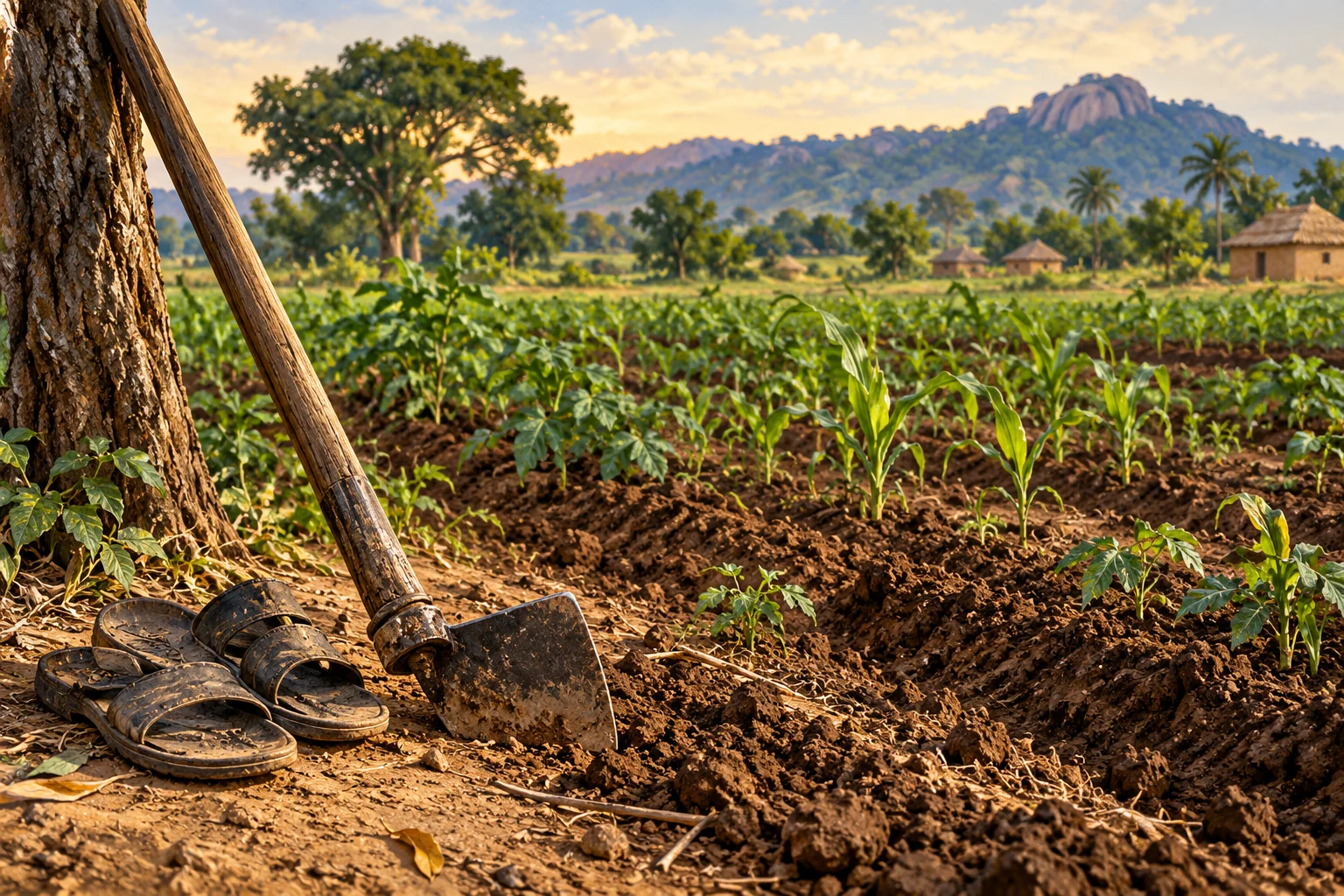
The field can look quiet from the road. Its apparent stillness contains seasons of attention, tools repaired, risks accepted and work repeated. Òrìṣà Òkò brings that sustaining labor into religious focus. Agriculture is not simply a symbol of abundance; it is a relationship between effort, living conditions and a future that cannot be fully controlled.
Òrìṣà Òkò’s agricultural context connects nourishment, used tools and continuing labor.
1. Farms and a remarkable emblem
Òrìṣà Òkò is associated with agriculture in Yorùbá traditions. The Metropolitan Museum’s sheath for Oko’s staff explains an emblem forged from worn farming implements and clothed in beadwork. The object connects the labor of cultivation with a form of sacred authority.
The Smithsonian’s staff from Irawo gives another specific material setting. These objects show why an apparently simple agricultural designation is not an adequate account of the figure. Skilled making, priestly relationships and ideas about authority stand inside the symbol.
2. Key image: a used implement becomes something else
The transformation of farming iron into an emblem invites a contemporary question about the knowledge carried by use. A worn tool can be treated as waste, but it also holds a history of work. What has made life possible may deserve a form of recognition that does not disappear when its practical task changes.
This is an interpretation of documented material, not a new traditional myth. It can illuminate the way a community treats retired workers, inherited skills or the people whose labor is considered ordinary. Recognition becomes shallow when it praises harvest while forgetting the hands and conditions that produced it.
3. Cultivation and limits
Agriculture joins preparation to uncertainty. A person acts in the present for a result that depends on weather, living systems and time. Neither total control nor passive waiting is adequate. Cultivation asks for responsible effort within conditions that remain larger than the individual.
The same structure appears in education, parenting and institution-building. A person can prepare, support and attend without forcing a living process to mature on command. Patience is active when it includes the work needed now; impatience is destructive when it demands a result while refusing that work.
4. Religious identity and the scope of this study
Òrìṣà Òkò should be introduced through farming understood as a sustained relationship among living soil, labor, seasonal opportunity and communal provision. The religious domain includes more than an abstract wish for fertility. Cultivated land produces food through repeated decisions whose consequences appear later, often after the moment when correction would have been easiest. This makes Òkò a precise subject for considering responsibility toward a future one cannot command. The book approaches him within its combined discussion of earth, elevation and cultivation. That arrangement supplies a differentiated terrestrial argument; it does not make Òkò another name for Onílẹ̀ or Oke.
The Metropolitan Museum's staff sheath offers an independent material anchor. Its account connects the emblem with exhausted agricultural tools remade by a smith, with priestly mediation and with petitions that exceed crop production. Those features complicate the stereotype of a minor farming figure. Labor, justice, sacred authority and the capacity to sustain households meet in one object. A psychological reading can develop this complexity by asking how dependable provision forms a person without allowing usefulness to become their entire identity. Such reflection remains an interpretation of the relationship, rather than a determination that farmers or productive people belong to Òkò.
5. Knowledge that gives the figure depth
5.1 Why does used farming iron matter?
The museum's account of the staff begins with implements that have already worked. Their useful history precedes their transformation into an insignia. This is materially important: agriculture and ironworking meet, so cultivation cannot be narrated as the action of a solitary farmer upon passive soil. Someone makes the tool; another learns its handling; soil and weather condition its effects; a community depends on the result. The old implement's remaking allows an original ethical interpretation about recognizing accumulated service. A society can praise harvests while treating the people who made them possible as disposable when age or injury changes their capacity.
The staff suggests a different imaginative question: how can work retain recognized dignity after its immediate economic use declines? This is an application, not a claim that the emblem historically functioned as a retirement policy. The same question helps distinguish respect for labor from worship of exhaustion. Past service deserves acknowledgment, but a worn person is not raw material to be endlessly repurposed for others. The religious object brings different forms of making into relation; contemporary analysis can therefore attend to the whole chain of support rather than crediting the final visible producer alone.
Evidence: Metropolitan Museum of Art, Sheath for ọ̀pá Oko (Oko’s staff) — Agricultural deity; staff forged from used agricultural implements; mediation by priestess; beaded sheath and authority imagery. Specific museum account, not pan-Yorùbá liturgical rule.
5.2 How can cultivation carry authority beyond harvest?
The Met describes a priestess as the medium through whom petitions reach Òkò's insignia. Its examples include prosperity and justice alongside bodily and household concerns. This matters because a functional label such as agriculture may hide a broad social reach. Food production influences stability, disputes, dependency and the possibility of raising children; it is not sealed away from the rest of life. The record should nevertheless remain an account of a particular documented genre and practice, not evidence that all Òkò institutions everywhere share one priesthood or identical requests.
What it permits is a question about why sustenance can confer authority. Those who help keep a community alive may carry moral claims beyond their economic task. Those claims also need scrutiny: provision can become coercive when the provider expects obedience in exchange for necessities. A contemporary reader can explore the tension without inventing a myth of Òkò punishing an ungrateful household. The book's cultivated-earth emphasis is useful precisely because cultivation implies an enduring obligation toward what is supported. Feeding people establishes a relationship of care; it should not authorize possession of the people who receive that care. Authority becomes more credible when it remains answerable to their actual needs.
Evidence: Metropolitan Museum of Art, Sheath for ọ̀pá Oko (Oko’s staff) — Agricultural deity; staff forged from used agricultural implements; mediation by priestess; beaded sheath and authority imagery. Specific museum account, not pan-Yorùbá liturgical rule.
5.3 What does seasonality teach about effort?
Seasonal cultivation brings effort into contact with contingency. Work can be timely and competent without securing the desired yield, while favorable conditions can sometimes reward imperfect preparation. Òkò therefore offers a stronger interpretive field than the common formula that hard work inevitably succeeds. The book emphasizes tending, patient repetition and the transformation of possibility into sustenance. That argument can be extended into a careful distinction between responsibility and omnipotence. Responsibility concerns what one can reasonably prepare, maintain, repair and learn; omnipotence imagines every result as proof of personal merit or failure.
Agricultural imagery exposes the difference because land is living and conditions change. An illustrative contemporary case would be a teacher who prepares lessons faithfully but cannot dictate every student's development. The teacher still has duties, including changing methods when evidence shows harm or misunderstanding. Acceptance of uncertainty is not an excuse for neglect. Conversely, an unsuccessful outcome does not automatically establish moral inadequacy. Òkò's field asks for a mature account of effort: committed enough to be accountable, responsive enough to revise, and humble enough to acknowledge conditions that exceed the worker. That differs from passive hope and from punitive productivity alike.
Evidence: Metropolitan Museum of Art, Sheath for ọ̀pá Oko (Oko’s staff) — Agricultural deity; staff forged from used agricultural implements; mediation by priestess; beaded sheath and authority imagery. Specific museum account, not pan-Yorùbá liturgical rule.
6. A depth-psychological reading
Interpretive basis: The shared chapter discussion in Babá Tilo de Àjàgùnnà’s The Orishas and the Human Soul, especially “Onílẹ̀, Oke, and Oko”, “Before the Òrìṣà Become Archetypes”, “Metals, Tools, Fire, Cloth, Stones, and the Crafted Body of Power”. The grouped chapter explicitly discusses Oko as cultivated fertility and provision; the three named lenses and contemporary cases extend that argument without claiming a separate Oko chapter.
6.1 Depth psychology: worth beyond output
A depth psychological lens can consider the provider identity: the inward agreement that one deserves a place only while delivering results. The book locates Òkò's shadow around narrowing life to production. The specific tension is not laziness against diligence. It is the difference between a meaningful capacity to cultivate and a self whose worth collapses whenever the field lies fallow. Such a person may become frightened by rest because rest removes the evidence by which they justify belonging. Success then brings relief without security; the next demand promptly restores the fear.
Cultivation offers a useful corrective image because maintenance, dormancy, renewal and preparation are parts of sustaining a field, even when they produce no immediate visible harvest. This is not a traditional doctrine that every quiet season promises greater future income. Its value is interpretive: a life can contain necessary activities whose worth is not measured by current output. An illustrative vignette is a household provider recovering from surgery who interprets receiving care as humiliation. The Òkò question would concern whether service has become the only permitted form of participation.
Recognition of dependence can deepen provision by allowing the giver to remain a person among people. No personality profile of Òkò devotees follows from this example, and the symbol supplies no clinical conclusion about the individual.
6.2 Relational development: tending without forcing
A relational lens concerns the interval between tending and receiving a response. Caregivers, teachers and community organizers often face a delay before their work becomes legible to anyone else. The field may appear unchanged while essential work occurs. If recognition is desperately needed, that delay can feel like rejection and provoke intrusive efforts to force a result. Òkò's cultivated-earth imagery makes the problem concrete: repeated attention supports a living process, but excessive interference may damage it. In a contemporary application, a parent who continually checks a child's achievement may describe the pressure as devotion.
The relevant inquiry is whether the parent's anxiety has become more influential than the child's needs. The book's distinction between disciplined fertility and bare productivity supports this reading. Cultivation requires observing what the recipient can use, not simply increasing the amount of activity. Conversely, patient waiting must remain connected with actual provision. Calling absence of support a respect for timing would misuse the image. Mature tending includes feedback, limits and willingness to learn. It can tolerate an interval without turning another living being into a deadline. This lens offers a way to examine how a person carries uncertainty within relationships; it does not identify the traditional religious relation as parenting psychology or establish that every developmental difficulty is an Òkò problem.
6.3 Family systems: who carries provision?
A family systems lens can follow the social organization of provision. A household may assign one member the permanent task of holding everything together, while other contributions disappear because they are less visible or less monetized. The apparent strong provider can then become both indispensable and resentful. Òkò's field helps ask who cultivates, who distributes, who eats and who receives public credit. These are different positions, sometimes held by different people. The museum's combination of agricultural labor, smithing, beadwork and priestly mediation usefully prevents a single heroic account of production.
A contemporary interpretation can apply that lesson to inherited family roles: a person may believe that refusing an unreasonable burden would betray the sacrifices of earlier generations. Recognizing those sacrifices need not require repeating every condition under which they were made. The future harvest may depend on changing an arrangement that exhausted the previous workers. This analysis does not infer hidden ancestral causes from someone's financial circumstances. It examines observable expectations and the stories that justify them. A more balanced arrangement makes contributions discussable and distributes responsibility without erasing skill differences.
In Òkò terms, provision matures when the field can continue to nourish beyond the efforts of one irreplaceable worker. Continuity requires transmission and cooperation as well as individual stamina.
7. What this relationship means for a person
7.1 In an established devotional or initiatory relationship
For someone with an established devotional or initiatory relationship involving Òkò, cultivation can become a recurring vocabulary for examining conduct over many seasons. The starting point is the relationship actually recognized by the person's community: the relevant shrine, priesthood, obligations and account of the deity. No universal claim about a personal head initiation follows from a public article. Within that boundary, the book's shared chapter can enrich reflection about how a person inhabits responsibility. Does diligence remain responsive to the lives it supports? Can the devotee receive assistance without treating it as loss of standing?
Are prosperity and service connected to fairness toward workers and dependents? These questions gain depth through repetition because the religious relationship may accompany prosperity, disappointment, retirement and changes of role. A provider who initially seeks increased yield may later need to learn succession, sharing or rest. Established relationship makes room for such changes without turning every difficulty into proof of failure or withdrawal of favor. The emblem's agricultural and crafted relations can also guide attention toward the people whose work supports religious life itself: maintenance, preparation, teaching and care.
Honoring that labor means more than admiring public ceremony. The interpretive contribution concerns ethical attention and self understanding; ritual decisions remain matters for accountable teachers. Sustained devotion should not be represented as a contract guaranteeing crops, employment or conception. Its reflective value lies in learning how to cultivate faithfully under conditions that remain shared and uncertain.
7.2 When the figure becomes relevant in consultation
When Òkò is encountered through consultation, the question is narrower and more situated. A divinatory context may direct attention toward cultivation, sustenance or duties that have been neglected, but that encounter does not itself establish a lifelong identity or authorize the reader to declare Òkò the client's head. The book offers a useful distinction between wanting another revelation and needing to tend an existing field. In a contemporary interpretive conversation, someone might have many promising projects while leaving each before its demanding middle stage. The Òkò question would be what requires repeated care now, and what realistic interval is needed before evaluating results.
Another person may be working beyond endurance; the same domain could ask about the conditions that sustain the worker. These are different situations, and assigning the same motivational speech would miss the point. Consultation should preserve that specificity. Practical reflection can include identifying whose needs are involved, what commitments have actually been made, what can be changed and what remains outside personal control. None of this substitutes for the revealed configuration or the consultant's trained judgment. A public article cannot infer a particular Odù from an agricultural problem, nor does an agricultural image prescribe an offering.
The encounter may simply help the person hear that a future depends on steady, proportionate participation. Its depth lies in clarifying a responsibility within a particular situation rather than converting a temporary concern into a fixed spiritual personality.
8. Nature, materials and human knowledge
The ecology of Òkò centers on cultivated soil rather than a generalized earth element. Seed, moisture, season, implements and stored food form a network of relations in which human intention meets living conditions. The book gives the furrow and harvest distinctive roles: possibility becomes usable nourishment through patient care. The museum staff provides a material connection to ironworking and to the histories of implements already used. These relations should be distinguished from Onílẹ̀'s moral ground and Oke's height, even when all involve land. An original ecological interpretation can ask whether a current yield consumes the conditions of future fertility.
That includes attention to workers as well as soil: a system that secures abundance by exhausting either undermines its own continuity. The article need not claim a documented ancient environmental program to make this contemporary ethical connection. It should instead show how cultivation requires care across time, because what is taken now affects what can grow later. Food also enters social ecology through storage, distribution and access. A harvest has not completed its human work merely by being counted; people must be able to receive sustenance from it. Òkò's associations therefore invite inquiry into maintenance and equitable provision as well as growth.
9. Diaspora, comparison and syncretism
The book reports that Oko and Oke can be independent powers in some settings and integrated with white or Obàtálá related religious complexes in others. That is a statement about varying arrangements, not proof that all such arrangements are identical or that Òkò disappears into another deity. The currently inspected museum source does not document a Catholic saint correspondence, so none should be supplied. Similarities with agricultural saints, harvest festivals or generic earth gods would establish only a comparison unless a specific historical community and source demonstrate an actual correspondence.
This limit is intellectually productive. It invites the article to teach how religious continuity can survive changed organization without assuming that a universal equivalence table explains the changes. An emblem made through a smith's work can connect Òkò with Ògún's technological domain while keeping their religious identities distinguishable. Likewise, the relation of farmland to earth does not make Òkò Onílẹ̀. Contemporary readers often seek one familiar label to settle an unfamiliar subject. The better interpretive movement is to retain several relations at once: agriculture, authority, iron, household provision and different local forms of worship. Specific practice determines which of those relations is foregrounded in a given community.
Evidence: Metropolitan Museum of Art, Sheath for ọ̀pá Oko (Oko’s staff) — Agricultural deity; staff forged from used agricultural implements; mediation by priestess; beaded sheath and authority imagery. Specific museum account, not pan-Yorùbá liturgical rule.
10. Questions for a fuller understanding
10.1 How does cultivation differ from compulsory productivity?
What separates cultivation from a demand to be productive all the time? Cultivation remains attentive to the conditions that make life possible. A field needs preparation and maintenance as well as harvest; a worker needs support as well as demands. Continuous output can ignore both. The book's Òkò discussion becomes useful when it asks whether effort is producing nourishment or merely proving the worker's worth. A person may need greater consistency, but another may need to stop an arrangement that consumes them. The distinction depends on the situation and its consequences. The contemporary interpretation is ethical and psychological; it is not a rule that every period of rest is ritually required or that every busy person has a particular deity.
10.2 Why start with the worn implement?
Why begin with a worn implement rather than an idealized harvest? The Met's object record preserves the history of tools remade into a sacred emblem. That history makes labor visible before the result is celebrated. It also reveals cooperation among cultivator, smith, beadworker and priestly setting. For reflection, the image can unsettle the habit of treating support as disposable once it has become familiar. A practical question follows: how are experience and service recognized when a person changes role or can no longer produce at the previous pace? This is a new ethical application of documented material, not an invented traditional explanation of the staff. Its strength is to keep gratitude connected with concrete relationships.
11. Correlations to life dimensions
| Dimension | A question for reflection |
|---|---|
| Work | What daily labor has become invisible because it reliably sustains everyone? |
| Planning | Have I prepared what I can while acknowledging what I cannot command? |
| Leadership | Who receives the credit for a harvest many people helped produce? |
| Ecology | Does the way I cultivate preserve the conditions of a future harvest? |
12. Related paths
Ògún brings the instrument and the responsibility of useful force. Onílẹ̀ opens a different study of earth and communal authority. Ajé introduces value and exchange. Together they can widen a reading of work without turning the figures into interchangeable economic functions.
13. Sources for the expanded interpretation
Interpretive basis: The shared chapter discussion in Babá Tilo de Àjàgùnnà’s The Orishas and the Human Soul, especially “Onílẹ̀, Oke, and Oko”, “Before the Òrìṣà Become Archetypes”, “Metals, Tools, Fire, Cloth, Stones, and the Crafted Body of Power”. The grouped chapter explicitly discusses Oko as cultivated fertility and provision; the three named lenses and contemporary cases extend that argument without claiming a separate Oko chapter.
- Metropolitan Museum of Art. Sheath for ọ̀pá Oko (Oko’s staff). Agricultural deity; staff forged from used agricultural implements; mediation by priestess; beaded sheath and authority imagery. Specific museum account, not pan-Yorùbá liturgical rule. Public institutional record or research text inspected; claim scope stated.
The museum record is one documented material/priestly context. No universal initiation pathway, saint correspondence, fixed color or ritual procedure was verified.