
Òdí Òkànràn is a mixed Odù in Ifá’s 256-part corpus. The selected Òdí Òkànràn passages connect destructive intention with the responsibilities of intermediaries. Awó Moyare’s brother directs a dangerous power against others until Elegbara exposes the arrangement and protects the intended victim. A separately attributed Epega Afolabi account portrays thieves who dismiss counsel and are caught. These stories concern accountability for actions performed through agents, tools, or opportunities; their religious imagery should not become an explanation of illness or misfortune.
A question to carry through the study: What action are you excusing because someone else would carry it out?

This Academy reads the right column first, then the left. Each row carries a single or double mark.
Where this Odù belongs
Òdí Òkànràn belongs to the Òdí family in this Academy’s study sequence. It is a mixed Odù, distinct from Òkànràn Òdí. The order matters. Its teaching is approached through its own narratives, rather than by adding two general descriptions of the principal signs together.
Key Òrìṣà and sacred relationships
The figures below are selected for their roles in the accounts discussed here. They offer connected reading paths through the tradition.
-
Èṣù. Elegbara uncovers how Tenta Orun is being used, intervenes on Moyare’s behalf, and renegotiates allegiance. His initial misunderstanding also shows that a mediator can miss a consequential condition.
-
Ṣàngó. Ṣàngó is named as a protector of Moyare, alongside his connection with his father’s ancestor and Elegbara. The passage gives protection a relational background rather than an isolated personal possession.
-
Baba Ẹ̀gún. The ancestor of Moyare’s father is explicitly honored in the story’s opening account of his support. This is a specific familial ancestor relationship, not a claim that all ancestors act identically.
Key myths and their meanings
The intermediary changes allegiance
Awó Abití uses Tenta Orun to destroy others, while his brother Moyare is described as a modest practitioner who helps. Elegbara learns what the intermediary has been doing and tries to bring it under different authority. A misunderstood final commitment leaves Moyare exposed. Further intervention blocks the intended harm and confronts the difference between service used for care and service commandeered for destruction.
The story refuses to let the person giving orders disappear behind the instrument. It also makes intervention fallible: Elegbara first accepts a condition without grasping its consequence. The practical concern is careful listening when a harmful arrangement is being changed. Claims about the destruction of bodies remain narrative beliefs and should never be applied to diagnose a person’s disease or accuse a suspected enemy.
Narrative setting: Spanish Cuban-style narrative.
The thieves who reject warning
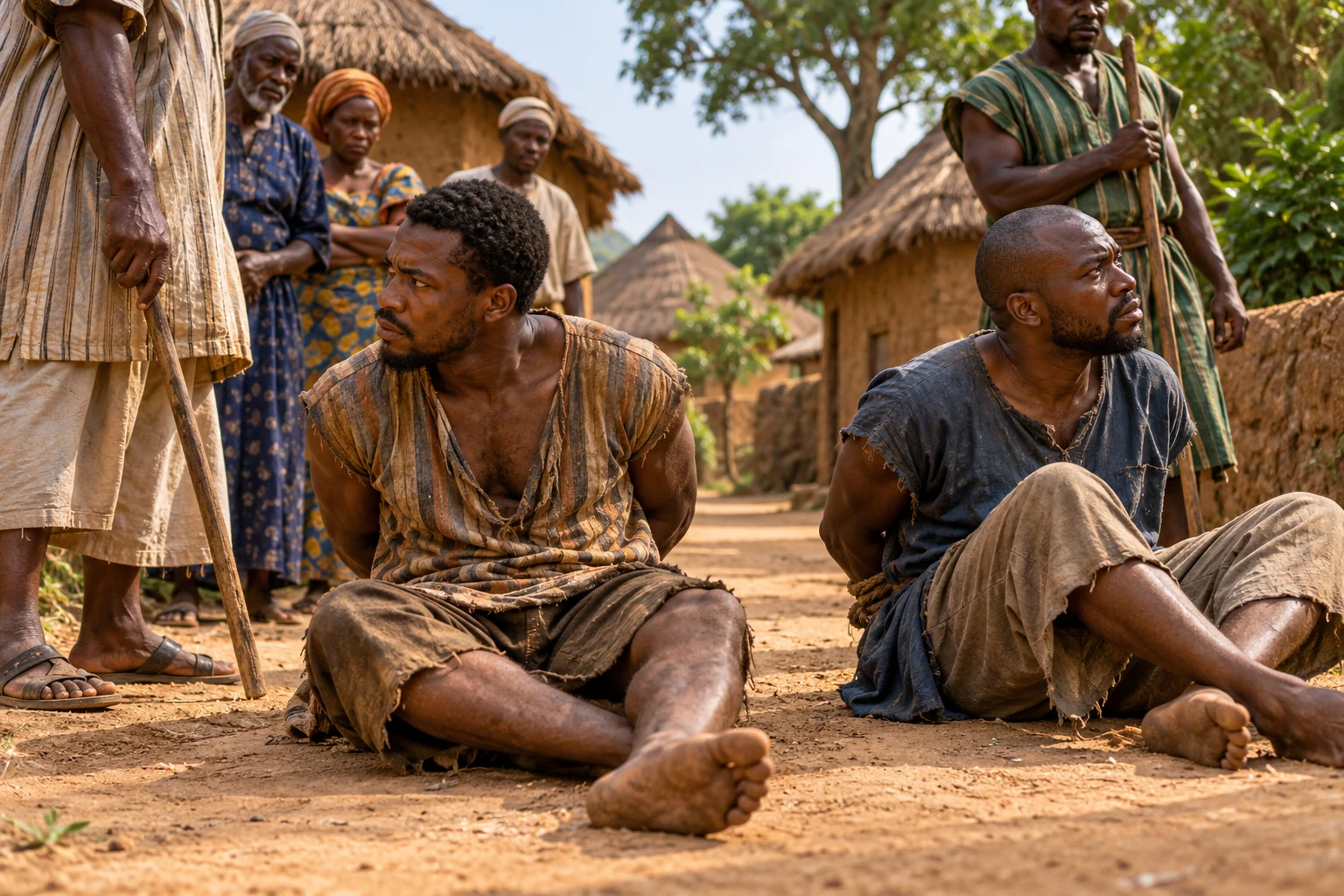
Two thieves seek divination before setting out on their usual activity. They are warned about capture and restraint but dismiss what they hear. Their intended adventure ends with them being seized and tied. The account names theft dishonorable and presents the land as acting on behalf of its owner, so the moral frame concerns an injured party rather than merely the thieves’ bad luck.
A warning is treated as knowledge about responsibility, not a technique that would make theft acceptable. The story’s sacrificial framework should not be read as a purchasable exemption from consequences. Its productive tension is whether someone seeks guidance in order to reconsider an action or only to secure success at an action already chosen, regardless of the harm it creates for others.
Narrative setting: Passage explicitly headed Revelações de Epega Afolabi.
The drum’s exhausted body becomes a tighter instrument
Gongon, a large drum, is preparing to perform far from home. Consultation warns that the journey may end in binding, but the response is not completed. The performance is initially impressive and draws prolonged dancing. When the drum becomes exhausted, Èṣù tells the listeners that fastening its head tightly will improve the music. The sound becomes more compelling as the tension increases, until the head bursts and the instrument’s pieces are discarded. The account narrates a performer whose success intensifies the audience’s use of the very body making the performance possible.
The drum is simultaneously an agent who travels and a material instrument tightened by others. That double condition gives the episode a specificity beyond a warning against overwork. Its capacity attracts an audience, but the audience interprets fatigue as a technical opportunity for further output rather than a limit. Within the religious account, the omitted exchange and Èṣù’s intervention explain why that vulnerability becomes consequential; the narrative is not simply an industrial fable from which the divine agent can be removed.
The earlier Moyare story also concerns a power directed by another person, though its problem is delegated destruction rather than entertainment. The thieves add a different relation to restraint: binding there follows intended wrongdoing, while the drum’s binding follows useful performance. Keeping those cases distinct prevents a simplistic reading that anyone restrained must deserve it. The unresolved issue is how a gifted or specialized body remains more than its product when others can make an intensification sound like admiration.
Narrative witness and setting: Account explicitly headed Revelações de Cromwell Osamaro
The elephant whose death crosses two claims
A farmer and a hunter are friends and each receives counsel about a future gain: one about securing an unexpected gift, the other about benefiting from fortune already pursued. Both dismiss it. The hunter later shoots an elephant, which dies on the farmer’s land. The farmer sees a gift and summons help; the hunter follows the animal’s tracks and blood. Their conflicting claims reach the ruler, who calls their shared diviner. The farmer then completes his response, while the hunter refuses. A royal adviser invokes a local convention assigning a dead animal to the land where it falls, and the farmer prevails.
The episode places labor, location, customary judgment, and sacred obligation within one disputed gain. The hunter’s effort is real, yet the narrative’s eventual judgment depends on more than effort alone. The farmer’s field supplies a different relation to the animal’s final place, while Èṣù’s influence on the adviser makes the legal convention spiritually consequential rather than an independent secular mechanism. This should be described as the account’s particular order, not cited as current law or a universal Yoruba rule of ownership.
The initial friendship is also important: proximity to a diviner makes the men dismiss advice that they might have taken more seriously from a stranger. Read beside the earlier thieves, the story complicates possession. Those thieves seek what belongs to another; here two friends each understand the same animal as properly theirs. The account does not fully reconcile the hunter’s labor with the judgment, leaving a meaningful tension between deserving through pursuit and receiving through place and addressed relationship.
Narrative witness and setting: Account explicitly headed Revelações de Cromwell Osamaro
What was born in this Odù
“Born” can name an explicit traditional origin association or what emerges through a story: a capacity, relationship, practice or order of life. Interpretations drawn from a narrative are labelled below, so their basis remains clear.
Dry wine
Selected traditional source association.
Dry wine appears in the sign’s explicit origin list. It is a source-specific association with a transformed beverage and social consumption, without establishing a universal rule about drinking or a historical invention claim.
Spirits and beer
Selected traditional source association.
Distilled spirits and beer are named alongside wine. They may support a narrowly framed concern with altered states and social responsibility, but the selected passage supplies no defensible universal alcohol prohibition or character diagnosis.
Correlations to life dimensions
These questions bring the selected stories into contemporary life. They are interpretive invitations for study.
Work and resources
The theft account names an owner whose interests the thieves disregard. The story centers the ethics of acquisition, asking whether gaining a resource has been separated from the person or community that bears the cost.
Reflect: Who loses when your plan succeeds?
Relationships and family
Moyare’s brother is also a source of intended harm. Kinship alone does not guarantee protective conduct, and the narrative locates safety in careful alliances and intervention rather than unquestioning family trust. Moyare’s poverty does not cancel his claim to protection.
Reflect: What boundary is needed even within a close relationship?
Character and inner life
The thieves ask for counsel without becoming willing to change direction. This distinction is useful when a person gathers advice mainly to strengthen an intention whose consequences they have already refused to examine. The rejected warning concerns harm already intended by its recipients.
Reflect: Are you asking for understanding or permission?
Community and responsibility
Tenta Orun’s delegated role makes responsibility extend through a chain of command. The story permits scrutiny of the people who instruct, enable, and redirect an action, rather than attributing everything to the last visible actor.
Reflect: Where does your responsibility continue after delegation?
A deeper reading of the sacred relationships
Èṣù acts within the passage from capacity to outcome
The drum can make music before the decisive crisis, and the hunter can bring down an elephant before losing the final gain. Their capacities are not denied; what remains unsettled is how an act becomes a durable benefit. In the selected witness, Èṣù shapes that passage, tightening the relation between an omitted sacred obligation and its consequence. The earlier Moyare narrative gives him a mediating role in redirecting another power, while the thieves neglect counsel before capture. These are distinct actions of a consequential divine agent, not merely an allegory of chance. Explaining that internal logic makes it possible to compare effort and outcome without promising that a contemporary reader can control either through a borrowed formula.
Restraint does not have one moral meaning
Binding the thieves follows an explicitly dishonorable intended act. Tightening Gongon follows a successful performance and the audience’s desire for more. Moyare’s danger involves a power bound to someone else’s destructive command, while the disputed elephant involves rules determining who can retain a gain. The same broad vocabulary of control consequently names punishment, exploitation, delegated service, and adjudication in different stories. A source-conscious discussion should resist treating control as inherently good or inherently bad before asking whose agency it regulates and why. This also protects the religious context from becoming an undifferentiated slogan about freedom: the accounts themselves recognize obligations while disagreeing in their narrative conditions about what their fulfillment or neglect produces.
A shared history can obscure a specific obligation
The farmer and hunter are close to the practitioner and therefore treat his earlier counsel lightly. Their familiarity does not supply an agreed account of the later elephant. In the Moyare account, brotherhood likewise does not prevent one person’s harmful use of power from endangering another. The comparison should not become a warning that intimate people are inherently unsafe. It instead distinguishes a relationship’s name from the particular responsibilities a new situation creates. Shared history can support trust, but cannot decide every disputed claim or make every delegated act legitimate. The drum’s audience offers a nonfamilial parallel: admiration establishes proximity without ensuring care for the performer’s continuing capacity.
Questions that deepen the study
Does the elephant judgment prove effort has no value?
No. The story explicitly preserves the hunter’s pursuit and the evidence by which he reaches the field. His difficulty concerns the conversion of that effort into an undisputed claim, not whether the pursuit occurred. The farmer has a different relation to the animal’s final place, and the account places the outcome inside sacred exchange and a cited convention. A careful explanation can state that logic without pretending it resolves every modern ownership dispute. The value of the episode is the tension among several grounds for entitlement. Reducing it to either hard work always wins or hard work never matters would discard the narrated conflict.
Why is Gongon’s better music also a sign of danger?
The sound improves while the body producing it is placed under increasing tension. The listeners therefore receive a benefit that can conceal a worsening condition. This is the episode’s sharp distinction between output and continued capacity. Within the sacred narrative, Èṣù’s intervention follows omitted counsel and exposes the journey’s anticipated binding. A contemporary application may ask how people respond to a performer’s fatigue, but it should not turn the event into a diagnosis or presume that achievement proves someone is thriving. The drum’s final destruction also leaves the audience’s responsibility open; the story does not require the reader to applaud their treatment of its body.
What links these stories to the earlier intermediaries and thieves?
All four ask how a person or power participates in an outcome larger than an isolated intention. Moyare is endangered through a commanded agent; thieves plan acquisition without regard for an owner; the drum’s audience transforms performance into increasing bodily use; the friends seek an authoritative settlement of incompatible claims. Their spiritual relations are not identical, so Èṣù’s involvement should be explained episode by episode. A contemporary reader can ask about responsibility across a chain of action, while avoiding the conclusion that every disappointing result has the same hidden cause. The particular relation determines what kind of accountability the story can support.
What the four narratives reveal together
The added Osamaro-attributed witnesses deepen Òdí Òkànràn through the uncertain passage between an action and what follows from it. Music can intensify while the performer is being destroyed; successful hunting can end in another claimant receiving the animal. These complications sit beside the earlier delegated harm and attempted theft without repeating them. The sources do not treat ability as unreal, but insist that outcomes are shaped by relations with divine powers, other participants, place, and obligation.
That religious order deserves explanation on its own terms before modern comparisons about labor or ownership are introduced. The four accounts also prevent a fixed interpretation of restraint: it may expose wrongdoing, intensify exploitation, bind an intermediary, or settle a dispute. Their differences contribute depth by refusing an easy equation of visible success with fulfilled destiny or of a bad outcome with one universally applicable moral failure.
Living with this Odù
A continuing life or initiatory relationship
For someone whose received life or initiatory history includes Òdí Òkànràn, responsibility does not disappear when an action passes through another agent. Awó Abití’s destructive commands and Elegbara’s imperfect intervention make careful listening important even when the aim is to change a harmful arrangement. Intention alone cannot guarantee that a condition has been understood. The thieves add that counsel cannot be used merely to make a chosen injury succeed without consequence.
Gongon’s exhausted body complicates the theme of restraint. Its binding follows valued performance, while the thieves’ binding follows intended wrongdoing; outwardly similar constraints have different moral histories. The elephant dispute adds competing claims whose resolution involves labor, place, local convention, and Èṣù’s action. A lifelong interpretation therefore asks more than whether the person has worked hard or followed an instruction. It examines who is affected, what authority governs the relation, and whether admiration is disguising extraction. Circumstances may call for reconsidering a delegated act, defending a useful body, or understanding a dispute in which several kinds of claim are real. The sign does not promise punishment or vindication. It invites character able to remain answerable beyond the point where responsibility becomes inconvenient.
A particular consultation and its question
In consultation, Òdí Òkànràn can help distinguish responsibility for intended harm from vulnerability created by useful service. The thieves knowingly pursue another’s property, whereas Gongon supplies music and becomes increasingly tightened when exhaustion is noticed. A restrained or depleted client cannot therefore be assumed to deserve the condition. The narratives’ religious explanations retain their own scope, including Èṣù’s intervention; contemporary reasoning must also hear the actions of those using the performer.
The intermediary episode asks whether a commitment has been understood before it is accepted, especially when someone claims to act on another’s behalf. The elephant dispute asks which kinds of claim meet in the same outcome: pursuit, location, customary judgment, and addressed sacred relation are not identical. A practitioner might examine whether the client seeks guidance to reconsider conduct or only to secure an outcome already desired. That question does not establish wrongdoing. It makes space for a more exact account of agency and dependence. The actual consultation supplies the relevant context; the stories cannot diagnose bodily harm, identify an enemy, or state current property law. A present result opens discernment about this arrangement rather than a permanent character judgment on the person receiving it.
Constructive and adverse possibilities
Constructive unfolding can involve withdrawing an injurious command, understanding a consequential condition, and recognizing a body’s limits before appreciation becomes intensified use. Counsel has ethical force in the thieves’ story: it is not a purchase that transforms an intended wrong into an acceptable undertaking.
Adverse unfolding may arise through delegated destruction, warnings treated as obstacles to ambition, or fatigue interpreted as an opportunity to demand more. The elephant episode adds unresolved competition between effort and place, with Èṣù participating in the particular judgment. Its outcome does not establish that the losing claimant’s labor was imaginary. These differences prevent a formula in which every restraint means punishment or every gain proves righteousness. The possible directions concern how power, limits, and responsibility interact. They cannot determine the state of an unknown reading or make a sacred narrative a rule of modern ownership.
An illustrative situation in everyday life
Imagine a hypothetical performer whose successful event becomes an annual expectation. When she reports exhaustion, organizers propose a larger audience and tighter rehearsal schedule because they believe success proves further capacity. She feels that refusal would betray the people who admire her. Gongon’s narrative clarifies the external arrangement: fatigue is being used as a reason for intensification rather than heard as a limit. The intermediary account adds the question of who has promised additional labor on her behalf. Choices include revising commitments, identifying who can authorize work, and allowing support to be measured by conditions rather than applause. This example does not explain exhaustion through sacred punishment; it uses the distinctive performer structure to distinguish appreciation from an increasingly extractive demand.
Sources and reading context
The first two narrative witnesses
The first account is Cuban-style and the second is explicitly attributed in the compilation to Epega Afolabi. That attribution is reported, not independently authenticated. Stigmatizing medical claims and a contradictory rich/poor anecdote are excluded from the selected evidence.
Narrative motifs are summarized independently. The life-dimension reflections are contemporary interpretation. How these reference studies are built explains the wider source approach and the distinction between a reference article and personal divination.
Additional named witnesses
-
Cromwell Osamaro. The explicit heading covers Gongon’s journey and the farmer/hunter elephant dispute.
-
Epega Afolabi. The earlier thief account is explicitly attributed separately and is used only for comparison with the new witnesses.
The elephant convention is a claim within this narrative, not verified current law. The drum’s personification is not treated as instrument history. Exact editions remain unresolved, and attached personal predictions or ritual directions are not reproduced.
Bibliographic identification
-
C. Osamaro Ibie. Ifism: The Complete Work of Orunmila. Lagos; multivolume publication beginning 1986. Library catalogue record. Related bibliographic record for the named narrative witness. Exact volume, edition and page of the transmitted account have not been independently matched.
-
Afolabi A. Epega and Philip John Neimark. The Sacred Ifa Oracle. San Francisco: HarperSanFrancisco, 1995. Library catalogue record. First-edition bibliographic record. The particular edition underlying the narrative witness has not been established.
Read the source method and wider scholarly context.
The catalogue links identify published works and their authors. They are separate from proof of an individual episode’s wording or attribution. Contemporary comparisons and the synthesis above are editorial interpretation. The author’s books and Academy companions below provide further study; their sales links are separate from the source references.