
Òdí Ògúndá is a mixed Odù in Ifá’s 256-part corpus. Òdí Ògúndá’s selected accounts bring the care of a household beside a dispute over religious initiation. Obatalá leaves a disorderly family and returns after its members change how they live. In another story, Oyá initiates her son despite Ṣàngó’s objection, and the completed ceremony does not settle concerns about his conduct. Both accounts make outward arrangements insufficient by themselves: belonging must be supported by practices of care and responsibility.
A question to carry through the study: What daily conduct must support the belonging or title you have acquired?

This Academy reads the right column first, then the left. Each row carries a single or double mark.
Where this Odù belongs
Òdí Ògúndá belongs to the Òdí family in this Academy’s study sequence. It is a mixed Odù, distinct from Ògúndá Òdí. The order matters. Its teaching is approached through its own narratives, rather than by adding two general descriptions of the principal signs together.
Key Òrìṣà and sacred relationships
The figures below are selected for their roles in the accounts discussed here. They offer connected reading paths through the tradition.
-
Obàtálá. Obatalá leaves a household whose members disregard shared care, then returns and recognizes their changed environment. His role gives domestic order a relational rather than merely decorative significance.
-
Ọ̀rúnmìlà. Òrúnmìlà advises the youngest child on the family’s rupture and later conducts the disputed initiation of Ṣàngó and Oyá’s son, placing him inside both selected conflicts.
-
Ọya. Oyá arranges her son’s successive initiations without Ṣàngó’s agreement. This specific maternal action is central to the narrative’s tension between protective intention and contested judgment.
-
Ṣàngó. Ṣàngó’s objection concerns the child’s expected conduct rather than the ceremony’s technical completion. He arrives after initiation and warns that status will not guarantee trustworthy service.
Key myths and their meanings
The house made habitable again
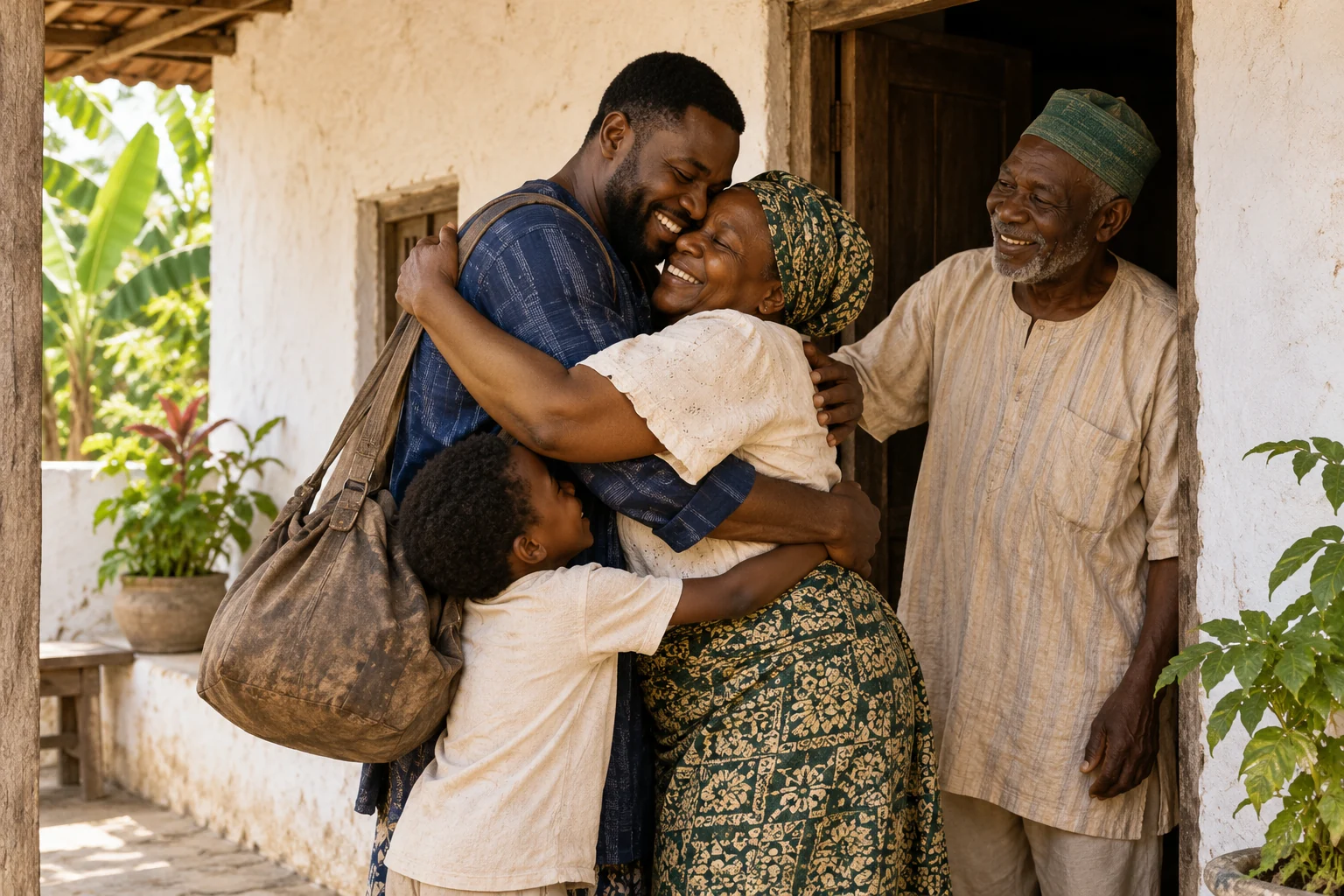
Obatalá’s children neglect the house and live in constant disturbance, so he leaves them. After their circumstances worsen, the youngest seeks Òrúnmìlà. The children alter their surroundings and manner of living. Meanwhile, Obatalá’s solitude becomes difficult. He enters an attractive white house and discovers his children there; their embrace and changed home allow a reunion that the earlier arrangement could not sustain.
The family’s repair includes both a changed environment and a renewed relationship. The father’s solitude also matters, preventing a reading in which dependence belongs only to the children. Cleanliness functions as narrative evidence of changed care, but should not be converted into a judgment on poverty or illness. The question is how a shared space expresses regard for those who must inhabit it together.
Narrative setting: Account explicitly labeled Cuba.
The initiation completed against objection
Ṣàngó tells Oyá that he does not want their son initiated. She nevertheless takes him through Palo and Lukumí consecrations, then brings him to Òrúnmìlà for Ifá. Ṣàngó arrives after the ceremony and learns the sign received. He warns that the child will not serve the religion faithfully and will betray Òrúnmìlà, leaving the family with an accomplished initiation but unresolved questions about conduct.
The account separates possessing religious status from practicing the responsibilities associated with it. It also depicts a serious failure of shared deliberation: one parent’s decision is presented to the other only after it becomes irreversible. The story asks us to examine how institutions assess readiness and respond to disagreement, while avoiding the narrative’s foretelling as a basis for judging actual initiates by their sign.
Narrative setting: Spanish Cuban/Lukumí and Palo account.
Akoko’s desolate ground becomes a sacred dwelling place
Akoko, called a tree of life, consults before coming into the world and is warned that a difficult beginning will precede a respected later life. The tree arrives at a refuse place and receives repeated degradation from people. Èṣù later remembers its completed sacred response and advises a prospective householder to build nearby. The person clears the surrounding rubbish before constructing a home. Religious activity begins at the tree’s foot, with visible signs of sacred attendance. The place once treated as available for waste becomes a place of worship and settlement, while the tree outlasts the individual who planted it.
The change begins through a remembered religious obligation and a redirected human dwelling, not through the tree simply deciding to regard itself differently. Èṣù’s memory matters because a completed act can remain consequential through a period when its benefits are not publicly visible. The householder’s clearing also gives the change a material sequence: reverence is accompanied by work on the surroundings. Compared with Obatalá’s earlier homecoming, this is not the return of a parent after children have altered a household, but the emergence of a sacred center where a living presence had been degraded.
Both accounts connect dwelling with an environment that makes relation possible. Yet Akoko’s narrative should not become an instruction that mistreated people must endure indefinitely until later honor arrives. It describes this tree’s sacred history and the agency of others who eventually change its conditions. The tree’s long duration also adds a timescale that exceeds one successful household or a single person’s later reputation.
Narrative witness and setting: Account explicitly headed Revelações de Cromwell Osamaro
Legbá’s frightening visitor tests Mavu’s protectors
The Fá signs gather nightly to protect Mavu and receive gifts, while Legbá receives nothing. He asks whether their collective presence would withstand a calamity, but they jeer. Legbá then animates a frightening, noisy figure and sends it toward the dwelling. The signs scatter into different divine rooms and hiding places, while Jiogbe stays at the portal. When they return, they question the one who remained as though he had also fled. Mavu calls Legbá to account. After hearing his grievance and seeing what his action revealed, Mavu assigns him a protective place at the entrance.
The account offers a Fon/Fá witness whose theological vocabulary must not be translated wholesale into a Yoruba deity list. Its Portuguese rendering itself moves between Mavu and Oduduá, an identification that should be reported as a feature of the witness rather than declared universal. Within its religious logic, Legbá’s animated figure is effective, the signs occupy a divine household, and the portal assignment changes responsibility among real sacred presences. His challenge also reveals that receiving gifts for protection does not establish the capacity to remain during fear.
Read beside Akoko, Legbá is another excluded or degraded presence whose standing changes, but his method is active disruption rather than patient survival. The earlier initiation dispute provides a third question about qualification: a completed religious status does not settle whether its bearer will act responsibly. The fright test remains ethically mixed, since Legbá produces the very emergency demonstrating his value. Recognition follows a disclosed weakness, not an independent proof that every disruptive claimant deserves authority.
Narrative witness and setting: Passage explicitly attributed to Bernard Maupoil and titled Di-Guda, using Fon/Fá names
What was born in this Odù
“Born” can name an explicit traditional origin association or what emerges through a story: a capacity, relationship, practice or order of life. Interpretations drawn from a narrative are labelled below, so their basis remains clear.
Royal messenger drum
Selected traditional source association.
The explicit origin list names the ilu, described as a messenger drum of kings. This associates the sign locally with communication and authority, without identifying every drum practice or treating all drumming as an identical institution.
Recorded voice
Selected traditional source association.
The origin list includes recording the voice. This unusual association can support reflection on preserved speech and accountability, but it is not evidence that a particular technology was historically invented under the sign.
Traps and falsehood
Selected traditional source association.
Traps and lies appear together in the origin list and nearby initiation narratives. They establish a moral concern in this compilation, not a diagnosis that people associated with the sign are inherently deceitful.
Correlations to life dimensions
These questions bring the selected stories into contemporary life. They are interpretive invitations for study.
Work and resources
The drum and recorded-voice associations make communication a resource with continuing effects. Read beside the initiation dispute, they invite attention to statements that establish expectations before a decision is made and records that survive afterward.
Reflect: Which agreement needs to be stated before action begins?
Relationships and family
The homecoming depends on changes that other family members can encounter directly. Reconciliation is not only a spoken request for forgiveness; the shared conditions that made living together difficult must also become different. The changed house lets others evaluate the new claim.
Reflect: What observable change would make a reunion sustainable?
Character and inner life
The disputed initiation leaves a gap between title and trustworthiness. That gap can be examined without accepting predictions about a child’s destiny: belonging creates work that no ceremony can complete on another person’s behalf. The family’s disagreement survives the completed act of admission.
Reflect: How are you practicing the responsibility attached to your role?
Community and responsibility
The narrative crosses named Palo, Lukumí, and Ifá settings. It can prompt questions about institutional responsibility when a candidate arrives through family pressure, divided consent, or prestige rather than an adequately shared account of readiness.
Reflect: How does your institution make room for principled objection?
A deeper reading of the sacred relationships
Different sacred households must retain their own order
The Maupoil-attributed Di-Guda account names Mavu, Legbá, Fá, and Jiogbe in a divine household with named rooms and differentiated responsibilities. The Osamaro account names Èṣù in Akoko’s remembered exchange and emerging sacred site. These can be compared without treating their names as interchangeable aliases. In each, dwelling is spiritually consequential: powers and persons establish where protection, worship, and memory are located. The earlier Cuban Obatalá household and Palo/Lukumí initiation passage add further institutional settings rather than supplying a single original template for them all. A strong interpretation can preserve the internal order of each witness before asking what they contribute to a shared discussion of qualification and care.
Duration distinguishes a sacred presence from a present judgment
Akoko survives degradation and the eventual householder, giving the source’s tree a continuity longer than public esteem. Legbá’s position, by contrast, changes through a dramatic night that exposes an immediate failure. Obatalá’s homecoming follows changed household conduct, while the initiation dispute leaves a question after the ceremony has already finished. These are four different relations between time and judgment: long survival, sudden disclosure, observed reform, and unresolved status. Contemporary reflection can use that variety to avoid equating current treatment with final worth. Yet it should also avoid promising later vindication to every person mistreated now, because the sacred history of Akoko is a particular account rather than a general schedule of justice.
A protective office can be tested and contested
Mavu’s signs occupy a protective role before Legbá’s figure approaches, but only Jiogbe remains at the entrance. The story distinguishes appointment, reward, and actual conduct under pressure. The earlier initiation account likewise distinguishes acquiring status from faithful service. Those parallels do not make a frightening ordeal the proper modern way to test people: the source’s own narrative has Legbá manufacture the event that establishes his later standing. A critical contemporary lens can ask whether an assessment reveals capacity fairly or creates dependence on the assessor. The religious account remains more than that lens, because the final portal role is an actual change in sacred responsibility within its named divine household.
Questions that deepen the study
Does Akoko’s later honor justify its earlier mistreatment?
No. The account narrates a passage through degradation, but the eventual sacred use of the site does not require approving how people treated the tree. Èṣù’s remembrance and the householder’s clearing change the conditions rather than declaring the refuse harmless. This distinction preserves the story’s religious sequence without turning it into a demand for passive endurance. A contemporary reader can recognize that a presence has value before others acknowledge it, while still asking what concrete help should arrive now. The narrative’s later time belongs to Akoko’s sacred history; it is not evidence that every neglected person will necessarily receive compensation if they wait long enough.
Should Legbá’s appointment be read only as a reward for deception?
The episode also concerns exclusion from an existing pattern of gifts, a refused warning, and the actual behavior of appointed protectors. Legbá’s frightening creation exposes a weakness the group would not discuss. Mavu’s response recognizes his consequential capacity and assigns responsibility at the portal. That does not make the method ethically uncomplicated, since he creates the threat used to prove the point. A careful study can preserve both the religious appointment and that tension. It should not turn the account into a universal rule that causing disruption earns office, or flatten the scene into a secular workplace parable that has no need for the divine household.
What is lost by calling every named figure an Òrìṣà?
The Maupoil-attributed witness uses a Fon/Fá setting, with its own names, rooms, and relations. Replacing them automatically with a Yoruba list would hide the very evidence that makes it a distinct witness. The source’s internal use of both Mavu and Oduduá should also remain an attribution question rather than being silently corrected into a universal equivalence. Comparative reading can identify similar concerns—threshold responsibility, sacred exchange, and exclusion—without claiming identical cosmologies. The earlier Cuban account explicitly crosses Palo, Lukumí, and Ifá settings, which likewise need their own names. Greater authority comes from preserving those differences, not from making a larger apparent list by collapsing them.
What the four narratives reveal together
The two new witnesses make Òdí Ògúndá’s concern with dwelling and qualification more theologically distinct. Akoko becomes the enduring center of a sacred site through remembered exchange and changed surroundings. Di-Guda places Legbá and the Fá signs inside a divine household where a frightening test changes protective responsibility. The earlier Cuban homecoming and initiation dispute remain separate: one narrates observed reform, the other leaves status and conduct in unresolved tension. Taken together, the accounts show that belonging, office, and effective service are related but not identical.
They also resist a single model of change, ranging from long endurance to sudden disclosure. Their comparison should preserve Ifá, Fon/Fá, Palo, and Lukumí settings rather than treating them as labels for one institution. Modern questions about testing authority or responding to neglect can be drawn from this variety, while the sacred actions remain real within the worlds the witnesses describe.
Living with this Odù
A continuing life or initiatory relationship
For someone carrying Òdí Ògúndá within a received spiritual history, belonging requires conditions that status alone cannot provide. Obatalá’s reunion occurs in a changed household, not simply after the children repeat that they want him back. His solitude also reveals mutual need. The initiation dispute introduces a different problem: completing ceremonies across the narrated Palo, Lukumí, and Ifá contexts does not settle disagreement about readiness or future conduct.
Akoko’s changing surroundings extend dwelling beyond one family. A place treated as waste becomes a sacred center through Èṣù’s remembered relation and another person’s work. The tree does not achieve this merely by enduring degradation with a better attitude. Maupoil’s Fon Di-Guda witness adds Legbá’s excluded labor and the protectors’ uncertain performance, retaining Mavu and the Fá setting rather than absorbing them into a standardized Yorùbá cast. Across a life, reflection can ask whether a title has outpaced conduct, a home has become uninhabitable, or a contributor’s place remains unrecognized. These are changing situations. The sign does not mark every initiate as unfaithful or require every mistreated person to await eventual honor. It invites responsibility for the relationships and environments through which belonging becomes real.
A particular consultation and its question
A consultation involving Òdí Ògúndá needs to distinguish an outwardly accomplished event from the conditions required to sustain it. The initiation account leaves conduct and shared deliberation unresolved after religious status has been acquired. That does not authorize forecasting betrayal by a real initiate. It offers a question about what has and has not been settled. Obatalá’s homecoming supplies another distinction: desire for reunion and a habitable shared life are related but separate achievements.
Akoko’s account asks how an environment can change when others begin to recognize a sacred presence they previously degraded. Its later honor is not a command that an endangered client should endure indefinitely. In the Fon witness, Legbá’s grievance and the signs’ conduct introduce the difference between claiming protection and demonstrating it under pressure. The actual consultation may concern readiness, reciprocal dependence, public responsibility, or exclusion; the name alone does not select one. Religious mediation remains active in each witness, while their traditions remain distinct. A careful conversation can identify what daily arrangement supports the desired belonging and whose perspective has been absent. The result concerns the present question, not a permanent verdict on a family, institution, or person associated with the sign.
Constructive and adverse possibilities
Constructive unfolding may include a dwelling changed enough for renewed relationship, a sacred presence recognized through material care, and a contributor receiving an accountable place. Obatalá’s need and the children’s need can both be heard without making one erase the other. Akoko’s transformation retains Èṣù’s memory as a consequential religious relation.
Adverse unfolding can involve assuming that a title guarantees conduct, presenting an irreversible decision after refusing shared deliberation, or celebrating protectors whose response has not been examined. The Fon witness’s Legbá is neither merely an excluded employee nor an interchangeable Yorùbá name. His action belongs to its divine household. These contrasts locate possibilities in particular relationships. They do not make the sign a forecast of betrayal, identify actual family poverty with neglect, or turn eventual sacred honor into a justification for present degradation.
An illustrative situation in everyday life
In a hypothetical example, a volunteer association welcomes a new director through an impressive ceremony while members disagree about the responsibilities involved. Its building remains inaccessible and poorly maintained, and the caretaker whose work sustains it is omitted from decisions. Òdí Ògúndá’s initiation and homecoming distinguish formal belonging from the environment that can support it. Akoko adds that recognition becomes material when people change how a place is treated. The director may feel that admitting unfinished work would invalidate the appointment. A more exact response would clarify duties and repair the arrangement without pretending the ceremony accomplished everything. This illustration preserves the gap between modern institutional reasoning and the distinct sacred agents through whom the narratives explain change.
Sources and reading context
The first two narrative witnesses
The sources explicitly distinguish Cuban, Palo, Lukumí, and Ifá settings within the selected initiation account. These are reported as narrated contexts, not merged into one tradition. Synthetic interpretation following the homecoming story is excluded from the evidence.
Narrative motifs are summarized independently. The life-dimension reflections are contemporary interpretation. How these reference studies are built explains the wider source approach and the distinction between a reference article and personal divination.
Additional named witnesses
-
Cromwell Osamaro. The explicit heading covers Akoko’s heavenly preparation, degradation, and emergence as a sacred dwelling center.
-
Bernard Maupoil; Fon/Fá Di-Guda witness. The explicit attribution and Di-Guda heading introduce the Mavu/Legbá protective-household account.
The Maupoil attribution is explicit, but exact edition and page remain unverified. The Portuguese rendering equates or alternates Mavu and Oduduá; this is not promoted to a universal identity claim. Di-Guda remains a Fon/Fá witness, not a Brazilian tradition inferred from language.
Bibliographic identification
-
C. Osamaro Ibie. Ifism: The Complete Work of Orunmila. Lagos; multivolume publication beginning 1986. Library catalogue record. Related bibliographic record for the named narrative witness. Exact volume, edition and page of the transmitted account have not been independently matched.
-
Bernard Maupoil. La Géomancie à l’ancienne Côte des Esclaves. Paris: Institut d’ethnologie, 1943. Library catalogue record. Historical bibliographic context for the Fon Fá witness; Fon and Yorùbá traditions retain their distinct settings.
Read the source method and wider scholarly context.
The catalogue links identify published works and their authors. They are separate from proof of an individual episode’s wording or attribution. Contemporary comparisons and the synthesis above are editorial interpretation. The author’s books and Academy companions below provide further study; their sales links are separate from the source references.