
Òdí Òyèkú is a mixed Odù in Ifá’s 256-part corpus. The selected Òdí Òyèkú material contrasts the blue jackal’s fraudulent kingship with masks that gain public value through carving, dancing, and renewal. Appearance can deceive, but fashioned appearance can also serve an acknowledged communal purpose. The key distinction is the relationship behind the visible form: denial of one’s own companions in the jackal story, and responsibility for a material body in the mask story. Recognition is never presented as self-sustaining.
A question to carry through the study: Does the recognition you seek depend on concealing a relationship you should acknowledge?
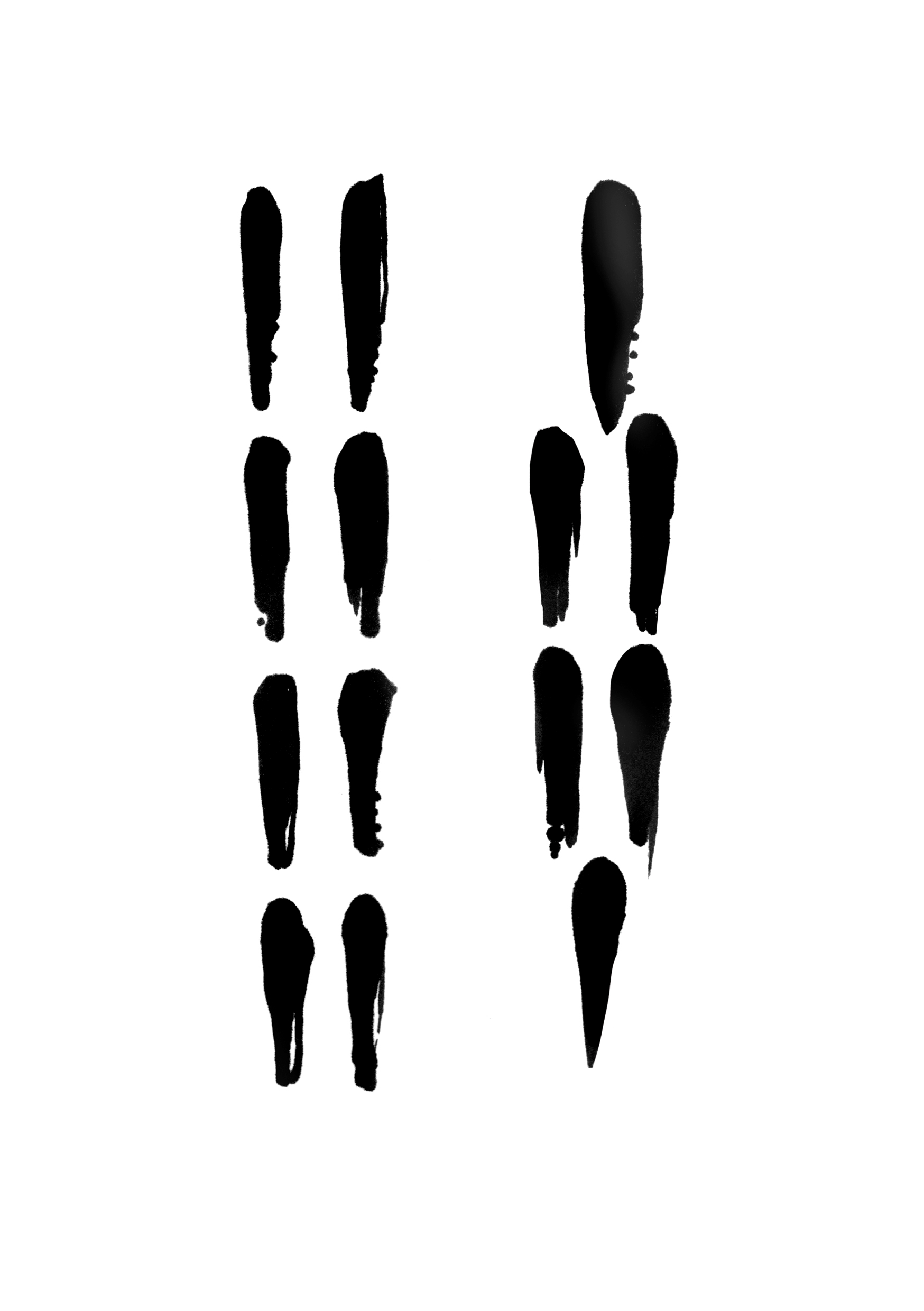
This Academy reads the right column first, then the left. Each row carries a single or double mark.

Where this Odù belongs
Òdí Òyèkú belongs to the Òdí family in this Academy’s study sequence. It is a mixed Odù, distinct from Òyèkú Òdí. The order matters. Its teaching is approached through its own narratives, rather than by adding two general descriptions of the principal signs together.
Key Òrìṣà and sacred relationships
The figures below are selected for their roles in the accounts discussed here. They offer connected reading paths through the tradition.
-
Ọ̀rúnmìlà. Òrúnmìlà advises the trees about consideration and protection, distinguishing the honor they seek from the ongoing care their material bodies also require.
-
Ògún. Ògún carves faces into the tree and prepares masks for public use. His craft turns wood into a shared religious medium whose deterioration remains consequential.
-
Èṣù. Elegbá notices the neglected obligation in the mask narrative and participates in explaining why respected objects still require renewal and protection from decay.
Key myths and their meanings
The blue ruler’s returning voice
A fleeing jackal falls into indigo dye and emerges blue. Other animals mistake the unfamiliar appearance for extraordinary authority. He claims a divine appointment, distributes offices, and excludes his own species. His rule lasts until he hears other jackals and involuntarily answers them. The sound discloses the identity his prestige depended on denying, and the subjects turn against him.
The disguise works because others surrender judgment to a startling surface. Yet the ruler also harms the ties that could have grounded him outside borrowed prestige. The story should not be used to police changes of status or identity. Its narrower concern is fraudulent entitlement and deliberate exclusion: a community’s fear helps construct an authority it later treats as entirely the deceiver’s creation.
Narrative setting: Spanish Cuban-style patakín in the selected account.
The honored tree and the masks
Trees seek consideration from Òrúnmìlà. Amojo alone acts on the first instruction but dismisses further protection after receiving honor. Ògún later carves masks from its wood. Their public dancing restores communal peace in a world troubled by disrupted generation. The masks’ exposure to termites explains why they must be renewed: recognition does not spare the tree’s transformed body from material deterioration.
The account separates acquiring a role from maintaining the conditions that let the role continue. Unlike the jackal’s fraudulent surface, these faces are openly made and collectively activated. Their authenticity does not make them imperishable. The lesson is not to fear decay, but to notice that care, replacement, and renewal can be part of respecting a tradition rather than evidence that it has failed.
Narrative setting: Spanish Cuban-style mask account.
An old settlement loses the road
Residents of an established settlement see people and wealth moving toward a newer community. Consultation concerns restoring the old place’s flourishing and includes a relationship with Èṣù and the earth power. The residents do not carry through the response. Authorities subsequently construct a road that diverts travelers and trade toward the new settlement. Visitors considering an industrial enterprise also choose the accessible place. Eventually the old residents move beside the highway themselves, and their former community disappears. The narrative makes a major change in public movement consequential to a place whose inhabitants had assumed an established settlement could continue.
The story combines a real spiritual obligation with a sharply observed account of circulation. Èṣù and the earth power are not merely decorative names for planning and infrastructure: within the account they are relationships through which a settlement’s continuity must be addressed. At the same time, the road and business relocation give the outcome a sequence more specific than a claim that neglect simply produces punishment. The older community loses the encounters that sustain it. This adds a different kind of material vulnerability to the earlier mask account.
Masks decay because their honored wooden body remains exposed; a settlement declines when routes of contact shift. Neither public recognition nor historical precedence automatically preserves the conditions of continued life. Contemporary analysis may examine transport policy and uneven opportunity, but should not claim that the consultation replaces such analysis. The unresolved question is how a community with limited resources responds when both sacred responsibility and external authorities shape a future it does not wholly control.
Narrative witness and setting: Account explicitly headed Revelações de Cromwell Osamaro
The meal that turns a joke into separation
Ojigbo visits his friend Oro and eats meat whose host later calls a snail’s leg. Rather than confront him immediately, Ojigbo invites him back and claims to serve a snake’s hand. Oro becomes angry at the impossible description and fails to recognize the reply to his own joke. Repeated explanation does not calm him. Their dispute reaches a ruler, who separates their activities into day and night. The passage gives contrasting food associations to the two figures afterward, but its clear narrative center is a friendship destroyed by an exchange whose participants refuse equal rules of interpretation.
The reciprocal joke is not identical for both friends because only one accepts the right to make it. Oro can present an impossibility as hospitality, but treats the corresponding response as an intolerable insult. That asymmetry makes the quarrel more than a generic warning about friendship. It concerns who controls the meaning of an exchange after another person has accepted food in trust. The royal settlement ends proximity rather than producing understanding; day and night become a durable separation between parties who cannot share the same interpretive space.
Read beside the blue jackal, the account shows another collapse of social appearance, but the mechanism differs. The jackal’s concealed identity is exposed by involuntary sound, whereas these friends know one another and cannot agree about what words permit. The translation’s unstable names and zoological terms should remain visible limitations. They do not authorize reconstructing an etymology, identifying Oro automatically with the Òrò institution, or converting the attached food rules into personal prohibitions.
Narrative witness and setting: Account explicitly headed Revelações de Cromwell Osamaro
What was born in this Odù
“Born” can name an explicit traditional origin association or what emerges through a story: a capacity, relationship, practice or order of life. Interpretations drawn from a narrative are labelled below, so their basis remains clear.
Masks for ancestors and Olókun
Selected traditional source association.
The origin list explicitly associates masks with ancestral and Olókun celebrations. The account does not license treating all African or diasporic masks as interchangeable or assigning these functions to every tradition.
Children
Selected traditional source association.
Children appear as a separate origin association. Read beside the troubled generation in the mask account, this is a source-specific image of continuity; it is not a promise concerning any reader’s fertility.
Correlations to life dimensions
These questions bring the selected stories into contemporary life. They are interpretive invitations for study.
Work and resources
Ògún’s carving gives material labor a place in sacred recognition. A public object depends on skilled making and subsequent maintenance, not only on the prestige attached to its final appearance. Its body continues to matter after recognition arrives.
Reflect: Whose craft supports the thing your community honors?
Relationships and family
The jackal excludes his own species to protect his new status. The episode makes the repudiation of companions part of the fraud, and asks what social belonging is sacrificed to maintain a flattering public image.
Reflect: Who becomes inconvenient when you protect your image?
Character and inner life
An unfamiliar color becomes a claim to supremacy. The narrative invites examination of the gap between being exceptional in appearance and being qualified to direct others. The animals mistake unfamiliarity for qualification to rule them.
Reflect: What evidence supports a claim you find impressive?
Community and responsibility
The masks require replacement because their material form remains vulnerable. Communal responsibility includes noticing wear and funding renewal, rather than expecting respected objects or institutions to maintain themselves. Renewal acknowledges the wood rather than denying its vulnerability.
Reflect: Which honored institution needs ordinary maintenance?
A deeper reading of the sacred relationships
Sacred continuity belongs to a place
The old settlement’s relationship with the earth power shows that residence is a religious relation as well as possession of land. Consultation seeks renewed flourishing through addressed powers, not simply through the residents deciding to think differently. The earlier mask narrative likewise links material forms with Egun: dancing and renewal matter because the masks participate in an actual ancestral relationship within that account. These strands should be explained before modern comparisons about maintenance or investment. Their common question is how a place or object remains connected to powers sustaining communal life. Their differences matter too: one story concerns neglected exchange before a road shift, while the other concerns honor, bodily exposure, and ancestral tranquility through masks.
Public life depends on routes of encounter
A settlement can possess houses and history while losing the movements that make those assets socially useful. The road redirects not only trade but prospective new enterprises and eventual residents. This is a different problem from the jackal’s fabricated prestige: the old place is not said to be fraudulent, only unable to preserve its position. Comparison prevents a simplistic idea that every decline reveals dishonesty. The mask story adds yet another case, where renewal can sustain a recognized function even as the original material form deteriorates. The selected accounts therefore offer several ways a social world can change: deception exposed, material support exhausted, circulation rerouted, and friendship separated after a failed exchange.
Reciprocity can fail through unequal interpretive rights
Oro and Ojigbo exchange meals, so outward reciprocity is present before the friendship fails. The problem is that a joke one person authorizes for himself becomes an offense when returned. This sharpens the earlier jackal story’s concern with unequal standing: its ruler banishes his own species while distributing roles to others, whereas the meal account preserves familiarity but denies equal permission to speak. The royal day-and-night division also differs from renewed masks. It preserves order through separation rather than restoring a shared space. An editorial account should keep both possible endings visible, since the source does not promise that every broken relationship can or should return to its earlier proximity.
Questions that deepen the study
Is the road story only a warning against resisting change?
It is more specific. The residents initially seek renewed flourishing rather than refusing every change, but do not complete the religious response described. The later highway is built by public authorities, so their fate is also shaped by decisions outside the settlement. A careful interpretation can recognize responsibility without assuming equal control over circumstances. The eventual move may be adaptation as well as loss. Nothing in the passage shows that remaining at all costs would have been better. Its religious logic concerns continuity through Èṣù and the earth power; a contemporary planning lens concerns access, investment, and routes that distribute opportunity unevenly.
Why does the ruler separate the friends rather than reconcile them?
The quarrel has reached a point where explanation no longer changes its meaning for Oro. The ruler therefore establishes different spheres of activity. Within the story, this gives a lasting form to a failed encounter rather than making the participants suddenly understand one another. It can be read as an acknowledgment that order sometimes requires distance, but should not become a universal instruction to abandon friends after disagreement. The episode gives no account of an attempted mediation beyond the explanations already offered. Its day-and-night pattern is a sacred narrative outcome, not evidence that contemporary relationships or religious institutions divide by the same rule.
What do these episodes add to the mask and jackal stories?
They make social change less dependent on either bodily appearance or individual deception. The road story locates a community inside routes and external decisions, while the meal story locates a friendship inside an unequal use of language. Masks and jackal both concern visible forms, but their forms differ ethically: masks are openly made for communal religious use, whereas the jackal claims unearned divine appointment. The new accounts prevent those two cases from dominating interpretation of the sign. They suggest asking what kind of relation is failing before proposing a remedy: material renewal, verified authority, altered access, and negotiated distance answer different problems.
What the four narratives reveal together
These additions place Òdí Òyèkú in a wider field of communal continuity. The old settlement loses the road through which trade and new residence might reach it; the friends lose the shared understanding that once made a meal possible. The earlier masks remain meaningful through renewal, while the blue jackal’s prestige collapses because it depended on concealed identity and repudiated kinship. The four outcomes should not be flattened into one moral about change.
Some forms can be renewed, some claims should be exposed, some places may be left, and some relationships are ordered through distance. Within the religious accounts, divination and addressed powers shape those outcomes rather than functioning only as modern metaphors. Contemporary readers can draw further questions about public access and reciprocal respect, provided those questions remain interpretations beside the traditions’ own explanations rather than replacing them.
Living with this Odù
A continuing life or initiatory relationship
A received relationship with Òdí Òyèkú can support a long inquiry into the conditions behind recognition. The blue jackal claims a sacred authorization that his conduct cannot sustain, while the masks have an acknowledged crafted form that still needs renewal. The distinction is not between natural appearance and every made appearance. It is between a deceptive claim that severs accountability and a communal form whose continuing material life requires care. A person can change roles without becoming fraudulent, and an authentic role can require replacement of its worn supports.
The settlement losing its road adds an external condition no individual personality can command. Historical standing does not preserve circulation when routes move elsewhere. Èṣù and the earth power retain agency in the witness’s religious account; planning alone cannot exhaust its meaning. The meal dispute adds a more intimate test: does the person accept from another the interpretive freedom they claim for themselves? Across a life, the appropriate question may shift from borrowed prestige to maintenance, from altered opportunity to unequal rules in friendship. None predicts inevitable exposure or decline. Together the narratives invite a character able to receive recognition, acknowledge its supports, and reconsider an arrangement before defending its appearance becomes the whole task.
A particular consultation and its question
When Òdí Òyèkú appears in consultation, resemblance to the jackal cannot justify announcing that someone is an impostor. The actual question may concern an unsupported claim, but it may instead concern the material renewal of a legitimate form, as in the masks. Both involve appearance and recognition, yet their implications differ. A careful conversation asks what evidence supports the claim and which relationship gives the form its meaning.
The old settlement introduces changed external circulation. A decline may involve decisions by authorities, altered access, and limited resources as well as the sacred response left incomplete in that witness. It cannot be reduced to the client’s attitude toward change. The reciprocal meal adds another distinction: misunderstanding may persist because one participant reserves privileges they deny the other. Clarification then differs from merely explaining the joke more often. The narratives help a practitioner examine deception, deterioration, changed conditions, and asymmetrical interpretation without making them identical. Religious relations remain present where the accounts name them, particularly Èṣù and the earth power. The present divinatory context decides which tensions become relevant; reading the sign’s stories does not assign a permanent identity of fraud, loss, or social rejection to an unknown person.
Constructive and adverse possibilities
Constructive unfolding can bring recognition grounded in accountable relation, renewed care for an honored material form, and attention to the routes through which a community remains connected. The mask account permits renewal to belong to continuity rather than signal failure. The settlement witness places that continuity within sacred as well as public conditions.
Adverse unfolding may involve borrowed authority maintained by exclusion, refusal to renew what is wearing out, or insistence that a longstanding place must flourish without responding to changed movement. In the meal dispute, the problem is unequal permission to define an exchange: humor becomes domination when reciprocity is rejected. These contrasts do not make every unusual appearance suspect or every declining community spiritually negligent. They distinguish ways a relationship can remain answerable from ways recognition can become detached from the conditions and people that sustain it.
An illustrative situation in everyday life
In a hypothetical example, a longstanding arts group loses visitors after transport routes change. Its director blames younger audiences and spends scarce funds on a grander public image. Meanwhile, costumes need repair and newer members are mocked for making jokes similar to those senior members enjoy making about them. The masks, bypassed settlement, and unequal meal together distinguish three issues: maintaining a real form, responding to altered circulation, and applying fair interpretive rules. The director’s embarrassment about diminished prestige is understandable but does not settle those issues. A revised program might address access and repair while making criticism reciprocal. This is an illustrative comparison, not a claim that the group has neglected the sacred relations described in the Odù witness.
Sources and reading context
The first two narrative witnesses
The selected narratives belong to the Spanish Cuban-style material. The blue jackal is a widely traveled fable motif; this compilation alone cannot establish its route into the account. Mask associations are reported locally, with no universal attribution asserted.
Narrative motifs are summarized independently. The life-dimension reflections are contemporary interpretation. How these reference studies are built explains the wider source approach and the distinction between a reference article and personal divination.
Additional named witnesses
-
Cromwell Osamaro. The explicit heading covers the old-settlement and Oro/Ojigbo episodes, whose vocabulary includes Yoruba and Bini glosses.
-
Spanish Cuban-style narrative sequence. The earlier blue-jackal and mask episodes remain a separate, unnamed source strand.
The compilation explicitly names Cromwell Osamaro, but no edition or page is established. Oro is also mistranslated as Gold in places; no identification with a named institution is inferred. Portuguese is the rendering language, not evidence of Brazilian provenance.
Bibliographic identification
- C. Osamaro Ibie. Ifism: The Complete Work of Orunmila. Lagos; multivolume publication beginning 1986. Library catalogue record. Related bibliographic record for the named narrative witness. Exact volume, edition and page of the transmitted account have not been independently matched.
Read the source method and wider scholarly context.
The catalogue links identify published works and their authors. They are separate from proof of an individual episode’s wording or attribution. Contemporary comparisons and the synthesis above are editorial interpretation. The author’s books and Academy companions below provide further study; their sales links are separate from the source references.