
Òyèkú Òdí is a mixed Odù in Ifá’s 256-part corpus. One source narrative explains Orunmila’s refusal of possession through a task still unfinished: reconciling people who mistake religious power for superiority. Another sends him into a stagnant community whose renewed life later outlasts the memory of his help. The sign thus offers a specific investigation of service without self-deification and of communities remembering those whose work made their present possible.
A question to carry through the study: What useful contribution has become invisible because its benefits now feel ordinary?

This Academy reads the right column first, then the left. Each row carries a single or double mark.
Where this Odù belongs
Òyèkú Òdí belongs to the Òyèkú family in this Academy’s study sequence. It is a mixed Odù, distinct from Òdí Òyèkú. The order matters. Its teaching is approached through its own narratives, rather than by adding two general descriptions of the principal signs together.
Key Òrìṣà and sacred relationships
The figures below are selected for their roles in the accounts discussed here. They offer connected reading paths through the tradition.
-
Ọ̀rúnmìlà. He accepts the work of reconciliation while postponing possession, and as Oloyu Ekun assists a community whose later generations no longer recognize him.
-
Èṣù. As Elegbara, he investigates earthly conflict and reports how recipients of religious power use it to claim superiority, making observation precede the attempted remedy.
-
Obàtálá. He is the first of the Orishas sent to address the conflict, but his mission does not succeed; the narrative explicitly limits even a revered authority’s effectiveness.
Key myths and their meanings
The promise not yet fulfilled
Olofin’s gifts of power are followed by rivalry among people who claim their Orisha makes them superior. Elegbara investigates, and successive Orishas fail to change their followers’ behavior. Orunmila finally accepts the task of reconciliation and states that he will not enter anyone’s head until it is achieved. The explanation of a religious distinction is placed inside an unfinished ethical undertaking.
The narrative criticizes a transformation of spiritual relationship into personal supremacy. Orunmila’s chosen limit gives the account its force: authority is tied to a task rather than displayed as an unlimited entitlement. The modern language of astral radiation in the compilation should not be mistaken for a verified account of African doctrine or a scientific explanation of possession.
Narrative setting: Cuban/Lukumí-labeled patakín in the multilingual source compilation; individual narrator and publication history are not established.
The forgotten visitor returns
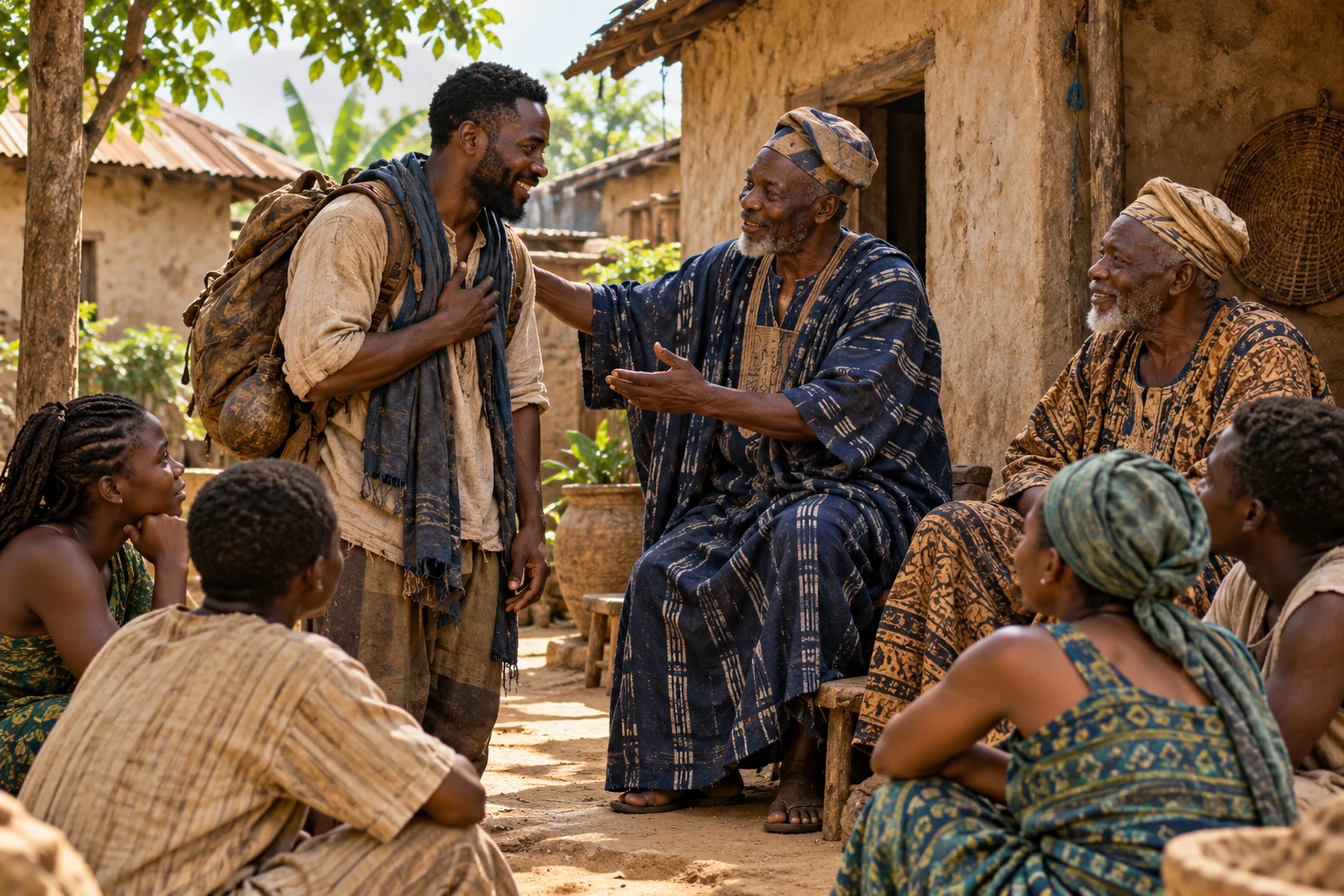
Orunmila arrives under the name Oloyu Ekun in a community represented as unable to flourish. He describes his work as speaking, performs divination, and the narrative depicts renewed births and growth. When he returns much later, descendants do not know him. Elders recognize the visitor, explain his earlier help, and a new generation of practitioners begins learning from him.
The time gap makes gratitude a problem of transmission rather than personal sentiment alone. Those who benefit most may never have witnessed the work that enabled their lives. Elders supply memory, while new learning turns recognition into an active relationship. Claims about restoring fertility remain within the religious narrative and should not be recast as treatment or promise.
Narrative setting: Cuban/Lukumí-labeled patakín in the multilingual source compilation; individual narrator and publication history are not established.
Morning wins arrival but not the whole duration
Morning and Evening consult before coming to earth. Morning wants precedence and dismisses a modest religious response concerned with enduring prosperity, asking instead for what will secure the earliest arrival. Evening takes longer to obtain what is required. Morning reaches earth first and is warmly received. Eshu then brings the Sun, whose heat diminishes Morning’s cool welcome and drives people into shelter. Evening arrives later as heat declines, gathering the returning people into a more sustained period. The account relates these personified journeys to changing parts of a day and then extends the contrast toward the wish for a fruitful later life.
The difference lies not simply in speed but in the purpose each traveler asks consultation to serve. Morning selects precedence as if being first will secure the whole future; the diviner’s earlier concern with duration is treated as less impressive. Evening’s slower preparation therefore belongs to another relation to time, not only another pace on the same race. Eshu and the Sun act within the narrative to expose the limit of early popularity, while the cooling arrival supplies a religious image of continuance.
The source’s later numerical claims about life stages and its predictions of early death must not be adopted as empirical rules. A depth study can preserve the personified cosmology while asking what kind of success a particular action is preparing for. It should also avoid romanticizing suffering as necessary for late reward. The narrative differentiates aims and responses; it does not prove that every slow beginning is destined for prosperity or every early achievement is morally suspect.
Narrative witness and setting: Section explicitly headed revelations of Cromwell Osamaro; Yoruba/Bini-framed personification narrative.
Three hostile instruments become a musical company
A great drum seeks honor before coming to earth and accepts divination rather than the charms it initially requests. During its preparation, its elder siblings, Gong and Rattle, arrive and strike or mock it. Their actions produce the characteristic sounds each will later have. Orunmila interrupts the conflict, hears the sounds together, and redirects the siblings from rivalry into coordinated performance. His authoritative declaration makes them useful to humanity in a new relation, and they acknowledge the inner head before departing. The account then presents their joint music as a sign of celebration rather than continuing fraternal assault.
The religious turning point is Orunmila’s exercise of authority, which does not erase the instruments’ differences. Their distinct voices become the condition of cooperation rather than evidence that one must replace the others. This gives a precise account of transformation: the same relation among striking, answering, and rattling is redirected toward a purpose all can share. It should not be generalized into a recommendation to endure abuse until it becomes art. The drum’s painful experience remains part of the story, and the account does not preserve a detailed apology from the siblings.
Their reconciliation occurs through an authoritative sacred reordering and a joint acknowledgment of their heads. Contemporary analysis can ask what institutional or relational change makes former opposition genuinely cooperative rather than merely presenting injury as entertaining. The episode also distinguishes seeking status through imposed effects from entering a divinatory relation that changes the role a person or object can have among others.
Narrative witness and setting: Section explicitly headed revelations of Cromwell Osamaro; Yoruba/Bini-framed account of drum, gong, and rattle.
What was born in this Odù
“Born” can name an explicit traditional origin association or what emerges through a story: a capacity, relationship, practice or order of life. Interpretations drawn from a narrative are labelled below, so their basis remains clear.
Orunmila’s postponed possession
Selected traditional source association.
The single explicit origin entry links the sign to Orunmila’s decision not to mount a head before humanity is reconciled. This is a local etiological account of ritual difference, not a universal explanation binding every Ifa or Orisha community.
Memory turns a past service into renewed teaching
Contemporary interpretation from the selected myth.
This contemporary interpretation follows Oloyu Ekun’s return: elders identify a forgotten helper and a new generation begins learning. It is an emergence motif grounded in that narrative, not an additional traditional origin-list attribution.
Correlations to life dimensions
These questions bring the selected stories into contemporary life. They are interpretive invitations for study.
Work and resources
Oloyu Ekun names speaking as his work and asks that it be recognized materially. Later generations inherit results without knowing their source. The episode supports inquiry into how less visible intellectual and relational work receives acknowledgment over time.
Reflect: Which form of work is easy to overlook?
Relationships and family
Elders reconnect descendants with a helper whose earlier intervention preceded their birth. Family and communal memory therefore require active narration. The story does not imply that descendants owe unlimited obedience to someone simply because earlier generations received help.
Reflect: What history should be passed on with a benefit?
Character and inner life
Followers treat affiliation with powerful figures as proof that they themselves outrank others. The narrative asks whether knowledge increases responsibility or merely pride. Its concern is enacted behavior toward peers, rather than a general condemnation of religious experience.
Reflect: Does your affiliation change how respectfully you treat others?
Community and responsibility
Repeated failed missions suggest that a collective conflict cannot be solved only by sending another prestigious representative. Orunmila frames his role through reconciliation and a limit on display. We can examine what institutional changes would make that stated purpose credible.
Reflect: What would make reconciliation more than a declaration?
A deeper reading of the sacred relationships
Ase changes the relation among different capacities
Orunmila’s declaration makes the instruments’ different sounds a shared festive presence. The passage explicitly gives that transformation an authoritative religious act, not merely a listener’s clever reinterpretation. In the earlier account of refusing possession, Orunmila likewise relates a mode of presence to the unfinished task of reconciling people, while Oloyu Ekun’s community learns anew from a remembered helper. These accounts connect knowledge with obligations that shape how it becomes effective. The Morning/Evening story adds the purpose specified before a journey. A depth treatment can explain Ifa, the inner head, and ase through their particular actions without reducing every religious event to confidence, musical teamwork, or delayed personal gratification.
The desired outcome determines what preparation means
Morning asks to arrive first, while the counsel initially concerns lasting flourishing. The drum asks for an imposed dignity, but accepts divination that leads to another role. Both narratives distinguish the question a seeker brings from the wider relation disclosed in the answer. The earlier possessive rivalry among humans offers a darker version: received religious powers are treated as credentials for superiority rather than responsibilities toward others. Contemporary interpretation can ask whether a desired outcome has been defined too narrowly, without implying that a counselor’s response is beyond examination. The religious sources show preparation as an encounter capable of changing the purpose, not simply a service that manufactures the requester’s first preference.
A shared sound requires difference to remain audible
The drum, gong, and rattle do not merge into one instrument. Their coordination depends on retaining distinguishable contributions. The earlier Oloyu Ekun return likewise depends on elders remembering a particular helper so that younger practitioners can enter a learning relation. These scenes contrast with the humans who treat spiritual affiliation as grounds to claim supremacy. A depth study can therefore distinguish common purpose from uniformity. It can ask how a group recognizes each contribution without making one voice the only legitimate voice, while also recognizing that the instrumental account gives Orunmila an authoritative ordering role rather than portraying cooperation as a purely spontaneous consensus.
Questions that deepen the study
Does Morning’s failure mean early success is always dangerous?
The story identifies a specific choice: Morning asks for precedence while neglecting a response concerned with duration. Eshu and the Sun then reveal the limits of that selected aim within a personified account of the day. The source’s extension into fixed life-stage predictions is not evidence about actual people. A contemporary reflection can instead ask whether a project prepares only for its launch or also for what sustains it. That question respects the narrative’s religious frame without declaring that every fast start is suspect, every later difficulty deserved, or every delayed beginning guaranteed a rewarding evening.
Is the siblings’ conflict justified because it eventually produces music?
The transformation does not require treating the preceding injury as good. The account supplies a decisive interruption and a new sacred purpose through Orunmila’s authority. Cooperation becomes different from the original attack because the instruments enter a shared role rather than continuing to harm one another under a more pleasing description. Contemporary analysis can ask what actually changes in a relationship before calling it repaired. The source gives joint religious acknowledgment but not a complete account of apologies or consent, so those should not be invented. The musical result is meaningful without becoming a universal excuse for abuse in creative or family settings.
How do these accounts deepen the earlier unfinished reconciliation?
The refusal-of-possession story states a large task: turning people away from spiritual superiority toward reconciliation. The instrument account gives a more specific scene in which difference is reordered through authoritative speech, while Morning and Evening show how the goal named before action can narrow or extend what follows. Oloyu Ekun’s return adds memory and teaching across generations. Together they provide several relations between religious capacity and social purpose. A contemporary reading can ask whether a practice helps others flourish or merely makes its holder more admired. The comparison should preserve divine action rather than treating the stories only as secular advice about leadership or collaboration.
What the four narratives reveal together
The original Cuban pair concerns religious knowledge misused as superiority and a helper remembered only when elders identify him. The Osamaro-headed additions place those concerns within time and sound. Morning’s preferred precedence differs from Evening’s more durable arrival; drum, gong, and rattle become cooperative without losing their voices. Consultation, sacred preparation, the inner head, and Orunmila’s ase are active in these accounts, not explanatory ornaments. The four stories therefore support a depth inquiry into the purpose for which power is sought and the relation through which it becomes effective.
Their limits remain distinct: reconciliation is unfinished, communal memory requires renewal, early acclaim does not secure duration, and a transformed ensemble does not retrospectively justify its painful conflict. Read together, the witnesses broaden religious and ethical understanding without promising that every hardship leads to prosperity or every difference can be harmonized by a single formula.
Living with this Odù
A continuing life or initiatory relationship
For someone whose received life or initiatory Odù is Òyèkú Òdí, recognition may need to remain answerable to a task rather than become proof of personal supremacy. Orunmila’s unfinished reconciliation gives a religious distinction an ethical horizon. The forgotten visitor’s return asks whether a community can remember work whose benefits have become ordinary to people born afterward. Long development can include serving without demanding adoration and receiving a legacy without treating its conditions as self-created.
Morning and Evening add a distinction between first arrival and sustained duration. The instruments add another between distinct voices competing for honor and those voices reorganized into a company. Neither supports a fixed claim that slow beginnings always win or that injury naturally becomes art. A change in relation, not time alone, makes cooperation possible.
The religious field includes Elegbara’s investigation, Orunmila’s authoritative redirection, Eshu and the Sun, and acknowledgment of the inner head. A received sign does not promise late prosperity or impose a universal doctrine of possession. Across changing circumstances, it can ask what kind of recognition a person is seeking, whether the underlying task remains unfinished, and which living forms of memory can transmit responsibility beyond the original witness.
A particular consultation and its question
In consultation, Òyèkú Òdí can distinguish a display of spiritual importance from progress on the work that importance is meant to serve. The reconciliation narrative asks whether affiliation has become a ranking of persons. The visitor’s return asks whether a present community recognizes the contribution enabling its current circumstances. A practitioner can examine unfinished responsibility and failed transmission of memory without inventing a past benefactor or declaring a visitor uniquely chosen to restore harmony.
Morning’s immediate welcome and Evening’s duration invite a question about the actual aim of preparation. Is the person seeking precedence, or a form of life that can continue? The instruments ask what change would allow distinct capacities to cooperate. Simply calling aggression musical does not make former injury resolved; the narrative requires authoritative redirection and a shared acknowledgment.
The actual result must locate these tensions within its question. Its religious explanation is not a scientific account of possession or a numerical forecast of life stages. One consultation cannot establish a permanent identity as mediator, forgotten helper, or late achiever. It can clarify whether the setting requires a limit on supremacy, active remembrance, revised preparation, or a new arrangement in which differences become useful without being erased.
Constructive and adverse possibilities
Constructively, religious authority can accept an unfinished task as a limit on self-display. Elders can transmit memory so gratitude becomes new learning rather than an impossible demand that descendants remember what they never witnessed. Distinct instruments can also enter a relation whose common purpose depends on their different voices. Recognition then sustains service and continuity rather than competition for supremacy.
Adversely, affiliation can become personal superiority, early welcome can be mistaken for lasting readiness, and a community can consume inherited benefits while forgetting the work that enabled them. Former hostility can also be presented as collaboration without examining what changed for those harmed. These are possible developments within the narratives’ tensions, not forecasts of Òyèkú Òdí’s condition. Iré and adverse circumstances belong to the actual reading. Interpretation asks whether honor is still connected to the work, memory, and shared purpose that could justify it.
An illustrative situation in everyday life
Hypothetically, an organization celebrates a newly appointed mediator as the person who will end its longstanding conflicts. She is tempted to accept the admiration before the work begins. Orunmila’s unfinished promise distinguishes a role from its completed task. At an anniversary meeting, younger members praise the organization’s stability without knowing who created its earlier support systems. The forgotten-visitor motif makes memory a transmission problem, not simply ingratitude. The mediator can invite elders to explain those contributions and involve younger members in maintaining them. Distinct working styles may then become a company rather than a contest, as in the instruments’ redirection. This hypothetical example illustrates accountable recognition without claiming that conflict must become harmony or that religious affiliation establishes superior personal standing.
Sources and reading context
The first two narrative witnesses
The sole explicit born entry concerns possession; a second motif is a labeled contemporary interpretation of the remembered visitor. The source mixes Cuban narrative with modern esoteric vocabulary. Fertility, possession, and reconciliation are contextualized as religious motifs, not medical claims or universal doctrine.
Narrative motifs are summarized independently. The life-dimension reflections are contemporary interpretation. How these reference studies are built explains the wider source approach and the distinction between a reference article and personal divination.
Additional named witnesses
- Cromwell Osamaro. An explicit section heading governs both Morning/Evening and the drum-gong-rattle sequence; the latter gives Yoruba/Bini instrument names.
The life-stage predictions appended to Morning/Evening are excluded. The instrument narrative is religious personification rather than organology or an endorsement of abuse. The heading does not establish an exact edition or page, and the Portuguese rendering is not evidence of Brazilian provenance.
Bibliographic identification
- C. Osamaro Ibie. Ifism: The Complete Work of Orunmila. Lagos; multivolume publication beginning 1986. Library catalogue record. Related bibliographic record for the named narrative witness. Exact volume, edition and page of the transmitted account have not been independently matched.
Read the source method and wider scholarly context.
The catalogue links identify published works and their authors. They are separate from proof of an individual episode’s wording or attribution. Contemporary comparisons and the synthesis above are editorial interpretation. The author’s books and Academy companions below provide further study; their sales links are separate from the source references.