
Ògbè Òtúrá is a mixed Odù in Ifá’s 256-part corpus. The chosen stories give water and storm distinct roles. Rain transforms an overheated, uninhabitable territory into a place of growth and image-making; a lightning stone restores a betrayed ruler’s power while Oyá prevents him from killing his son. The resulting focus is the relation between environmental transformation and political restraint: receiving power does not settle how that power should be used.
A question to carry through the study: What would recovery look like if it did not require revenge against the person who caused the loss?

This Academy reads the right column first, then the left. Each row carries a single or double mark.
Where this Odù belongs
Ògbè Òtúrá belongs to the Ògbè family in this Academy’s study sequence. It is a mixed Odù, distinct from Òtúrá Ògbè. The order matters. Its teaching is approached through its own narratives, rather than by adding two general descriptions of the principal signs together.
Key Òrìṣà and sacred relationships
The figures below are selected for their roles in the accounts discussed here. They offer connected reading paths through the tradition.
-
Obàtálá. He initiates the attempt to make an inhospitable territory livable and responds when the envoy’s distress reaches him, linking authority to care for conditions of life.
-
Odùdùwà. Named Odua in the account, he carries out the consultation and joins the envoy as rain, waterways, and shaped images emerge in the new territory.
-
Ọya. As Iyansan, she gives Oladu Awo the lightning stone that restores his capacity, then appears in a dream to prevent retaliatory killing of his son.
Author’s further study: The Myths and Revelations of Odù Ògbè Òtúrá develops this sign at book length. The inherited accounts discussed here retain their named witnesses and religious settings.
Key myths and their meanings
Rain before the first images
Obatala sends an envoy to develop a territory made uninhabitable by intense heat. The envoy’s appeal brings a response involving Odua and rain. Vegetation and waterways appear, while weathered forms in stone and earth suggest figures that the two shape further with their hands. The territory acquires both conditions for life and objects of recognition before responsibilities for governing it are assigned.
The story links art to an already transformed environment: people recognize and work with forms that water and weather begin. It resists a simple account of creation as solitary mastery. The appointment of rulers follows this collaborative process, raising a useful question about whether political authority remains answerable to the ecological and communal conditions that made settlement possible.
Narrative setting: Cuban-labeled narrative in the accounts considered here; no independently established narrator or publication history.
The stone and the spared son
Oladu Awo’s enemies obtain his secrets through a disloyal son, and the ruler loses home and wealth. In response to his appeal, a storm forms and Oyá gives him a lightning stone with which to regain power. He then intends to kill the son. Oyá intervenes in a dream and directs him away from that retaliation, leaving him restored but restrained.
The stone’s value is not simply victory; its giver also sets a limit on what victory permits. Betrayal remains painful and the family relationship is not neatly repaired. A careful reading keeps that unresolved grief while isolating the decisive refusal of revenge. The text’s later curse-like prediction about descendants should not become a claim about actual families.
Narrative setting: Cuban-labeled narrative in the accounts considered here; no independently established narrator or publication history.
Ready food is exchanged for unopened endowments
Fa and Loco prepare sons to settle adjoining land. Loco is wealthy and hides workers, money, and livestock inside three yams for Hunsu. Fa consults and sends Amusu with ready-to-eat food. During the journey Hunsu becomes hungry and exchanges each raw yam for an immediately usable meal. Neither young man knows the yams’ contents. At the destination Amusu opens them and gains the resources to build and prosper. Hunsu makes a poor shelter. When the fathers visit, Loco reveals the endowments and blames his son for trading them away; Hunsu replies that the food supplied did not meet the hunger of the journey.
The narrative gives both the exchange and its judgment unequal information. Hunsu knows he is hungry and cannot readily cook the yams, but not that they contain a future household economy. Amusu also does not know he is acquiring more than yams. The resulting prosperity therefore cannot be explained simply as a shrewd buyer defeating a foolish seller. Fa’s consultation is efficacious within the Fon account, while Loco’s concealed provision fails because its recipient cannot recognize or use what has been sent. The father’s promise that wealth will protect his son is exposed as incomplete preparation, not merely the son’s inadequate gratitude.
At the same time, the story treats workers as transferable endowments, a historical hierarchy that must not be endorsed. Its specific dilemma is the mismatch between a gift’s intended future and a traveler’s present need. A contemporary interpretation can ask what explanation and accessible provision are required before a person can reasonably be held responsible for preserving a resource they do not know they carry.
Narrative witness and setting: Fon Fá/vodun narrative explicitly attributed to Bernard Maupoil; Fa, Loco, Amusu, and Hunsu retain their local identities.
The youngest son brings a company to lift the fallen tree
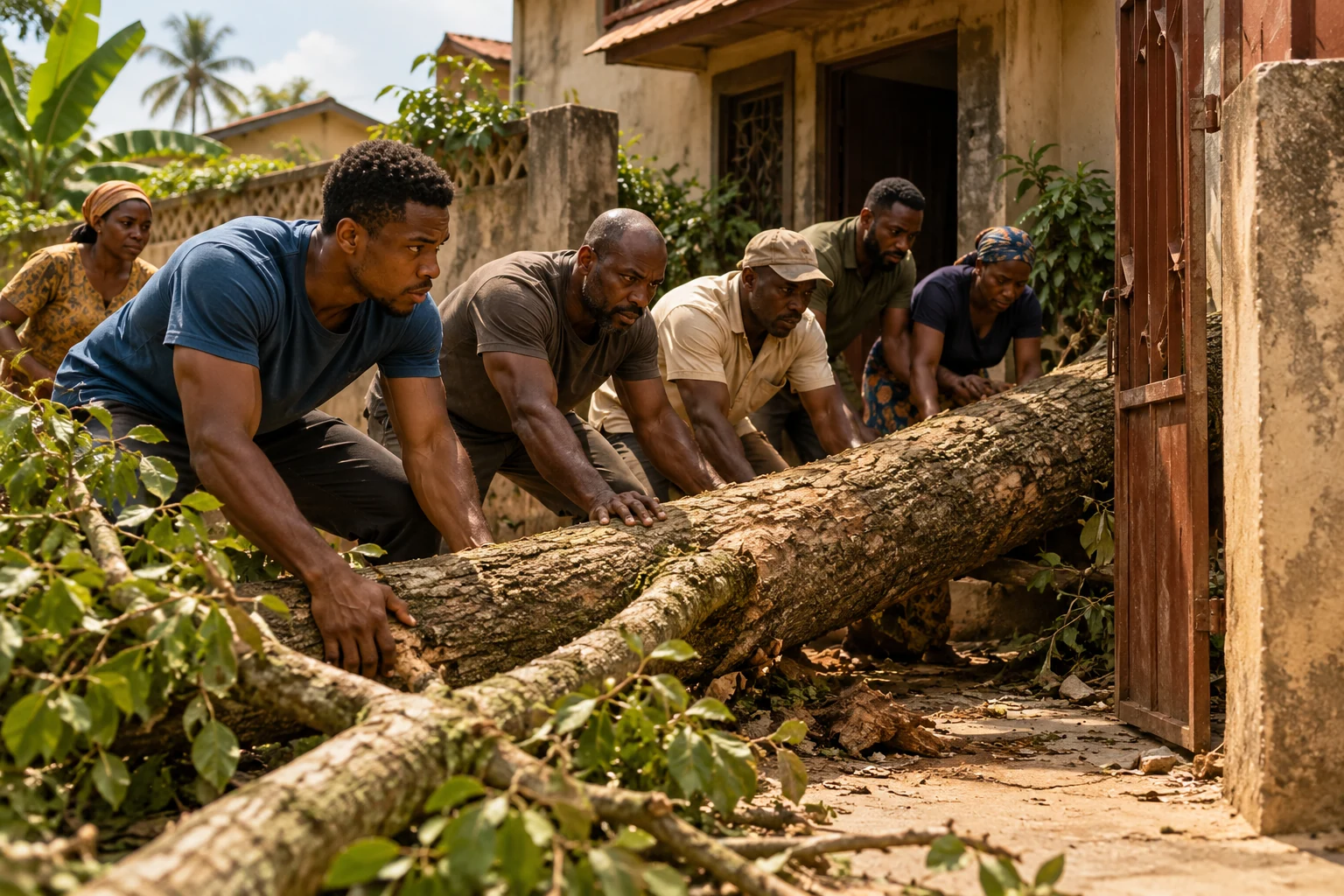
Olodumare Agotun’s children receive resources for their earthly journeys. Some use them privately, while Elegiiri regularly shares food and drink with companions. A great tree later blocks the father’s entrance. The apparently powerful sons are summoned one after another but cannot move it. Elegiiri is called last and immediately summons the people with whom he has shared his resources. Their combined effort lifts the obstruction. The account identifies the father through a specific interpretive explanation rather than assuming every use of the name Olodumare means the same figure. Its family count and name spellings are unstable, but the collective lifting sequence is clear.
The father intends the resources as investment, while the youngest appears to spend them on sociability. The blocked entrance makes visible a return that the earlier accounting cannot capture: companions arrive when he calls. This is not proof that lavish hospitality always produces loyal labor or that social ties should be cultivated only as a tool. The account depicts a religiously significant network in which shared life becomes effective cooperation. Its clarification of the father’s identity is equally important. Names that sound supreme or familiar require interpretation within a particular corpus; they cannot be normalized by a global substitution.
The sequence also broadens what counts as strength. Several sons fail individually, while a son with a company succeeds through a different arrangement of persons. The tree’s later transformation begins another episode and should not be silently folded into this accomplishment. A careful supplement can remain with the supported lifting scene and ask how generosity, investment, and collective capacity acquire meaning over different spans of time.
Narrative witness and setting: Compilation attribution to Yemi Elebuibon; explicitly identified as material from an Ogbe Alara corpus.
What was born in this Odù
“Born” can name an explicit traditional origin association or what emerges through a story: a capacity, relationship, practice or order of life. Interpretations drawn from a narrative are labelled below, so their basis remains clear.
The shadow between practitioner and Orunmila
Selected traditional source association.
The origin inventory names Afimaye as a shadow between Orunmila and the awó. The bare association can be retained as a mediation image, while the compilation’s added definition is not treated as established theology or etymology.
The New Year ceremony
Selected traditional source association.
The sign is associated with a New Year ceremony in its origin list. This is a local ritual-calendar attribution and should not be generalized into a single universal Yoruba New Year or an identical practice across diasporic communities.
Correlations to life dimensions
These questions bring the selected stories into contemporary life. They are interpretive invitations for study.
Work and resources
The envoy cannot accomplish settlement by determination alone; heat makes the assignment unworkable until water changes the conditions. The story directs attention to what a project requires environmentally, including the response of those who commissioned it when its limits become clear.
Reflect: What condition must change before this work is possible?
Relationships and family
Oladu Awo’s son helps enemies damage the household. The story does not demand that the father deny the betrayal, but it interrupts his intention to kill. This makes space to distinguish acknowledging an injury, rebuilding boundaries, and pursuing vengeance.
Reflect: Which boundary can protect without reproducing harm?
Character and inner life
Recovered power intensifies the temptation to retaliate. Oyá’s second intervention therefore matters as much as her first gift: the protagonist needs restraint after restoration. We can examine the emotional demands of recovery without promising that grievance disappears with success.
Reflect: What restraint becomes necessary after regaining power?
Community and responsibility
The new territory’s images and waterways arise through several contributors before governance is assigned. The tale invites inquiry into whether political credit follows the work of making a place habitable and whether those contributors retain a voice afterward.
Reflect: Who should share in decisions after building a place?
A deeper reading of the sacred relationships
Named identities require interpretation inside their corpus
The Elebuibon-attributed unit explicitly distinguishes the figure called Olodumare Agotun from a simple reference to the supreme creator, explaining a local reading through Orunmila. The Fon account retains Fa and Loco as different parents rather than assuming their roles match a Yoruba household. The earlier Cuban creation and lightning stories likewise give Obatala, Odua, and Iyansan particular actions within their own settings. This variety is part of the religious evidence, not a defect to erase. A depth treatment can explain how sacred names operate relationally while marking uncertain genealogy or translation. Contemporary comparison should follow those distinctions rather than create one flattened pantheon in which every similar function proves identical identity.
A provision must be usable during the journey
Loco imagines a settled future inside the yams, while his son must eat before that future can begin. Fa’s consultation answers the route as well as the destination, making the ready food consequential through a sacredly prepared exchange. The earlier envoy’s heat-stricken territory presents another mismatch between assignment and present conditions: an intended settlement cannot proceed without water. The stories therefore connect provision with timing and environment rather than quantity alone. Their religious logics differ, but each makes a plan answerable to the conditions in which a recipient must act. A contemporary lens can ask what information, tools, or intermediate support make a resource genuinely available to the person entrusted with it.
Shared life creates a capacity no single gift contains
Elegiiri’s company moves a tree the powerful individual sons cannot lift. In the earlier art-origin account, rain, earth, the envoy, Odua, and the gathered Orishas contribute to making a territory livable and recognizable. Neither plot makes the central achievement solitary. The lightning story adds a limit after restoration: Oyá’s gift does not authorize the father’s intended revenge. Together these scenes distinguish support from unrestricted command. A depth study can ask how an account remembers the network enabling an accomplishment and what obligations remain toward that network. The point is not that every successful act needs a large group, but that the narrative specifies relationships the final holder of power cannot legitimately forget.
Questions that deepen the study
Is Hunsu simply foolish for exchanging the yams?
The story gives him immediate hunger and no knowledge of the concealed endowments. It also gives Amusu no prior knowledge of what he is receiving. Those facts limit a simple judgment of intelligence or deserved wealth. Within the Fon account, consultation establishes the conditions of Fa’s son’s successful arrival; contemporary interpretation can additionally ask whether Loco prepared his child adequately for the route. Hunsu’s answer to his father keeps that failure visible. The account does not make people legitimate possessions, and its historical transfer of workers should remain contextualized rather than repeated as an acceptable model of family provision.
Does the collective tree-lifting mean hospitality is only a hidden investment?
The father’s investment language and the son’s sociability are deliberately placed in tension, but the companions are not described as a purchased workforce. They respond through a shared relationship. The later need reveals a practical capacity created by eating and drinking together, without proving that every gift is owed an equivalent service. A contemporary reading can ask what forms of value an individual financial accounting misses. The religious account also explains its own names and corpus placement, so the scene should not be detached from that frame and turned into a universal management parable. Its company matters as a lived relation before it becomes an effective group.
How do these witnesses deepen the earlier storm and rain narratives?
The earlier stories show a livable world emerging through water and a betrayed father receiving power that is then restrained. The additions ask how provision reaches someone across a journey and how a network becomes available in a moment of obstruction. Their connection lies in the conditions of effective help, not a claim that weather, food, friends, and sacred stones are equivalent. Reading them together can preserve each power’s active religious role while asking whether an intended benefit fits the recipient’s situation. It also keeps restraint visible: being given resources or restored authority does not settle the right to use others or retaliate.
What the four narratives reveal together
The four accounts make helpful power answerable to the conditions in which life must continue. The earlier Cuban stories provide rain for an uninhabitable territory and a lightning gift limited by Oyá’s intervention against vengeance. The Fon yam-exchange account adds a contrast between concealed endowment and immediate need, while the Elebuibon-attributed family scene makes companionship effective where individual strength fails. Their religious realities remain distinct: Fa’s consultation shapes a journey, named powers transform a world, and a corpus explains how a sacred name should be understood locally.
The comparison therefore does more than praise cooperation. It asks what a gift makes possible, what its recipient can know, and which relationships must remain acknowledged after the visible task is completed. Keeping these distinctions permits real depth without treating every successful outcome as proof of superior judgment or merging African, Fon, and Cuban witnesses into one universal doctrine.
Living with this Odù
A continuing life or initiatory relationship
For someone whose received life or initiatory Odù is Ògbè Òtúrá, renewed power may require responsibility toward the conditions that made renewal possible. Rain creates a habitable territory before rule is assigned. Oyá restores a betrayed ruler’s capacity while prohibiting his intended revenge. These motifs distinguish receiving power from receiving unlimited permission. A person may repeatedly need to ask whether recovery sustains a larger life or merely enables the return of an earlier grievance.
The concealed yams and collective tree lifting add two different accounts of resources. A provision for the future can fail if it does not meet the traveler’s present needs or explain what is carried. Shared food can become an enduring company whose combined effort succeeds where isolated strength fails. Long study can therefore concern the timing, intelligibility, and social life of what one gives or receives.
The religious settings remain particular: Odua and rain, Oyá’s intervention, Fa and Loco’s sons, and Elebuibon’s specifically explained father figure cannot be made one universal family. A received sign does not promise wealth or justify blaming hunger. It can invite a life in which authority remembers collaboration, provision includes usable care, and restoration retains a limit even when injury remains unresolved.
A particular consultation and its question
In consultation, Ògbè Òtúrá can distinguish the recovery of capacity from permission to retaliate. The lightning stone’s giver also restrains the restored ruler. A question about a lost position may therefore need to examine what restoration would make possible and which actions remain unacceptable. The rain narrative asks a broader question: have the material and communal conditions of a livable place been established before authority is claimed over it?
The Fon yam exchange prevents a quick accusation of improvidence. Hunsu cannot knowingly preserve an endowment whose contents he does not understand while his immediate hunger remains unprovided for. A practitioner can ask whether information and usable resources accompanied an obligation. The tree-lifting scene adds another distinction between resources spent only privately and resources supporting a company able to cooperate. It does not make sociability an automatic investment return.
The actual result must determine how these motifs address the visitor’s question. It does not identify a disloyal relative, promise hidden wealth, or equate all named divine figures. A consultation remains a particular religious encounter. Interpretation can clarify whether the situation requires restraint, accessible provision, acknowledgment of environmental conditions, or shared capacity rather than a more impressive display of individual force.
Constructive and adverse possibilities
Constructively, transformation can make a place habitable before rule begins, and restored authority can accept a restraint on revenge. Provision can also become intelligible to the person receiving it, while shared resources support relationships that later act together. The religious accounts make these developments more than private optimism: rain, Oyá’s direction, consultation, and a particular network of companions alter what becomes possible.
Adversely, injury can turn recovered power toward killing, a concealed gift can become an occasion to blame its hungry recipient, and a giver can value resources only through their private accumulation. The yams’ workers also remain part of an unendorsed hierarchy of transferable persons. These contrasts do not establish whether an unknown Ògbè Òtúrá reading is Iré or adverse. They ask how power, information, and care are distributed, including whether an apparently favorable outcome leaves its enabling relationships unnamed.
An illustrative situation in everyday life
Hypothetically, a parent gives a young adult an account intended to fund training but does not explain that it contains money beyond the first month’s rent. The young adult sells a useful possession to meet food costs and is later accused of wasting the future. Hunsu’s reply distinguishes a provider’s intention from what the traveler can actually recognize and use. A sibling offers practical help while expecting permanent control over decisions. The lightning-stone motif adds a boundary: restoring someone’s capacity does not authorize every exercise of power afterward. The family can clarify resources and terms rather than treating hunger as moral failure. This imagined example concerns intelligible provision and restrained authority, not a claim that a hidden gift or religious reversal awaits the reader.
Sources and reading context
The first two narrative witnesses
These Cuban-labeled stories contain modern interpretive overlays that are excluded. The origin inventory wrongly equates several distinct figures elsewhere, so only its bare named motifs are used. Oyá remains distinct from Matamba, and the lightning stone is discussed as narrative symbolism.
Narrative motifs are summarized independently. The life-dimension reflections are contemporary interpretation. How these reference studies are built explains the wider source approach and the distinction between a reference article and personal divination.
Additional named witnesses
-
Bernard Maupoil; Fon Fá/vodun narrative. The sons of Fa and Loco, concealed yams, and later parental visit appear under an explicit local attribution.
-
Yemi Elebuibon. The source heading explicitly attributes the Olodumare Agotun family unit and identifies an Ogbe Alara corpus; its own explanation distinguishes the father’s referent.
The Elebuibon unit says three children but lists four; the exact number is not repaired by invention. Its placement names Ogbe Alara, retained as an attribution concern rather than silently equated with every Otura text. Portuguese or English rendering of African/Fon material is not Brazilian tradition. No exact edition/pages are established.
Bibliographic identification
-
Bernard Maupoil. La Géomancie à l’ancienne Côte des Esclaves. Paris: Institut d’ethnologie, 1943. Library catalogue record. Historical bibliographic context for the Fon Fá witness; Fon and Yorùbá traditions retain their distinct settings.
-
Chief Priest Yẹmí Ẹlẹ́buìbọn (Ifayemi Elebuibon). The Healing Power of Sacrifice. Nigeria: author publication, 2014 university catalogue record. Library catalogue record. Related published work by this named author, not a claim that the particular episode above has been located in this edition. Ifayemisi Elebuibon is a different author.
Read the source method and wider scholarly context.
The catalogue links identify published works and their authors. They are separate from proof of an individual episode’s wording or attribution. Contemporary comparisons and the synthesis above are editorial interpretation. The author’s books and Academy companions below provide further study; their sales links are separate from the source references.