
Ògúndá Òyèkú is a mixed Odù in Ifá’s 256-part corpus. Ogunda Oyeku moves from a fighter who accepts incompatible loyalties to a court that nearly executes an innocent servant. The first concerns promises treated as commodities under pressure for food and status. The second challenges confidence that official procedure cannot be wrong. Together they separate accountability from punishment: a person can have a real duty to keep an agreement while an institution still lacks reliable grounds to impose a severe sentence.
A question to carry through the study: What evidence would make you question a punishment even when the procedure appears authorized?

This Academy reads the right column first, then the left. Each row carries a single or double mark.
Where this Odù belongs
Ògúndá Òyèkú belongs to the Ògúndá family in this Academy’s study sequence. It is a mixed Odù, distinct from Òyèkú Ògúndá. The order matters. Its teaching is approached through its own narratives, rather than by adding two general descriptions of the principal signs together.
Key Òrìṣà and sacred relationships
The figures below are selected for their roles in the accounts discussed here. They offer connected reading paths through the tradition.
-
Ògún. The narrative’s note associates the fighter’s correction with Ogun and a tool of conflict. This is a source linkage, not a claim that Ogun narrates or endorses the punishment.
-
Ṣàngó. The born list identifies Shango among defending powers. He is retained as a separate association rather than inserted into the selected court narrative.
-
Baba Ẹ̀gún. The same list includes the dead among defending presences. The selected stories do not identify a particular ancestor or authorize communication claims about a living reader.
Key myths and their meanings
The contract accepted twice
A formidable traveler earns food through fighting and is recruited into a local dispute. After promising support to one family, he accepts the rival family’s offer as well. An older host confronts the breach. The betrayal is eventually exposed, and the first group responds with public violence and humiliation.
Immediate survival helps explain why payment attracts the fighter without making contradictory promises workable. The older adviser names a specific ethical issue before the retaliation occurs. The public beating is not a model of appropriate accountability. An article can distinguish explaining a compromised choice, correcting it, and endorsing disproportionate revenge.
Narrative setting: Cuban/Lukumí patakín in a multilingual source compilation; no individual narrator is established.
The palace rooster returns
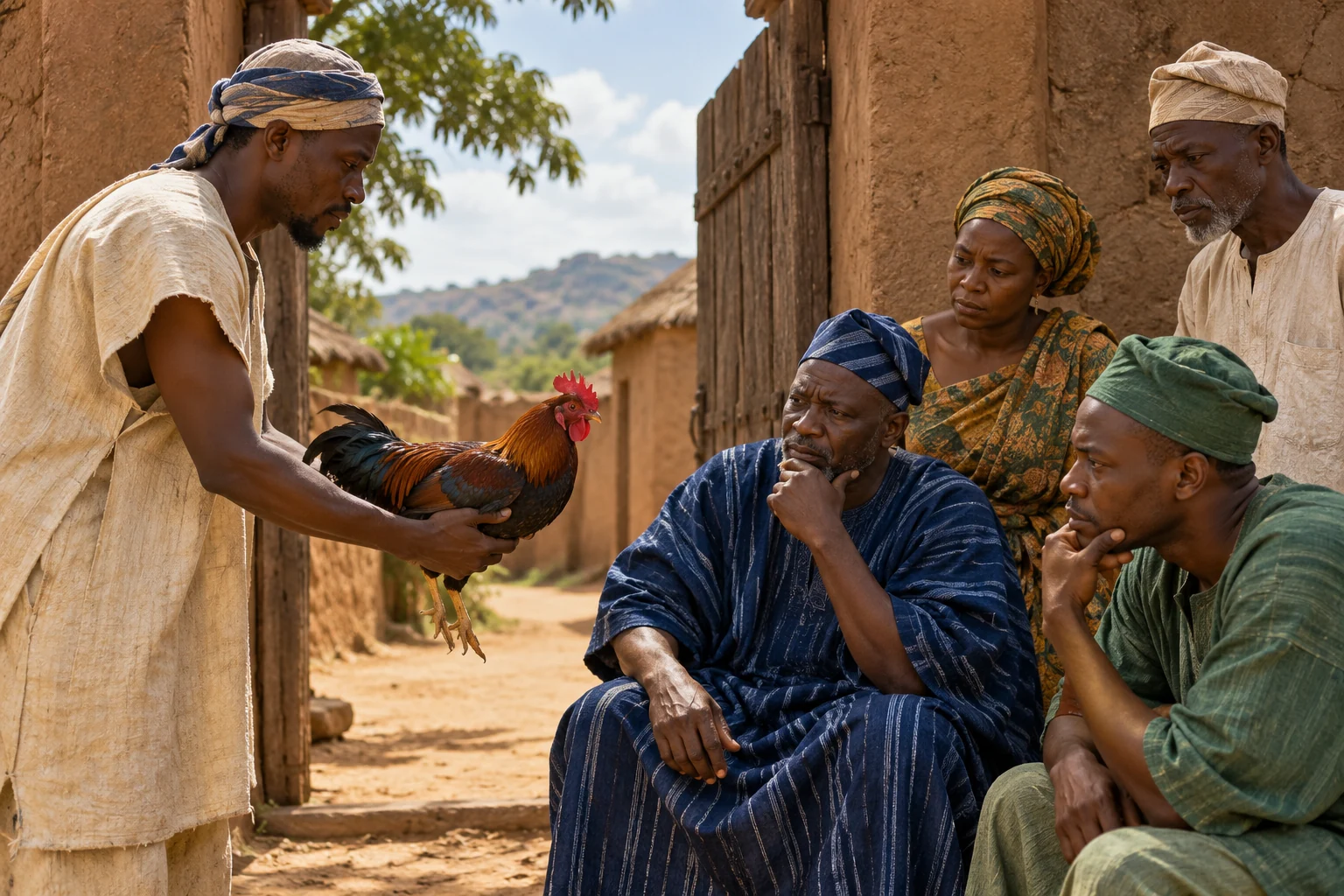
Two servants disagree about whether legally condemned people can be innocent. The senior hides the palace rooster, then implicates his colleague through a coincidental private observance. The accused is close to execution when the senior produces the living rooster and reveals how easily the court accepted a false conclusion.
The demonstration exposes the difference between a plausible story and proof. It also creates real danger for an innocent person, so the demonstrator’s method deserves criticism. The strongest contemporary question concerns irreversible punishment under uncertainty. The source’s later sweeping account of legal history is commentary, not evidence supporting a factual historical claim.
Narrative setting: Cuban/Lukumí patakín in a multilingual source compilation; no individual narrator is established.
The wine worker learns the animals’ language
A palm-wine worker faces theft and damage to borrowed collecting vessels. He initially objects that the advised religious response is beyond his means, then borrows after the losses continue. Following the thief leads him into an animal gathering, where the wider group acknowledges the offense, provides compensation, and teaches him its language. He later enters service to repay the vessel owner rather than settling entirely with the compensation. The new language reveals hidden treasure and a forthcoming inheritance, and his position changes. The witness combines a real grievance, a surprising settlement, a new interpretive capacity, and morally complicated later acquisitions.
The worker begins as someone whose labor and borrowed goods are being damaged. The animal community does not simply defend its own member; it explains that the thief had resources to purchase wine and acknowledges the worker’s claim. That moment gives restitution a more concrete ground than the later fortune. Within the religious account, consultation and sacred response help open the encounter and the new capacity to understand other beings. Contemporary analysis can then notice that the worker’s own choices remain questionable: he keeps compensation while offering service and takes treasure discovered through overheard speech.
The earlier fighter’s incompatible contracts likewise distinguish a genuine need for food from the obligations accepted to obtain it. The legal-fallibility episode adds a further warning that an official resolution is not identical to truth. These comparisons preserve the story’s effective sacred generosity without pretending that every subsequent benefit is ethically transparent or that newly acquired knowledge removes responsibility for how it is used.
Narrative witness and setting: Translated excerpt in the multilingual compilation’s expressly attributed Cromwell Osamaro sequence, with Yoruba/Bini-facing material. The compilation’s language is not evidence of a Brazilian tradition.
The invitation’s food returns to its carriers
A ruler invites Orunmila to Ikimi after hearing of his reputation. Before traveling, Orunmila consults and is advised to host a meal on the morning after arrival. The ruler also sends prepared food through three messengers, concealing a lethal intention unknown to the carriers. Because Orunmila is already holding his own feast, the sent food is returned as something the messengers may eat. They do so and die. The ruler then suppresses discussion of the event. The account makes the guest survive through sacred preparation, but its ending leaves innocent carriers bearing a harm they did not knowingly arrange.
The invitation and the gift are not what their public form announces. The crucial difference from a generic warning against hospitality is that Orunmila’s own feast remains a positive religious response, while the ruler’s concealed act misuses the same form. Within the witness, consultation is effective in a sequence that prevents the intended victim’s death. Yet protection is not distributed equally: the messengers are unaware of what they carry and become the victims. Their deaths should not be described as deserved return to the sender.
The earlier law episode similarly threatens an innocent person through a convincing account controlled by someone else, while the fighter’s story exposes the consequences of an actual breach. Together the four narratives require an exact allocation of knowledge and responsibility. A contemporary reading can ask how a ruler’s power controls both danger and public memory, without turning the sacred survival into a medical claim or a practical method for testing food.
Narrative witness and setting: Translated excerpt in the multilingual compilation’s expressly attributed Cromwell Osamaro sequence, with Yoruba/Bini-facing material. The compilation’s language is not evidence of a Brazilian tradition.
What was born in this Odù
“Born” can name an explicit traditional origin association or what emerges through a story: a capacity, relationship, practice or order of life. Interpretations drawn from a narrative are labelled below, so their basis remains clear.
The well and plum tree
Selected traditional source association.
Both are listed together as speaking motifs. The selected narratives do not develop their story, so their association is recorded without inventing an ecological or moral correspondence.
Ambition within a mayombero setting
Selected traditional source association.
The source names this as an origin association, locating one strand in a distinct Afro-Cuban religious vocabulary. It should not become a judgment on all practitioners or a merger of Ifa and Palo authority.
Correlations to life dimensions
These questions bring the selected stories into contemporary life. They are interpretive invitations for study.
Work and resources
The fighter promises the same capacity to opposing clients. Resource pressure does not make an exclusive commitment divisible without renegotiation.
Reflect: Which two commitments cannot both be fulfilled as stated?
Relationships and family
An older host offers correction before the public crisis. A trusted person can name a breach without endorsing the retaliation that follows.
Reflect: Who can tell you a difficult truth early?
Character and inner life
The junior servant trusts procedure absolutely until he becomes its target. Confidence needs a way to account for mistaken evidence.
Reflect: What safeguards would you want if the accusation concerned you?
Community and responsibility
The court nearly makes a reversible suspicion irreversible. Public responsibility includes the limits of institutional knowledge.
Reflect: Where should uncertainty require delay or review?
A deeper reading of the sacred relationships
Religious response and interpretive capacity remain joined
The wine worker’s sacred response leads toward restitution and the ability to understand animals, while Orunmila’s preparation establishes a feast that changes how the ruler’s food is received. These are not merely examples of better intuition. Within the witness, relations with Ifa and divine agency alter what can be known and what becomes possible. The earlier legal demonstration and fighter’s consultation also place knowledge inside a religious field rather than outside it. Contemporary evidence questions can follow, but should not replace that world with an exclusively secular account. The study should explain what capacity is gained or sustained, while withholding procedures and declining to infer that every later use of the capacity is automatically right.
Responsibility follows knowledge unevenly
The thief knows it is taking wine, the animal gathering recognizes the complaint, the ruler knows the food’s purpose, and the messengers do not. In the earlier court demonstration, the person arranging the missing rooster knows what the accused cannot explain. The fighter, by contrast, has accepted mutually incompatible promises. These distinctions prevent a source study from treating everyone near harm as equally guilty or every harmed protagonist as wholly innocent. The contemporary analytical question is who knew what before acting. The religious accounts remain particular in how consequences are disclosed, and their favorable outcomes do not erase the information that the narrator has already given about a participant’s own conduct.
A settlement and a later gain need separate assessment
The animals’ compensation answers a real loss, but the worker’s later treasure and inheritance arise through another sequence. The guest’s survival is distinct from justice for the messengers, just as the court’s near-error is distinct from the dangerous method used to demonstrate it. These are concrete reasons not to summarize the sign as a single favorable reversal. A contemporary study can track which claim an outcome settles and which questions remain. That is not an attempt to empty sacred events of meaning. It recognizes that religious efficacy, legal closure, financial benefit, and ethical repair can coexist without being identical achievements in every story.
Questions that deepen the study
Does the wine worker’s later fortune erase the ambiguity of his choices?
No. The initial grievance is clear, and the animal group’s compensation acknowledges it. Later, he chooses service instead of fully using the compensation to address the borrowed vessels and takes treasure revealed by animal speech. The witness celebrates his changed position, but those details remain part of the account. A contemporary analysis can distinguish restitution from further acquisition while preserving the religious capacity through which the new knowledge arrives. The story is not a universal instruction to seize what hidden speech reveals or a claim that eventual prosperity proves every earlier decision ethically sound.
Why is it wrong to call the messengers’ deaths simply justice returning to the sender?
Because the text says they do not know what they carry. The ruler’s intention is concealed from them as well as from the guest, and the deaths then allow the ruler to suppress inquiry. Orunmila’s survival is a meaningful result within the religious witness, but it is not a complete account of justice for everyone affected. A study can explain sacred protection and still identify displaced harm. The earlier false-accusation episode reinforces the need to distinguish a persuasive account from actual responsibility. No poisoning mechanism or test needs to be described to make that distinction clear.
What links these episodes with the fighter’s broken commitments?
All require a differentiated account of obligation and knowledge. The fighter knowingly accepts incompatible contracts; the wine worker has a real debt and later compensation; the guest responds to an invitation whose hidden terms endanger unwitting carriers. These are not interchangeable examples of betrayal. The earlier law story asks whether institutions can recognize that difference before imposing irreversible harm. Contemporary comparison can make the distinctions explicit, while divination and sacred preparation retain their effective roles in the witness. The sign’s depth comes from asking which relation has actually been breached or sustained, not from assigning one permanent label of victim or wrongdoer to every protagonist.
What the four narratives reveal together
The added witness deepens Ogunda Oyeku through the unequal distribution of knowledge and consequence. A wine worker receives restitution and a new language whose later uses remain ethically complex; a prepared guest survives an invitation while unwitting messengers die and the ruler controls the account. The earlier fighter and near-executed servant provide different cases of actual breach and mistaken accusation. Religious efficacy remains substantial, especially where consultation opens interpretation and changes an encounter.
Contemporary analysis can then distinguish survival, compensation, legal closure, and justice rather than treating them as synonyms. The four stories do not make every successful protagonist innocent or every adverse event deserved. Their details allow a precise account of who knows, who owes, and whose harm remains outside the favorable ending, while avoiding procedures or clinical claims that the narratives cannot responsibly establish for readers.
Living with this Odù
A continuing life or initiatory relationship
For someone whose received life or initiatory sign is Ògúndá Ọ̀yẹ̀kú, explaining a compromised decision does not make its obligations disappear. The fighter needs food yet accepts incompatible commitments; the wine worker has a genuine claim but later benefits in ways that require separate judgment. Across changing conditions, these narratives can support a character capable of acknowledging both harm received and responsibility retained. Need is relevant without making every subsequent acquisition ethically transparent.
The rooster demonstration and concealed food sharpen the allocation of knowledge. One innocent servant is endangered to prove a point, while unaware messengers die carrying a ruler's hidden intention. The intended guest's sacred protection is effective without making their deaths deserved. Long-term judgment can distinguish a settlement, a favorable reversal and justice for everyone involved. The sign does not supply legal history, a food-testing strategy or certainty that official condemnation proves guilt. Its narratives ask who knew what before acting and which result actually answers which claim. The wine worker's new language remains a sacredly received capacity, not merely intuition; that efficacy increases the importance of examining how knowledge is used rather than placing its holder beyond correction.
A particular consultation and its question
A consultation yielding Ògúndá Ọ̀yẹ̀kú can help distinguish actual breach from a convincing accusation and from participation without knowledge. The fighter has accepted mutually incompatible promises; the accused servant has not stolen the rooster; the messengers do not know what the ruler's food contains. A practitioner should not treat proximity to harm as equal responsibility. The actual question determines which allocation of knowledge matters.
The wine worker adds another distinction between restitution for a real grievance and later gains arising from a new capacity. The animals acknowledge the theft and compensate him, while his subsequent choices remain open to ethical scrutiny. Sacred response and understanding animal speech are effective within the attributed witness, not a guarantee that every benefit is rightful. The invited Orunmila's feast also remains a positive religious response despite the ruler's misuse of hospitality. Consultation can ask what a settlement repairs and who remains unprotected. It cannot forecast acquittal, diagnose illness through the theological vocabulary or recommend a dangerous demonstration of fallibility. The result is particular to its encounter, rather than permanent identity as betrayed guest, wrongful prisoner or justified fighter.
Constructive and adverse possibilities
Constructive relations could acknowledge an actual loss, distinguish plausible suspicion from proof and let new interpretive capacity open a response that was previously unavailable. The animal community does not merely defend its own thief, and Orunmila's sacred preparation changes the intended harm's course within its witness.
Adverse unfolding may involve contradictory promises, official certainty under incomplete evidence or a powerful figure controlling both a gift's danger and the public story afterward. The guest survives while unaware carriers die; that cannot be called a deserved return to the sender. These contrasts do not assign ìrè or òṣogbo to a present reading. They ask who knew the relevant facts and what a favorable result leaves unsettled, while preserving religious efficacy without converting legal closure, material benefit and ethical repair into the same achievement.
An illustrative situation in everyday life
In a hypothetical dispute, a contractor accepts payment from opposing groups for commitments that cannot both be fulfilled. When exposed, the contractor points to genuine hardship as if it settled the breach. The fighter distinguishes explanation from fulfillment. Meanwhile, a junior employee is blamed because they carried the disputed documents without knowing their contents. The unaware messengers make that difference in knowledge essential. This illustration offers no legal conclusion or analogy for poisoned food. It asks each party to identify the promise, the information available before action and the claim an eventual settlement would actually resolve. Relief for the principal beneficiary need not be justice for the person who unknowingly bore the risk.
Sources and reading context
The first two narrative witnesses
The Cuban stories include Asowano and mayombero vocabulary whose broader identities are not forced into a single deity system. The legal episode is interpreted as an argument about fallibility, not cited as legal history or advice. Violent punishment is examined critically.
Narrative motifs are summarized independently. The life-dimension reflections are contemporary interpretation. How these reference studies are built explains the wider source approach and the distinction between a reference article and personal divination.
Additional named witnesses
- Cromwell Osamaro Ibie. The surrounding sequence is expressly attributed to Cromwell Osamaro. These selected episodes are read through the multilingual compilation’s translated renderings; exact edition and original translation chain remain unverified.
The worker’s occupation is inconsistently rendered as tapper or drinker, so the broader role is used. The ruler’s lethal gift is described without substances or methods. Animal-language knowledge and the guest’s protection remain religious testimony, not a safety test, inheritance forecast, or medical mechanism.
Bibliographic identification
- C. Osamaro Ibie. Ifism: The Complete Work of Orunmila. Lagos; multivolume publication beginning 1986. Library catalogue record. Related bibliographic record for the named narrative witness. Exact volume, edition and page of the transmitted account have not been independently matched.
Read the source method and wider scholarly context.
The catalogue links identify published works and their authors. They are separate from proof of an individual episode’s wording or attribution. Contemporary comparisons and the synthesis above are editorial interpretation. The author’s books and Academy companions below provide further study; their sales links are separate from the source references.