
Òkànràn Ògbè is a mixed Odù in Ifá’s 256-part corpus. Okanran Ogbe gives visible coordination between Oshun and Oya a protective public effect, then tests a returning traveler’s ability to pause before acting on appearances. Shared clothing confuses a threatened city’s opponents; a remembered lesson prevents a father from attacking the son he fails to recognize. These motifs connect relationship with interpretation. The longer return tale contains coercion elsewhere, so its useful insight must remain bounded rather than endorsed as a complete moral model.
A question to carry through the study: What pause or conversation could prevent you from treating an appearance as a settled fact?
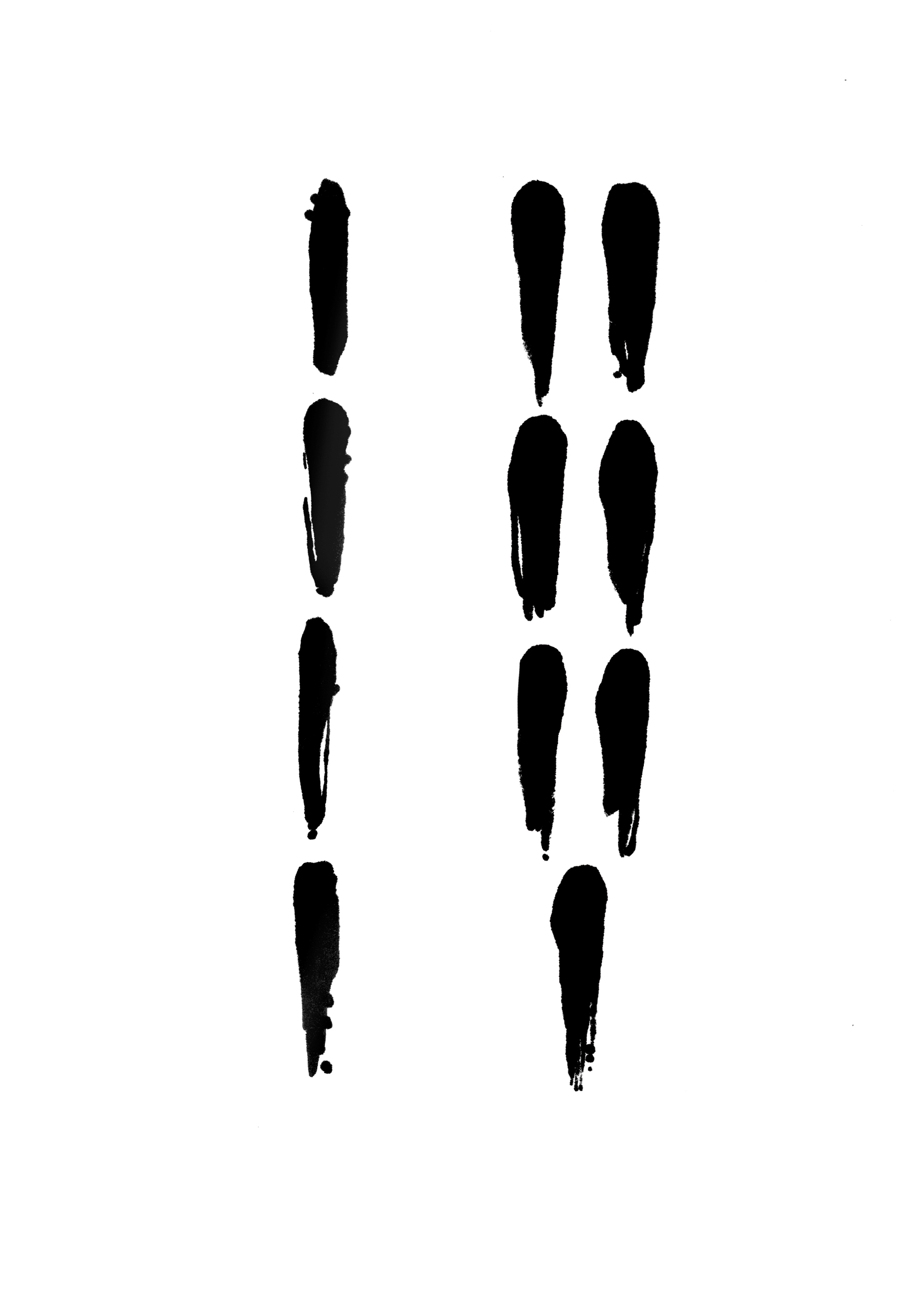
This Academy reads the right column first, then the left. Each row carries a single or double mark.
Where this Odù belongs
Òkànràn Ògbè belongs to the Òkànràn family in this Academy’s study sequence. It is a mixed Odù, distinct from Ògbè Òkànràn. The order matters. Its teaching is approached through its own narratives, rather than by adding two general descriptions of the principal signs together.
Key Òrìṣà and sacred relationships
The figures below are selected for their roles in the accounts discussed here. They offer connected reading paths through the tradition.
-
Òṣun. She notices possible danger to Oya, seeks counsel, and sends clothing that makes their solidarity visible despite living in different cities.
-
Ọya. She receives and wears her sister’s garment, participating in a coordinated public sign that unsettles those preparing rebellion.
-
Ọ̀rúnmìlà. He counsels Oshun and interprets the sisters’ bond before the challengers. This is a narrative identification of solidarity, not a linguistic claim validated beyond the source.
Key myths and their meanings
A garment shared across cities
Oshun dreams that Oya is in difficulty and consults before acting. She sends a garment, and Oya wears it. Observers misread the apparent movement between places and become uncertain about their challenge. Consultation then affirms the sisters’ interdependence, and a celebration publicly acknowledges their alliance.
The material sign works because an actual relationship supports it. Coordinated appearance does not replace solidarity; it communicates it at a critical moment. Avoid turning the source’s phrase about one heart into an invented Yoruba etymology. The story is specifically about two related figures joining their capacities, not a claim that their identities or worship are interchangeable.
Narrative setting: Cuban/Lukumí patakín in a multilingual source compilation; no individual narrator is established.
The father at the window
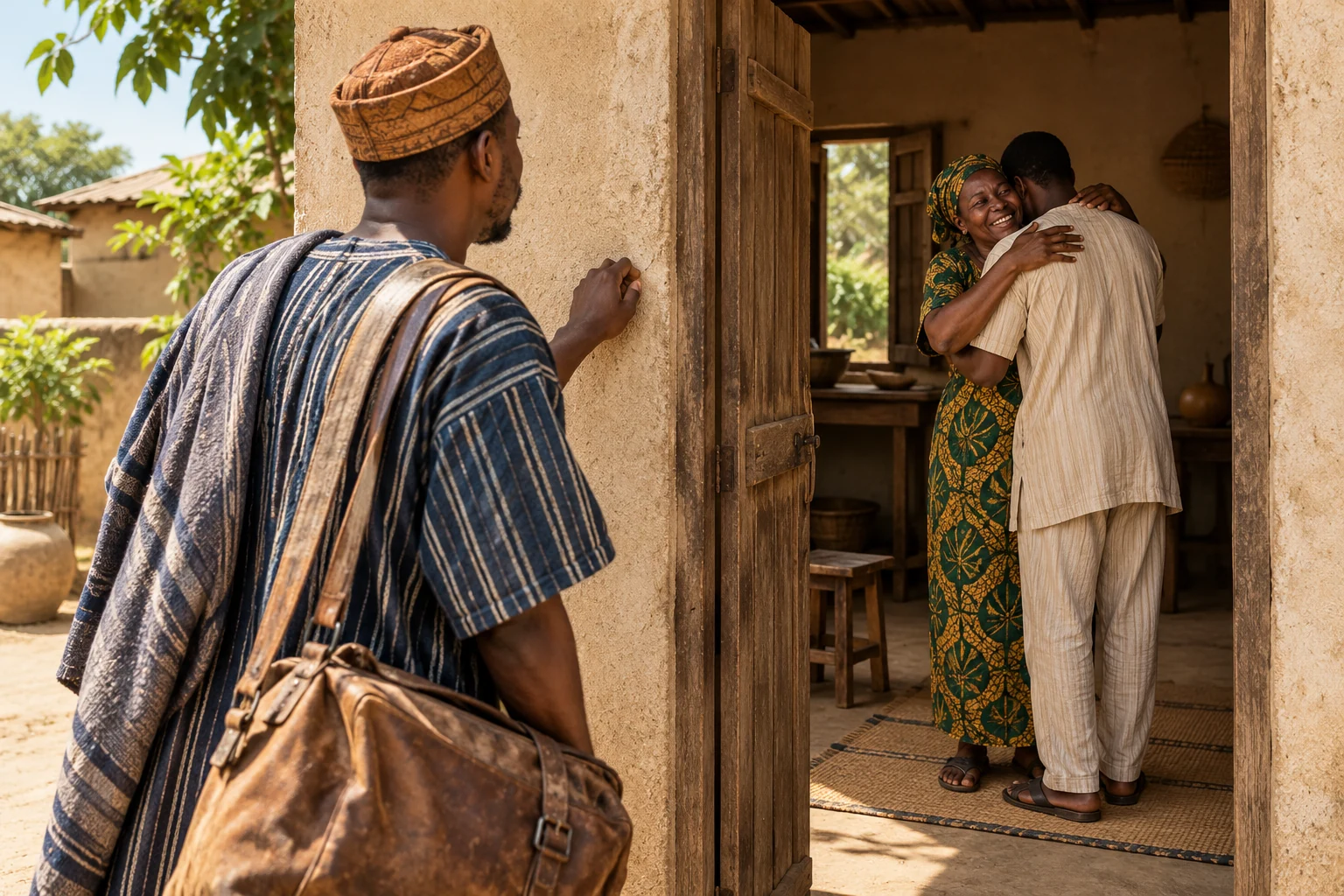
After years away, a traveler returns home and sees his wife affectionately greeting a grown young man. He first imagines betrayal. Remembering counsel against acting on the first impression, he knocks instead of attacking. The greeting reveals that the young man is his son, whose appearance changed during the long absence.
Time has altered the facts available to the observer. Restraint protects a relationship because inquiry replaces an accusation built from a partial view. This bounded motif should not validate the longer tale’s treatment of a coerced young wife or its other punishments. This study uses the return scene for its precise conflict between seeing and knowing.
Narrative setting: Cuban/Lukumí patakín in a multilingual source compilation; no individual narrator is established.
The heavenly gifts still need a passage home
The divine powers ask for what will make the newly formed earth habitable. Higher authority opens a treasury and permits them to carry away desired goods. Most regard further preparation as unnecessary because the permission is already given. Orunmila consults and acknowledges Esu and the guardian of the route. On the return journey, that guardian prevents the others from retaining their acquisitions. Orunmila instead offers hospitality, and music changes the encounter so he can continue with the gifts. The witness distinguishes receiving permission, obtaining goods, and completing the passage by which those goods become available to earthly life.
The theological point is not that divine generosity is false. The treasury truly opens, but a grant from one authority does not abolish every relation involved in its realization. Orunmila’s preparation recognizes that plurality rather than treating the highest permission as complete control. Esu’s participation and the guardian’s changed response make the route effective. A contemporary analogy about implementation can clarify the sequence, but should not replace a world in which sacred agencies have their own claims.
The earlier sisters’ shared garment also makes a relationship effective across distance, while the returning father must correct a dangerous interpretation before entering his home. The new episode adds the problem of transit between domains. Its depiction of the guardian uses a stigmatized body form, which should not become an explanation of disability or a category of frightening people. The enduring issue is that possession at departure and useful arrival are different conditions with different obligations.
Narrative witness and setting: Translated excerpt in the multilingual compilation’s expressly attributed Cromwell Osamaro sequence, with Yoruba/Bini-facing material. The compilation’s language is not evidence of a Brazilian tradition.
The missing dog is found on the return
Elekole’s favored dog disappears, and three religious interpreters respond differently. The first two conclude that it should be forgotten, presenting death or permanent loss as the likely explanation. The third proposes a religious response and anticipates return. When the person carrying out that response travels back, the dog is encountered in a communal place. Elekole acknowledges the interpreter whose counsel led to the renewed encounter. The compact narrative concerns a loss that is not what the earlier explanation assumed. It does not establish that missing animals always return or that one favorable result makes every third opinion authoritative.
The dog is found through a sequence that includes disagreement, sacred response, movement, and observation. The witness does not place religious action and the actual discovery in competition; they belong to one event in its world. A contemporary interpretation can still be exact about what the discovery proves. It resolves this disappearance, not the reliability of every optimistic account. The returning-father episode provides a related but different correction: a visible scene is initially misread until kinship is spoken.
The treasury passage corrects a third assumption, that an authorized possession is already secure. Across the four stories, a first explanation or a formal status may be incomplete, yet the remedy is not indiscriminate doubt. It is a specific relation or encounter that discloses what was missing. The dog’s communal location also matters because the sought being exists outside the owner’s view, without necessarily having crossed into the final condition the first interpreters announced.
Narrative witness and setting: Translated excerpt in the multilingual compilation’s expressly attributed Cromwell Osamaro sequence, with Yoruba/Bini-facing material. The compilation’s language is not evidence of a Brazilian tradition.
What was born in this Odù
“Born” can name an explicit traditional origin association or what emerges through a story: a capacity, relationship, practice or order of life. Interpretations drawn from a narrative are labelled below, so their basis remains clear.
Inle Abata
Selected traditional source association.
The sole explicit born item names Inle Abata. The inspected list does not explain the relationship between those names, and no automatic merger with Erinle or another wetland figure is justified by it.
Visible solidarity across distance
Contemporary interpretation from the selected myth.
A contemporary interpretation sees coordinated support emerge through the sisters’ shared garment. The visible act expresses an existing bond; it is not presented as a traditional claim that solidarity originated in this sign.
Correlations to life dimensions
These questions bring the selected stories into contemporary life. They are interpretive invitations for study.
Work and resources
The traveler’s lost years affect what he can recognize. Experience and old knowledge can become outdated even when a person remains confident.
Reflect: Which assumption needs updating after a long absence?
Relationships and family
The sisters act across distance without becoming the same figure. Reliable alliance can preserve different roles while making mutual support unmistakable.
Reflect: What visible act would confirm a relationship you already value?
Character and inner life
The return scene gives a moment of restraint lasting consequences. A feeling can be acknowledged without granting it control of the next action.
Reflect: What would you ask before acting on suspicion?
Community and responsibility
Public celebration follows the sisters’ coordinated action. Communities can acknowledge interdependence instead of attributing every success to a single powerful individual.
Reflect: Whose contribution should be named alongside yours?
A deeper reading of the sacred relationships
Permission and realization belong to multiple sacred relations
The treasury account treats higher authorization, Orunmila’s consultation, Esu’s aid, and the guardian’s response as distinct elements of one passage. No single permission makes every other agency irrelevant. The sisters’ coordinated action likewise depends on a relation confirmed through Ifa rather than their standing alone. The missing dog is found within a religiously sustained sequence that also includes human movement. These particulars show a sacred world with differentiated agency, not a model in which one act buys an automatic outcome. A contemporary discussion of prerequisites can be helpful, provided it follows rather than replaces that religious account and does not invent a public ritual checklist.
A correction needs something more exact than optimism
The traveler’s mistaken view of his wife is corrected by identifying his son; the dog’s disappearance is corrected by an actual encounter; the sisters’ relation changes the public reading of a garment; and the divine gifts arrive only after the route is negotiated. These stories offer different evidence, not a universal claim that hopeful appearances should be preferred. A reference study can ask what exact addition makes a previous interpretation inadequate. That keeps the religious account credible without turning each result into a general forecast. It also distinguishes suspending a hasty conclusion from simply choosing the answer one most wants to hear.
Return is an achievement with a changed understanding
Orunmila returns with gifts, the dog returns to Elekole’s sphere, and the father returns after years of absence. In each, arrival alone is not the whole event. The carrier learns the route’s obligations, the owner learns the loss was not final, and the father learns that time has changed his child’s appearance. The sisters’ solidarity offers a counterpoint in which support travels without their identities merging. Comparing these forms of return makes homecoming a relation of knowledge and responsibility rather than a simple reversal of departure. The narrative does not say every departure should end in return, but it shows why a return can require discernment beyond physical movement.
Questions that deepen the study
Why are the treasury gifts not secure when they are granted?
The witness distinguishes the legitimacy of receiving from the conditions of carrying something between domains. Higher authority permits the gifts, but the return route still contains a guardian whose relation has not been addressed by most travelers. Orunmila’s preparation acknowledges that field, and Esu helps make passage possible. A contemporary reader may compare the difference between a formal grant and practical access, but the religious claim concerns active sacred persons, not merely bureaucratic obstacles. The account does not tell readers to distrust every gift. It asks what continuing relation is involved before an acquired good becomes part of lived provision.
Does the dog story teach that a later opinion is always better?
No. Its later interpretation is followed by an encounter that resolves the particular loss, which is stronger evidence than its position in the sequence. The source’s religious world also regards the sacred response as consequential. A reference study can preserve both statements without turning third opinions into a rule or dismissing all unfavorable counsel as incompetent. The meaningful distinction is between a confident explanation and what the later event establishes. That same discipline applies to the returning father: a pause is valuable because it allows identification, not because suspicion is always wrong or every reassuring explanation should be accepted.
How do the sisters fit stories otherwise centered on return?
Their solidarity makes support effective across separate cities without requiring one to become the other. The shared garment creates a public sign of a real relation, while the treasury traveler needs an acknowledged relation to make gifts cross a boundary. The father and dog episodes concern a different boundary between what someone sees or knows and what is actually present. The comparison is therefore about how a relation becomes intelligible across distance, not a claim that all four plots share one mechanism. Oshun and Oya remain distinct divine persons, and the garment’s meaning should not be turned into a fabricated universal etymology.
What the four narratives reveal together
The new witness deepens Okanran Ogbe through the difference between a legitimate beginning and a completed return. Heavenly gifts require a passage that remains answerable to sacred agencies, while a missing dog disproves the finality assigned by earlier explanations. The earlier sisters and returning father show different corrections of distance and appearance. Their comparison preserves a substantial religious world: Ifa, Esu, the guardian, Oshun, and Oya act through particular relationships rather than serving as interchangeable symbols of good judgment.
Contemporary questions about access and evidence can then be drawn carefully. The four stories do not recommend optimism regardless of facts or promise that every loss reverses. They specify what must become known, acknowledged, or encountered before a desired arrival is real, and how a changed understanding belongs to return rather than following it as an optional moral.
Living with this Odù
A continuing life or initiatory relationship
For someone who has received Òkànràn Ogbè as a life or initiatory sign, arrival can require a changed understanding rather than a simple reversal of departure. The returning father must discover who has grown during his absence; the divine gifts need a passage beyond the permission that first made them available. Across a life, these narratives can develop patience with facts outside one's present view. Suspending an accusation is different from denying what one sees, and receiving authorization does not remove every relation through which action becomes possible.
The sisters' garment and missing dog give other ways a connection becomes effective across distance. Oshun and Oya remain distinct while their alliance changes how observers interpret an appearance. The dog returns within a sacredly sustained sequence that includes movement and actual discovery, not optimism alone. Long-term character can include inquiry specific enough to correct a mistaken conclusion without treating every favorable account as true. The sign does not establish that missing beings always return or that consultation guarantees transport of every desired good. It asks how knowledge, support and arrival are joined, preserving Esu, the guardian and Ifa as active relations rather than reducing the stories to private reassurance.
A particular consultation and its question
A consultation yielding Òkànràn Ogbè can invite a distinction between what has been observed and what has been concluded. The father sees an unfamiliar young man but does not yet know the relationship; Elekole hears interpretations of a disappearance that an eventual encounter corrects. A practitioner can ask what exact information is absent and what could responsibly change the account. The narratives do not recommend optimism as a substitute for evidence or suggest that every third opinion is authoritative.
A question about resources may instead concern the route between a grant and its realization. Higher permission opens the treasury, yet Esu and the guardian remain effective in the gifts' return. The sisters' shared garment likewise communicates an existing solidarity without merging their identities. These distinct sacred arrangements can illuminate the present question without becoming a public checklist of prerequisites. The longer return narrative's coercive marriage must also remain outside any endorsement of the father's restraint. A result obtained now does not define permanent identity as abandoned parent, successful carrier or inseparable sibling. It addresses which relation or correction is needed in the actual encounter, while leaving outcomes not narrated by the source open.
Constructive and adverse possibilities
Constructive unfolding might let a relationship provide the precise addition that corrects a dangerous assumption: kinship is identified, a lost dog is encountered or a route becomes passable through acknowledged sacred agencies. Oshun's support for Oya also makes solidarity visible while preserving their difference. These are particular corrections, not proof that the most hopeful reading should always prevail.
Adverse relations include treating an impression as a complete account, permission as control of every passage or verbal familiarity as knowledge of what time has changed. The guardian's stigmatized depiction cannot categorize actual disabled people, and the missing dog's return cannot guarantee every loss reversible. These possibilities do not assign ìrè or òṣogbo to an unknown result. They ask whether an explanation remains open to the specific encounter that could disclose what it presently lacks.
An illustrative situation in everyday life
In a hypothetical homecoming, a parent absent for several years sees an unfamiliar adult embracing their partner and immediately imagines betrayal. Pausing to ask allows the parent to recognize a child whose appearance changed during the separation. The return scene makes time, observation and identification distinct. The missing-dog motif adds a separate caution against declaring a loss final before its actual circumstances are known. This illustration does not excuse the longer source's coercive relationships or promise that every suspicion will dissolve. It asks what information would change the conclusion and whether the observer can remain present long enough to receive it, rather than make an irreversible response to a partial view.
Sources and reading context
The first two narrative witnesses
The source supplies one named origin association only, so the card is partial in that field. The sisters’ episode and the bounded return scene are Cuban materials. Coercive marriage and violence elsewhere in the longer narrative are not approved or converted into relationship advice. Additional emergence motifs are explicitly contemporary interpretations drawn from the selected narratives, not traditional origin-list claims.
Narrative motifs are summarized independently. The life-dimension reflections are contemporary interpretation. How these reference studies are built explains the wider source approach and the distinction between a reference article and personal divination.
Additional named witnesses
- Cromwell Osamaro Ibie. The surrounding sequence is expressly attributed to Cromwell Osamaro. These selected episodes are read through the multilingual compilation’s translated renderings; exact edition and original translation chain remain unverified.
The treasury guardian’s bodily description is contextualized rather than repeated as a claim about disability. The missing-dog account is brief and no outcome is promised for another loss. Edition, exact original terms, and the translation chain remain unverified.
Bibliographic identification
- C. Osamaro Ibie. Ifism: The Complete Work of Orunmila. Lagos; multivolume publication beginning 1986. Library catalogue record. Related bibliographic record for the named narrative witness. Exact volume, edition and page of the transmitted account have not been independently matched.
Read the source method and wider scholarly context.
The catalogue links identify published works and their authors. They are separate from proof of an individual episode’s wording or attribution. Contemporary comparisons and the synthesis above are editorial interpretation. The author’s books and Academy companions below provide further study; their sales links are separate from the source references.