
Òkànràn Òyèkú is a mixed Odù in Ifá’s 256-part corpus. Okanran Oyeku contrasts a small polity’s convivial life with a larger ruler’s ambition, then turns a gourd into three figures whose claimed abilities are tested. In the first, hospitality changes the loyalties of arriving soldiers. In the second, successful hunting is undone by an unpaid agreement. The pairing prevents generosity from becoming merely a display: public abundance needs credible relationships, practical competence, and attention to obligations beyond immediate gain.
A question to carry through the study: Which agreement might be forgotten precisely because things have begun to go well?

This Academy reads the right column first, then the left. Each row carries a single or double mark.
Where this Odù belongs
Òkànràn Òyèkú belongs to the Òkànràn family in this Academy’s study sequence. It is a mixed Odù, distinct from Òyèkú Òkànràn. The order matters. Its teaching is approached through its own narratives, rather than by adding two general descriptions of the principal signs together.
Key Òrìṣà and sacred relationships
The figures below are selected for their roles in the accounts discussed here. They offer connected reading paths through the tradition.
-
Olókun. Water associated with Olokun is explicitly named in the origin list. It is not assigned an invented role in the two selected narratives.
-
Ọ̀rúnmìlà. The affiliated-figure list places Ifa in a role of guidance and support. This is a separate association, not a claim that he personally appears in the gourd episode.
-
Orí. The inner head is listed in connection with fulfillment and support. It remains an inward orienting principle in this study, not a separate Academy deity.
Key myths and their meanings
The small land welcomes an army
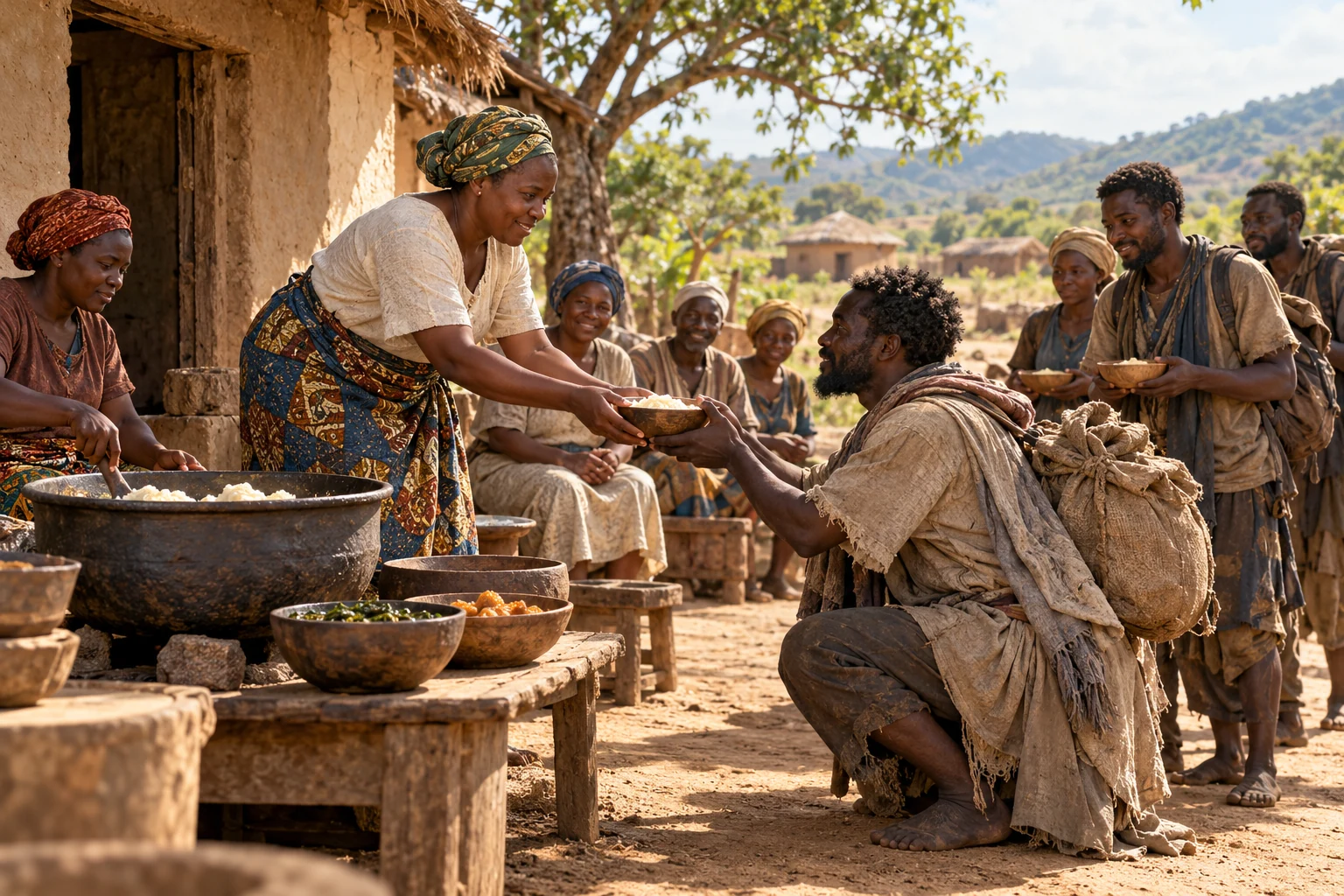
A larger ruler resents the existence of a smaller sovereign whose people enjoy frequent communal feasts. An invading army arrives during a celebration and receives food and considerate attention. The soldiers refuse their officers’ demand to attack the hosts and eventually turn against the ruler who sent them.
Hospitality allows soldiers to encounter a different account of political life. Their change of allegiance is not simply purchased by a meal; it follows the contrast between conquest and shared welfare. The violent overthrow at the end remains unresolved. A contemporary reading can examine legitimacy through daily conditions without portraying hospitality as a guaranteed defense against invasion.
Narrative setting: Cuban/Lukumí patakín in a multilingual source compilation; no individual narrator is established.
Three claims from one gourd
A woman divides a gourd, and each piece resists becoming an ordinary utensil by claiming a grander occupation. Two fail at their declared work. The third succeeds at trapping birds after accepting a local condition, but the household withholds the agreed first share. The arrangement then collapses, and the hunter disappears.
The ordinary utensil and the prestigious occupation form the story’s central contrast. Claiming a role does not establish competence, while genuine success still depends on honoring conditions. The woman and her companions benefit before the debt is remembered, making abundance a point of ethical risk rather than proof that every earlier choice was sound.
Narrative setting: Cuban/Lukumí patakín in a multilingual source compilation; no individual narrator is established.
Orunmila leaves interpretation among many successors
Orunmila announces that he is leaving earthly life for a home beyond the sea. His children and followers ask whom they can approach afterward as their father and interpreter. The response directs them toward available practitioners rather than one person who will possess all his knowledge. The connected prose emphasizes that a practitioner may explain something another has not taught, and rejects a blanket prohibition against sharing one’s sign in an appropriate religious consultation. The departure therefore becomes a narrative about the continuation and distribution of knowledge, not only the absence of a founding presence. It does not authorize public disclosure of protected manuscripts or restricted rites.
The witness treats departure as a change in access rather than the extinction of Ifa. Orunmila’s knowledge continues through multiple practitioners, none of whom can claim to exhaust it. This is a religious account of succession and interpretive humility, not merely a modern defense of plural opinions. The followers’ question is concrete: without the original teacher physically present, how does an ongoing relationship remain possible? The answer makes encounter with others important while leaving discernment necessary. Compare the earlier gourd figures, who claim abilities they cannot all perform: a declared identity is not the same as demonstrated capacity.
The small land’s welcome also establishes relations beyond its own border, though its military ending belongs to a different problem. The new episode contributes a nonmilitary form of continuing community through shared but incomplete understanding. A contemporary reader may value openness, while the study must not convert that openness into permission to expose every restricted name, text, or practice outside its appropriate setting.
Narrative witness and setting: Translated excerpt in the multilingual compilation’s expressly attributed Cromwell Osamaro sequence, with Yoruba/Bini-facing material. The compilation’s language is not evidence of a Brazilian tradition.
Two neighboring communities face a divided outcome
Igbehin and Itori receive a common warning concerning threatened death and are advised to undertake religious commitments. Igbehin responds, while Itori declines. In the narrative, Esu travels at night with a drum, and danger that would have fallen on one place proceeds toward the other. A destructive outbreak follows in Itori. People who heard the nocturnal announcement report it, and the community eventually acts; the deaths then stop within the account. The witness frames differentiated protection through sacred relation and a belated response. It is not treated as verified epidemiological history, evidence of a disease mechanism, or a judgment on present communities.
The difficult feature is not simply a difference in preparation. The account explicitly represents protection as a redirected danger, giving the neighboring community a position that a triumphal summary could omit. Its late response also matters: the first refusal does not make further relation impossible, although real losses have occurred within the plot. The earlier hospitality account similarly spares one small land while force is redirected toward another ruler. These episodes raise a comparative question about the boundary of a beneficiary’s safety.
Within the sacred witness, Esu’s movement and the community’s response are effective, and should not be replaced by a secular explanation the text does not supply. Contemporary ethical interpretation can then ask whether one group’s relief settles responsibilities toward those harmed elsewhere. That question is not a correction to the religious plot but a transparent additional lens. No conclusion about actual epidemics, moral worth, or ritual protection should be inferred from the narrator’s localized account.
Narrative witness and setting: Translated excerpt in the multilingual compilation’s expressly attributed Cromwell Osamaro sequence, with Yoruba/Bini-facing material. The compilation’s language is not evidence of a Brazilian tradition.
What was born in this Odù
“Born” can name an explicit traditional origin association or what emerges through a story: a capacity, relationship, practice or order of life. Interpretations drawn from a narrative are labelled below, so their basis remains clear.
Olokun-associated water
Selected traditional source association.
The association locates depth and water within this sign’s local origin vocabulary. The selected stories do not establish an oceanic creation event or a universal Olokun correspondence.
The anger of the divine powers
Selected traditional source association.
Anger is named as an origin motif. It can contextualize broken agreements and authority, but it should not be used to diagnose a person’s troubles as divine displeasure.
Correlations to life dimensions
These questions bring the selected stories into contemporary life. They are interpretive invitations for study.
Work and resources
The gourd figures seek status beyond ordinary utility. Reliable performance may be more valuable than a grand claim about one’s occupation.
Reflect: What work can you actually deliver?
Relationships and family
The household shares in a successful catch but fails to meet its condition. Benefiting together also creates shared responsibility for a promise.
Reflect: Who needs to know the obligations attached to a benefit?
Character and inner life
The smaller ruler’s confidence rests on daily relations with the people. Self-assurance can grow from care rather than territorial size.
Reflect: What existing relationship is a stronger asset than expansion?
Community and responsibility
Soldiers revise their allegiance after seeing another social arrangement. Encountering lived conditions can unsettle an official account of an adversary.
Reflect: What direct encounter could challenge your group’s inherited hostility?
A deeper reading of the sacred relationships
A departed teacher remains present through distributed knowledge
Orunmila’s departure does not leave the followers with an empty category of authority. It gives them a way to continue consulting, learning, and encountering dimensions of Ifa that one practitioner may not hold. The religious presence is therefore not exhausted by physical proximity or a single representative’s completeness. This account should not be reduced to a modern marketplace of equally interchangeable opinions. It affirms a tradition of knowledge whose human carriers remain partial. A contemporary lens on learning can follow, while preserving the distinction between responsible consultation and indiscriminate disclosure. The witness’s criticism of exclusive control is specific and does not erase legitimate restrictions surrounding particular practices or source material.
Protection has a social boundary
The small land welcomes an approaching army and changes its allegiance; Igbehin’s sacred response precedes danger moving toward Itori; and the gourd hunter obtains a successful catch while neglecting the share promised to another authority. Each account gives a beneficiary something valuable without settling every surrounding claim. A strong study can track where the protected circle ends and who stands outside it. That is a comparative ethical question, not a claim that the stories have identical mechanisms. Hospitality, sacred commitment, and a territorial bargain remain different relations. Their juxtaposition prevents the reference article from equating a principal figure’s favorable outcome with a universally peaceful or just conclusion.
A response can be late without being meaningless
Itori’s first refusal is followed by loss, but the later act changes the narrated continuation. The gourd hunter, by contrast, offers an expanded future share after a neglected agreement, yet does not restore the previous arrangement. The departing Orunmila opens a further continuity in which others must learn after a change they cannot reverse. These differences make timing concrete. A late acknowledgment may still matter, but it cannot make earlier consequences disappear or guarantee the same result as preparation. The study should describe what a renewed relation accomplishes in each story and what remains outside its ending, rather than offer a generic assurance that it is never too late for every kind of repair.
Questions that deepen the study
Does the departure episode make every practitioner equally authoritative?
It denies that any one human carrier can contain all of Orunmila’s knowledge, but that is not the same as declaring every claim equally sound. The point is that another practitioner may illuminate something not previously learned. The story retains a recognizable religious field in which consultation and interpretation matter; it does not erase training or discernment. A contemporary reader can therefore remain open to further instruction without accepting a person’s status merely because it is announced. The earlier gourd figures reinforce that distinction through claims to occupations that are tested in action. Openness and evaluation belong together rather than canceling each other.
How should the divided community outcome be described responsibly?
The article can explain the religious sequence directly: two communities respond differently, Esu’s nocturnal action redirects danger, and a later response changes Itori’s continuation. It should also state that this is a localized sacred account, not verified disease causation or evidence that real victims failed a duty. The comparison with the small land can ask about safety that moves harm beyond its own boundary. That is a contemporary ethical question, distinct from the witness’s explanation of efficacy. Keeping both levels visible avoids either endorsing a harmful medical inference or stripping the story of the divine agency through which it understands events.
What does succession add to a sign otherwise concerned with agreements and hospitality?
It extends relationship beyond the immediate host, bargain, or conflict. The followers must sustain access to knowledge after the person they knew departs, so continuity depends on encountering several partial carriers rather than repeating one physical arrangement. The gourd hunter’s failed agreement and the small land’s transformed alliance then appear as other kinds of relation with different conditions of continuation. The new witness does not turn them into one universal lesson. It gives a reference study another scale: how a tradition remains available when its original presence cannot be approached in the same way, and why learning must remain open afterward.
What the four narratives reveal together
The new witness extends Okanran Oyeku from the immediate terms of welcome and bargain toward the continuity and limits of protection. Orunmila’s departure leaves a distributed field of interpretation rather than a single complete successor. Igbehin and Itori show a differentiated sacred response whose favorable result for one community has a troubling boundary. The earlier small land and gourd accounts make those questions more exact: relationships can redirect force or secure abundance while leaving another claim unsettled. Divine agency remains substantial, especially in Esu’s nocturnal movement and Orunmila’s continuing availability through knowledge. Contemporary reflection can ask about access, partial understanding, and responsibility beyond one’s own relief, provided those questions are not presented as the sole or hidden meaning of the tradition. No medical inference or blanket rule of disclosure follows from this comparison.
Living with this Odù
A continuing life or initiatory relationship
For a person whose received life or initiatory sign is Òkànràn Ọ̀yẹ̀kú, continuity can depend on a community of partial knowledge rather than one complete representative. Orunmila's departure leaves followers with practitioners through whom the religious relationship continues; the gourd figures show why a declared role alone cannot establish capacity. Across changing teachers and responsibilities, the narratives can support openness that remains discriminating. Another person may supply something genuinely missing without every opinion becoming equally reliable or every restricted teaching becoming public property.
The neighboring communities and small land make protection ethically bounded. The beneficiary's relief can redirect danger rather than bring peace to everyone, and a late response can change events without returning those already lost. Long-term character may include honoring a specific agreement when success makes it easy to forget, while recognizing that help and security have consequences outside one's own circle. The received sign does not predict invasion, illness or the return of lost prosperity. It asks how knowledge and protection continue through changed relations, preserving Esu's agency and the localized witnesses without making their favorable outcomes a certificate that every surrounding claim has been settled.
A particular consultation and its question
In consultation, Òkànràn Ọ̀yẹ̀kú can help distinguish a change in access from the end of a relationship. The departing Orunmila directs followers toward multiple interpreters; the loss of a founding person's physical presence does not make the tradition empty. A practitioner can examine whether the question concerns succession, a needed additional account or a claim to exclusive authority. The narrative's openness still has an appropriate religious setting and does not authorize publication of protected material.
A question involving benefit may require tracking its boundary. The small land's welcome changes an army's allegiance, while Esu's movement in the community witness redirects danger rather than eliminating it universally. The gourd hunter's success also remains conditional on an agreement the beneficiaries neglect. These are different mechanisms, so hospitality cannot be promised as defense and the outbreak cannot explain actual epidemiology. Consultation may ask what a late response can still change and which costs remain. It cannot establish that the unknown client's neighbors deserve harm or that one favorable result means every party has been treated justly. The sign's appearance in a particular question remains different from a permanent personal identity.
Constructive and adverse possibilities
Constructive relations could distribute learning among responsible practitioners, let demonstrated capacity replace unsupported occupational claims and sustain the terms on which a benefit was received. Itori's later response also changes the narrated continuation, while leaving earlier losses real. Religious agency remains effective without requiring every beginning to be irreversible.
Adverse unfolding may involve exclusive control of interpretation, forgotten conditions after abundance or protection understood only from the beneficiary's standpoint. Danger redirected toward another community and captives or victims left outside a triumphant ending cannot become ordinary examples of fair exchange. These contrasts do not decide ìrè or òṣogbo for an actual reading. They ask how an ongoing relationship remains possible after departure, what evidence supports a role and whether renewed acknowledgment addresses a particular loss without pretending to restore everything that preceded it.
An illustrative situation in everyday life
In a hypothetical study community, a founding teacher retires and members fear that no one can continue the work. One successor claims exclusive possession of the entire teaching, while others can demonstrate complementary knowledge. The departure narrative supports continuity through several accountable carriers without making their competence identical. The gourd figures add a test of claims: a title must meet an actual task. This illustration does not turn the source into permission to disclose restricted teachings. It asks how members can seek an additional interpretation responsibly and distinguish a tradition's continuing life from the prestige of one representative. The founder's absence changes access, but need not erase the relationships through which learning can proceed.
Sources and reading context
The first two narrative witnesses
The narratives are Cuban, while figure affiliations are explicitly identified as separate list associations. Olokun is not made a participant where the stories do not name that power. Unselected stigmatizing origin material is not developed, and hospitality is not promised as a reliable safeguard against violence.
Narrative motifs are summarized independently. The life-dimension reflections are contemporary interpretation. How these reference studies are built explains the wider source approach and the distinction between a reference article and personal divination.
Additional named witnesses
- Cromwell Osamaro Ibie. The surrounding sequence is expressly attributed to Cromwell Osamaro. These selected episodes are read through the multilingual compilation’s translated renderings; exact edition and original translation chain remain unverified.
The community outbreak is sacred narrative rather than authenticated epidemiology. The departure passage contains awkward directional wording in translation. Its openness concerns religious interpretation and does not authorize exposing protected texts, restricted procedures, or every private ritual identity.
Bibliographic identification
- C. Osamaro Ibie. Ifism: The Complete Work of Orunmila. Lagos; multivolume publication beginning 1986. Library catalogue record. Related bibliographic record for the named narrative witness. Exact volume, edition and page of the transmitted account have not been independently matched.
Read the source method and wider scholarly context.
The catalogue links identify published works and their authors. They are separate from proof of an individual episode’s wording or attribution. Contemporary comparisons and the synthesis above are editorial interpretation. The author’s books and Academy companions below provide further study; their sales links are separate from the source references.