
Òyèkú Òkànràn is a mixed Odù in Ifá’s 256-part corpus. A child damages Osanyin’s tree and is later confused with another offender; a community loses consecration paints because two powerful participants feel excluded from the colors. These specific plots explore the difference between accountability and mistaken blame, then between suppressing disagreement and enlarging a shared symbolic order. The origin inventory’s preparation of paint directly anchors the second narrative.
A question to carry through the study: Can a grievance be heard without requiring someone to disrupt the whole shared project?

This Academy reads the right column first, then the left. Each row carries a single or double mark.
Where this Odù belongs
Òyèkú Òkànràn belongs to the Òyèkú family in this Academy’s study sequence. It is a mixed Odù, distinct from Òkànràn Òyèkú. The order matters. Its teaching is approached through its own narratives, rather than by adding two general descriptions of the principal signs together.
Key Òrìṣà and sacred relationships
The figures below are selected for their roles in the accounts discussed here. They offer connected reading paths through the tradition.
-
Òsanyìn. He is the tree attacked by the child and responds by confining him, making injury to a living sacred presence central to the first episode.
-
Odùdùwà. His representative distinguishes the goat’s later damage from the child’s act, interrupting mistaken attribution; he also retains a judging role around the restored paints.
-
Èṣù. He helps search for the missing paints and brings the disputing figures back toward a joint resolution with Obatala and Shango.
Key myths and their meanings
The child and the second attack
A child repeatedly ignores counsel from Oshun and Obatala, enters the forest, and destroys a tree identified as Osanyin. Osanyin confines him. Later Eshu sends a goat, whose horns damage another part of the tree. Osanyin assumes the child is responsible again until a representative of Oduduwa identifies the actual cause of the second incident.
The child’s first wrongdoing does not make every later accusation true. The correction is therefore more precise than a general warning about disobedience. The story also imagines a tree as a sacred participant rather than inert property. We can retain both responsibilities: acknowledging an original injury and resisting the transfer of unrelated blame onto a person already judged.
Narrative setting: Cuban/Lukumí-labeled patakín in the multilingual source compilation; individual narrator and publication history are not established.
Paints hidden over excluded colors
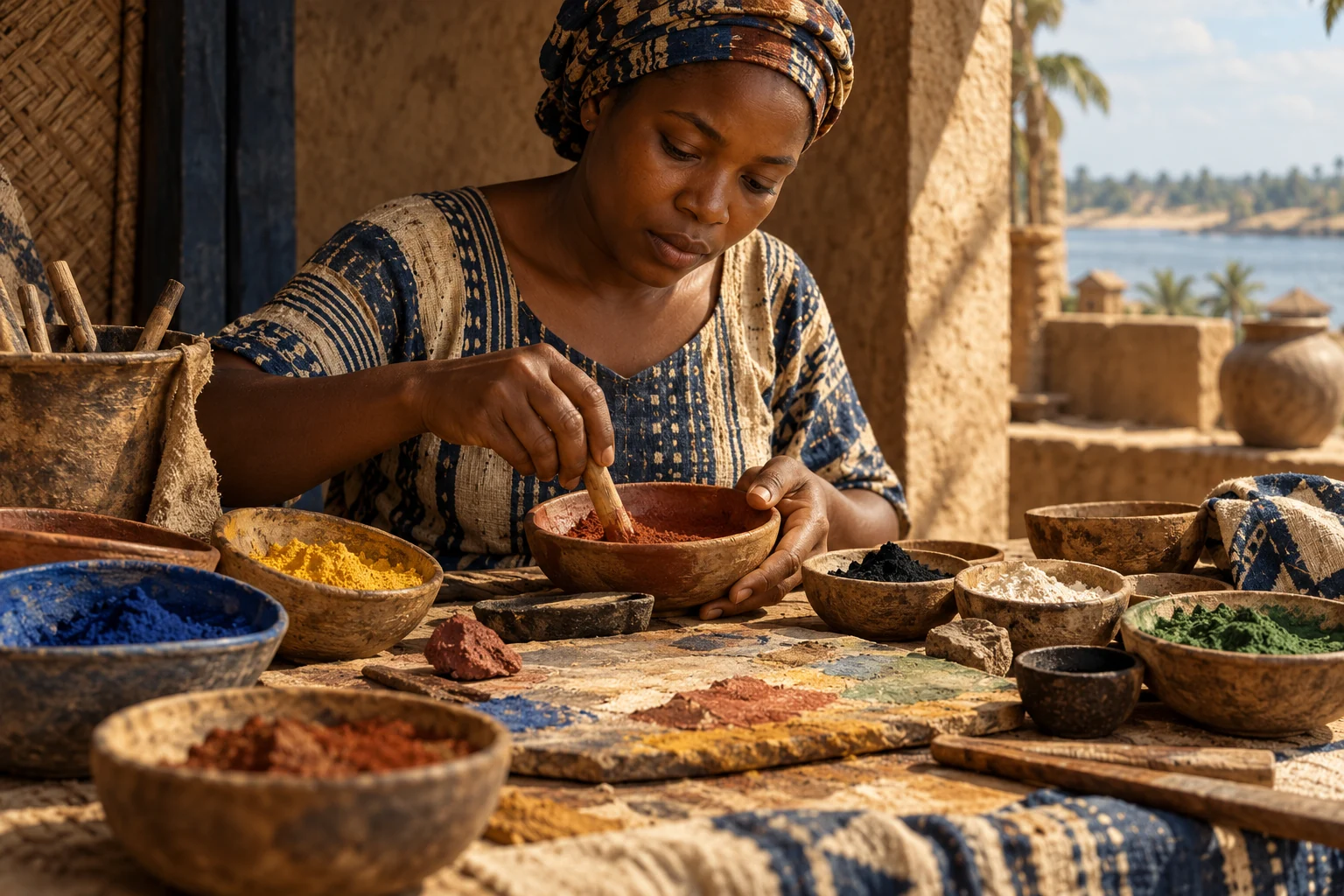
Paints needed for consecration disappear, halting the community’s ceremonies. Yemaya and Oshun have hidden them because their own colors are missing from the established set. An elephant associated with Oduduwa helps recover the container, and Eshu brings the disagreement back to Obatala and Shango. The resolution adds the omitted colors and prepares the paints for renewed communal use.
The concealment harms everyone, yet the complaint reveals an exclusion within the shared symbol system. The resolution restores the resource while changing its composition, rather than merely returning to the earlier arrangement. The passage has an unstable description of the recovered container; its reliable narrative issue is the negotiation over whose colors can appear in a community’s religious life.
Narrative setting: Cuban/Lukumí-labeled patakín in the multilingual source compilation; individual narrator and publication history are not established.
Iroko mediates a violated obligation between sisters
Iroko and two sisters come to earth after different responses to divination. One sister, Ogboi, has many children, while the mother of witches has one. They exchange care during market journeys. Ogboi’s children kill the single child left in their household, breaking a relation previously honored by their aunt. Iroko recalls a celestial prohibition and supports the bereaved sister’s retaliation, then gives her a place. After losses in her own household, Ogboi consults Orunmila and finally completes the neglected religious response. At Iroko’s house the offering leads him to interrupt another attack, establishing an ongoing relation of appeasement rather than erasing the original death.
The account’s theology places maternal powers and Iroko inside an enforceable order of obligation. The first injury is not an inexplicable eruption of hostility: entrusted care has been answered with an irreversible breach, and Iroko invokes a law understood to precede earthly life. The later response does not make the lost child return. It changes what the surviving household can ask of powers whose grievance remains real. This is a religious explanation of appeasement, not merely a modern allegory about conflict management.
Its severity and collective retaliation nevertheless remain open to analytical attention. The mother of witches must not be confused with Aje as wealth, nor Iroko with Kitembo through a functional resemblance. Contemporary reflection can ask how one acknowledges a harmful action whose consequences cannot be undone, without endorsing violence against descendants or diagnosing actual family losses as punishment. The story’s continuing exchange is a particular sacred relation, not a generalized accusation that people are secretly subject to a hostile female category.
Narrative witness and setting: Section explicitly headed revelations of Cromwell Osamaro; Yoruba/Bini-framed account of Iroko, Ogboi, and the mother of witches.
A chain of alarms ends in a heavenly hearing
Three fishing brothers suffer successive injuries while trying to obtain help. A squirrel laughs at a fall, frightening a snake whose flight drives a rabbit out of its hole. Other animals read the movement as danger, and the disturbance travels through a monkey, a damaged tree branch, a bird’s eggs, a gorilla’s drumming, and an elephant’s rush into town. Human losses follow. A heavenly messenger halts the confusion and asks every participant to explain. The accounts reveal inherited fears and neglected religious directions. The messenger distinguishes responsibility, restores the harmed relations and bodies within the story, and sets limits on future conduct.
The hearing gives each reaction a history rather than assuming the entire chain is one act of malice. Several participants respond to signs associated with earlier danger, while the tree’s specific warning is ignored and the initial religious responses have been deferred. The messenger’s authority is therefore both restorative and discriminating: the source does not simply declare that everyone shares equal blame because everyone is connected. The comprehensive restoration belongs to the account’s spiritual reality and should not become a medical promise. Its theological scope is larger than ordinary mediation because the messenger can reset bodily and interspecies conditions that human actors cannot undo.
Contemporary interpretation can still ask how a community separates an initiating breach, a foreseeable reaction, and a later independent choice. The story’s explanatory language is often mistranslated, so exact animal taxonomy and psychological labels should be avoided. Its concrete depth comes from allowing many accounts to be heard before assigning responsibility, rather than selecting the loudest alarm as a complete description of what happened.
Narrative witness and setting: Section explicitly headed revelations of Cromwell Osamaro; extended Yoruba/Bini-framed animal and human narrative.
What was born in this Odù
“Born” can name an explicit traditional origin association or what emerges through a story: a capacity, relationship, practice or order of life. Interpretations drawn from a narrative are labelled below, so their basis remains clear.
Religious preparation of paint
Selected traditional source association.
The origin list directly attributes paint preparation to the sign, while the narrative distinguishes an earlier discovery from a later consecration. This is a local ritual origin account and does not establish the history of pigments or visual art.
Reincarnation as a narrative theme
Selected traditional source association.
The inventory separately names a path of reincarnation. The selected stories do not elaborate it, so retain only the stated religious association; avoid importing the nearby episode’s stigmatizing claims about sexuality, childhood, or illness.
Correlations to life dimensions
These questions bring the selected stories into contemporary life. They are interpretive invitations for study.
Work and resources
The missing paints halt a collective activity because a shared resource is controlled through concealment. Restoring access requires hearing why it was removed. The story supports asking how institutions manage necessary resources when representation within them is disputed.
Reflect: Which shared resource depends on an unresolved agreement?
Relationships and family
Oshun and Obatala advise the child, but counsel does not prevent the initial injury. The later intervention protects accuracy without pretending he never acted wrongly. This distinction can support fair correction within a family or teaching relationship.
Reflect: Can correction remain specific to what actually happened?
Character and inner life
Osanyin’s justified anger about the first attack makes a mistaken second inference plausible. The narrative gives a concrete reason to pause before connecting a new event to an old offender. Recognition of a pattern still needs evidence in each case.
Reflect: What evidence separates this event from the earlier one?
Community and responsibility
The colors are restored by widening the accepted set. This makes symbolic inclusion a practical condition of continued communal work. A study reading can examine how dissent is heard early enough that participants need not remove a common resource to be noticed.
Reflect: How can excluded participants make a claim before disruption?
A deeper reading of the sacred relationships
Celestial responsibility is not identical with earthly suspicion
The sisters’ account invokes a prior law of entrusted care and later sacred appeasement, while the cascade ends through a messenger whose authority can restore and delimit relations. The earlier tree story likewise distinguishes the child’s first damage from a goat’s later act, and the paint story renews a communal religious order by acknowledging omitted colors. These accounts give sacred law, divination, and named powers active roles in responsibility. They should not be reduced to a claim that suspicion is always correct or that any misfortune identifies an offender. The sources often require disclosure and differentiation before a relation changes, even when the final judgment is more expansive than ordinary human repair.
Hearing several histories changes the account of a crisis
The heavenly messenger asks each participant for a cause, revealing that one sound has different meanings for different creatures. The tree-child episode supplies a smaller version of that correction: justified anger about an earlier injury is not sufficient evidence for another accusation. The paint dispute adds a grievance whose meaning was hidden by the initial appearance of theft alone. These cases do not say that every explanation excuses an action. They show why responsibility may depend on sequence, knowledge, and the obligations already binding the actor. Contemporary interpretation can use those distinctions while keeping the religious hearing’s restorative authority distinct from an ordinary committee’s capacity.
An irreversible injury and a restored order are not the same
The bereaved sister’s child does not return, even after Ogboi enters a relation that interrupts further attack. The cascade, by contrast, gives the heavenly messenger a comprehensive power of restoration. The paint account repairs shared ceremonial capacity by enlarging the accepted colors, while the child’s first injury to Osanyin’s tree remains part of his responsibility. These different outcomes prevent a single reassuring account of forgiveness. A depth treatment can ask what is acknowledged, what can be changed, and what the religious relation continues to carry. It should not invent reconciliation when the source supplies only restraint, nor deny the spiritual restoration that another particular story actually narrates.
Questions that deepen the study
Does the mother-of-witches account describe arbitrary hostility?
Its sequence gives a specific violated trust: a child is left in a household whose children destroy that entrusted life after their aunt has cared for them. Iroko appeals to a prior celestial law, and the later religious response changes the surviving household’s relation to the injured powers. That theological account should be explained directly rather than reduced to a generic fear of women. Contemporary interpretation can examine the severity of collective retaliation without treating actual deaths as evidence of such a breach. The source’s mother of witches is also distinct from wealth-associated Aje, and the two should not be merged merely because their names resemble one another.
Are all participants in the chain of alarms equally responsible?
The hearing explicitly differentiates them. Some react to inherited dangers, one ignores a direct warning, and the initial brothers and squirrel are connected with deferred religious responses. The messenger’s restoration does not require declaring every action identical in intent or consequence. Contemporary analysis can ask what each actor knew and what choice remained available at the time. The account’s comprehensive healing is an act of heavenly authority, not a promise that an ordinary investigation can reverse every loss. Its value is in combining spiritual restoration with a narrated inquiry rather than using connection alone as a sufficient reason to distribute blame indiscriminately.
How do the four narratives distinguish correction from simple punishment?
Oduduwa’s representative corrects a false second attribution at the tree; the paint account changes the common palette after hearing a grievance; the sisters’ episode establishes restraint through a religious exchange after irreversible loss; and the cascade restores relations through a heavenly hearing. None is merely a different example of giving an offender what they deserve. Each changes a different relation and leaves a different limit. Contemporary interpretation can ask which kind of correction is actually possible in a given setting while respecting the sacred agencies named. The comparison does not produce one universal legal policy or a guarantee that every harm ends in full reconciliation.
What the four narratives reveal together
The earlier Cuban tree and paint accounts distinguish mistaken blame from an actual first injury and transform a shared ceremonial resource by acknowledging excluded colors. The Osamaro-headed additions broaden the inquiry through maternal sacred obligation and a whole chain of misunderstood danger. Iroko’s intervention and the heavenly messenger’s hearing are active theological events, not merely devices for modern moral instruction. Their outcomes nevertheless differ: a continuing appeasement restrains further loss, while another account grants comprehensive restoration.
Read together, the four witnesses ask how responsibility is located through sequence, knowledge, and an already existing relation. They also prevent correction from becoming a single formula of punishment or forgiveness. A depth study can preserve the source’s spiritual order while clearly separating contemporary questions about proportionality, inherited fear, and the limits of repair from claims about what actually causes a reader’s family difficulties or bodily suffering.
Living with this Odù
A continuing life or initiatory relationship
For someone whose received life or initiatory Odù is Òyèkú Òkànràn, accountability may require resisting the way one established wrong can absorb unrelated events. The child damages Osanyin’s tree, yet that first responsibility does not prove the later goat’s damage is also his. The missing paints expose another distinction: a disruptive response can be harmful while the grievance it reveals requires a change in the shared order. Long development can involve keeping responsibility precise enough that neither blame nor restoration becomes indiscriminate.
The sisters’ violated care and the chain of alarms add scale. An irreversible breach cannot be undone by a later exchange, even when appeasement changes continuing relations. A cascade of reactions needs a hearing that distinguishes histories and choices rather than declaring everyone equally guilty because everyone is connected. Religious authority in these accounts is both consequential and demanding of differentiation.
A received sign does not identify hostile maternal powers in an actual family or predict a child’s wrongdoing. Oshun, Obatala, Osanyin, Oduduwa’s representative, Iroko, and the heavenly messenger retain their particular roles. Across changing circumstances, the person can ask what happened this time, whose exclusion needs acknowledgment, and what repair can change when full reversal of harm is impossible.
A particular consultation and its question
In consultation, Òyèkú Òkànràn can distinguish an established offense from a new accusation resting only on the offender’s reputation. The damaged-tree story makes the second cause independently discoverable. A practitioner can ask what evidence belongs to the present incident without erasing the first injury. The paints narrative asks whether restoring a shared resource must also revise the system that excluded some participants. Returning the container alone would leave its motivating grievance intact.
The sisters’ account requires care with irreversible harm and collective retaliation. A later religious relation can interrupt further attacks without returning the lost child. The alarm cascade offers a different structure: hearing each participant permits distinctions among an initiating act, a fear-driven response, and a later choice. These differences are more exact than either total exoneration or shared undifferentiated blame.
The actual result determines how the narratives speak to a particular question. It does not license an accusation against women, equate Iroko with a figure from another tradition, or promise comprehensive bodily restoration. Consultation remains a specific religious encounter. Interpretation may clarify evidence, representation, continuing obligation, or the need for a many-voiced hearing without assigning the visitor a permanent role in a narrative of damage and punishment.
Constructive and adverse possibilities
Constructively, a new event can receive its own inquiry, an omitted color can become part of the shared symbolic composition, and a continuing relation can interrupt further harm even when the first loss remains. The heavenly hearing gives reactions their histories without making every action equally justified. Religious authority enables a more discriminating account than the loudest alarm initially supplies.
Adversely, an earlier offender can become the automatic explanation for every later injury, exclusion can be ignored until shared resources disappear, and retaliation can extend a grievance into another generation. Collective connection can also become an excuse to avoid assigning specific responsibility. These possibilities do not determine whether a reading is Iré or adverse. That condition belongs to the consultation. The motifs ask whether restored order has become more inclusive and accurate, or whether it merely silences a problem while leaving blame and injury ready to travel again.
An illustrative situation in everyday life
Hypothetically, a student who once damaged equipment is blamed when another machine fails. An administrator initially treats the earlier offense as sufficient evidence. The second attack on Osanyin’s tree distinguishes a real history from proof of a new event. During the inquiry, several students reveal that the shared workshop’s displays exclude their work, and one has hidden materials in protest. The paints motif asks how to restore access while addressing the exclusion rather than calling either concealment or the original system entirely acceptable. The group can investigate separate acts and revise representation. This hypothetical situation concerns precise responsibility and changed shared order; it does not identify the students with sacred figures or claim that every dispute permits complete restoration.
Sources and reading context
The first two narrative witnesses
Two Cuban patakines are selected. The paint-container description is unstable, so no exact physical reconstruction is given. Reincarnation is only an inventory association here; nearby stigmatizing explanations of sexual orientation and disease are excluded. Oduduwa and Osanyin remain distinct figures.
Narrative motifs are summarized independently. The life-dimension reflections are contemporary interpretation. How these reference studies are built explains the wider source approach and the distinction between a reference article and personal divination.
Additional named witnesses
- Cromwell Osamaro. An explicit heading governs both Iroko’s two sisters and the three-brothers/animal-alarm cascade.
The mother of witches is not identified with wealth-associated Aje; Iroko is not equated with Kitembo. Translation, names, and psychological terms in the cascade are uneven. Child harm and spiritual restoration remain contextualized narrative events, without graphic detail, diagnoses, personal accusations, or ritual procedures.
Bibliographic identification
- C. Osamaro Ibie. Ifism: The Complete Work of Orunmila. Lagos; multivolume publication beginning 1986. Library catalogue record. Related bibliographic record for the named narrative witness. Exact volume, edition and page of the transmitted account have not been independently matched.
Read the source method and wider scholarly context.
The catalogue links identify published works and their authors. They are separate from proof of an individual episode’s wording or attribution. Contemporary comparisons and the synthesis above are editorial interpretation. The author’s books and Academy companions below provide further study; their sales links are separate from the source references.