
Òyèkú Òbàrà is a mixed Odù in Ifá’s 256-part corpus. A horse trades freedom for help against a tormentor, while a practitioner’s pursuit of power leads him to expel his wife and child before seeking their forgiveness. The sign’s horse-and-harness origin is direct and unusually concrete. These two stories investigate control from different sides: accepting another’s control to win, and losing one’s own direction while seeking greater power.
A question to carry through the study: What are you being asked to surrender in exchange for help against someone else?

This Academy reads the right column first, then the left. Each row carries a single or double mark.
Where this Odù belongs
Òyèkú Òbàrà belongs to the Òyèkú family in this Academy’s study sequence. It is a mixed Odù, distinct from Òbàrà Òyèkú. The order matters. Its teaching is approached through its own narratives, rather than by adding two general descriptions of the principal signs together.
Key Òrìṣà and sacred relationships
The figures below are selected for their roles in the accounts discussed here. They offer connected reading paths through the tradition.
-
Èṣù. As the horse’s hunter-rider he withholds release after the revenge is complete; as Eshu Mako he later helps interrupt Oyekun Bara’s destructive isolation.
-
Obàtálá. He responds to the mistreatment of the wife and child and later receives the practitioner’s admission of wrongdoing, keeping family obligations central to restoration.
-
Òsanyìn. He joins Eshu in reaching the isolated practitioner and participates in his return to a religious life that must include care for his household.
Key myths and their meanings
The saddle accepted for revenge
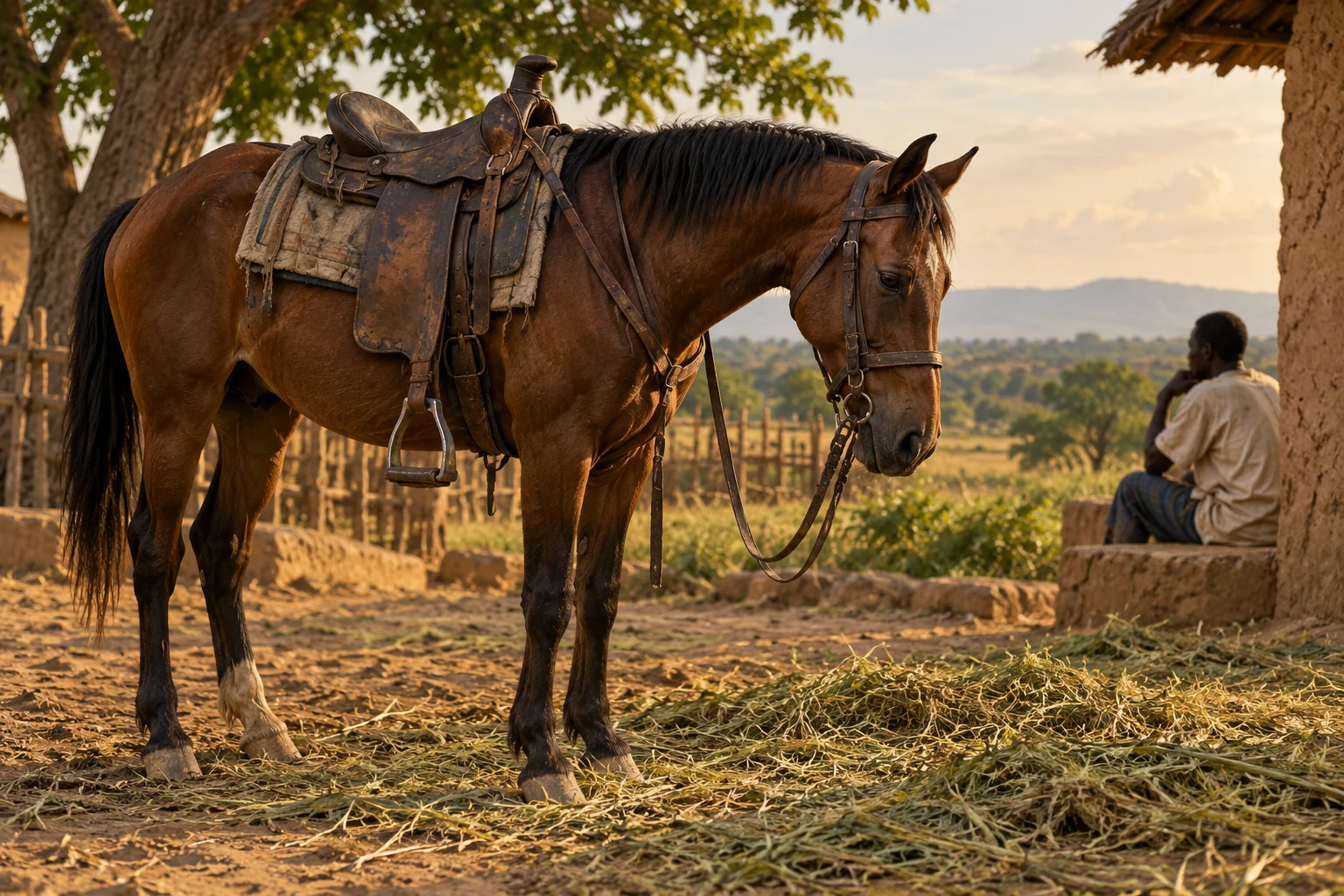
A boar spoils a horse’s water and grazing. Orunmila warns that revenge may cost the horse its freedom, but the horse seeks another helper. A hunter offers assistance on condition of a saddle, bridle, and rider. They kill the boar. When the horse asks for release, the hunter, identified as Eshu, refuses because the animal has become useful to him.
The initial grievance is real, so the story is not merely a criticism of oversensitivity. Its turning point is an agreement accepted without an enforceable exit. Revenge solves one injury by creating a durable dependency. We can focus on the terms of assistance, including whether urgency or anger makes a person accept control they would otherwise question.
Narrative setting: Cuban/Lukumí-labeled patakín in the multilingual source compilation; individual narrator and publication history are not established.
Power pursued at the household’s expense
Oyekun Bara becomes absorbed in practices associated with death while his wife and child become frightened. He expels them and his life deteriorates. Eshu Mako and Osanyin intervene; a dream directs him to seek forgiveness. He meets his family, acknowledges his conduct, gives material assistance, and returns to Obatala with a renewed obligation not to abandon them again.
The story does not need a medical explanation of his distress to make its relational concern clear. A pursuit that claims to increase power has narrowed his attention and displaced responsibility. The return includes both words and a material act, but the text gives little of the wife’s response. Her independent choice should not be invented or assumed.
Narrative setting: Cuban/Lukumí-labeled patakín in the multilingual source compilation; individual narrator and publication history are not established.
The intended beneficiary’s resources are repeatedly diverted
A creature named Ihorobi can afford a religious response that several related animals cannot. It sends resources through them to obtain what is needed, but each uses the materials for its own purpose. Their subsequent offspring become an occasion for mocking the one whose help they appropriated. Ihorobi consults Orunmila and receives a response through which its own descendants are given formidable mouths. It is told not to explain their difference to them. Persistent questions eventually produce disclosure, and the descendants begin preying on the other animals’ young. The account locates a continuing predatory relation in the delayed consequences of family deception.
The repeated delegation makes the betrayal systematic rather than an isolated theft. The intermediaries use the beneficiary’s resources to establish their own sacred relations, then treat the resulting difference as proof of the beneficiary’s foolishness. Orunmila’s response supplies a distinct future, but the instruction not to reveal its origin gives that future a boundary the parent eventually breaches. The religious logic therefore includes both restored generative capacity and responsibility for what knowledge is handed to descendants. The final retaliation is carried out by children who inherit a grievance before they can evaluate its earlier circumstances.
A contemporary interpretation can examine how a family transmits injury across generations, while preserving the account’s actual spiritual efficacy and refusing to make predation a model of ordinary justice. The creature’s uncertain identity should remain uncertain; naming it as a known species would create an unwarranted origin claim. Nor should the source’s appended suspicion of relatives become a prediction about contemporary families.
Narrative witness and setting: Section explicitly headed revelations of Cromwell Osamaro; animal-kin narrative whose zoological identification is unstable.
A debtor turns a discarded parcel into a court claim
Awun the turtle serves Esi to repay money owed and consults about escaping the obligation. After following the religious response, the turtle misses several days of service and sends a parcel containing stones wrapped with a significant bead. Esi discards it without inspecting its claimed value. Awun later asks about the parcel and describes it as precious coral beads. The dispute reaches the town’s elders. Esi is found responsible for the loss, and the supposed beads are counted against the outstanding debt. The account narrates relief through a changed legal obligation without establishing that the parcel actually contained the wealth the debtor claims.
The plot gives the debtor a religiously prepared success through a strategically ambiguous object. Its difficulty is not that sacred efficacy fails, but that success and straightforward truth do not coincide. Esi’s careless disposal creates an opening, while Awun’s later description enlarges what the creditor is held to have lost. The elders treat an unverified account of value as an adequate basis for settling the debt. This differs from the earlier horse story, in which a helper openly refuses release after the expected exchange is complete: here a subordinate uses the court to reverse a burden through a concealed substitution.
A contemporary analysis can acknowledge the pressure of debt service without making every tactic of escape ethically equal. It can also ask what a fair tribunal would need to know about the parcel, the existing contract, and each person’s knowledge. The source gives a concise victorious outcome, not a complete defense of its evidentiary reasoning or a universal endorsement of debtor fraud.
Narrative witness and setting: Section explicitly headed revelations of Epega Afolabi; African Ifa account of Awun and Esi.
What was born in this Odù
“Born” can name an explicit traditional origin association or what emerges through a story: a capacity, relationship, practice or order of life. Interpretations drawn from a narrative are labelled below, so their basis remains clear.
The horse and its harness
Selected traditional source association.
The sole origin entry names the horse together with its binding equipment. The domestication fable develops that association as a loss of freedom through an unequal bargain; it is a sacred fable rather than a historical explanation of horse domestication.
A demand for release reveals an unequal bargain
Contemporary interpretation from the selected myth.
This is a contemporary interpretation of the horse’s request after the hunt, not a second traditional origin item. The helper’s refusal reveals that a supposedly temporary surrender of control has become a continuing dependency.
Correlations to life dimensions
These questions bring the selected stories into contemporary life. They are interpretive invitations for study.
Work and resources
The hunter recognizes the horse’s economic usefulness and refuses to honor the expected end of their arrangement. The story makes exit terms central to a partnership. Resources gained through another’s help can come with a continuing claim that was not fully understood.
Reflect: What explicit exit does this arrangement permit?
Relationships and family
Oyekun Bara’s wife and child are not peripheral to his spiritual life: abandoning them is the decisive rupture. His attempted repair includes acknowledgment and resources. A careful reading preserves their needs without supplying a reconciliation or consent the passage does not narrate.
Reflect: What material repair accompanies an apology?
Character and inner life
The horse’s anger makes a warning about consequences feel irrelevant. The practitioner similarly pursues power while losing peace and relational judgment. Both plots support examining a narrowing of attention that allows an immediate objective to outweigh longer-term obligations.
Reflect: What consequence has your current objective pushed aside?
Community and responsibility
Eshu and Osanyin reach someone who has isolated himself, while Obatala insists on responsibility toward those expelled. The community’s role is not merely to restore the practitioner’s status but to attach that restoration to the household he has harmed.
Reflect: What responsibility should accompany a person’s return?
A deeper reading of the sacred relationships
Sacred efficacy is not a simple award for transparent conduct
The turtle completes its religious response and obtains relief through a disputed claim, while Ihorobi’s response gives descendants a power whose transmission requires restraint. These accounts make Ifa consequential without turning every beneficiary into an unambiguous ethical exemplar. The earlier practitioner’s return to his family links restoration with renewed care, and the horse’s lost freedom dramatizes a different continuing burden. A religious depth lens should therefore explain what each consultation discloses and what responsibility follows, rather than treating ritual as a mechanical prize for a character judged good in advance. The tension between effective action and unresolved worldly judgment belongs to the sources and need not be removed to respect their spiritual reality.
Delegation changes the risks of dependency
Ihorobi’s resources pass through intermediaries who can redirect them, while the horse depends on a hunter who controls the conditions of release. The debtor’s service places obligation inside another unequal relation, and the isolated practitioner depends on helpers to reconnect him with the household he harmed. These forms should not be collapsed into a generic warning against accepting help. Each asks what control another person has acquired over a necessary action or resource. Contemporary interpretation can ask which terms are explicit, what information the dependent party can verify, and whether a relationship permits correction before a breach becomes permanent or is passed to another generation.
A grievance can outlive the person who first carried it
Ihorobi’s descendants obtain an explanation of their difference and turn it against their relatives’ offspring. The earlier family-return story offers another possibility: the practitioner himself acknowledges harm and supplies resources before resuming his role. The contrast distinguishes transmission of injury from attempted repair, while the turtle’s court victory and horse’s captivity show burdens fixed by an institutional or powerful decision. A depth treatment can ask what happens when the next generation receives a grievance as an instruction rather than a history open to judgment. That question remains separate from the sacred origin of the descendants’ power, which the narrative gives through Orunmila rather than through ordinary psychological inheritance alone.
Questions that deepen the study
Does Ihorobi’s eventual retaliation belong to the original injury alone?
The descendants act after hearing the parent’s account, so the grievance moves into another generation and affects the other animals’ young. Within the religious story, their formidable mouths originate in Orunmila’s response; the later disclosure gives that capacity a particular target. A contemporary interpretation can distinguish obtaining protection or strength from deciding how descendants should use it. The account’s predatory ending is not a model for family justice, and its uncertain creature-name should not be turned into natural history. Its depth lies partly in the warning that explaining a power through inherited injury may shape conduct long after the first participants’ acts.
Is Awun’s debt canceled because the creditor truly lost valuable beads?
The narrative identifies stones in the parcel and a later claim about coral beads. It does not establish that the creditor actually destroyed the value awarded in court. That gap is central to the plot rather than something to repair through invention. Ifa’s prepared outcome remains efficacious within the account, while contemporary analysis can question the tribunal’s verification and the debtor’s description. The existing service burden matters too, but its pressure does not itself prove the later claim true. Reading both dimensions preserves the religious narrative without confusing success with a complete ethical vindication of every means used.
What do these additions change about the horse and household-return stories?
They show that control can operate through resources and descriptions as well as direct force or spiritual isolation. The horse loses freedom through an explicit bargain that its helper refuses to end; Ihorobi loses intended materials through delegation; Awun changes a debt through a disputed account of value; the practitioner returns by acknowledging people he had expelled. Together the stories ask who can define an obligation and what makes that definition answerable. Their religious actions remain distinct, and the endings are not equally reparative. A depth reading can therefore compare freedom, successful deception, inherited retaliation, and renewed responsibility without labeling all four as the same triumph.
What the four narratives reveal together
The earlier Cuban pair concerns a horse’s costly bargain and a practitioner’s return from destructive isolation to family responsibility. The Osamaro and Epega additions place unequal obligation inside delegated religious resources and debt litigation. Each story gives sacred relations real efficacy, but the outcomes differ ethically: renewed care, continuing captivity, inherited predation, and relief through an unverified claim. Those differences should remain visible rather than be resolved by assuming the successful figure is always wholly justified.
The research can explain what each consultation makes possible and what responsibility still attends the use of a new capacity. It can also ask who controls the account of a bargain, a gift, or a grievance after the event. That comparison deepens freedom and dependency as religiously situated concerns without turning them into one modern rule against help, family, or debt.
Living with this Odù
A continuing life or initiatory relationship
For someone whose received life or initiatory Odù is Òyèkú Òbàrà, assistance against an injury may need examination of the dependency it creates. The horse’s grievance is real, yet the helper’s terms remove its future freedom. The practitioner’s pursuit of power places another kind of control beside that bargain: ambition narrows attention until family responsibility is expelled. Long development can involve asking what a desired victory requires one to surrender and whom the pursuit is already harming.
The diverted resources and debt parcel add difficult reversals. Intermediaries can appropriate another’s means and later mock the disadvantage they produced. A debtor can obtain relief through an evidentially ambiguous claim. The successful religious response therefore cannot be treated as proof that every tactic is equally truthful or that the outcome settles all responsibility.
A received sign does not predict manipulative relatives or authorize fraud. Orunmila’s counsel, Eshu’s differing roles, Osanyin’s intervention, and renewed relation to Obatala remain specific. Across changing circumstances, the person may need an enforceable exit, acknowledgment of harm, clearer delegation, or scrutiny of a court’s reasoning. Repair becomes more demanding when it includes material responsibility without assuming another person’s forgiveness or freedom to return.
A particular consultation and its question
In consultation, Òyèkú Òbàrà can distinguish a legitimate grievance from the terms accepted to resolve it. The horse’s revenge succeeds while its freedom disappears. A question about a powerful helper may therefore require examining the exit and the helper’s continuing interest, rather than judging the offer solely by whether it defeats the first opponent. The practitioner’s household account asks whether a pursuit described as empowerment has displaced a responsibility already present.
The animal-kin story directs attention to intermediaries repeatedly using an intended beneficiary’s resources for themselves. The turtle’s parcel asks what evidence supports a reversed obligation. Neither motif establishes that an unknown visitor’s relatives are dishonest or that pressure from debt excuses every representation of value. A practitioner can hold coercive conditions and accuracy of claims apart.
Religious agency remains active in both favorable and troubling outcomes. The stories do not permit Eshu’s different actions to become one simple character judgment, nor do they turn successful litigation into complete justice. The actual result belongs to its question. It may clarify dependency, abandonment, delegated resources, or an unexamined legal inference without assigning a permanent identity as captive, offender, or ingenious escapee.
Constructive and adverse possibilities
Constructively, the wish for power can become accountable to family responsibility, and a person can recognize that words of remorse need material action. Entrusted resources can be protected through clearer participation, while debt and assistance can be examined for terms that preserve a future beyond the immediate struggle. Religious counsel can disclose more than the single victory a person initially seeks.
Adversely, revenge can purchase lasting subordination, intermediaries can prosper through systematic diversion, and inherited injury can become a mandate for descendants to retaliate. A court can also relieve a burden through a claim whose evidentiary basis remains untested. These contrasts do not declare Òyèkú Òbàrà fortunate or adverse by nature. The actual reading must establish its condition. Interpretation asks whether relief restores freedom and responsibility, or merely changes who controls the relationship and whose account of value becomes unquestionable.
An illustrative situation in everyday life
Hypothetically, a shop owner bullied by a competitor accepts rescue from a larger distributor. The distributor stops the competitor’s pressure but requires permanent control of purchasing and refuses any exit after the immediate problem ends. The horse’s saddle makes the second dependency visible without denying the first injury. Meanwhile, the owner has neglected family commitments while pursuing the fight. The household narrative asks whether recovering influence also requires acknowledgment and practical repair at home. He can examine the distributor’s terms and his own conduct separately rather than using one wrong to excuse the other. This imagined example illustrates the price of assistance and the scope of repair; it does not offer a financial strategy or assume his family must forgive him.
Sources and reading context
The first two narrative witnesses
The Cuban source offers one explicit born association, supplemented by a labeled contemporary interpretation of the horse’s bargain. Eshu’s roles differ across the stories. Distress and spirit imagery are contextualized without diagnosis, treatment instructions, or stigma toward other traditions; limited explicit origin evidence remains flagged.
Narrative motifs are summarized independently. The life-dimension reflections are contemporary interpretation. How these reference studies are built explains the wider source approach and the distinction between a reference article and personal divination.
Additional named witnesses
-
Cromwell Osamaro. The diverted-resources and formidable-descendants narrative appears under an explicit heading.
-
Epega Afolabi. The Awun/Esi debt-parcel litigation appears in the explicitly headed Epega section.
Ihorobi/Ijanikpere’s identity and pronouns are unstable; no species is guessed. The debt account’s successful result does not supply an evidentiary defense. No blanket prediction about relatives, reproductive guarantee, fraud instruction, or exact edition/page is added.
Bibliographic identification
-
C. Osamaro Ibie. Ifism: The Complete Work of Orunmila. Lagos; multivolume publication beginning 1986. Library catalogue record. Related bibliographic record for the named narrative witness. Exact volume, edition and page of the transmitted account have not been independently matched.
-
Afolabi A. Epega and Philip John Neimark. The Sacred Ifa Oracle. San Francisco: HarperSanFrancisco, 1995. Library catalogue record. First-edition bibliographic record. The particular edition underlying the narrative witness has not been established.
Read the source method and wider scholarly context.
The catalogue links identify published works and their authors. They are separate from proof of an individual episode’s wording or attribution. Contemporary comparisons and the synthesis above are editorial interpretation. The author’s books and Academy companions below provide further study; their sales links are separate from the source references.