
Ọ̀ṣẹ́ Ìká is a mixed Odù in Ifá’s 256-part corpus. Òṣé Ika’s selected narratives connect public suffering caused by rivalry with an enslaved herb specialist persecuted for knowing more than his owner. In the first, a messenger makes withheld rain visible to higher authority; in the second, river powers and a receiving community turn attempted elimination into a new political position. The distinctive tension concerns control over shared necessities and knowledge, and the intermediaries who make abuse impossible to conceal.
A question to carry through the study: Who can make an abuse of control visible when the affected people cannot reach the decision-maker directly?

This Academy reads the right column first, then the left. Each row carries a single or double mark.
Where this Odù belongs
Ọ̀ṣẹ́ Ìká belongs to the Ọ̀ṣẹ́ family in this Academy’s study sequence. It is a mixed Odù, distinct from Ìká Ọ̀ṣẹ́. The order matters. Its teaching is approached through its own narratives, rather than by adding two general descriptions of the principal signs together.
Key Òrìṣà and sacred relationships
The figures below are selected for their roles in the accounts discussed here. They offer connected reading paths through the tradition.
-
Asojano. The narrative names Asowano or Shakuana as the elder chosen to govern earth, whose position is undermined by withheld rain and restored through mediation; this identification is kept distinct from other healing figures.
-
Èṣù. Elegbá investigates conditions on earth and sends a small bird messenger whose signal brings the drought’s severity to Olofin’s attention, then helps secure intervention.
-
Òṣun. Òṣun recognizes Erú Kayode’s danger, affirms the source of his herbal knowledge, and sends him toward counsel and eventual protection across the river.
-
Erinlẹ̀. Inle Abata appears in the river specialist’s protective encounter; the river’s fish later carry the endangered man toward a community prepared to receive a new ruler.
Key myths and their meanings
The small bird makes a drought visible
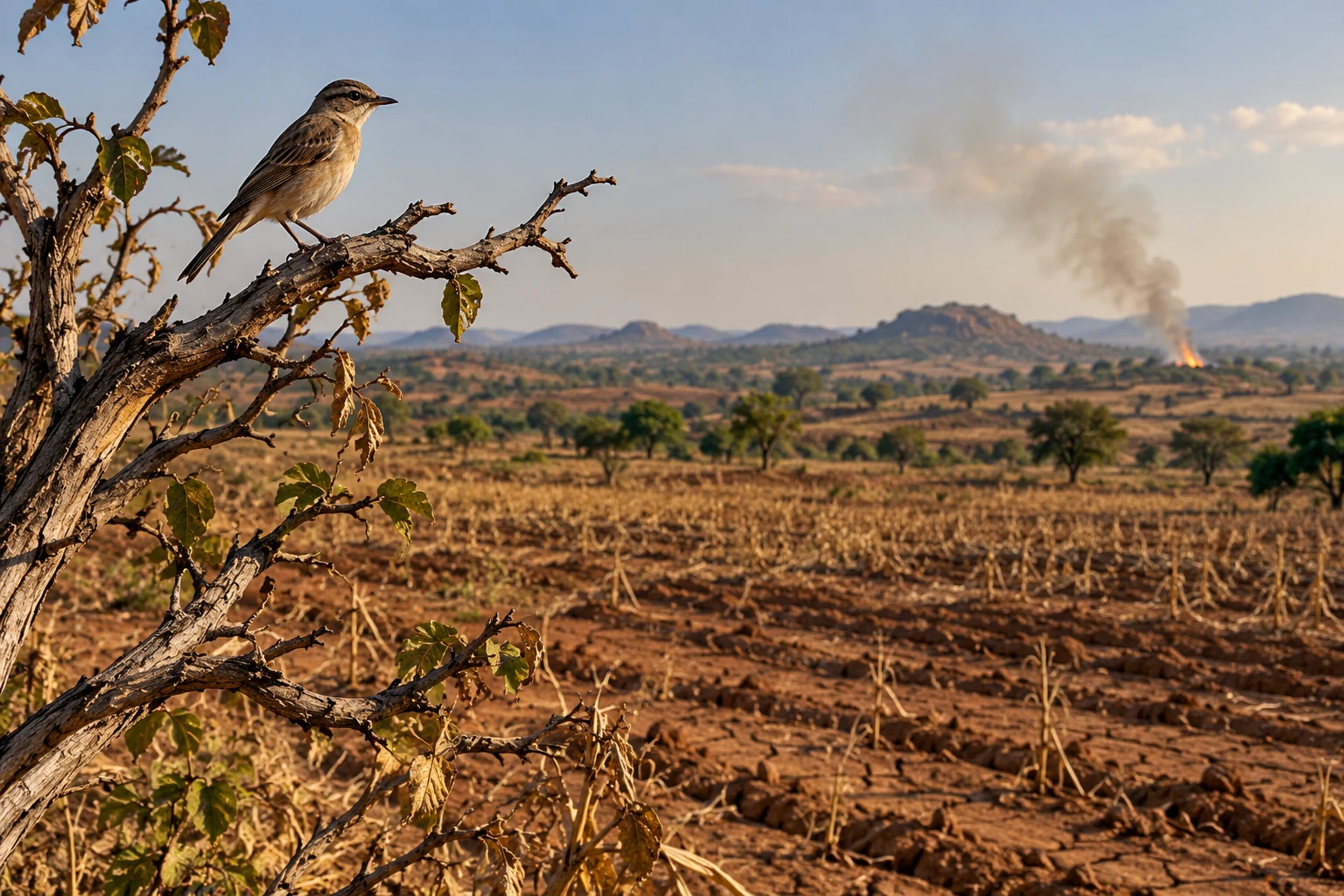
Olofin chooses the elder Shakuana for earth, provoking Ṣàngó’s jealousy. Ṣàngó withholds rain so that people will demand a different ruler. Asowano seeks counsel, and Elegbá investigates the deprivation. A small bird carries a message connecting an earthly fire with the danger of the drought. Olofin sees the crisis, orders rain, and requires reconciliation, allowing Shakuana to retain his position.
The environmental crisis is represented as a political abuse of a shared necessity. Those who suffer are being used as instruments in a contest they did not choose. The messenger matters because the remote authority has not grasped the dispute’s effects. A careful analysis can examine blocked information and manipulated scarcity while keeping weather control within myth and resisting any claim that actual droughts reveal divine jealousy.
Narrative setting: Cuban/Lukumí patakín identified in the selected account; no individual narrator is named.
The specialist carried to another shore
Erú Kayode is enslaved but respected for herbal knowledge. His owner envies a competence he does not possess and arranges his punishment and disposal in a river. Before this, Òṣun directs Kayode toward counsel and Inle’s protection. Fish carry the endangered man toward another community, whose people revive him and recognize him as a new ruler. The former owner cannot bear the reversal, and the two territories eventually come under Kayode’s authority.
The central conflict is an owner’s refusal to tolerate knowledge beyond his control. Recognition in the receiving community contrasts with persecution in the first, showing that the same capacity can be treated as a threat or a contribution. The extraordinary ending does not redeem the violence or make enslavement a necessary path to leadership. It supports questions about protection, sanctuary, and the institutional conditions under which knowledge can serve people freely.
Narrative setting: Cuban/Lukumí patakín identified in the selected account; no individual narrator is named.
Onímòká rediscovers the rope-making lineage
Onímòká Ònà Òfà leaves the rope-making occupation associated with his father and ancestors, who had prospered through it in the Salami witness. Other ventures fail to bring advancement, and he seeks two named diviners. They direct him back toward the inherited work. He resumes making ropes of varied forms and sizes, which people buy for tethering livestock. The account then affirms prosperity and gives the craft a place among the conditions supporting companions, children, and other goods. It does not describe a hereditary office, a prohibition enforced by a living parent, or a specific historical workshop.
The return is religiously directed rather than simply a nostalgic preference for an old skill. Consultation locates Onímòká’s path within an ancestral continuity that the witness treats as consequential for his life. The concrete craft also matters: the result is not produced by lineage identification alone, but through making forms that people can use. A contemporary reader can notice the resources of inherited knowledge without converting this person’s counsel into a rule that everyone must enter a parent’s profession.
The earlier enslaved specialist offers a necessary contrast, because knowledge there is endangered by an owner who wants exclusive control, while the rope account presents lineage as a source of orientation. Neither relation should be used to erase the other. The unresolved question is how a received path remains alive rather than merely repeated. The different forms and sizes provide a modest textual basis for recognizing practice and adaptation, without inventing an entrepreneurial biography.
Narrative witness and setting: Passage explicitly labeled Ayo Salami, with Yoruba verse and Spanish translation in the supplied compilation.
The dog returns to the life received at home
A female dog seeks counsel while longing for children. The consultation affirms the desired good and asks for a response; the dog complies, and the verse celebrates many offspring. That welcome is paired with an instruction not to remain away too long when traveling. The conclusion returns to the image of going home to embrace the young. No disaster caused by a completed absence is narrated, and no particular journey is described. The unit joins receiving a good with remaining present to sustain it, rather than ending the religious account at the moment the desired children appear.
The second movement gives the gift duration. Within the witness, the dog’s response to Ifá opens a desired good, but care remains necessary after it arrives. Home is not simply the place where abundance is stored; it is where relationships require continuing presence. This religious logic differs from a transaction completed by obtaining an outcome. A contemporary interpretation can examine the balance between travel and responsibility, while avoiding a gendered rule that mothers must never leave a house.
The source’s recipient is a particular speaking animal, and its conclusion does not define the full range of human caregiving arrangements. The earlier rescue of Erú Kayode complicates the comparison further: leaving one territory can be necessary for survival, whereas returning home preserves a good in this verse. The stories therefore require attention to what a place actually holds and how its relationships operate, rather than a blanket command either to stay or to depart.
Narrative witness and setting: Passage explicitly labeled Ayo Salami, with Yoruba verse and Spanish translation in the supplied compilation.
What was born in this Odù
“Born” can name an explicit traditional origin association or what emerges through a story: a capacity, relationship, practice or order of life. Interpretations drawn from a narrative are labelled below, so their basis remains clear.
A channel for public warning
Contemporary interpretation from the selected myth.
The bird’s intervention can support an emergence reading about making blocked suffering visible to remote authority. This is contemporary interpretation of the selected drought story, not a traditional origin association or a claim about actual weather control.
A community receives threatened knowledge
Contemporary interpretation from the selected myth.
The receiving community’s care for Erú Kayode can be read as the emergence of sanctuary for knowledge persecuted elsewhere. This is contemporary interpretation of the rescue, not a traditional birth-list item or a justification of the violence preceding it.
Correlations to life dimensions
These questions bring the selected stories into contemporary life. They are interpretive invitations for study.
Work and resources
Rain and herbal knowledge are necessities that powerful figures try to control for status. The stories connect resource stewardship with recognizing that competence and common needs must not become hostages in a private rivalry within the governing relationship.
Reflect: What shared necessity is being controlled for someone’s personal advantage?
Relationships and family
Ṣàngó’s rivalry with an elder becomes a crisis for people beyond their dispute. The motif asks whether family or seniority conflicts are being displaced onto dependents who have little ability to refuse the consequences from royal rivalry.
Reflect: Who is bearing the cost of a disagreement they did not choose?
Character and inner life
The envious owner treats another person’s knowledge as an insult to his own rank. The contrasting response is acknowledgment: recognizing the value of a skill without needing to possess, silence, or surpass its bearer within your own institution.
Reflect: Can you value expertise that exceeds your own?
Community and responsibility
Both narratives need intermediaries and receivers: the bird makes suffering visible, and the river community revives a stranger. Collective responsibility includes safe channels for warning and a willingness to support people driven out by coercive power.
Reflect: What makes your community a safe place for unwelcome truth?
A deeper reading of the sacred relationships
Ancestral continuity and the obligation after a gift
The two Salami witnesses place good within continuing religious relationships. Onímòká responds to counsel that locates his work in an ancestral path; the dog responds to Ifá and then must remain present to the life received. Neither account treats offering as a purchase that leaves no subsequent responsibility. The earlier drought narrative likewise requires mediation and reconciliation among powers, while Erú Kayode’s rescue depends on acknowledged relations with Òṣun and Inle. These are distinct settings of sacred agency, not interchangeable symbols of personal effort. A contemporary reflection can ask how a vocation or household is sustained, but should preserve the witnesses’ claim that inherited path, divine assistance, and response actually shape what is possible.
Leaving and returning have different meanings
Onímòká’s departure from a craft proves unfruitful within one account, while Erú Kayode’s departure from an abusive owner makes a new community possible. The dog’s return sustains a household, whereas the drought’s messenger moves between earth and heaven so that a blocked necessity can circulate again. These movements prevent a reference from presenting the sign as uniformly conservative or uniformly liberating. The relevant question is what relationship a movement acknowledges, escapes, or renews. That is comparative analysis, not a hidden doctrine stated by all the witnesses. Their concrete differences allow a reader to examine an inherited path without assuming that every old place is safe or every new one is progress.
Knowledge can be entrusted or monopolized
The rope trade appears as usable knowledge within a lineage, while Erú Kayode’s herbal competence provokes an owner who cannot tolerate another person knowing more. The stories distinguish continuity from domination through their actual relations, rather than through the mere presence of authority. Onímòká seeks counsel and resumes a craft; the enslaved specialist is punished for an expertise others value. A contemporary interpretation can ask whether an inheritance equips someone to act or claims ownership over their capacity. The drought account adds the political withholding of a shared necessity, making control consequential beyond the rival figures themselves. Religious agency remains central to the narrated responses, not merely an ornament added to social analysis.
Questions that deepen the study
Must a reader return to a parent’s occupation?
The Salami witness gives that counsel to Onímòká in a specific account whose ancestral rope trade and failed alternatives are narrated. It does not establish an occupational rule for everyone associated with Òṣé Ika. Within its setting, consultation discloses a path connected with lineage and lived practice. A contemporary reader may examine inherited skills, obligations, or neglected forms of knowledge without assuming that family expectation alone settles vocation. Erú Kayode’s story also shows why control over another person’s knowledge deserves scrutiny. The religious particularity of one recipient’s path should be preserved rather than converted into a universal instruction about careers.
Why does the dog’s verse continue after the desired children arrive?
Its conclusion makes the received good something that needs presence and care. The religious response does not eliminate the ongoing work of relationship; the call to return home places that work inside the story’s favorable ending. A contemporary application can ask what responsibilities follow a long-awaited opportunity or family change. It should not turn the dog’s instruction into a ban on travel, a fixed gender role, or a prediction that absence will cause harm. No such completed disaster is narrated. The witness contributes a movement from desire to response to continuing attention, keeping care within the life that has been welcomed.
How can ancestral guidance be honored without excusing coercion?
The four accounts supply different relationships rather than one abstract category of authority. The rope-maker seeks diviners who recall a profitable ancestral craft; the enslaved specialist confronts an owner’s jealousy and violence; the rain crisis arises when a power withholds water to change a political appointment; the dog receives counsel tied to care. A present interpretation can therefore examine consent, the effects of a demand, and whether knowledge is being sustained or suppressed. Those questions do not replace the stories’ sacred order. They help distinguish a religiously disclosed path from a human claim to dominate another person merely by invoking ancestry, rank, or need.
What the four narratives reveal together
The new Salami witnesses add inherited vocation and continuing care to Òṣé Ika’s earlier accounts of withheld rain and protected knowledge. They do not cancel the movement toward sanctuary in Erú Kayode’s story or turn every departure into error. Instead, the four narratives ask what a relationship makes possible: a craft can orient a life, an owner can suppress expertise, divine mediation can restore a shared necessity, and home can hold a good that requires presence.
The religious logic remains active in each case through consultation, lineage, named powers, and responses that exceed an isolated person’s effort. Contemporary reflection can explore how to receive guidance without surrendering judgment, while keeping those applications distinct from the witnesses’ particular counsel. The comparison is strongest when it preserves different reasons to leave, return, learn, or remain, rather than supplying a universal rule about tradition or change.
Living with this Odù
A continuing life or initiatory relationship
For a person whose received life or initiatory Odù is Ọ̀ṣẹ́ Ìká, these witnesses distinguish continuity that equips a life from control that claims ownership over it. Onímòká’s return to ancestral rope-making is directed through consultation and realized through usable craft. Erú Kayode’s knowledge, by contrast, provokes an owner who cannot tolerate competence beyond his command. The former does not require everyone to inherit a profession; the latter does not make violent displacement a necessary route to recognition.
The drought account makes withholding consequential for a whole population, while the dog’s verse carries responsibility beyond receiving desired offspring. Over changing circumstances, the important question is what a place, vocation or relationship actually sustains. Leaving can provide sanctuary, returning can renew care and movement between authorities can make a hidden crisis visible. These meanings cannot be chosen by a uniform instruction to stay or depart. Òṣun, Inle, Elegbá, Olofin and Ifá have specific roles in the sources rather than being interchangeable symbols of resilience. The sign supplies no weather prediction, guaranteed fertility or fixed destiny of persecution. Long-term development involves recognizing entrusted knowledge, interrupting monopolized necessities and remaining present to goods already received.
A particular consultation and its question
When Ọ̀ṣẹ́ Ìká arises in consultation, the stories can help distinguish a frustrated inherited path from a capacity endangered by domination. The same advice to return would mean different things for Onímòká and Kayode. One resumes an ancestral craft after counsel; the other survives an enslaver’s violence through sacred protection and a receiving community. An interpreter should not use the first to send someone back into coercion or the second to dismiss every inherited obligation.
The drought account asks whether a shared necessity has become leverage in someone else’s struggle and whether those able to respond know its effects. The dog’s verse asks what continuing presence a received good requires, without narrating a disaster caused by absence. These distinctions need the actual inquiry and the consultation’s religious interpretation. They cannot establish hidden enemies, divine jealousy behind a real drought or a prescribed vocation for an unknown person. A situated result is not permanent identity. Contemporary reflection can examine what knowledge is entrusted, what is being withheld and which relationships a proposed movement would protect or escape, while preserving the particular sacred agencies through which the witnesses narrate change.
Constructive and adverse possibilities
Constructive unfolding can involve a blocked necessity becoming visible to authority, threatened knowledge finding sanctuary, ancestral skill becoming useful again and care continuing after a desired good arrives. In the sources, divine assistance and response to Ifá shape those possibilities; they do not reduce to personal effort or public relations.
Adverse possibilities include using deprivation to force political change, treating another person’s competence as property or obtaining a household good while neglecting its continuation. Yet the rope-maker’s success cannot make every departure from tradition wrong, and Kayode’s recognition cannot redeem enslavement. The dog’s return should not become a rule confining all mothers. These are distinct relationships whose outcomes must be interpreted proportionately. They can inform the constructive and adverse possibilities of an actual consultation without determining its state, assigning a character type or attributing ordinary environmental events to the myth’s divine rivalry.
An illustrative situation in everyday life
Hypothetically, a skilled technician leaves a controlling employer who punishes colleagues for knowing more than management. A new workplace values the technician’s expertise, but relatives insist that any departure from familiar authority is disloyal. Kayode’s structure helps distinguish sanctuary from advancement purchased through suffering. Onímòká offers a different comparison: inherited skill may still be worth carrying into the new setting, even when the old institution must be left. The technician’s inner conflict concerns gratitude, safety and the freedom to use knowledge; the external conditions remain decisive. This is an illustrative interpretation, not a claim that modern employment equals enslavement or that the source guarantees promotion. It shows why leaving one arrangement need not require abandoning every resource received earlier.
Sources and reading context
The first two narrative witnesses
The passages use Cuban/Lukumí vocabulary and local Asowano, Shakuana, and Inle identifications. The explicit origin list supplies only an omitted medical condition, leaving traditional origin evidence partial. Both retained emergence motifs are contemporary interpretations of selected narratives, not traditional origin claims. No botanical treatment or ritual instructions are included.
Narrative motifs are summarized independently. The life-dimension reflections are contemporary interpretation. How these reference studies are built explains the wider source approach and the distinction between a reference article and personal divination.
Additional named witnesses
-
Ayo Salami. Both additional motifs, Onímòká’s rope-making and the dog’s return to its young, come from the explicitly named bilingual block.
-
Fategbe Fatumnbi Fasola, as labeled. A neighboring English rendering repeats the rope motif but differs in its statement about ancestral profit; it is noted as a variant, not merged into the selected account.
-
Cuban/Lukumí compilation witness. The earlier drought and Erú Kayode rescue remain separate Cuban narratives.
The neighboring Fasola-labeled English variant says the ancestors had not made money from ropes, unlike the selected Salami rendering. That contradiction is retained. The dog’s instruction is not generalized to human gender roles, and neither verse establishes a career prescription, fertility guarantee, or ritual recipe.
Bibliographic identification
-
Ayo Salami. Ifá: A Complete Divination. Lagos: NIDD, 2002 catalogue record. Library catalogue record. Bibliographic identification of the named author and work; the edition behind the transmitted account remains to be matched.
-
Fategbe Fatunmbi Fasola. The Holy Odu: A Collection of Verses from the 256 Ifa Odu with Commentary. CreateSpace Independent Publishing Platform, 2015; ISBN 9781508633044. Library catalogue record. Bibliographic identification of the named verse witness. The selected passage’s page and exact edition are not independently matched.
Read the source method and wider scholarly context.
The catalogue links identify published works and their authors. They are separate from proof of an individual episode’s wording or attribution. Contemporary comparisons and the synthesis above are editorial interpretation. The author’s books and Academy companions below provide further study; their sales links are separate from the source references.