
Ọ̀ṣẹ́ Òsá is a mixed Odù in Ifá’s 256-part corpus. The selected Òṣé Osa stories pair Òṣun’s release from a controlling captor with Òrúnmìlà’s refusal of a hurried ride. Both make pace a consequential choice: deliberate movement succeeds where force, confinement, and urgency appear dominant. The more substantial motif is restoration of another person’s ability to leave and be recognized publicly. Patience here deserves analysis through actual conditions of safety, rather than through a universal promise that slowness always wins.
A question to carry through the study: Which pressure to move faster would become clearer if you first asked whose freedom or safety is at stake?

This Academy reads the right column first, then the left. Each row carries a single or double mark.
Where this Odù belongs
Ọ̀ṣẹ́ Òsá belongs to the Ọ̀ṣẹ́ family in this Academy’s study sequence. It is a mixed Odù, distinct from Òsá Ọ̀ṣẹ́. The order matters. Its teaching is approached through its own narratives, rather than by adding two general descriptions of the principal signs together.
Key Òrìṣà and sacred relationships
The figures below are selected for their roles in the accounts discussed here. They offer connected reading paths through the tradition.
-
Òṣun. Òṣun is held and controlled by a man who restricts her movement and appearance; the story ends with release and public recognition as Òṣun Tilumu.
-
Ọ̀rúnmìlà. Òrúnmìlà notices the confinement, offers help, and leads the escape; in a second tale he declines a faster ride and reaches the celebration on foot.
Key myths and their meanings
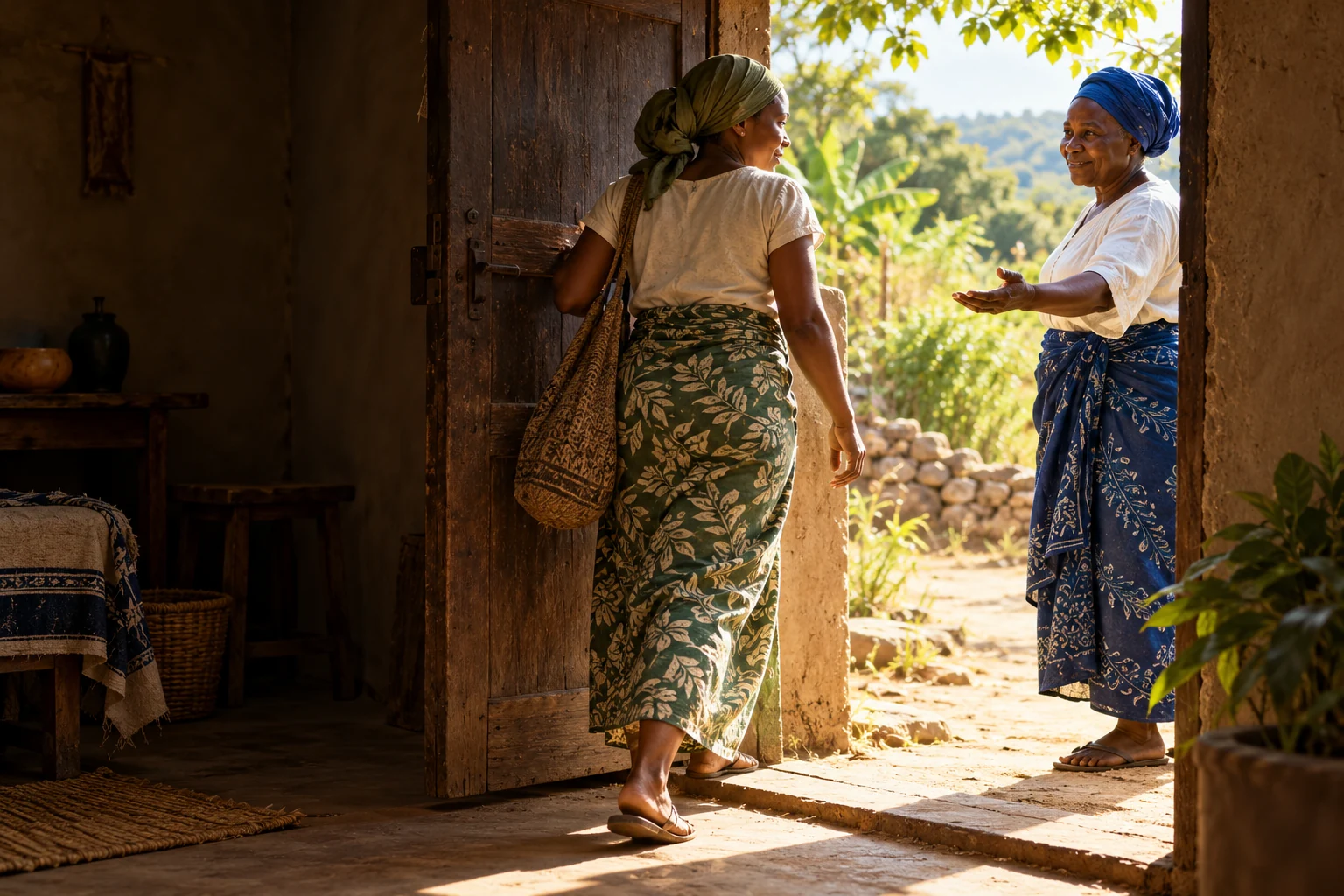
Leaving the locked house
Òṣun lives under a man’s coercive control: her appearance is altered, the house is locked, and a guard dog helps prevent departure. An elderly Òrúnmìlà notices her situation and persists in offering assistance despite her fear for his safety. He returns, opens a route out, and leads her away. Their pursuer is delayed through another encounter, and Olofin ultimately crowns her as Òṣun Tilumu.
The story’s center is control over movement and the recovery of a public identity beyond captivity. Òṣun’s anxiety for the helper also shows how coercion can make seeking assistance feel dangerous to others. The rescue includes supernatural and violent elements that should remain literary rather than practical guidance. A careful interpretation stresses supportive attention and restored agency without assuming that outside intervention can replace the survivor’s voice or eliminate all risk.
Narrative setting: Cuban/Lukumí patakín identified in the selected account; no individual narrator is named.
The declined shortcut
Òrúnmìlà walks toward a celebration and meets a friend traveling there on horseback. The rider offers him a place, suggesting that walking will make him late. He declines and continues at his own pace. The horse subsequently throws and injures its rider, while the walker reaches the event. This compact story makes the promised advantage of speed depend on conditions neither traveler fully controls.
The plot gives patience a concrete setting rather than merely praising delay. A faster means of travel appears helpful, but the walker does not let another person’s timetable determine his choice. The accident should not be read as proof that accepting help is dangerous or that careful people never suffer injury. Its useful question concerns how urgency can obscure assessment of a particular option, especially when speed has become its only advertised benefit.
Narrative setting: Cuban/Lukumí patakín identified in the selected account; no individual narrator is named.
The turtle changes the meaning of its sentence
A turtle leaves one community for another and is eventually condemned to die by fire. From confinement it remarks that fire is its close ally, and listeners carry the statement to those responsible for the sentence. The authorities reconsider and decide to throw it into a river from a height instead. The turtle protests that the first sentence should stand, reinforcing their belief that water is the harsher alternative. Once submerged, it returns to the surface and reveals that the river was what it wanted. The episode ends in escape, without describing the original offense in enough detail to assess it.
The turtle survives by influencing the authorities’ interpretation of its preferences. Their determination to choose what it most fears makes them susceptible to a performance designed around that expectation. The account does not establish innocence, and its sparse description of the original accusation should remain a limit rather than being repaired with invented wrongdoing. Its religious setting includes extraordinary relationships with fire and the speaking animal world; those features need not be reduced to a clever human trick.
At the same time, the narrator’s reversal invites contemporary scrutiny of a punishment system more interested in inflicting distress than understanding a being’s actual relation to its environment. The protest is meaningful because it is strategic, not transparent evidence of what the turtle wants. The unresolved question is whether escape changes any relationship beyond immediate survival, since the story gives neither reconciliation with the community nor a judgment that the original charge was false.
Narrative witness and setting: Passage explicitly located among Cuban revelations in the supplied compilation; no individual narrator is established.
Dance succeeds where an invasion has failed
The Salami witness describes several divine figures attempting to subdue Ìlóbìnrin without success. Òrúnmìlà receives counsel to respond before going and to avoid force. He arrives with music, movement, and singing, drawing the women’s attention. Èṣù releases birds connected with the earlier response, and Òrúnmìlà asks for help catching them. The pursuit leads the women into his house, where the verse says they cannot leave. The explanatory ending associates the episode with desired female companionship, but the narrated action explicitly includes captivity. No consent to remaining, subsequent marriage, or later release is described.
The witness’s religious efficacy is clear even where its ethical tension remains difficult. Òrúnmìlà’s success follows divinatory counsel and Èṣù’s intervention, distinguishing his approach from the earlier failed exertions of force. Yet the absence of force at the point of approach does not make the final confinement freely chosen. That distinction should remain visible, especially beside the earlier story in which Òrúnmìlà helps Òṣun leave coercive captivity. A reference entry should not solve the tension by inventing consent or by dismissing the sacred action as merely a manipulation story.
The traditions can preserve different narrative uses of efficacy without yielding one simple contemporary model of relationship. Music and apparent invitation create movement, while the destination changes the participants’ freedom. The unresolved issue concerns whose good the ending measures. The introductory devotional wish speaks from one recipient’s position, whereas the narrated women’s later situation is left without their own account.
Narrative witness and setting: Passage explicitly labeled Ayo Salami, with Yoruba verse and Spanish translation in the supplied compilation.
What was born in this Odù
“Born” can name an explicit traditional origin association or what emerges through a story: a capacity, relationship, practice or order of life. Interpretations drawn from a narrative are labelled below, so their basis remains clear.
Joints and articulation
Selected traditional source association.
The source’s beginning list names joints. This can be retained as an image of connection, movement, and coordinated parts; it should not become a medical diagnosis, a bodily prediction, or a claim that anatomy originated historically in one sign.
Addimú as an offering category
Selected traditional source association.
A separate narrative in the section explains the term addimú through an extreme maternal offering. The association supports contextual discussion of giving and communal restoration; the violent origin plot is not a prescription and no ritual procedure is reproduced.
Correlations to life dimensions
These questions bring the selected stories into contemporary life. They are interpretive invitations for study.
Work and resources
The brief travel story exposes speed as a benefit that may conceal another dependency. In practical reflection, a proposal should be judged by its actual conditions, controllability, and purpose rather than by the promise of arriving sooner.
Reflect: What does a faster option require you to surrender control over?
Relationships and family
Òṣun’s confinement makes visible the difference between attachment and control. Help begins when another person notices restricted movement and listens to fear, while any modern analogy must preserve the affected person’s choices and circumstances when departure is restricted.
Reflect: Does care in your relationships expand another person’s ability to choose?
Character and inner life
Òrúnmìlà’s confidence does not take the form of matching the pursuer’s frantic speed. The narrative permits reflection on composure under pressure, while remembering that a story’s guaranteed escape cannot be promised to real people facing danger.
Reflect: What helps you think clearly when someone else creates urgency?
Community and responsibility
The crowning makes restoration visible after a hidden captivity. A community’s role is more than celebrating a helper: it must recognize the released person’s dignity and belonging and examine the conditions that allowed coercion to remain unseen.
Reflect: Who needs recognition after a harm your community did not initially see?
A deeper reading of the sacred relationships
Religious efficacy does not erase narrative difficulty
The Salami invasion account attributes success to response to Ifá and Èṣù’s active mediation. The earlier rescue of Òṣun likewise gives Òrúnmìlà a spiritually effective role, but one that restores departure rather than preventing it. A faithful reference should preserve both religious claims without assuming that every narrated divine act supplies a universal human ethical rule. These witnesses have particular audiences, forms, and desired goods; their differences are part of the record. Contemporary scrutiny of captivity can therefore be explicit without replacing spiritual agency with an exclusively political explanation. The religious question is how efficacy operates in each account; the interpretive question includes who benefits and whose voice remains unreported.
The direction of movement changes its meaning
The turtle is forced toward a river yet reaches a setting that enables escape. The women pursue birds apparently voluntarily but arrive at a house they cannot leave. Òṣun exits a guarded home through assistance, while the walker declines a faster route and reaches his destination at his own pace. These four movements resist a simple equation between motion and freedom. A change of place can restore agency, conceal a trap, or preserve a chosen rhythm. Their comparison is contemporary analysis, but it is grounded in concrete actions rather than a generic ideal of liberation. The decisive questions concern knowledge of the destination, the possibility of refusal, and what happens after arrival.
A strategic utterance differs from an honest report
The turtle’s comments are designed to produce a mistaken inference, while Òrúnmìlà’s request for help catching birds is literally connected to an activity whose larger purpose remains hidden from the women. The earlier captor’s control and the traveler’s pressured offer provide other scenes in which words do not disclose the whole situation. These distinctions matter because an account of cleverness can otherwise become an invitation to admire every successful concealment. The sources show several kinds of attention: listening to a plea, reading an adversary’s expectation, and recognizing a route’s consequences. A contemporary reader can assess them separately without claiming that all strategic speech is false or all literal truth is sufficient.
Questions that deepen the study
Does avoiding force mean the women freely chose captivity?
No such choice is narrated. The verse explicitly directs an approach without force, but its conclusion says that the women enter the house while pursuing birds and cannot depart. A responsible account should distinguish the means of approach from the condition produced at the end. Within the witness, divinatory response and Èṣù’s intervention remain effective religious realities; acknowledging that does not require inventing consent. A contemporary interpretation can question confinement while preserving the source rather than rewriting it into a romance. The text’s later association with female companionship belongs to its framing, not evidence that the captives agreed to remain.
Why keep a troubling account beside Òṣun’s rescue?
Their contrast prevents a selective portrait in which one figure always occupies the same ethical position. Òrúnmìlà restores a constrained person’s ability to leave in one Cuban account and succeeds in a conquest ending in confinement in the Salami witness. Those narratives should not be flattened into a single doctrine or explained away as an accidental inconsistency. They preserve distinct settings and uses of sacred efficacy. A contemporary entry can make its ethical reading visible while allowing readers to encounter the tradition’s complexity. Source transparency is especially valuable where a reassuring synthesis would require adding events, consent, or later repair that neither passage reports.
What can be learned from the turtle without endorsing its whole conduct?
The account shows how an authority’s wish to impose distress can be redirected through its own assumptions. That is a precise observation about the scene, not proof that the turtle was innocent or that deception is always justified. The original offense remains too briefly described for a complete judgment. A contemporary reader can examine the importance of understanding an environment and the danger of reading protest as transparent preference, while acknowledging the sacred speaking world in which the story unfolds. The ending supplies escape rather than reconciliation, leaving the larger relationship between the turtle and its judges unresolved.
What the four narratives reveal together
The additional witnesses deepen Òṣé Osa by making freedom, invitation, and efficacy more difficult to equate. A turtle reaches safety through a sentence intended to harm it; a musical approach culminates in confinement; Òṣun escapes a guarded house; a walker refuses speed and arrives safely. The religious narratives affirm active sacred powers, speaking beings, and the consequences of responding to Ifá, yet their humanly legible outcomes do not all point in the same ethical direction.
That difference is essential material for an authoritative entry. It allows contemporary questions about consent, strategic speech, and the conditions of movement to be identified honestly as interpretation rather than passed off as one settled traditional doctrine. The synthesis should preserve the unknown offense, the unreported captives’ perspective, and the distinct source settings, letting depth arise from what the accounts actually say and leave unresolved.
Living with this Odù
A continuing life or initiatory relationship
For someone whose received life or initiatory Odù is Ọ̀ṣẹ́ Ọ̀sá, the accounts ask what movement actually does to freedom. Òṣun leaves coercive confinement through assistance; the women pursuing birds enter a house they cannot leave. The turtle reaches escape through a sentence intended as harm, while the walker declines another traveler’s pace. A continuing task is to assess departure, invitation and destination by their actual conditions, rather than assuming that motion or gentle appearance guarantees agency.
The tension between the two Òrúnmìlà accounts should remain open. Sacred efficacy can restore one figure’s departure and secure another group’s confinement; successful divine action does not automatically yield a universal human rule. Over time, a person may need patience, careful assistance or recognition that an apparently voluntary step conceals later restrictions. That discernment includes listening to the person affected, not replacing their voice with a helper’s intention. Ifá and Èṣù remain active in the Salami witness even while its ending requires ethical scrutiny. The sign predicts neither captivity nor escape and gives no warrant to imitate trickery. It supports exact questions about consent, pace and what remains possible after arrival.
A particular consultation and its question
In consultation, Ọ̀ṣẹ́ Ọ̀sá can help distinguish a route that restores choice from one that merely changes the form of control. The locked-house account includes fear that assistance will endanger the helper, while the birds episode withholds any account of the women consenting to remain. Those are substantial external conditions. An interpreter should not translate them into generic reluctance to change or a romantic lesson about attracting companionship.
The walker’s refusal asks whether speed is being advertised as sufficient reason for a choice; it does not make accepting help inherently dangerous. The turtle’s strategic protest reveals authorities intent on distress, but the source does not establish its innocence or later reconciliation. A consultation has its own question and religious interpretation, so these distinctions cannot diagnose the client’s relationships or prescribe a departure. They can sharpen inquiry into the right to refuse, knowledge of consequences and whose good an outcome measures. The sacred efficacy of counsel and Èṣù’s action remains within the witnesses, while contemporary analysis can still name confinement. A result is not permanent identity, and apparent invitation should not be mistaken for complete information about what will follow.
Constructive and adverse possibilities
Constructive possibilities include assistance that increases an endangered person’s choices, a pace selected with discernment and survival that reaches a genuinely inhabitable setting. Òṣun’s restored public recognition and the walker’s arrival offer different goods; they cannot be treated as one instruction to leave quickly.
Adverse possibilities include coercion concealed by welcome, success measured only from the captor’s position or a punishment system seeking pain more eagerly than understanding. The birds account remains religiously efficacious while narrating confinement, and that difficulty should not be solved by inventing consent. The turtle’s escape likewise does not prove every strategic deception admirable. These tensions allow a real consultation to examine whose agency changes and what happens after movement. They do not determine its favorable or adverse state, justify captivity or promise that patience and ingenuity reliably overcome danger in ordinary life.
An illustrative situation in everyday life
Hypothetically, a prestigious training program invites applicants through friendly events, then reveals that accepting a place requires exclusive work and makes departure financially punitive. A participant feels flattered and hesitant to disappoint those who welcomed them. The birds structure helps distinguish an inviting approach from freedom after arrival; it does not equate the program with a sacred figure. The walker adds a question about resisting another party’s urgency long enough to examine terms. A constructive choice might require clearer information and a real possibility of refusal. This illustration follows the narrative arrangement of movement and hidden restriction. It is not advice for a specific legal dispute, a claim of actual abuse or evidence that a divinatory result has identified captivity.
Sources and reading context
The first two narrative witnesses
These Cuban/Lukumí stories are selected from a section that also contains separately labeled Arará material; that label is not transferred here. The notes omit bodily predictions and recipes. Coercive control and violent pursuit are narrative content, not recommended conduct or guaranteed escape strategies.
Narrative motifs are summarized independently. The life-dimension reflections are contemporary interpretation. How these reference studies are built explains the wider source approach and the distinction between a reference article and personal divination.
Additional named witnesses
-
Ayo Salami. The Ìlóbìnrin account of divinatory preparation, music, Èṣù, and captivity is selected from this explicitly named source block.
-
Cuban/Lukumí compilation witness. The condemned turtle, Òṣun’s release, and the declined ride are separate Cuban narratives.
The selected African-author witness explicitly ends in captivity; no consensual marriage or release is invented. The turtle’s original offense is underspecified. The accounts’ religious efficacy is preserved while captivity, lethal sentencing, and strategic deception remain open to clearly distinguished contemporary ethical examination.
Bibliographic identification
- Ayo Salami. Ifá: A Complete Divination. Lagos: NIDD, 2002 catalogue record. Library catalogue record. Bibliographic identification of the named author and work; the edition behind the transmitted account remains to be matched.
Read the source method and wider scholarly context.
The catalogue links identify published works and their authors. They are separate from proof of an individual episode’s wording or attribution. Contemporary comparisons and the synthesis above are editorial interpretation. The author’s books and Academy companions below provide further study; their sales links are separate from the source references.