
Ọ̀ṣẹ́ Ògúndá is a mixed Odù in Ifá’s 256-part corpus. Òṣé Ogunda’s selected narratives concern a disputed child and an unproductive field. In the court story, willingness to relinquish possession reveals care more clearly than competing claims; in the agricultural story, a worm challenges a powerful cultivator to request help respectfully. Both motifs relocate authority away from assertion. They ask whether a person can protect what matters by abandoning domination and recognizing a contribution that rank has made easy to dismiss.
A question to carry through the study: What outcome matters enough that you would give up being seen as its sole owner or author?

This Academy reads the right column first, then the left. Each row carries a single or double mark.
Where this Odù belongs
Ọ̀ṣẹ́ Ògúndá belongs to the Ọ̀ṣẹ́ family in this Academy’s study sequence. It is a mixed Odù, distinct from Ògúndá Ọ̀ṣẹ́. The order matters. Its teaching is approached through its own narratives, rather than by adding two general descriptions of the principal signs together.
Key Òrìṣà and sacred relationships
The figures below are selected for their roles in the accounts discussed here. They offer connected reading paths through the tradition.
-
Ọ̀rúnmìlà. Òrúnmìlà advises the ruler in the disputed-child case and uses the claimants’ different responses to imminent loss to distinguish protective care from possession.
-
Òrìṣà Òkò. Òrìṣà Oko leads agricultural labor yet cannot make the land productive until he learns from a worm who represents interdependent natural forces.
Key myths and their meanings
Care relinquishes its claim
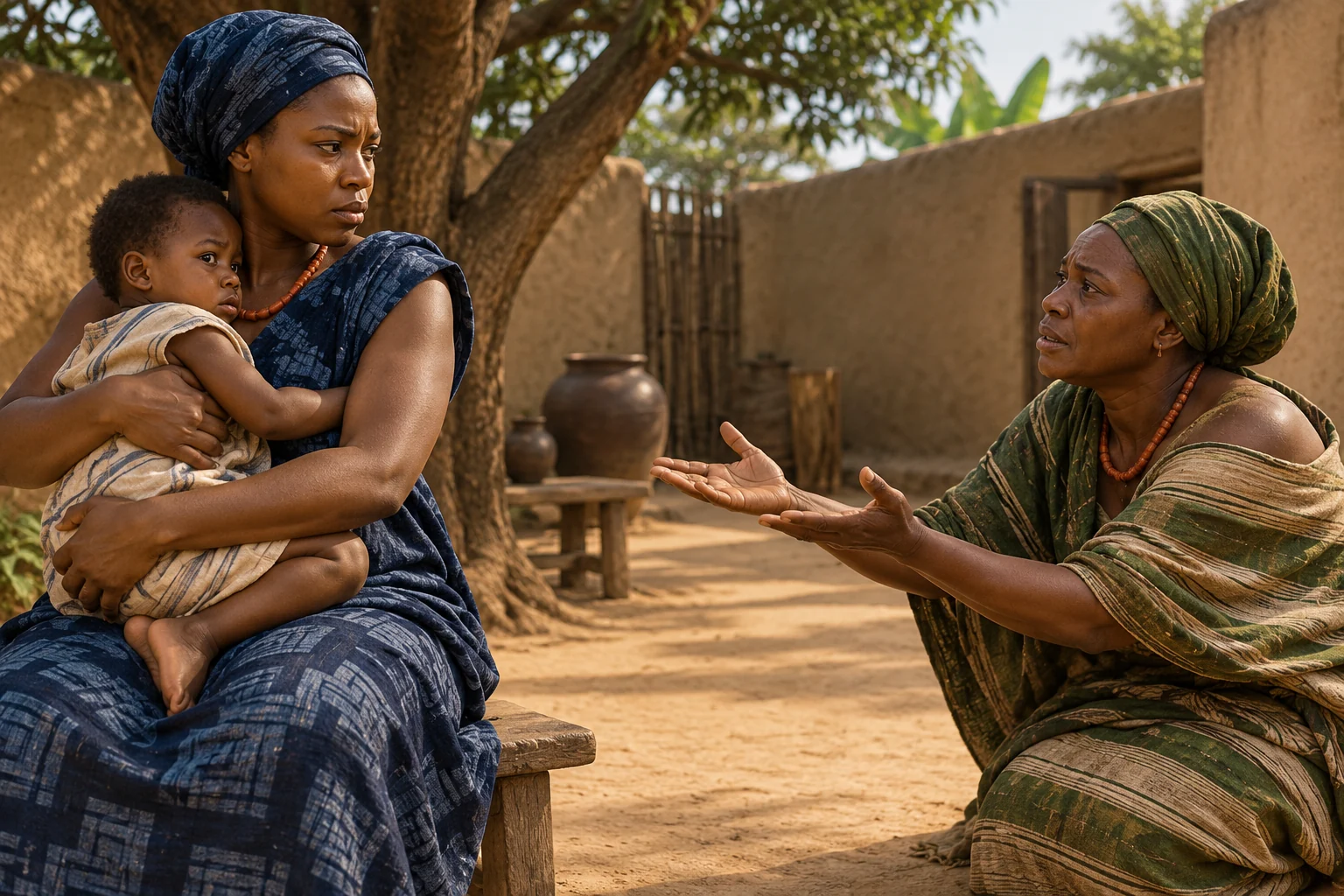
Two women claim the same child, and judges cannot resolve the case. The ruler worries that an error will expose him to enemies and reluctantly admits Òrúnmìlà as an adviser. A proposed division of the child produces sharply different responses: one claimant would surrender the child rather than see it killed. Òrúnmìlà identifies this protective refusal as the decisive evidence and also exposes courtiers eager to encourage catastrophe.
The source embeds a familiar judgment motif within a Cuban Ifá narrative; its value lies in distinguishing protection from ownership. The ruler’s anxiety about reputation also threatens to displace the child’s welfare, while hostile advisers exploit his uncertainty. A later article should keep the proposed harm within the narrative’s dramatic device and avoid presenting threats to children as a legitimate investigative method or reliable real-world test of parenthood.
Narrative setting: Cuban/Lukumí patakín identified in the selected account; no individual narrator is named.
A worm corrects the cultivator’s demand
Òrìṣà Oko directs many workers but the land remains barren. While resting and thinking, he meets a worm that offers help and identifies itself with Mother Nature. He initially demands proof, then learns to make a respectful request. The ensuing exchange brings attention to water, sunlight, air, and their coordination. Productivity appears when he recognizes a larger system rather than relying only on his command of labor.
The worm’s small body contrasts with the scale of the problem and the cultivator’s authority. Its correction concerns the manner of asking as well as the content of the request, so ecological dependence and interpersonal humility reinforce each other. The source presents natural forces symbolically; it should not be converted into an agronomic recipe. Its sharper lesson is that adding effort does not solve a problem whose relationships have been misunderstood.
Narrative setting: Cuban/Lukumí patakín identified in the selected account; no individual narrator is named.
Two siblings bring light to their shared undertaking
The Salami unit concerns an elder and younger sibling preparing to go to Ìpére. They ask whether the stay will be favorable and receive counsel that includes attention to Òòsàálá and Òrúnmìlà. Both respond before arriving at the farm, where the verse describes a light associated with wealth being kindled and a favorable discovery following. They celebrate and praise their diviner, who praises Ifá. The account preserves the siblings as a pair rather than elevating one at the other’s expense. It does not identify a specific crop, the nature of the discovery, or a later division of the gain.
The undertaking combines kinship, movement, and sacred preparation. The siblings do not merely pool labor after arrival; their shared response acknowledges powers whose presence belongs to the venture’s religious order. Light is consequently not a detachable symbol of entrepreneurial clarity. Within the witness, it is part of a response through which good becomes possible at Ìpére. The explanatory passage names both Òòsàálá and Òrúnmìlà, so an account should preserve their differentiated acknowledgment rather than assign the entire result to one generalized deity.
A contemporary reading can examine how partners prepare together before sharing a livelihood, but it cannot invent a contract or assume equal shares that the verse does not describe. The absence of an inheritance dispute is also valuable beside other family stories: elder and younger can appear as collaborators from the outset. Their difference of position need not become a struggle over which one deserves the whole result.
Narrative witness and setting: Passage explicitly labeled Ayo Salami, with Yoruba verse and Spanish translation in the supplied compilation.
A spider shelters the diviner who left in haste
Òrúnmìlà consults before a journey and receives counsel concerning an ancestral obligation, but haste leads him to depart without completing it. On the road, supernatural pursuers drive him from his carriage into a hole. A spider covers the opening with its web, causing the pursuers to overlook the refuge. His Èṣù companions, separated during the flight, search for him; one meets Ògún, and they cooperate. They open the web without injuring the spider and bring Òrúnmìlà out. He then fulfills the earlier response and continues. The episode explains a regular practice of a diviner’s consultation in its local setting.
The diviner is himself a recipient of counsel, and his status does not make an unfinished obligation disappear. This is a religiously important limit: Ifá’s authority is not identical with a practitioner’s freedom to disregard what has been disclosed. The spider’s intervention also belongs to the world’s active network of assistance, alongside Èṣù and Ògún. Rescue is not achieved by one display of superior force; concealment, searching, recognition, and cooperation all contribute. The detail that the helpers avoid harming the spider gives acknowledgment a practical form within the scene.
A contemporary interpretation may ask how haste interrupts preparation or how helpers are remembered after a crisis, but should not turn the story into a promise that a web will protect someone in danger. Its unresolved tension is how the initial failure and the subsequent rescue relate: assistance permits continuation, yet it does not excuse the obligation that the traveler still returns to complete.
Narrative witness and setting: Passage explicitly located among Cuban revelations in the supplied compilation; no individual narrator is established.
What was born in this Odù
“Born” can name an explicit traditional origin association or what emerges through a story: a capacity, relationship, practice or order of life. Interpretations drawn from a narrative are labelled below, so their basis remains clear.
The land’s fertilization
Selected traditional source association.
The explicit origin list links the sign to making earth fertile. Read with the worm narrative, this associates productivity with conditions and relationships that labor alone cannot command, without claiming a universal history of agriculture or giving cultivation instructions.
Religious clothing and habits
Selected traditional source association.
Religious habits appear in the source’s beginning list. This supports a modest association between visible belonging and disciplined practice; it does not specify a universal garment, confer spiritual authority through dress, or establish a chronology of religious clothing.
Correlations to life dimensions
These questions bring the selected stories into contemporary life. They are interpretive invitations for study.
Work and resources
Òrìṣà Oko has workers and commitment but lacks an adequate understanding of the conditions that sustain production. The field story asks whether a stalled project needs more effort or a different account of how its parts depend on one another.
Reflect: What relationship is missing from your explanation of a stalled project?
Relationships and family
The child dispute distinguishes preserving a life from winning a claim. Its reflective use concerns whether care can prioritize another person’s wellbeing over status, possession, or public vindication, while avoiding crude tests of authentic parenthood.
Reflect: Where does care require releasing a claim rather than strengthening it?
Character and inner life
Both powerful protagonists must accept knowledge from outside their accustomed authority. The ruler needs an adviser and the cultivator needs a worm; embarrassment is a smaller cost than persisting in a decision that harms what they are responsible for.
Reflect: Which source of help have you discounted because it seems too small?
Community and responsibility
The hostile courtiers welcome a disastrous verdict because it could damage the ruler. The story therefore asks communities to evaluate advice by its effects on vulnerable people, not by the political advantage a faction hopes to gain.
Reflect: Whose wellbeing disappears when a dispute becomes a contest for influence?
A deeper reading of the sacred relationships
A religious specialist remains answerable to counsel
The new journey account makes Òrúnmìlà’s own response central: he consults, leaves in haste, receives help, and completes what was left undone. The Salami siblings supply a different sequence in which shared preparation precedes arrival. Read together, they do not make consultation a technique for eliminating uncertainty; they establish a relationship that asks something of the recipient, even when that recipient is a revered diviner. The earlier court narrative similarly requires a ruler to accept counsel rather than rely solely on rank, while Òrìṣà Oko must learn from a small being. Within these religious worlds, authority includes receptivity and obligation, not exemption from them.
Nonhuman help is specific rather than decorative
The worm in the earlier field account speaks as Mother Nature and discloses interdependence among forces; the spider in the new journey account provides concealment that changes the pursuers’ understanding of a place. Their contributions are not interchangeable animal symbols. One corrects a cultivator’s manner of asking and his understanding of productivity, while the other creates a refuge that later helpers recognize without destroying its maker. A contemporary ecological reflection can emerge from this attention to contribution, but the sources’ sacred and speaking world should not be reduced to environmental advice. Their specificity asks what each being actually does and what kind of acknowledgment its action requires.
Sharing an undertaking before its outcome is visible
The siblings’ common response takes place before the favorable discovery, while the court’s competing claimants face a dispute after a child is already present. These different temporal positions illuminate cooperation and possession without equating family roles. Shared preparation can establish a relation of responsibility before success has to be divided; a later dispute may reveal whether a claim protects another life or merely seeks control. The spider episode adds helpers who search before they know the traveler’s exact location. All three situations ask what participants do while the result remains uncertain. This comparative lens should not invent a family contract or turn a dramatic judicial threat into an acceptable real-world test.
Questions that deepen the study
Why does Òrúnmìlà need help after consulting before the journey?
Consultation in the account discloses a response, but the traveler’s haste leaves it unfinished. The story therefore distinguishes receiving knowledge from inhabiting the obligation it makes visible. His later rescue through the spider, Èṣù, and Ògún does not make the earlier counsel irrelevant; he completes it before continuing. That is the religious sequence the witness supplies. A contemporary application might concern preparation or follow-through, but it should not turn an accident into evidence that a person neglected a spiritual duty. The account describes this particular sacred journey, not a method for explaining every danger encountered by a traveler.
Does the light at Ìpére explain how a farm becomes productive?
The verse gives a religious account of a shared venture, not an agricultural manual. It connects the siblings’ response to Òòsàálá and Òrúnmìlà with a favorable arrival and a discovery, without naming a crop or a material technique that an editor could responsibly reconstruct. The earlier worm narrative supplies a different sacred explanation through coordinated natural forces. Their comparison allows an entry to discuss preparation and dependence while keeping both stories’ spiritual logic intact. A reader may reflect on what partners acknowledge before working together, but no practical crop recommendation or financial forecast follows from the light image.
What does sparing the spider add to the rescue?
The helpers do not treat the web simply as an obstacle to be destroyed once its usefulness is over. They open the refuge without injuring the being that made it, preserving a concrete acknowledgment inside the action. This detail is modest but important beside the worm’s correction of Òrìṣà Oko’s demanding manner. Both witnesses allow a small being to contribute without disappearing into a powerful protagonist’s achievement. A contemporary interpretation can ask how assistance is recognized after a crisis. The source itself does not narrate a separate vow, altar, or continuing ceremony for the spider, so those additions should not be invented.
What the four narratives reveal together
The additional witnesses place shared preparation and received assistance beside Òṣé Ogunda’s earlier concern with judgment and the conditions of growth. The siblings respond together before reaching Ìpére; Òrúnmìlà must complete counsel after a hurried departure; a worm corrects the cultivator; a disputed child exposes the difference between possession and protection. These accounts do not establish one rule about obedience or expertise. They show different moments at which authority must receive something beyond itself, and they affirm sacred beings and nonhuman helpers as active participants.
The comparison can support contemporary reflection on cooperation, care, and acknowledgment while keeping religious response central to what the stories say has happened. It should retain the witnesses’ limits: an unnamed discovery, a local explanation of consultation, a speaking Mother Nature, and a dramatic court device that cannot be converted into a general method of determining parenthood.
Living with this Odù
A continuing life or initiatory relationship
For a person whose received life or initiatory Odù is Ọ̀ṣẹ́ Ògúndá, these witnesses make authority answerable to contributions it cannot command into existence. The ruler must accept counsel, Òrìṣà Oko must listen to a small speaking being and Òrúnmìlà himself remains responsible for unfinished ancestral obligations. Long-term development can therefore include receiving correction without experiencing every limit as humiliation. Receptivity is part of authority rather than its defeat.
The disputed child adds a sharper ethical test: does a claim protect another life or insist on ownership even at its expense? The dramatic threat belongs to the plot and cannot become an investigative method. The siblings’ shared preparation supplies a contrasting relationship before dispute, with Òòsàálá and Òrúnmìlà acknowledged distinctly. The spider rescue then makes remembrance practical, since the helpers preserve the being whose web sheltered the traveler. As circumstances change, a person may need to release control, prepare collaboratively or complete what assistance allowed them to survive leaving undone. Ifá and nonhuman helpers remain active within these narratives. The sign does not guarantee rescue, establish agricultural expertise or assign an inherently protective personality to its recipient.
A particular consultation and its question
When Ọ̀ṣẹ́ Ògúndá appears in consultation, the actual issue determines which relation of authority is at stake. A dispute may require distinguishing protection from a demand to possess. A stalled undertaking may involve misunderstood conditions rather than insufficient labor. A hurried departure may have left a recognized obligation incomplete. These possibilities should remain separate instead of becoming one command to work harder or relinquish everything.
The worm speaks within a sacred world and redirects Òrìṣà Oko’s manner of asking; it is not a concealed agronomic recipe. The siblings’ response likewise precedes their favorable discovery without establishing equal shares or a modern contract. Òrúnmìlà’s rescue involves concealment, searching and cooperation among a spider, Èṣù companions and Ògún, followed by completion rather than exemption. A practitioner can examine what the client has already received, which helper is overlooked and whether preparation has actually occurred. Consultation is not a permanent identity claim or a guarantee that missing preparation will be supplied by others. The stories retain Ifá’s authority while contemporary reflection asks how the disclosed relationships organize action, uncertainty, dependence and acknowledgment in the particular situation.
Constructive and adverse possibilities
Constructive unfolding may involve a life protected over a claimant’s pride, small knowledge correcting large command and partners acknowledging sacred responsibilities before success becomes available. Assistance can also create an opportunity to complete an unfinished obligation. The helpers’ care for the spider gives gratitude an action within the narrated rescue.
Adverse possibilities include reputation displacing a child’s welfare, greater effort repeating a mistaken understanding or religious status becoming an excuse to ignore counsel. Rescue does not retrospectively make haste appropriate. The threatened division should never be offered as a reliable test of parenthood, and the web does not establish physical protection in emergencies. These contrasts preserve agency and consequence without deciding the state of an actual reading. The relevant constructive question concerns whether authority can learn and acknowledge what supports it, while the adverse question concerns what control makes invisible.
An illustrative situation in everyday life
Hypothetically, two siblings plan to reopen a family workshop. One insists that enough overtime will solve repeated failures, while a junior technician notices that the process lacks a necessary coordination step. The worm structure asks whether command has been mistaken for understanding. A constructive response would hear the small contribution and change the arrangement before increasing effort. The Salami siblings add a distinct question about shared preparation: have both partners acknowledged the responsibilities they are entering, rather than waiting until gain must be divided? The modern example does not reproduce the witnesses’ sacred response or claim that a technical adjustment guarantees prosperity. It illustrates an external problem, a plausible reluctance to receive correction and the possibility of authority becoming more receptive.
Sources and reading context
The first two narrative witnesses
This study concerns Cuban/Lukumí narrative passages. The child-judgment tale resembles a widely circulating motif, but its historical route is not established by this source. The worm’s natural-force teaching remains symbolic and is not scientific or agricultural instruction.
Narrative motifs are summarized independently. The life-dimension reflections are contemporary interpretation. How these reference studies are built explains the wider source approach and the distinction between a reference article and personal divination.
Additional named witnesses
-
Ayo Salami. The elder-and-younger siblings at Ìpére are selected from this explicitly named source block.
-
Cuban/Lukumí compilation witness. The spider-refuge journey is a separately headed Cuban account; the earlier child-judgment and Mother Nature stories remain separate comparators.
The Salami translation alternates forest and farm for Ìpére and does not identify the discovered wealth. The spider account’s origin explanation remains local. No ancestral rite, protective method, or agricultural procedure is reproduced, and shared success is not presumed to establish a particular division of property.
Bibliographic identification
- Ayo Salami. Ifá: A Complete Divination. Lagos: NIDD, 2002 catalogue record. Library catalogue record. Bibliographic identification of the named author and work; the edition behind the transmitted account remains to be matched.
Read the source method and wider scholarly context.
The catalogue links identify published works and their authors. They are separate from proof of an individual episode’s wording or attribution. Contemporary comparisons and the synthesis above are editorial interpretation. The author’s books and Academy companions below provide further study; their sales links are separate from the source references.