
Ọ̀ṣẹ́ Òkànràn is a mixed Odù in Ifá’s 256-part corpus. The selected Òṣé Okanran stories examine two failures to see essential labor clearly. An exhausted parent delegates care to someone who neglects the children; a trader dismisses a disabled servant who subsequently creates the basis of his prosperity. The material links responsibility to what a person actually does, rather than to a promise or an assessment of bodily appearance. Both stories also carry punitive and coercive assumptions requiring careful interpretation.
A question to carry through the study: Where have you judged someone’s capacity before asking what support, skill, or opportunity they actually have?

This Academy reads the right column first, then the left. Each row carries a single or double mark.
Where this Odù belongs
Ọ̀ṣẹ́ Òkànràn belongs to the Ọ̀ṣẹ́ family in this Academy’s study sequence. It is a mixed Odù, distinct from Òkànràn Ọ̀ṣẹ́. The order matters. Its teaching is approached through its own narratives, rather than by adding two general descriptions of the principal signs together.
Key Òrìṣà and sacred relationships
The figures below are selected for their roles in the accounts discussed here. They offer connected reading paths through the tradition.
-
Obàtálá. Obàtálá is the overburdened parent in the care narrative and the trader who initially underestimates a disabled servant before benefiting from his initiative.
-
Olúfọ̀n. The caregiving variant names Oshalufón as the elderly working parent. This is a specific local narrative identification, retained without making every Obàtálá story an Olúfọ̀n account.
-
Ọ̀rúnmìlà. Òrúnmìlà is consulted about both the household’s failed care arrangement and the trader’s difficulty meeting his business obligations; counsel precedes the protagonists’ changed situations.
Key myths and their meanings
The promised caregiver does not arrive
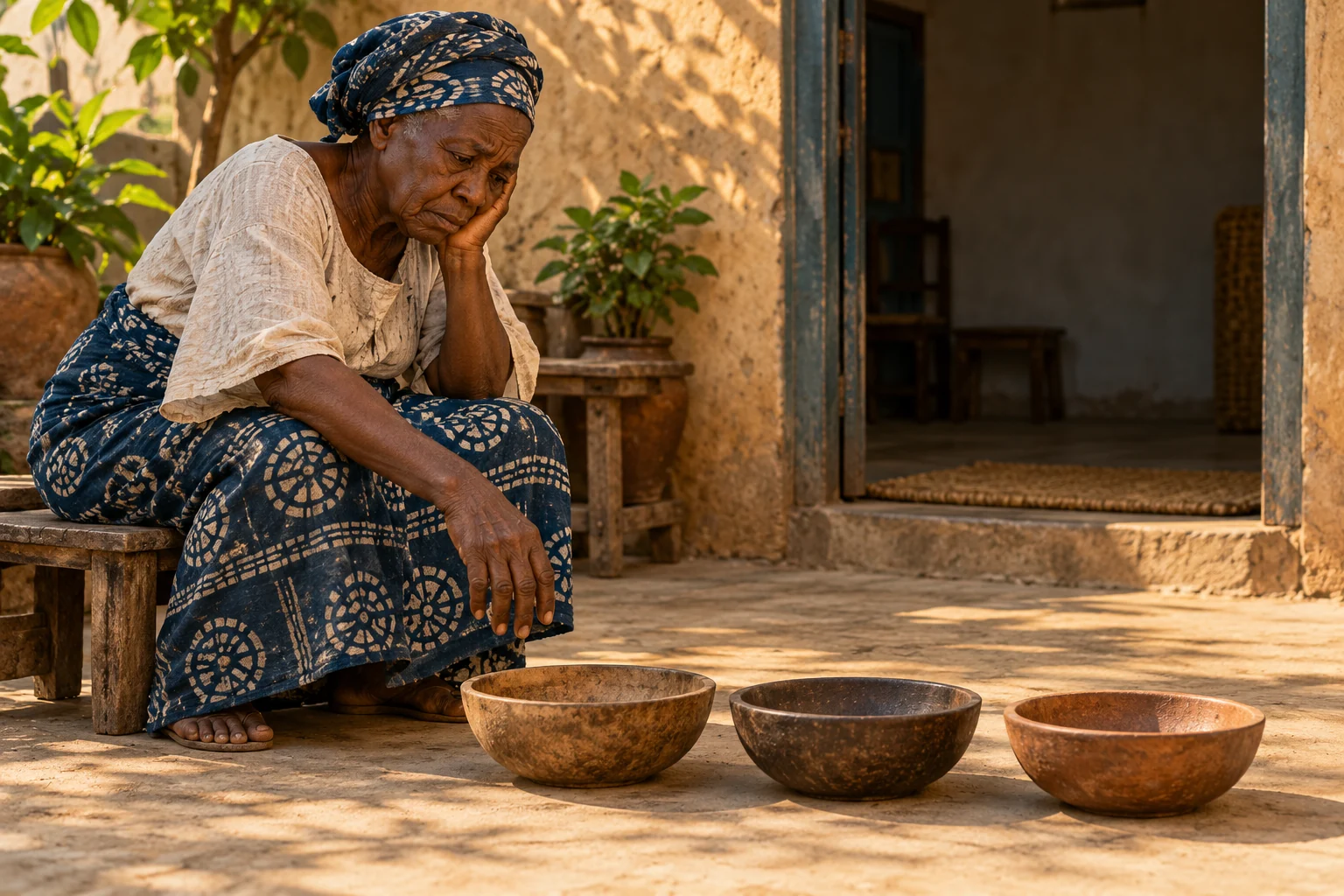
In one account, Obàtálá cannot feed three children and sends for the goat’s assistance. She agrees but forgets, and the children die. An expanded version portrays an elderly Oshalufón struggling to combine paid work and domestic care, then engaging a caregiver who repeatedly neglects the household. The story’s violent punishment supplies a local explanation for a ceremony, while its immediate human problem is an essential promise left unfulfilled.
The stronger analytical focus is the gap between agreeing to care and reliably performing care. The expanded version also makes parental exhaustion visible, showing that responsibility exists within material limits. Its conclusion blames irresponsible mothers, although the plot concerns delegated labor more broadly; later writing should resist that gendered narrowing. Violent punishment cannot be treated as an appropriate caregiving remedy, and no ceremonial procedure is needed to understand the motif.
Narrative setting: Cuban/Lukumí patakín identified in the selected account; no individual narrator is named.
The servant whose idea changes the business
Obàtálá needs help with an enterprise and follows Òrúnmìlà’s counsel by acquiring a servant. Seeing the man’s disability, he assumes that he has been misled. Left at home, the servant plants corn, observes the parrots drawn to it, and catches them. The birds provide valuable feathers, creating a profitable trade. Obàtálá recognizes the contribution, rewards the man, and releases him from servitude.
The narrative locates initiative in a person whom the owner judges through bodily limitation. Planting, observation, and an improvised plan accomplish what the owner’s assumptions could not foresee. Yet recognition is tied to the man’s exceptional economic usefulness, and freedom remains a reward conferred by an owner. A careful reading should affirm equal dignity without making productivity the price of respect or treating the servant’s acquisition as an unproblematic hiring arrangement.
Narrative setting: Cuban/Lukumí patakín identified in the selected account; no individual narrator is named.
A new wife crosses a threshold with counsel
The Salami unit presents a new wife on the way to her husband’s home. A named diviner associated with Òsekànràn receives her concern and directs a response within Ifá. The verse wishes her children, records her compliance, and concludes with an abundant household and praise for the diviner. Its final images concern the passage from conception toward a child, but they do not provide a physiological explanation. No conflict with the husband, a prior history of infertility, or a named co-wife is narrated. The concrete scene is entry into a new household under acknowledged religious guidance.
The threshold matters because the woman is presented at the beginning of a relationship whose future is not yet visible. Within the witness, counsel and offering situate that future within sacred recognition rather than leaving the crossing as a purely domestic transfer. The resulting children belong to the verse’s devotional affirmation, not a result that a reference entry can promise to anyone making a similar transition. The unit also gives little access to the bride’s inner reasoning or the terms of her new home, so it cannot establish a complete ideal of marriage.
Its comparison with the earlier caregiver story is nevertheless valuable: the beginning of a household is accompanied by anticipated life, while its continuation requires dependable care. A contemporary question about consent, support, or reproductive expectation can be raised separately. It should not replace the source’s own concern with a religiously recognized passage and the good sought for its recipient.
Narrative witness and setting: Passage explicitly labeled Ayo Salami, with Yoruba verse and Spanish translation in the supplied compilation.
The next dawn brings generous encounters
Òrúnmìlà wakes repeatedly with the complaint that good things remain beyond his reach. He receives counsel to respond and be patient, then acts within the consultation’s religious requirements. At the next dawn, wealth is described as arriving from both sides, and the verse develops that change through encounters with generous or kindly people connected with resources, companionship, children, a house, and other goods of life. Praise returns through the diviners to Ifá. The passage does not describe a specific trade, inheritance, or sudden find. Its distinctive scene is waking into a world of newly favorable encounters.
The arrival is represented as abundance, but the concluding sequence makes that abundance relational. Òrúnmìlà meets people rather than merely receiving objects into an empty house. Their generosity and character are named repeatedly, giving a social form to the good that Ifá brings within the witness. Patience is therefore not simple inactivity: the recipient has responded, and a changed field of encounter becomes possible. The next dawn is the narrative’s time of reversal, not a deadline an editor can transfer to readers.
A contemporary interpretation may ask what it means to remain open to help without measuring every person by immediate usefulness. Yet the account does not reduce divine agency to networking; Ifá is credited with bringing the meetings about. The unresolved question is what reciprocal conduct follows these encounters, since the verse celebrates their arrival without narrating the longer history of the relationships they begin.
Narrative witness and setting: Passage explicitly labeled Ayo Salami, with Yoruba verse and Spanish translation in the supplied compilation.
What was born in this Odù
“Born” can name an explicit traditional origin association or what emerges through a story: a capacity, relationship, practice or order of life. Interpretations drawn from a narrative are labelled below, so their basis remains clear.
A communal Itá-day ceremony
Selected traditional source association.
The sole beginning entry places a particular ceremony at the threshold of the Ifá initiation space. Its narrative explanation emphasizes sustenance and caregiving responsibility; the protected ritual actions and words are omitted, and the custom remains source-specific.
Recognition beyond bodily assumptions
Contemporary interpretation from the selected myth.
The servant’s initiative can be read as the emergence of recognition that revises a prejudiced first judgment. This is contemporary interpretation, not a source origin claim, and human dignity does not depend on producing an exceptional economic result.
Correlations to life dimensions
These questions bring the selected stories into contemporary life. They are interpretive invitations for study.
Work and resources
The elderly parent cannot meet every demand alone, while the trader misjudges the worker who could help him. Both settings require realistic attention to labor, capacity, and dependable cooperation rather than status or promises within a household.
Reflect: Which task needs reliable help rather than another promise?
Relationships and family
Children’s dependence gives caregiving commitments unusual weight. The story supports checking whether care is actually occurring and helping an exhausted parent, without assuming that women alone bear responsibility or that failure justifies violent punishment within this narrative.
Reflect: Who checks that a care arrangement is working in practice?
Character and inner life
Obàtálá’s first judgment of the servant reflects a prejudice the later outcome exposes. The productive insight is a willingness to revise expectations and recognize initiative, while grounding dignity in personhood rather than in exceptional achievement.
Reflect: What assumption about another person are you willing to revise?
Community and responsibility
The ceremony’s communal setting turns a household failure into a remembered collective concern. A contemporary reflection can ask how responsibility for vulnerable people is shared, monitored, and supported before neglect becomes a crisis for an already exhausted household.
Reflect: How does your community support those carrying essential care work?
A deeper reading of the sacred relationships
Sacred response at the beginning of a relationship
The two Salami units locate religious action before a good has become settled possession. The new wife crosses toward a household, while Òrúnmìlà faces another dawn without what he seeks. Counsel and response open the relation to a future the witnesses affirm as spiritually consequential. The earlier parrot story also places consultation before an encounter whose useful participant is initially misjudged. These accounts do not make divination a substitute for caregiving, observation, or work. They place those activities within an order in which Ifá can disclose a fitting response and bring people into meaningful relation. Contemporary reflection should follow that logic rather than replacing it with optimism alone.
The character of the people who arrive
The dawn verse repeatedly identifies the people encountered as generous or kind. This gives an important counterweight to the earlier accounts of a neglected household and a servant underestimated through disability. A person is not valued only for the resource they control or the labor they may perform; the manner of relation matters. Yet the parrot account also exposes a difficult condition of recognition, because the servant’s freedom follows exceptional productivity. Comparing the witnesses allows a contemporary reader to ask whether welcome depends on usefulness and whether acknowledged kindness becomes continuing reciprocity. That question is an interpretation; the Salami verse itself records the favorable encounter rather than its full aftermath.
Beginning a household is different from sustaining one
The bride’s transition concerns anticipated life and the formation of a household; the caregiver account concerns the ongoing labor without which dependent children cannot flourish. Neither story can answer the other by itself. A celebrated beginning does not guarantee dependable care, and a burdened parent’s need for help does not erase the dignity of someone entering a family. The next-dawn verse adds a wider network of people associated with different goods, while the servant’s initiative adds work that the owner did not expect. These distinctions make household continuity something sustained through several relations rather than achieved once through marriage, wealth, parenthood, or a single promise.
Questions that deepen the study
Does the bride’s verse define a woman’s worth through children?
It expresses a particular desired good within a religious consultation and celebrates children in its conclusion. That does not supply a complete account of the woman, her marriage, or every possible good in a life. A responsible entry can preserve the witness’s devotional intention without making reproductive outcome a universal measure of dignity. The earlier caregiver narrative also reminds the reader that children’s presence brings sustained responsibilities, not only celebration. Contemporary reflection may ask how a household supports someone entering it and whether expectations are freely shared, while identifying those questions as present interpretation rather than events explicitly narrated in this compact verse.
Why are generous people more important than a list of possessions in the dawn account?
The passage’s concluding movement repeatedly describes encounters with kindly people associated with different goods. This gives the reversal a relational shape: resources and opportunities become available through a field of persons whom Ifá brings into contact with the recipient. It does not establish that every new acquaintance is divinely appointed or that a person without wealth lacks generosity. A contemporary reading can ask how to recognize help without treating another person merely as its vehicle. Within the witness, the meetings remain acts of sacred assistance; the social form through which they arrive does not make that assistance less real in the account’s religious setting.
What does patience mean when a household’s needs are urgent?
The new verse asks for patience after a religious response, but the caregiver story shows a situation in which delay and neglect carry grave consequences. Their contrast prevents patience from becoming a reason to leave dependents without care. It also prevents urgency from making every promise believable or every worker’s capacity obvious. The parrot story adds the need to observe initiative beyond first impressions. Contemporary judgment must therefore ask what can wait, what requires immediate reliable support, and what relationship can sustain the response. The sources do not provide one timetable for all needs, and the dawn reversal cannot be converted into a promised date.
What the four narratives reveal together
The additional Salami units bring beginnings and encounters into Òṣé Okanran’s earlier concern with care and underestimated ability. A new wife moves toward a household under sacred counsel; Òrúnmìlà wakes into meetings with generous people; an exhausted parent needs reliable caregiving; a disabled servant contributes an initiative the owner did not imagine. These are distinct relations, not four versions of a promise that every need will be rewarded. The religious witnesses affirm Ifá’s capacity to disclose response and bring good encounters, while the narratives retain practical demands of attention, work, and continuing care.
A later synthesis can therefore ask what makes a household or a new relationship inhabitable without reducing spiritual assistance to social support. It should also keep visible what the short verses do not narrate: consent’s full circumstances, the duration of favorable encounters, and the reciprocal obligations that may follow an auspicious beginning.
Living with this Odù
A continuing life or initiatory relationship
For someone whose received life or initiatory Odù is Ọ̀ṣẹ́ Ọ̀kànràn, these accounts distinguish the promise of a relationship from the conditions that keep it alive. The caregiver’s agreement does not feed the children when dependable action is absent. The bride’s threshold concerns a beginning whose later household labor is not narrated. Long-term responsibility therefore includes asking what support will make an anticipated good sustainable, without turning all caregiving failure into a judgment against mothers.
The underestimated servant makes another distinction: bodily difference does not tell an owner the limits of someone’s initiative. His profitable work brings freedom in the story, but dignity should not depend on extraordinary output or an owner’s generosity. The next-dawn verse adds encounters marked by kindness rather than resources alone. Within it, Ifá brings people into relation; this is not merely a prediction of useful contacts. Over changing circumstances, a person may need to make a promise more concrete, recognize another’s competence or remain open to help without treating people as instruments. The sign supplies no fixed family future, guaranteed children or deadline for prosperity. Its enduring concern is how welcome, work and ongoing care become reliable relationships.
A particular consultation and its question
In consultation, Ọ̀ṣẹ́ Ọ̀kànràn can help separate a lack of goodwill from a lack of dependable arrangements. The expanded caregiver account makes exhaustion and paid work part of the setting, so a practitioner need not reduce every failure to indifference. What was agreed, who could carry it and how would absence be noticed? Those distinctions concern the actual situation rather than a presumed character defect.
The servant narrative asks whether prejudice has prevented a real contribution from being seen. It also requires preserving servitude as coercion, rather than renaming acquisition ordinary employment. A consultation may instead concern entry into a new household or a wish for favorable encounters. Salami’s bride and dawn verses place these beginnings within response to Ifá, while leaving consent arrangements, later reciprocity and domestic details largely unreported. Their favorable endings cannot establish fertility or next-day success for an unknown reader. The result of one consultation is not permanent identity. It can support a specific inquiry into whose needs have been anticipated, what follow-through exists and whether the people encountered are recognized for their character as well as their usefulness, with sacred agency retained throughout.
Constructive and adverse possibilities
Constructive possibilities include an essential commitment becoming dependable, underestimated knowledge receiving room to act and a new household being approached through acknowledged sacred relation. The dawn verse’s generous people make abundance social and religious, rather than a pile of goods. Participation in Ifá’s order remains part of what changes the encounter.
Adverse possibilities include a celebrated beginning concealing unsupported care, promises without a reliable means of fulfillment or respect granted only after exceptional economic success. The caregiver’s violent punishment cannot become an appropriate remedy, and the servant’s freedom does not justify his prior enslavement. Nor should the bride’s children become a measure of every marriage’s worth. These tensions keep success from cancelling the ethical conditions around it. They can inform the interpretation of a real result without assigning its state, diagnosing someone’s capacity to care or declaring that the sign guarantees a particular household future.
An illustrative situation in everyday life
Hypothetically, two relatives agree that one will collect a dependent adult from regular appointments while the other works. Everyone feels reassured by the promise, but no backup or confirmation arrangement exists. After a missed collection, anger centers on moral blame while the external gaps remain. The caregiver structure helps distinguish accepting a duty from making its performance reliable; it does not justify the story’s punishment. A constructive response would clarify capacity, timing and alternatives while hearing the dependent person’s preferences. The bride’s beginning provides a second question about whether a warmly welcomed arrangement has resources for continuation. This is an illustrative modern scenario, not a clinical account, a ritual prescription or evidence that any reader’s family is neglectful.
Sources and reading context
The first two narrative witnesses
These Cuban/Lukumí variants identify Obàtálá and Oshalufón differently within the care motif. Only one explicit beginning is given. Disability prejudice, enslavement, gendered blame, and lethal punishment are source features to examine critically; none is adopted as an ethical prescription. The added emergence motif is explicitly interpretive where marked, rather than a traditional origin-list claim.
Narrative motifs are summarized independently. The life-dimension reflections are contemporary interpretation. How these reference studies are built explains the wider source approach and the distinction between a reference article and personal divination.
Additional named witnesses
-
Ayo Salami. The new-wife threshold and next-dawn encounters are selected from this explicitly named bilingual source block.
-
Cuban/Lukumí compilation witness. The earlier caregiver and parrot-servant narratives remain distinct Cuban accounts used for comparison.
The new-wife verse offers no biography or clinical fertility history. The dawn is the narrative’s reversal, not a promised timetable. Disability, enslavement, and gendered punishment in the older narratives remain source features requiring careful interpretation rather than universal religious norms.
Bibliographic identification
- Ayo Salami. Ifá: A Complete Divination. Lagos: NIDD, 2002 catalogue record. Library catalogue record. Bibliographic identification of the named author and work; the edition behind the transmitted account remains to be matched.
Read the source method and wider scholarly context.
The catalogue links identify published works and their authors. They are separate from proof of an individual episode’s wording or attribution. Contemporary comparisons and the synthesis above are editorial interpretation. The author’s books and Academy companions below provide further study; their sales links are separate from the source references.