
Ògúndá Ọ̀ṣẹ́ is a mixed Odù in Ifá’s 256-part corpus. Ogunda Ose places a father and son on opposing sides of a war before their relationship is revealed, then follows a man who wants to monopolize knowledge. In the first, recognition arrives after exclusion and conflict have already caused damage. In the second, a passerby’s simple observation disproves the claim to total mastery. Both ask what pride prevents a powerful person from knowing, with tragic endings kept as losses rather than celebrations of greatness.
A question to carry through the study: What useful knowledge could you receive if you stopped needing to be the person who knows most?
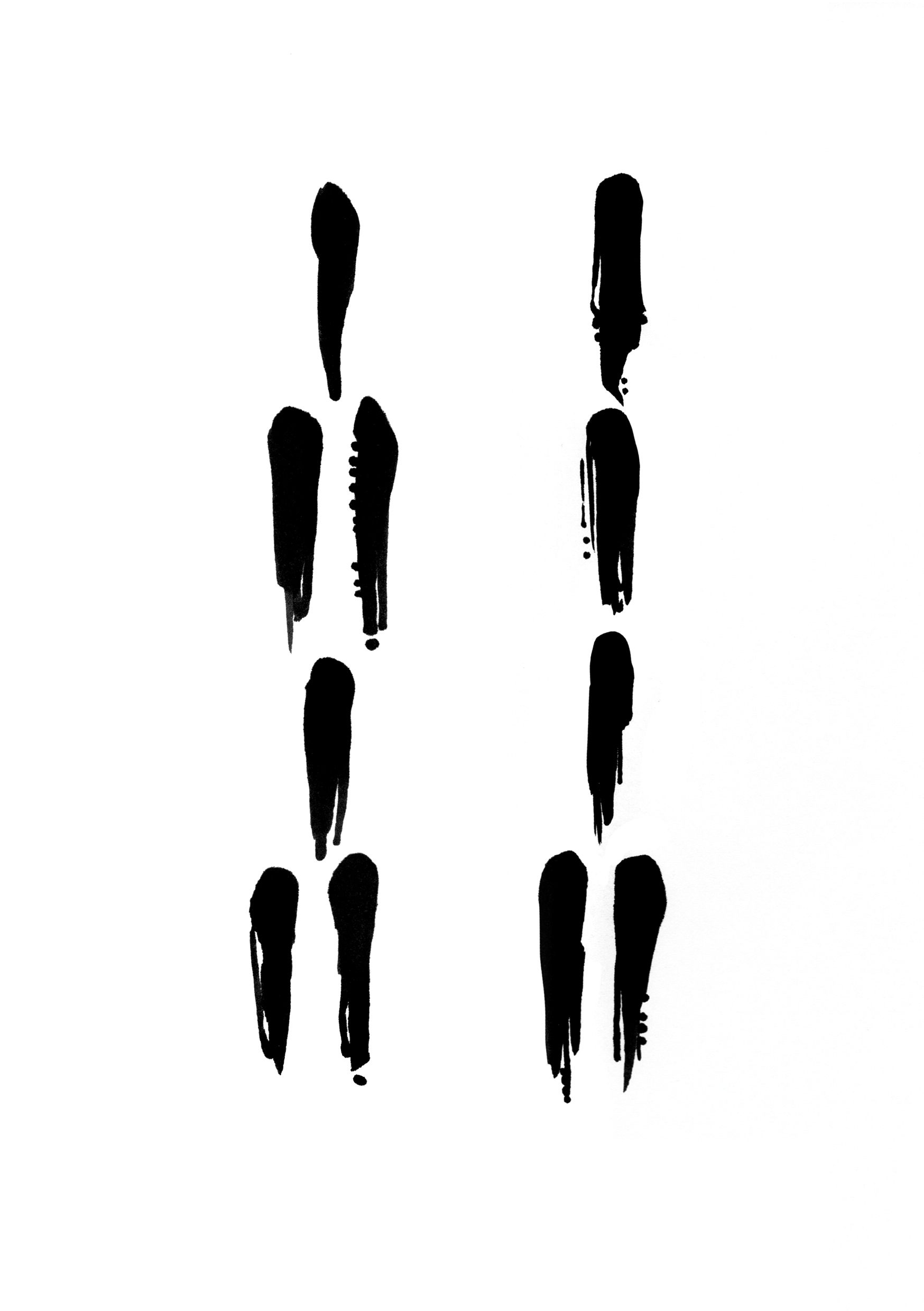
This Academy reads the right column first, then the left. Each row carries a single or double mark.

Where this Odù belongs
Ògúndá Ọ̀ṣẹ́ belongs to the Ògúndá family in this Academy’s study sequence. It is a mixed Odù, distinct from Ọ̀ṣẹ́ Ògúndá. The order matters. Its teaching is approached through its own narratives, rather than by adding two general descriptions of the principal signs together.
Key Òrìṣà and sacred relationships
The figures below are selected for their roles in the accounts discussed here. They offer connected reading paths through the tradition.
-
Ọ̀rúnmìlà. He warns the ambitious man that someone will always know more and frames the problem as a limit on the desire to dominate other knowledgeable people.
-
Ọya. The origin list associates her with a mask and particular attributes. She is not made an actor in the selected father-son or wisdom-monopoly stories.
-
Òsanyìn. A vessel associated with Osanyin is used in the ambitious man’s imagined containment of others’ knowledge. This is a narrative object association, not a claim that Osanyin endorses the plan.
Key myths and their meanings
The son outside the town’s rule
A young man repeatedly displays a flag against the town’s restriction and is expelled. He gathers an army and defeats the ruler’s forces. As the ruler faces death, the young man’s mother reveals that they are father and son. The father acknowledges the relationship, passes on the crown, and dies in the emotional aftermath.
The family connection becomes known only at the brink of irreversible harm. The tale invites questions about unrecognized children, exclusion, and late acknowledgment rather than proving that blood relation legitimizes war. The mother holds decisive knowledge, but her voice arrives very late. A critical reading asks what earlier recognition might have prevented.
Narrative setting: Cuban/Lukumí patakín in a multilingual source compilation; no individual narrator is established.
The passerby outside the monopoly
A man seeking political mastery insists that no local person knows more than he does. He tries to contain the wisdom of others within a sacred object, yet cannot carry out an ordinary climbing task. A passerby immediately identifies the practical obstacle. Unable to accept that someone remains beyond his control, the man ends in fatal despair.
The passerby’s knowledge is modest and sufficient, exposing the difference between collecting authority and understanding a task. The tragedy should not be presented as deserved or imitated. The strongest insight is that useful expertise is distributed, and another person’s contribution need not diminish one’s worth. Trying to eliminate that dependence makes the man’s achievement impossible.
Narrative setting: Cuban/Lukumí patakín in a multilingual source compilation; no individual narrator is established.
The helpful face becomes a means of obtaining secrets
A son of Oya and Obatala wants access to powerful knowledge. His father initially resists initiation, while his mother arranges an encounter intended to change that decision. The son receives Ifa but the parents seek further powers of altered appearance. Other practitioners first hesitate, then help establish the capacity to present a different face and character. With that appearance, the son obtains a mentor’s knowledge through deception and becomes prominent. The unnamed Cuban narrative associates the mask with this troubled route to greatness. Appended English claims about a universal ritual mask are not used as independent ethnographic evidence.
The parents’ care does not remain ethically simple. Their desire for the son’s greatness supports an appearance that limits the mentor’s informed judgment. Within the narrative, transfiguration and initiation are effective religious capacities, not merely social acting. Contemporary analysis can examine deception while retaining that spiritual reality. The earlier man who wants to contain every wise person offers another desire for knowledge that becomes domination, while the unknown son’s conflict with his father turns recognition into a belated revelation.
These stories share neither identical motives nor the same outcome. The new mask account is particularly useful because the source moves between a language of good intentions and an explicit statement that the mentor is deceived. An editor should not erase that tension by calling the result wholly noble or wholly fraudulent. The narrative establishes acquired power and prominence; it does not demonstrate that the means become just because the parents or eventual beneficiary desired them.
Narrative witness and setting: Unnamed Cuban/Lukumí narrative in the compilation. The appended English explanation of a universal Majá mask is not used as an independent witness.
Orisemi Lere receives and acknowledges a changed condition
Orisemi Lere consults before the fame and resources described later in the account. He is advised to attend to his inner head and undertakes the sacred response. The narrative then reports the arrival of favorable conditions, followed by gratitude toward the practitioners and praise of Ifa. Its scale is concise: no rival, hidden enemy, prolonged ordeal, or detailed professional career is narrated. The episode presents fulfillment through a relation to Ori and acknowledged religious assistance. It is not a guarantee that a reader’s resources will change after a particular act or an explanation that every deprivation reflects neglect of the head.
The lack of a rival matters when placed beside the sign’s more competitive stories. Orisemi Lere’s favorable change does not require collecting every expert’s knowledge, defeating a father, or deceiving a mentor. The source instead gives inward sacred orientation and gratitude a sufficient narrative place. Within the witness, Ori is not merely an attitude; the response participates in an effective relation to the person’s life. A contemporary interpretation can consider a desire that remains answerable rather than becoming domination, but should not pretend the passage supplies a complete psychology.
Its brevity also sets limits on the researcher. There is no evidence for inventing a generous public career, an exact sequence of success, or a permanent state beyond difficulty. The episode’s contribution is comparative: it gives a quieter route to flourishing and a return of acknowledgment, allowing the other three accounts’ dramatic claims to greatness to be examined without assuming that prominence must always be won through conflict.
Narrative witness and setting: Translated excerpt in the multilingual compilation’s expressly attributed Cromwell Osamaro sequence, with Yoruba/Bini-facing material. The compilation’s language is not evidence of a Brazilian tradition.
What was born in this Odù
“Born” can name an explicit traditional origin association or what emerges through a story: a capacity, relationship, practice or order of life. Interpretations drawn from a narrative are labelled below, so their basis remains clear.
The mask and Oya-associated serpent motif
Selected traditional source association.
The source explicitly places these associations in the born list. They concern religious material and appearance, but the selected stories do not narrate their origin; no generalized mask theology is invented.
The sacred word of Olofin
Selected traditional source association.
This is a named origin association. This study does not quote a sacred formula or treat a separate gendered origin account as factual anatomy or an adequate basis for present social hierarchy.
A father asks the son’s forgiveness
Selected traditional source association.
The list names a reversal within the father-son hierarchy. It can support inquiry into acknowledgment across generations, without adding an apology absent from the selected story’s actual ending.
Correlations to life dimensions
These questions bring the selected stories into contemporary life. They are interpretive invitations for study.
Work and resources
The passerby solves a task through observation rather than status. Work benefits from knowledge that can arrive outside the recognized circle of experts.
Reflect: Who can see a practical obstacle you have stopped noticing?
Relationships and family
The father learns his son’s identity only during a lethal confrontation. Family recognition should not depend on a dramatic proof of strength.
Reflect: What relationship needs acknowledgment before another conflict?
Character and inner life
The wisdom seeker experiences another person’s insight as humiliation. Learning requires an account of worth that survives correction.
Reflect: What makes it hard to accept a simple suggestion?
Community and responsibility
The town responds to difference through expulsion, and the conflict returns at greater scale. Community rules need a proportionate process for disagreement.
Reflect: What response could address a breach without making a permanent enemy?
A deeper reading of the sacred relationships
Ori offers a relation other than mastery over others
Orisemi Lere attends to the inner head and responds in gratitude, while the mask story obtains a mentor’s knowledge through altered appearance. The earlier monopolist tries to remove every other wise person from independent existence, and the father-son conflict ends in public recognition of kinship. These are different religious and social routes toward a desired position. A spiritually grounded lens should preserve Ori as an effective inward relation rather than only self-esteem, and transfiguration as a capacity rather than only metaphor. Contemporary interpretation can then ask how desire becomes answerable without declaring that one narrative supplies a universal shortcut or that all conflict is a sign of failed inward alignment.
Care can support a harmful means
Oya’s advocacy responds to her son’s future, yet the eventual method deceives a teacher. The unknown son’s mother also holds decisive knowledge that changes a conflict, but at a much later point and through disclosure rather than concealment. Orisemi Lere’s gratitude acknowledges assistance without manipulating another person’s access to facts. These differences keep the word care from explaining everything. A contemporary study can ask what a helpful intention authorizes and whether the person affected can understand the arrangement. The religious accounts remain particular in their powers and stakes. Their successful outcomes do not make every parental request or protected ambition ethically identical.
Knowledge claims need a relation to what remains outside them
The monopolist is undone by a passerby’s ordinary observation, while the masked learner’s access depends on concealing something from the mentor. The unknown son’s power develops before his father knows the kinship, and the concise Ori episode offers no claim to total knowledge at all. These are specific limits, not a generic argument against ambition. A contemporary reference can ask who is allowed to know what and what a declared capacity actually establishes. The source’s spiritual realities do not remove that inquiry; they make the distribution of knowledge consequential. An editor should not supply a complete ethical reconciliation where the narrative leaves either concealment or belated recognition unresolved.
Questions that deepen the study
Does the mask account simply endorse clever self-presentation?
No. The source explicitly associates the eventual success with deceiving a mentor, even while it also describes parental hopes and good intentions. That tension should remain part of the study. The mask is an effective religious capacity within the narrative, not merely modern impression management, but effectiveness does not erase the mentor’s limited knowledge of the arrangement. A contemporary reader can ask whether advocacy has become manipulation. The appended general description of a Santeria mask is a separate, weakly grounded explanatory layer and cannot settle the question by making the entire account an uncomplicated devotional practice.
What does the brief Ori account add that the dramatic stories do not?
It gives a favorable change without a conquered rival or a teacher deceived. Orisemi Lere responds to counsel, attends to the inner head, and acknowledges assistance. The religious witness is concise but meaningful: fulfillment remains related to Ori and Ifa rather than isolated personal command. A contemporary interpretation may consider a less dominating form of aspiration, while admitting that the source gives no detailed later biography. The point is not that quiet action always succeeds or that a particular devotional response guarantees fortune. It is that the archive does not make conflict the only imaginable route to a changed life.
Why preserve the different mothers’ actions instead of calling both protective?
The mask narrative’s mother arranges and sustains access through a concealed appearance, while the unknown son’s mother reveals a fact that prevents a final act against his father. Both concern a child’s future, but the information relations and consequences differ. A reference study can value their agency without erasing those differences. The sacred powers in the first story and the kinship revelation in the second remain specific. Contemporary analysis can ask what a protective act requires others to know or accept, rather than making every parent’s desire for greatness a sufficient justification for the means chosen.
What the four narratives reveal together
The added material gives Ogunda Ose a striking contrast between acquired appearance and inward sacred orientation. The unnamed Cuban mask narrative achieves prominence through a mentor’s deception, while Orisemi Lere’s attributed African episode gives Ori and gratitude a quieter route to favorable change. The earlier wisdom monopolist and unrecognized son retain different struggles over knowledge and kinship. Religious capacities remain substantive, including transfiguration, initiation, and the inner head, rather than being replaced by modern personality terms.
Contemporary analysis can then ask what aspiration authorizes and who may understand its means. The four stories do not make greatness one uniform achievement or care an automatic defense of every act. Their depth lies in the distribution of knowledge and responsibility, and in preserving a concise account’s silence rather than enlarging it with an invented career or guaranteed spiritual result.
Living with this Odù
A continuing life or initiatory relationship
For someone whose received life or initiatory sign is Ògúndá Ọ̀ṣẹ́, knowledge can become either an accountable relation or an attempt to remove another's independence. The monopolist cannot perform an ordinary task while a passerby sees what remains outside his claimed mastery. The masked learner gains effective power by limiting what a mentor can know. Across changing ambitions, these narratives can develop attention to how desire for recognition organizes access and what it conceals from those affected.
The unknown son and concise Ori account give different continuations. Late disclosure changes the father-son conflict only near irreversible harm, while Orisemi Lere's favorable condition involves inward sacred relation and gratitude without a rival's defeat. Long-term character can include receiving assistance without turning another's knowledge into a possession or treating parental advocacy as proof that every means is justified. The sign does not make tragic death deserved, blood relation a justification for war or costly action a guarantee of fame. Ori and the mask's capacities remain spiritually effective within distinct witnesses; the unnamed Cuban account cannot establish universal ritual doctrine. The received sign invites judgment about who can know, who can consent and what remains unmastered beyond a successful result.
A particular consultation and its question
A consultation yielding Ògúndá Ọ̀ṣẹ́ can help distinguish a missing practical fact from a claim to complete authority. The passerby's observation corrects an ordinary obstacle that the monopolist's ambition has obscured. A question about learning may instead involve the mask's altered appearance, which gains access by managing a mentor's judgment. A practitioner should not make both stories a generic warning against ambition or erase the parents' mixture of care and troubling means.
The father-son disclosure and Orisemi Lere add other routes toward a changed position. Kinship becomes known late, while the brief Ori witness gives acknowledgment a place without narrating conflict, enemies or a complete career. Ori remains an effective sacred relation rather than self-esteem, but the passage cannot guarantee present resources or explain deprivation through neglect. Consultation can ask which participant lacks essential knowledge and whether access has become domination. It cannot diagnose suicidal despair in an unknown person, approve the source's tragedy or assign permanent identity as hidden heir or manipulative student. The actual result remains tied to its question and to the difference between the unnamed Cuban witness and the explicitly attributed Ibie account.
Constructive and adverse possibilities
Constructive relations may permit another person's observation to matter, disclose kinship before further irreversible harm and acknowledge religious assistance without controlling someone else's knowledge. Orisemi Lere's concise gratitude supplies a quieter sacred continuation alongside the sign's dramatic competitions, without claiming a complete future beyond difficulty.
Adverse unfolding could include parental care shielding deception, prominence validating its own means or another's expertise experienced as a threat to existence. The monopolist's fatal despair cannot be treated as deserved, and the father's recognition does not justify the war that preceded it. These contrasts leave a real reading's state undetermined. They ask what a claim to mastery excludes and what an effective capacity has actually authorized, while preserving the source's spiritual realities without turning an appended mask explanation into universal doctrine or a private ambition into an unlimited right of access.
An illustrative situation in everyday life
In a hypothetical mentorship, a learner's family helps conceal the learner's intention to compete so a guarded teacher will release more knowledge. The learner becomes prominent, but the result does not show that the mentor could make an informed choice. The mask account keeps that tension visible. The passerby adds a separate limit if prominence tempts the learner to believe no important knowledge remains outside their control. This illustration does not authenticate a ritual mask or predict a tragic response to correction. It asks whether another person's contribution can remain independent and whether a desired future is being pursued through a relation able to withstand truthful disclosure of the intention that produced it.
Sources and reading context
The first two narrative witnesses
The Cuban narratives include political violence and suicide-related tragedy, described without methods or claims of deserved harm. The strongly gendered bodily-origin account elsewhere in the section is not used as doctrine or medical fact. Oya and Osanyin associations remain distinct from the selected stories’ direct cast.
Narrative motifs are summarized independently. The life-dimension reflections are contemporary interpretation. How these reference studies are built explains the wider source approach and the distinction between a reference article and personal divination.
Additional named witnesses
-
Cromwell Osamaro Ibie. The concise Orisemi Lere episode appears in the expressly attributed Cromwell Osamaro sequence. Its source identity is separate from the unnamed Cuban mask narrative; exact edition and translation chain are unverified.
-
Cuban/Lukumí compilation narrative; individual narrator unnamed. The Oya and Obatala family episode supplies the new mask-and-mentor motif. No African author is inferred for this passage.
The mask narrative is an unnamed Cuban witness, distinct from the attributed Orisemi Lere passage. Its later synthetic mask description is not treated as established doctrine. Orisemi Lere’s brevity is preserved, and neither Ori nor the tragic earlier stories is converted into diagnosis, method, or promised fortune.
Bibliographic identification
- C. Osamaro Ibie. Ifism: The Complete Work of Orunmila. Lagos; multivolume publication beginning 1986. Library catalogue record. Related bibliographic record for the named narrative witness. Exact volume, edition and page of the transmitted account have not been independently matched.
Read the source method and wider scholarly context.
The catalogue links identify published works and their authors. They are separate from proof of an individual episode’s wording or attribution. Contemporary comparisons and the synthesis above are editorial interpretation. The author’s books and Academy companions below provide further study; their sales links are separate from the source references.