
Ògúndá Ìrẹtẹ̀ is a mixed Odù in Ifá’s 256-part corpus. Ogunda Irete connects Obatala’s search for solitude with a barber whose exclusion interrupts an entire religious community. Quiet in the first story still depends on assistance from several powers. Confidential service in the second becomes visible only after envy drives the worker away. The pairing asks how institutions treat the people and conditions they rely on, while distinguishing a person’s need for space from abandonment of reciprocal responsibility.
A question to carry through the study: Which trusted person or quiet condition does your community notice only when it is gone?

This Academy reads the right column first, then the left. Each row carries a single or double mark.
Where this Odù belongs
Ògúndá Ìrẹtẹ̀ belongs to the Ògúndá family in this Academy’s study sequence. It is a mixed Odù, distinct from Ìrẹtẹ̀ Ògúndá. The order matters. Its teaching is approached through its own narratives, rather than by adding two general descriptions of the principal signs together.
Key Òrìṣà and sacred relationships
The figures below are selected for their roles in the accounts discussed here. They offer connected reading paths through the tradition.
-
Obàtálá. He seeks relief from noise and receives a place at an iroko tree, but further assistance is still needed around the new refuge.
-
Òrìṣà Òkò. He notices Obatala’s new situation, offers recognition, and seeks Esu’s help when the place is troubled. His care is responsive to a particular need.
-
Èṣù. He works with Orunmila to remove disruption around Obatala’s refuge, showing that solitude can require a supporting network.
-
Ọ̀rúnmìlà. He contributes to the protection of Obatala’s quiet setting. The barber episode concerns Ifa’s trusted institutional role without identifying the barber as Orunmila.
Key myths and their meanings
Solitude that still needs helpers
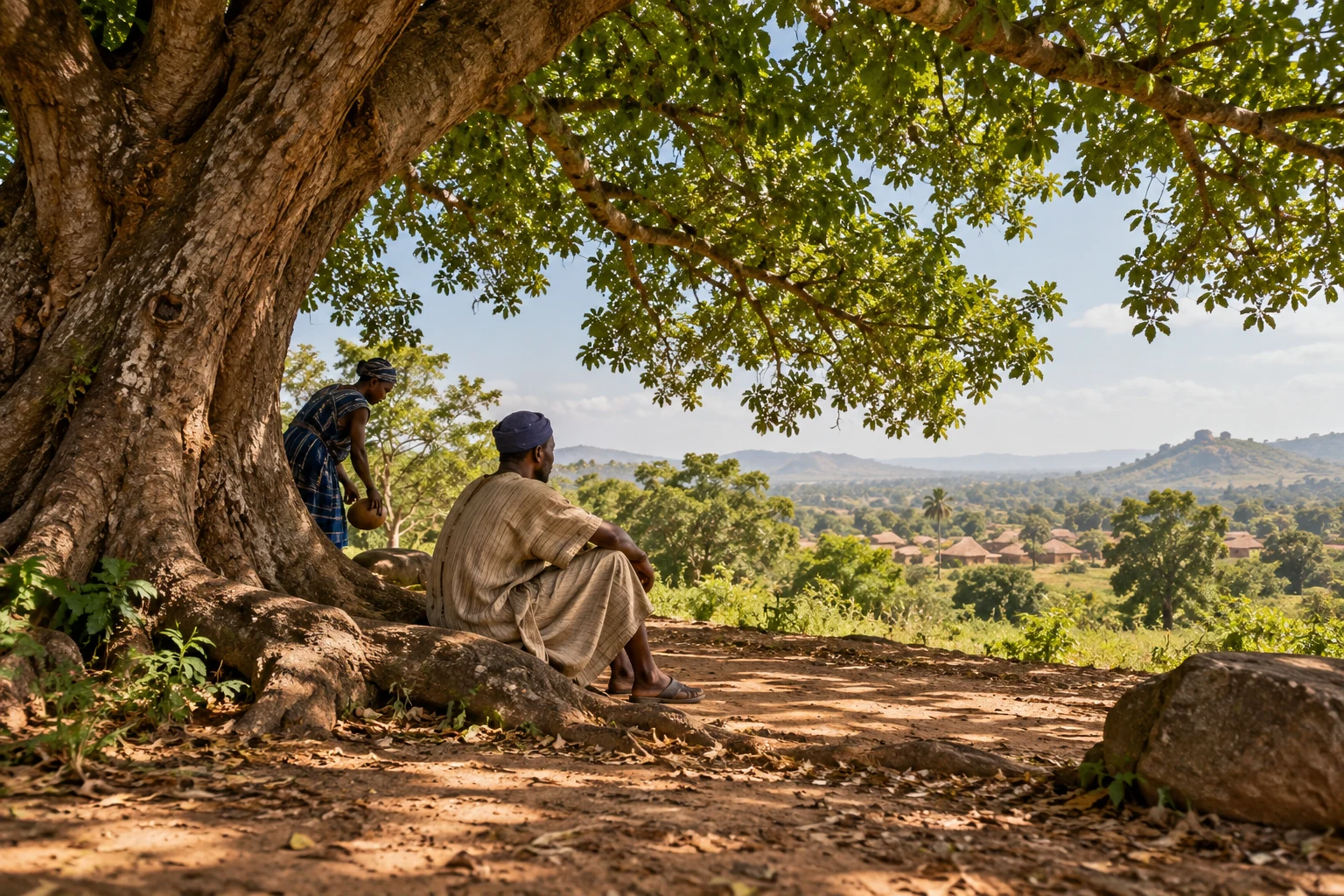
Disturbed by his noisy surroundings, Obatala requests a secluded place and moves to an iroko tree. Orisa Oko recognizes him there but finds that disturbance remains around the refuge. He calls Esu, who works with Orunmila to make the new place usable. Withdrawal alone has not completed the desired change.
The story does not oppose independence and interdependence absolutely. A person can need quiet while still relying on others to establish its conditions. The tree is a setting here, not automatically a separate deity entry. Religious language about disruptive dead presences remains contextual rather than becoming a diagnosis of ordinary noise sensitivity.
Narrative setting: Cuban/Lukumí patakín in a multilingual source compilation; no individual narrator is established.
The barber whose discretion mattered
A barber carries out essential initiation work and keeps private something he has seen on Olofin’s head. Envious people make his position intolerable, and he leaves. Olofin refuses other barbers, religious work stops, and the community eventually brings the trusted worker back into an established place.
The barber’s importance combines technical skill and discretion. The community recognizes dependence only after its own hostility makes that capacity unavailable. The ending is institutional repair rather than a simple personal reward. An article can ask why trust had no protection before the departure, and how a role can be supported without making one worker permanently indispensable.
Narrative setting: Cuban/Lukumí patakín in a multilingual source compilation; no individual narrator is established.
Adibo’s protection is framed by humane disposition
Adibo, named as Orunmila’s son, is repeatedly sought by Death. The opening framing contrasts numerous powerful charms with the need for a humane disposition if they are to be effective. Adibo receives counsel, undertakes a sacred response, and Esu removes Death from his path. The passage is brief and does not narrate a full biography, a public contest, or a later career. Its specific contribution is the joining of spiritual capacity, conduct, and preservation within a named filial relation. It does not promise a reader immunity or treat every real death as evidence that someone lacked humane character.
The framing refuses to make the quantity of powerful objects sufficient in itself. A disposition toward others belongs to how efficacy is understood, while the actual event still depends on counsel and Esu’s agency. That is a religious relation between character and power, not only an ethical comment placed beside a magical mechanism. The earlier trusted barber offers a practical counterpart in which discretion matters to a religious office, while Obatala’s quiet place depends on other helpers. The new Ogun route then supplies strength that succeeds only through preparation and a costly passage.
A contemporary reader can ask what a capacity is for and what conduct sustains it, without converting the account into a diagnosis of why someone was harmed. The brevity of Adibo’s rescue is also important: the researcher should not supply a detailed confrontation, a particular weapon sequence, or an unrecorded family history to make the episode feel longer or more dramatic than the source permits.
Narrative witness and setting: Translated excerpt in the multilingual compilation’s expressly attributed Cromwell Osamaro sequence, with Yoruba/Bini-facing material. The compilation’s language is not evidence of a Brazilian tradition.
Ogun’s prepared route establishes indispensability
The divine powers contest seniority and are told to demonstrate their capacity through reaching earth. Several fail to find a route. Ogun consults before setting out and undertakes the advised sacred commitment. At a river between domains he encounters a python and survives a dangerous crossing through his effective force. The ordeal leaves a temporary bodily cost, yet he completes the mission and reports back. Higher authority declares his indispensability to earthly life and work. The account gives a localized origin of Ogun’s standing through prepared action, not an encouragement to confront an animal or a universal hierarchy shared by every tradition.
Ogun’s strength is real, but the route is not presented as strength detached from religious preparation. The sequence therefore complicates a familiar opposition between force and wisdom: consultation belongs to the effective use of the capacity that makes him distinctive. The temporary cost also prevents an effortless triumph from becoming the whole story. The earlier barber’s indispensability comes through a different combination of skill and discretion, while the quiet-tree episode relies on a network of support. Adibo adds a humane disposition rather than an accumulation of charms.
Together they make standing a relation to a contribution and responsibility, not simply a claim to be greater than others. A contemporary interpretation can ask how recognition is grounded, while retaining the sacred crossing and divine declaration as the witness’s own explanation. It should not turn the ordeal into a practice for proving worth or infer that another person’s injury was necessary to validate an office.
Narrative witness and setting: Translated excerpt in the multilingual compilation’s expressly attributed Cromwell Osamaro sequence, with Yoruba/Bini-facing material. The compilation’s language is not evidence of a Brazilian tradition.
What was born in this Odù
“Born” can name an explicit traditional origin association or what emerges through a story: a capacity, relationship, practice or order of life. Interpretations drawn from a narrative are labelled below, so their basis remains clear.
Moral laws governing human life
Selected traditional source association.
The list explicitly foregrounds moral norms. The selected narratives give them practical shape through confidentiality, recognition, and care, without supplying one universal legal code for all traditions.
The power of the inner head
Selected traditional source association.
Ori appears as a named source association. It concerns inward orientation and responsibility here, not a separate Academy deity or a claim that an individual’s destiny can be diagnosed from the text.
Red earth and black earth
Selected traditional source association.
These two kinds of ground are listed together. The selected stories do not explain their origin or assign them fixed moral qualities, so the association remains material and local.
Correlations to life dimensions
These questions bring the selected stories into contemporary life. They are interpretive invitations for study.
Work and resources
The barber combines specialized work with trusted discretion. Technical competence and ethical reliability may be different reasons a role becomes difficult to replace.
Reflect: What qualities must a successor be able to carry?
Relationships and family
Obatala’s solitude is supported rather than abandoned by others. Respecting someone’s space need not mean withdrawing all care.
Reflect: What support would make another person’s quiet possible?
Character and inner life
The barber’s silence protects information he could exploit. Possessing a secret does not establish a right to use it for status.
Reflect: What knowledge should remain outside your public story?
Community and responsibility
The community repairs the role after a breakdown. Better institutions protect necessary people before their departure reveals the cost.
Reflect: What pattern of exclusion should be addressed while there is still time?
A deeper reading of the sacred relationships
Character and preparation belong within efficacy
The Adibo framing makes humane disposition relevant even where many powerful means are possessed. Ogun’s route joins consultation with force, and the earlier quiet refuge depends on Esu and Orunmila rather than solitude alone. These are religious accounts in which conduct and relation are not separate from the question of what works. A contemporary ethics lens can follow, but should not replace Esu’s intervention or the sacred passage with abstract conscience. Nor does the witness make character a clinical guarantee. The article should explain how the source joins these dimensions while refusing to diagnose actual deaths, bodily conditions, or setbacks through a presumed moral deficiency.
Indispensability has different grounds
The barber’s trusted knowledge and discretion keep an institution functioning; Ogun’s route establishes material capacity for earthly life; and Adibo’s preservation is not narrated as a public office at all. Obatala’s refuge shows a powerful figure needing others. These differences prevent every favorable outcome from being described as recognition of greatness. A contemporary reference can ask what actual continuing contribution or relation grounds a status claim. The religious witness supplies divine declaration in one case and institutional dependence in another. Keeping those grounds distinct respects the source more than making all sacred figures examples of the same modern leadership principle.
A necessary capacity can remain vulnerable
The barber can be driven away despite his value, Obatala needs a protected quiet setting, and Ogun’s successful crossing has a bodily cost. Adibo’s named relation to Orunmila does not mean Death never approaches him in the narrative. These are exact limits on a simplistic equation between importance and invulnerability. A contemporary interpretation can ask how a community cares for someone it relies on. The religious accounts remain particular about how preservation and recognition occur, and they do not promise that every valued participant will be spared harm. Their depth includes need and assistance within power, rather than an image of sacred persons who never require support.
Questions that deepen the study
Does the humane-disposition framing blame people who suffer harm?
No such inference is warranted. The passage states a relation between conduct and effective spiritual means within Adibo’s account, then describes his preservation through Esu. It does not provide evidence about another person’s character or the cause of a real death. A spiritually attentive study can explain that religious efficacy is not treated as a mere inventory of objects, while keeping the human application bounded. The earlier need for communal care also resists treating vulnerability as failure. Contemporary reflection may ask what one does with a capacity, but should not turn that question into a verdict on victims.
Why does Ogun consult if his force is what opens the route?
The witness does not make those explanations compete. Consultation and preparation belong to the sequence through which his distinctive force becomes successful in a sacred passage. That is different from claiming that strength is either sufficient by itself or worthless. A contemporary reader may compare appropriate preparation before using a skill, but should retain the actual divine person, river boundary, and declaration of indispensability. The bodily cost also matters: the source does not present the task as an effortless display. None of this supplies an ordeal for readers or a universal ranking of every power in every lineage.
How does the new material sharpen the earlier barber account?
It distinguishes forms of necessary capacity. The barber matters because skill and confidentiality sustain an institution that mistreats him. Ogun matters through a sacredly prepared contribution to earthly life, while Adibo’s rescue emphasizes disposition and relation without a public appointment. The quiet refuge adds support needed by someone already powerful. A comparative study can therefore ask what the community actually depends on and how that participant is cared for. That is contemporary analysis grounded in specific stories, not a universal doctrine that usefulness creates all worth. Religious authorization remains one particular source of standing rather than a substitute for describing the contribution.
What the four narratives reveal together
The added witness makes Ogunda Irete’s relation between capacity, care, and standing more exact. Adibo’s brief rescue is framed by humane disposition, while Ogun’s prepared crossing establishes a distinctive indispensability with a real cost. The earlier quiet refuge and trusted barber offer different needs inside powerful or necessary roles. Religious logic remains substantial: character, divination, Esu’s action, and a divine declaration participate in efficacy rather than merely illustrating modern self-improvement. Contemporary interpretation can then distinguish the grounds of recognition and the care a capacity still needs. The four accounts do not make importance invulnerability, suffering moral failure, or an extreme ordeal a test for readers. Their depth lies in showing what a contribution permits, what relation sustains it, and what vulnerability remains even where the source names a figure effective or indispensable.
Living with this Odù
A continuing life or initiatory relationship
For a person who has received Ògúndá Ìrẹtẹ̀ as a life or initiatory sign, needing independence need not erase the relationships that make it possible. Obatala seeks quiet but still needs helpers to establish a usable place. The trusted barber's technical skill and discretion also require institutional protection rather than recognition only after departure. Across changing responsibilities, these narratives can deepen attention to how necessary capacities are cared for while remaining vulnerable.
Adibo and Ogun add different grounds of efficacy. Humane disposition matters within a sacred relation that still includes counsel and Esu; Ogun's force becomes effective through preparation and a costly passage. Long-term character can include asking what a capacity serves instead of treating importance as invulnerability or an accumulation of powerful means as sufficient. The received sign does not explain actual deaths through moral deficiency, recommend an ordeal or make one worker's permanent indispensability an ideal. It asks what contribution supports standing and what help the valued participant continues to need. The quiet tree remains a setting rather than an automatic deity identity, while Ogun's declaration stays within the witness's localized account rather than a universal rank among traditions.
A particular consultation and its question
In consultation, Ògúndá Ìrẹtẹ̀ can help distinguish a need for quiet from a claim that no other person should matter. A secluded setting may remain unusable until its conditions are addressed, just as an institution may possess a role without protecting the trusted person who performs it. The tree refuge and barber therefore illuminate different external arrangements. A practitioner should ask what actual assistance or institutional change the present concern requires.
The attributed accounts add character and preparation within effective capacity. Adibo's preservation is brief and does not narrate office or public greatness; Ogun's crossing establishes a specific indispensability while carrying bodily cost. Esu remains an active agency rather than conscience alone, but the narratives cannot diagnose death, guarantee safety or prescribe confronting an animal. Consultation may examine whether importance has concealed need and what grounds a claim of necessary service. It cannot make the client permanently a solitary elder, indispensable artisan or protected divine child. The result addresses a particular question, leaving technical procedures, universal hierarchies and unrecorded family histories outside what the compact accounts establish. A valued participant's vulnerability should remain visible rather than be treated as proof against their capacity.
Constructive and adverse possibilities
Constructive relations might establish quiet through appropriate support, protect discretion before a trusted worker leaves and join a capacity's effective use with conduct and preparation. Ogun's strength is not opposed to consultation within the witness; Adibo's humane disposition is not a secular addition that replaces Esu's intervention. Their religious grounds remain distinct.
Adverse unfolding could involve an institution discovering dependence only after hostility removes a worker, a powerful person mistaking importance for invulnerability or an accumulation of means treated as sufficient apart from conduct. These contrasts do not determine the state of a real reading. They ask how necessary work is sustained and what a favorable result actually establishes, without blaming a harmed person for insufficient character or making injury a necessary proof that an office or sacred capacity is genuine.
An illustrative situation in everyday life
In a hypothetical organization, a discreet specialist performs essential work but receives no protection from persistent hostility. When the specialist leaves, leaders discover that substitutes cannot immediately restore trust. The barber's narrative distinguishes institutional dependence from a simple personal reward for returning. Obatala's refuge adds a different possibility: the specialist may need quiet without needing complete isolation from support. This illustration does not equate a modern role with restricted initiation or make one person's permanent monopoly desirable. It asks what should have been protected earlier and how a renewed arrangement could sustain both the work and the worker's limits. Recognizing necessity after a breakdown does not by itself repair the conditions that caused departure.
Sources and reading context
The first two narrative witnesses
The selected Cuban narratives concern quiet, trust, and institutional roles. Iroko as a tree is not merged with Kitembo or automatically personified as a deity. Medical explanations, sexualized stigma elsewhere in the section, and procedural initiation details are excluded.
Narrative motifs are summarized independently. The life-dimension reflections are contemporary interpretation. How these reference studies are built explains the wider source approach and the distinction between a reference article and personal divination.
Additional named witnesses
- Cromwell Osamaro Ibie. The surrounding sequence is expressly attributed to Cromwell Osamaro. These selected episodes are read through the multilingual compilation’s translated renderings; exact edition and original translation chain remain unverified.
Adibo’s episode is genuinely brief and receives no invented confrontation or biography. The python crossing is described without technique, and bodily outcomes are not medical claims. The asserted divine seniority is local, while humane disposition is not used to blame actual victims or explain mortality.
Bibliographic identification
- C. Osamaro Ibie. Ifism: The Complete Work of Orunmila. Lagos; multivolume publication beginning 1986. Library catalogue record. Related bibliographic record for the named narrative witness. Exact volume, edition and page of the transmitted account have not been independently matched.
Read the source method and wider scholarly context.
The catalogue links identify published works and their authors. They are separate from proof of an individual episode’s wording or attribution. Contemporary comparisons and the synthesis above are editorial interpretation. The author’s books and Academy companions below provide further study; their sales links are separate from the source references.