
Ògúndá Òtúrá is a mixed Odù in Ifá’s 256-part corpus. Ogunda Otura follows three brothers seeking knowledge and Orunmila facing severe scarcity. The least confident brother prepares with counsel and later remembers the others in his new position. In the second account, an encounter with birds interrupts a moment of suicidal despair. These motifs connect limited self-sufficiency with renewed relationship. Their hopeful endings must not imply that distress is cured by comparison with others or that help depends on prior religious compliance.
A question to carry through the study: Who or what could help widen your view when a problem has begun to feel like the whole of life?
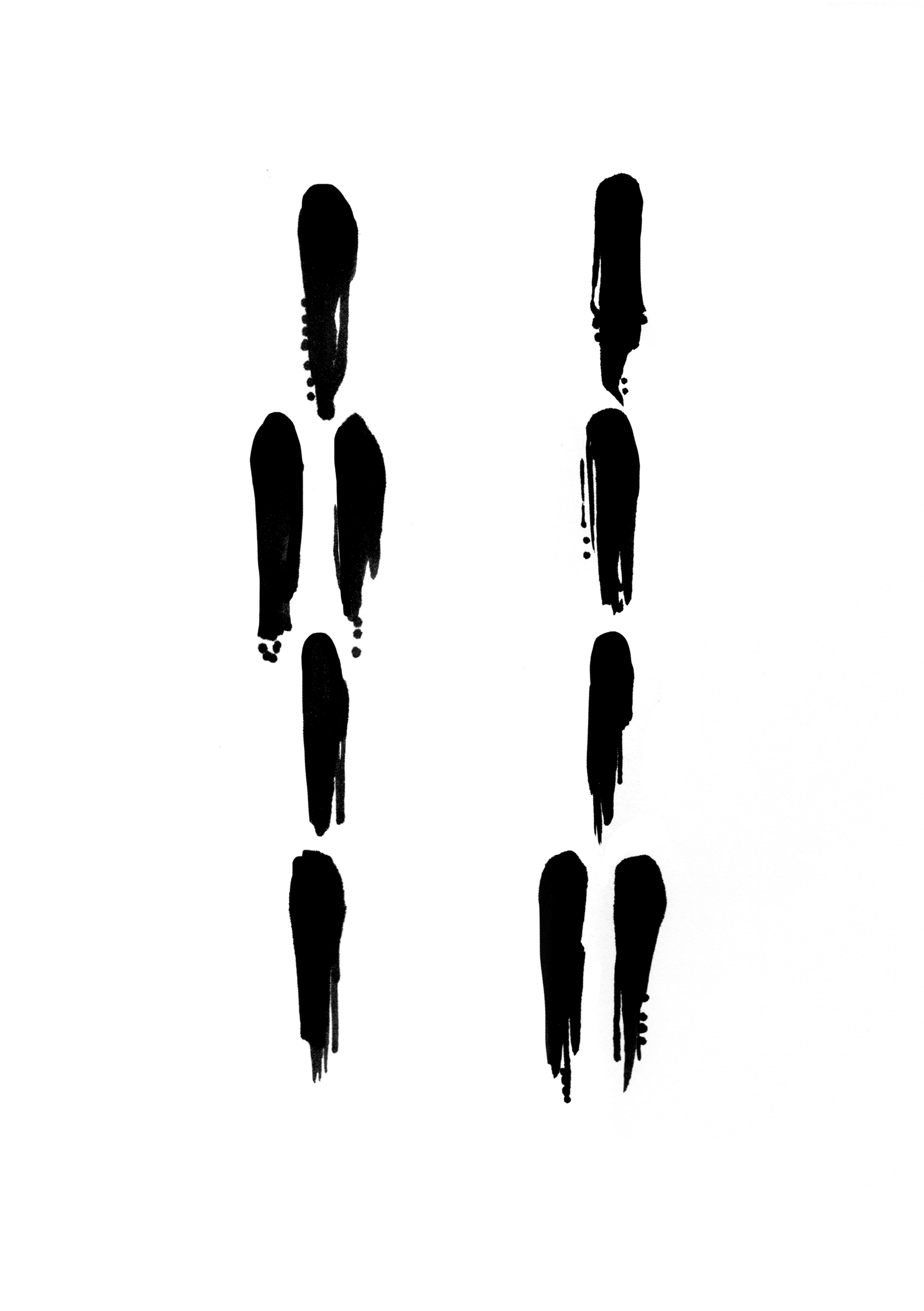
This Academy reads the right column first, then the left. Each row carries a single or double mark.
Where this Odù belongs
Ògúndá Òtúrá belongs to the Ògúndá family in this Academy’s study sequence. It is a mixed Odù, distinct from Òtúrá Ògúndá. The order matters. Its teaching is approached through its own narratives, rather than by adding two general descriptions of the principal signs together.
Key Òrìṣà and sacred relationships
The figures below are selected for their roles in the accounts discussed here. They offer connected reading paths through the tradition.
-
Ọ̀rúnmìlà. He guides the youngest brother’s preparation and is himself vulnerable to despair in the second story. These distinct positions complicate an image of the adviser as invulnerable.
-
Ògún. He is associated with the land and local recognition through which the youngest brother advances. His account also reveals the older brothers’ deaths rather than erasing them.
-
Baba Ẹ̀gún. The older brothers’ dead presences remain connected with the survivor’s role. The motif concerns remembered kinship, not claims about a specific reader’s deceased relatives.
Key myths and their meanings
The youngest travels with preparation
Three learned brothers seek a wider field of knowledge. The first two depart confidently and are lost. The youngest, aware of his limits, consults and prepares before leaving. In the new land he gains recognition, learns what happened to his brothers, and carries their memory within the position he eventually holds.
The youngest’s willingness to ask matters more than his initial rank in knowledge. Yet his success does not justify presenting the others’ deaths as deserved. The ending connects advancement with remembrance instead of allowing the survivor to claim a wholly individual achievement. Ritual particulars are unnecessary for discussing preparation, limits, and inherited responsibility.
Narrative setting: Cuban/Lukumí patakín in a multilingual source compilation; no individual narrator is established.
The birds interrupt the closed horizon
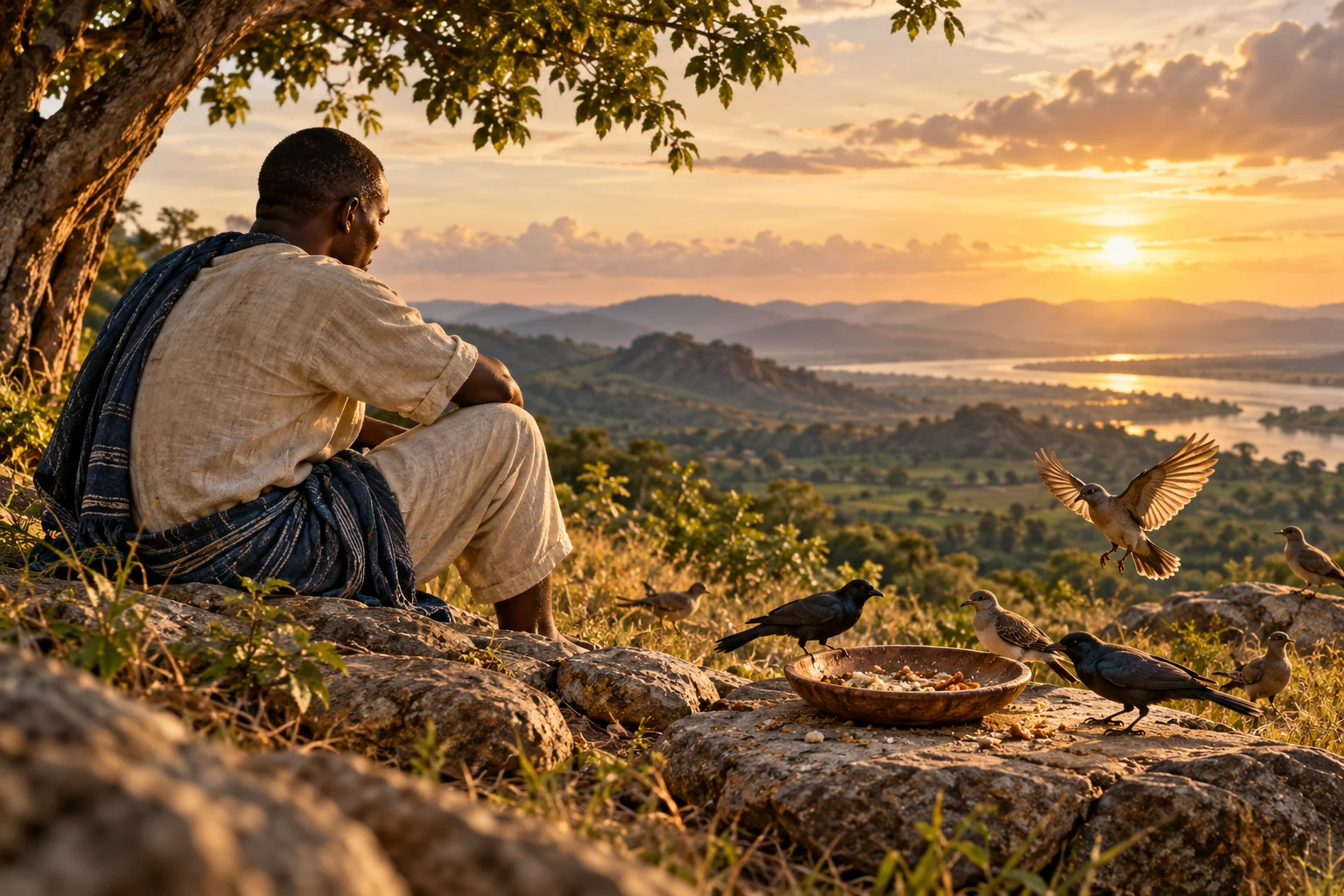
Orunmila reaches a point of extreme despair amid financial hardship and withdraws to a hill. Birds approach the remains of his meal and call his attention outward. The encounter interrupts his suicidal intention, and he leaves. The narrative later identifies a continuing relationship between him and those birds and gives the story a hopeful turn.
A small encounter can interrupt a moment that feels final, but the source’s comparison with creatures in greater need should not become a demand that a distressed person feel grateful. Nor is later fortune a dependable explanation of recovery. The usable motif is a pause that reopens connection and time, with the sufferer’s dignity and need for support kept central.
Narrative setting: Cuban/Lukumí patakín in a multilingual source compilation; no individual narrator is established.
Afuma arrives carried above the competing trees
Forest plants compete over leadership and receive counsel before presenting themselves to divine authority. Only Afuma, rendered as a parasitic plant, undertakes the advised response. Esu then gives it a condition that prevents walking. Afuma declines companions’ invitations, considering itself unable to compete with tall trees. Iroko carries it toward the gathering, and its conspicuous position is read as the distinguishing sign. Divine authority declares it chief and explains its continuing place above other plants. The story is a sacred etiology of growth through another’s support, not a biological origin, a botanical identification, or an explanation of actual disability.
The result reverses the relation between apparent weakness and public height. Afuma does not rise through independent strength; the position by which it is recognized depends on Iroko’s carrying. Within the witness, Esu’s action and the prior commitment are effective in creating that circumstance. A contemporary account of being lifted by others can be useful, but should not erase the divine agency or make bodily impairment a spiritual advantage in general. The earlier youngest brother also knows his limits and prepares, while his later recognition remains connected to his lost siblings.
The despair episode gives an ordinary bird encounter a very different kind of interruption. These comparisons make assistance particular: carrying a contender, preparing a journey, remembering kin, and reopening a moment of time are not one mechanism. The story also leaves Iroko’s continuing position less explored than Afuma’s royal outcome. A strong study can notice that asymmetry without inventing an unrecorded protest or portraying every dependence as exploitation.
Narrative witness and setting: Translated excerpt in the multilingual compilation’s expressly attributed Cromwell Osamaro sequence, with Yoruba/Bini-facing material. The compilation’s language is not evidence of a Brazilian tradition.
The two mothers answer harm in the same currency
Two bird mothers share a home and each has a child. One leaves a child in the other’s care while traveling. Hunger leads the caregiver and its own young to sell the entrusted child into servitude for food. On return, the first mother conceals anger and the friendship continues. When the other later travels, it leaves its own child and receives the same harm in return. The resulting cries become the witness’s account of the birds’ calls. The narrative gives a cycle of injury and retaliation, without restoring the children or giving them a speaking place in the settlement.
The first mother’s quiet response is not reconciliation; it becomes delayed replication of the injury. That distinction matters because the story’s outward continuation could otherwise look like forgiveness. The second sale also does not repair the first child’s loss. The witness ends with voiced accusation and reminder, turning continuing sound into a record of a relation that has not been healed. A contemporary interpretation can examine retaliation without endorsing the appended rule that children should never be left with others.
The sacred archive supplies one extreme account, not evidence against every form of trusted care. Comparison with the earlier brothers makes remembered kinship a contrasting continuation, while Afuma shows support that changes status without the same betrayal. The birds in the despair episode should also remain different participants, not a universal symbol of compassion. Religious and animal personhood allow these varied roles; flattening them into one fixed meaning would erase the exact harm and unresolved ending.
Narrative witness and setting: Translated excerpt in the multilingual compilation’s expressly attributed Cromwell Osamaro sequence, with Yoruba/Bini-facing material. The compilation’s language is not evidence of a Brazilian tradition.
What was born in this Odù
“Born” can name an explicit traditional origin association or what emerges through a story: a capacity, relationship, practice or order of life. Interpretations drawn from a narrative are labelled below, so their basis remains clear.
Religious weariness
Selected traditional source association.
The list explicitly names weariness in religious life. This can contextualize strained commitment or exhaustion without turning spiritual doubt into failure or using the sign to diagnose depression.
Shango guarding a sacred crown
Selected traditional source association.
The source assigns Shango a custodial relation to a sacred crown. The selected brothers’ narrative resonates with entrusted position, but does not independently tell the crown’s story.
A bird of exceptional beauty
Selected traditional source association.
A named bird appears in the origin-association list. It is distinct from the pigeons in the despair narrative; the study does not merge them to create a single symbolic species.
Correlations to life dimensions
These questions bring the selected stories into contemporary life. They are interpretive invitations for study.
Work and resources
The youngest prepares because he knows less, not because he possesses superior status. An honest account of limits can improve the conditions of learning.
Reflect: What help would you seek if you did not need to appear ready already?
Relationships and family
The survivor keeps his brothers present in his later role. Advancement can include grief and responsibility rather than replacing the family’s losses.
Reflect: Whose unfinished hope accompanies your present opportunity?
Character and inner life
Orunmila’s vulnerability allows the adviser to be someone who also needs interruption and care. Expertise does not remove a person’s ordinary human limits.
Reflect: Who supports the person others always ask for help?
Community and responsibility
The birds create an opening beyond an isolated moment. Communities can make such openings more available through dependable attention, without claiming a guaranteed outcome.
Reflect: What form of contact could make room for another day?
A deeper reading of the sacred relationships
Sacred preparation can act through another’s support
Afuma’s commitment and Esu’s intervention lead to a position made possible by Iroko’s carrying. The earlier youngest brother likewise prepares within a relation to Ifa and later keeps kin present in his role. These are religious accounts of agency that do not equate efficacy with isolated force. A contemporary reflection on receiving support can follow, but should not replace the divine condition with a mere confidence lesson. The despair episode also supplies a different opening through encounter, while the child-care narrative lacks a comparable completed repair. Explaining these differences preserves sacred reality without turning every impairment, loss, or dependency into a sign of a predetermined beneficial result.
A relation can continue outwardly after trust is gone
The bird mothers remain associated after the first injury, yet the later retaliation shows that the relation has changed beneath its surface. The earlier three brothers share an aim but follow different preparations, while Afuma’s place in the company is transformed by being carried. These are distinct continuities, not proof that every bond is unreliable. A contemporary study can ask what an unchanged outward arrangement actually contains: remembered support, unspoken grievance, unequal assistance, or shared purpose. The religious narratives retain their particular agents and events. The reader should not be asked to infer a hidden betrayal merely because a relationship has remained quiet or a visible structure has not changed.
The helper and the dependent need separate attention
Afuma’s prominence can obscure Iroko’s carrying, while the two sold children become instruments in their mothers’ injury and retaliation. The youngest brother’s recognition preserves the older brothers’ memory, and the birds interrupting Orunmila’s despair are encountered as living presences rather than tools he commands. These comparisons support a contemporary inquiry into who remains visible in a favorable or dramatic result. The source does not give every participant equal narrative space, and an editor should not invent their feelings. It can still identify the asymmetry as a real limit. Sacred and animal agency are made more exact when a single protagonist does not absorb everyone else’s contribution or loss.
Questions that deepen the study
Does Afuma’s result say that disability is a divine strategy for greatness?
The narrative gives one plant a particular sacredly caused condition leading to a carried arrival. That etiology does not establish why actual people have disabilities or what outcome they must expect. A spiritually grounded study can explain Esu’s agency and the role of preparation while explicitly limiting the human analogy. The important relationship is that public height depends on Iroko’s support, not only Afuma’s desire. A contemporary reader may consider the dignity of receiving help and the need to recognize the helper. Neither reflection requires treating a bodily condition as evidence of special merit, fault, or a promised future office.
Why is the first mother’s quietness not proof of forgiveness?
The later action reveals that the earlier injury has been retained as the basis for retaliation. The story does not narrate an apology, restoration of the child, or an agreed resolution before the friendship continues outwardly. A contemporary analysis can therefore distinguish calm appearance from repaired trust without assuming every quiet person harbors revenge. The second sale repeats the harm rather than making the first child safe. Within the witness, the resulting calls preserve that unresolved relation as an animal etiology. The account is not a universal assessment of caregivers and should not be used to condemn ordinary mutual childcare.
How do these darker bird roles relate to the birds in the despair account?
They demonstrate why an animal should not be assigned one fixed moral meaning across a sign’s materials. In one episode, birds draw attention outward and interrupt a dangerous moment. In another, mothers and offspring inhabit a cycle of hunger, betrayal, and retaliation. These are distinct agents and sequences, not contradictions that require one to be hidden. A reference study can preserve their personhood and religious setting while drawing different contemporary questions from each. It should neither treat every bird as a guaranteed helper nor make the betrayal negate the hopeful encounter. The exact relation, not the category alone, gives the event its meaning.
What the four narratives reveal together
The added witness deepens Ogunda Otura through the difference between receiving support and perpetuating injury. Afuma’s carried arrival becomes a sacredly recognized position, while two bird mothers preserve an outward bond that later reproduces harm. The earlier prepared brother and interrupted despair offer different forms of connection and continuity. Religious agency remains active, particularly Esu’s role and the relation to Ifa, while contemporary analysis can attend to helpers, dependents, and unhealed trust.
The four stories do not make weakness a guarantee of greatness or quietness a guarantee of reconciliation. They also do not give every bird one symbolic role. Their depth lies in describing what each relation actually carries forward: kinship, a public position, another day, or an injury that no retaliatory repetition can restore. Those differences should remain visible beside the spiritual explanations, not replaced by universal promises or suspicion.
Living with this Odù
A continuing life or initiatory relationship
For someone whose received life or initiatory sign is Ògúndá Òtúrá, receiving support can change a situation without making the supported person self-sufficient or morally superior. The youngest brother prepares while acknowledging limits, and Afuma's public height depends on Iroko's carrying. Across changing positions, these narratives can develop attention to the people and sacred agencies present within recognition. Advancement need not erase loss or rewrite a history as solitary achievement.
The two bird accounts make interruption and continuity very different. One encounter opens time during Orunmila's extreme despair; the mothers' outward friendship continues while retaliation replaces trust. Long-term character can include recognizing that quiet is not necessarily forgiveness and that returning harm does not restore the children whose agency the narrative omits. The sign does not diagnose distress, promise rescue through birds or demand gratitude as a cure. Nor does it prescribe mistrust of all shared care. Within the attributed witness, Esu's action and sacred preparation remain effective without making impairment a general advantage. The received sign offers specific questions about support, remembered kinship and unresolved harm rather than a uniform destiny of survival, betrayal or public elevation.
A particular consultation and its question
A consultation yielding Ògúndá Òtúrá can help distinguish assistance that reopens a possibility from an apparent continuation that conceals unaddressed injury. The bird encounter interrupts a closed horizon, while the mothers repeat a harm without restoring either child. These structures should not be merged into one meaning of birds or friendship. A practitioner needs the actual concern before deciding what kind of connection has changed.
The brothers and Afuma add different relations to limits. Preparation supports a journey, and a carried contender becomes publicly distinguished through another's contribution. Their sacred agencies remain real within the witnesses, without explaining actual disability or promising that suffering leads to office. The older brothers' deaths also cannot become deserved failure. Consultation can ask who carries, who remembers and what support the present situation makes available. It cannot infer suicidal intention in an unknown reader or substitute later prosperity for care in present distress. A result for one question does not make the person permanently a survivor, betrayed caregiver or overlooked contender. Its interpretation should preserve the specific external condition and the difference between a pause, an elevated status and a relationship still without repair.
Constructive and adverse possibilities
Constructive relations may let a person receive help without erasing its source, sustain preparation through acknowledged limits and preserve memory within a changed role. The youngest brother's recognition remains linked with kin, while Afuma's position depends on Iroko and the witness's sacred action. A small encounter can also create time without guaranteeing a future outcome.
Adverse unfolding could include treating outward association as restored trust, using a dependent child to answer another's injury or letting public elevation absorb the helper's contribution. Retaliation does not return the first child, and the despair episode cannot make support conditional on comparison with creatures in greater need. These contrasts do not assign ìrè or òṣogbo to an actual reading. They ask what the relation now contains and whose loss or assistance an apparently favorable continuation still needs to acknowledge.
An illustrative situation in everyday life
In a hypothetical community project, a candidate who feels unable to compete accepts another member's practical support and becomes the most visible representative. Afuma's carrying helps distinguish public prominence from independent capacity. The youngest brother adds a responsibility to remember absent contributors rather than turn recognition into a complete story of personal superiority. Later, a quiet working relationship is assumed repaired despite an unspoken grievance; the bird mothers provide a different warning about outward continuity. This illustration does not compare ordinary disappointment with the source's extreme tragedies or promise that support produces status. It asks who made the position possible and whether the relationship beneath its unchanged appearance has actually become more trustworthy.
Sources and reading context
The first two narrative witnesses
These Cuban narratives include suicide-related material, treated without methods, blame, prediction, or a claim that spiritual practice guarantees rescue. The source’s later good fortune is not presented as a mental-health mechanism. Bird names and ancestral motifs are kept distinct.
Narrative motifs are summarized independently. The life-dimension reflections are contemporary interpretation. How these reference studies are built explains the wider source approach and the distinction between a reference article and personal divination.
Additional named witnesses
- Cromwell Osamaro Ibie. The surrounding sequence is expressly attributed to Cromwell Osamaro. These selected episodes are read through the multilingual compilation’s translated renderings; exact edition and original translation chain remain unverified.
Afuma’s plant identity is not fixed botanically, and its impairment is not applied to human disability. The sold children remain losses rather than a justified exchange. The despair account is compared without methods or a promised recovery mechanism, and the caregiver warning is not universalized.
Bibliographic identification
- C. Osamaro Ibie. Ifism: The Complete Work of Orunmila. Lagos; multivolume publication beginning 1986. Library catalogue record. Related bibliographic record for the named narrative witness. Exact volume, edition and page of the transmitted account have not been independently matched.
Read the source method and wider scholarly context.
The catalogue links identify published works and their authors. They are separate from proof of an individual episode’s wording or attribution. Contemporary comparisons and the synthesis above are editorial interpretation. The author’s books and Academy companions below provide further study; their sales links are separate from the source references.