
Òtúrá Ìròsùn is a mixed Odù in Ifá’s 256-part corpus. In the selected Òtúrá Ìrosùn material, an exchange of humiliation between Owl and Rooster stands beside Yewá’s journey for beautiful materials. Both stories concern being seen, but in different ways: the first turns an audience into an instrument of retaliation, while the second makes appearance draw a figure into a landscape from which her former life cannot return. The source’s association with indiscriminate goodness provides a counterpoint to both competitive display and revenge.
A question to carry through the study: When your dignity feels injured, what response preserves it without recruiting an audience against someone else?
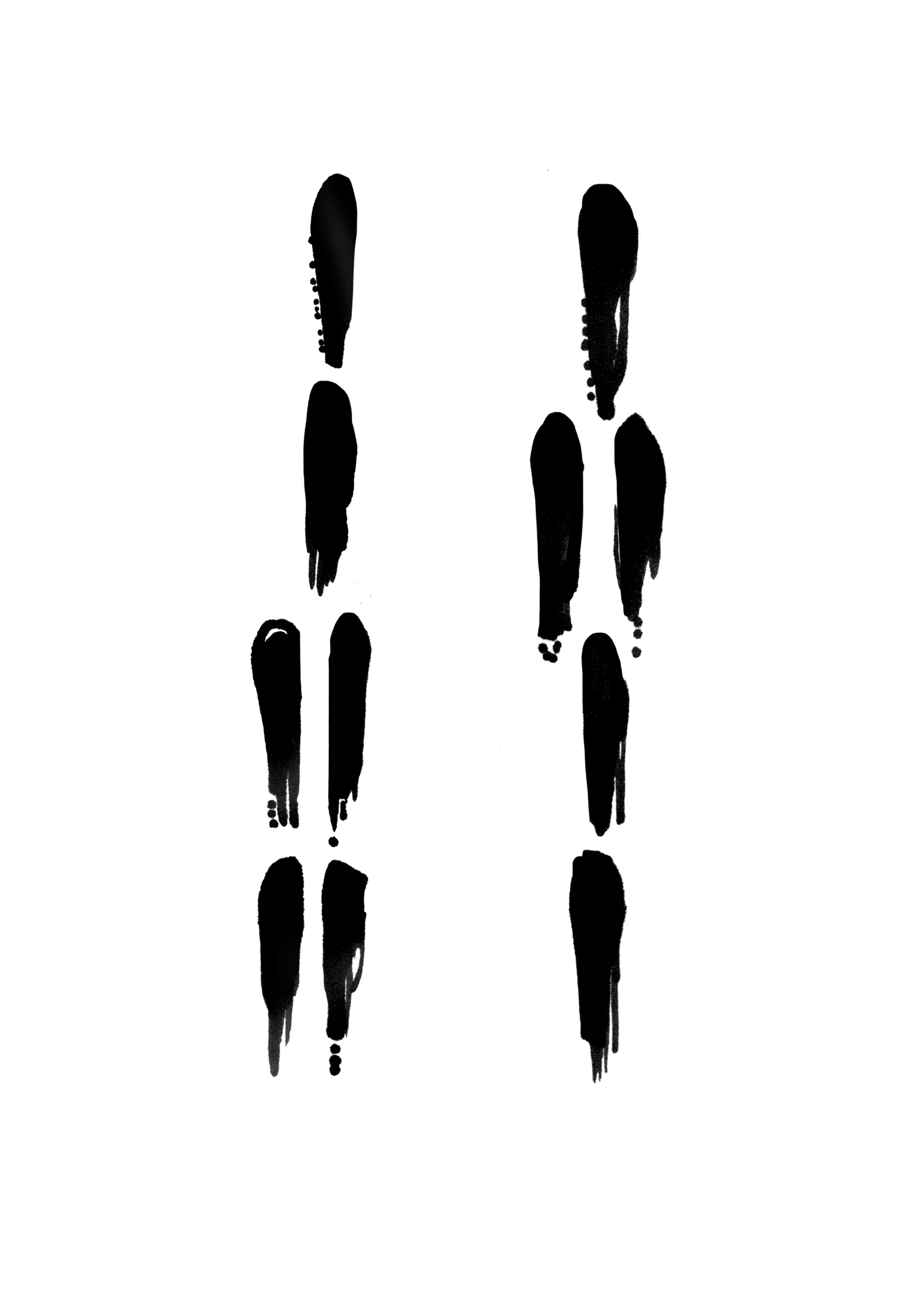
This Academy reads the right column first, then the left. Each row carries a single or double mark.

Where this Odù belongs
Òtúrá Ìròsùn belongs to the Òtúrá family in this Academy’s study sequence. It is a mixed Odù, distinct from Ìròsùn Òtúrá. The order matters. Its teaching is approached through its own narratives, rather than by adding two general descriptions of the principal signs together.
Key Òrìṣà and sacred relationships
The figures below are selected for their roles in the accounts discussed here. They offer connected reading paths through the tradition.
-
Ọ̀rúnmìlà. Ọ̀rúnmìlà advises Rooster after public embarrassment and warns Yewá before her forest journey; these different interventions place counsel within conflicts about appearance and exposure.
-
Yewá. Yewá seeks materials for distinctive adornment, becomes lost in the forest, and returns only as spirit; the episode explains a transformed relationship to landscape and presence.
Key myths and their meanings
A ballroom turns into a tribunal
Owl’s deceptive movement makes Rooster fall during a crowded dance, turning him into a spectacle. He seeks counsel and arranges a second encounter that lasts until daylight, when Owl becomes vulnerable. The audience then laughs at her distress. The source’s following comment explicitly warns against humiliating others, making the repeated public reversal central rather than leaving the ending as uncomplicated revenge.
The community watches two injuries and treats each as entertainment. That audience gives retaliation its force. The story can therefore be read beyond the rivalry itself: spectators help reproduce humiliation by rewarding whoever controls the scene. The source’s final caution complicates the counselor’s tactical advice, leaving a productive tension between obtaining satisfaction and ending the pattern of shame.
Narrative setting: Cuban compilation, Owl and Rooster episode.
Adornments sought beyond the familiar landscape
Yewá takes pleasure in elaborate dress made from colored and woven materials. She consults before collecting what she needs in the forest, but leaves without the preparation she has been advised to make. She becomes lost and cannot return. Her sisters search unsuccessfully until a later intervention allows her presence to be recovered in a different condition: what returns is a spirit rather than her earlier embodied life.
The landscape matters: a figure situated between river and sea enters the forest for materials that make her appearance distinctive. The narrative binds beauty to movement across boundaries and to irreversible transformation. It should not become a prohibition on women’s independence or adornment. The sisters’ search also keeps relationship visible after loss, even though it cannot restore exactly what existed before.
Narrative setting: Cuban compilation, Yewá episode situated between river and sea.
The invited diviner is stripped of royal-looking authority
Idereluma is an accomplished diviner whose crown and bead ornaments resemble royal regalia. A ruler invites him while intending to end that display of parallel authority. Consultation warns of danger, but the visitor relies on his own ability to manage circumstances. At the palace, a royal wife supplies his needs and draws him into an intimate relationship arranged by the ruler. His ornaments are removed and delivered to the host. The plot then disables his ability to respond, leaving him without sight or regalia. The account uses this episode to explain a change in the public styling of diviners.
The source presents more than an individual lapse of judgment. The invitation itself is organized around a ruler’s determination to remove a rival form of visible authority. Hospitality becomes the means of gaining access, and the wife participates within instructions whose terms the visitor does not know. His confidence matters to the religious lesson, but it does not make the host’s deception or violence disappear. Crown and beads also signify recognized office in the account, so their loss is institutional as well as personal.
Compared with Owl and Rooster’s public reversals, the machinery of humiliation here is controlled by a ruler rather than a shared audience. Compared with Yewá’s pursuit of adornment, the ornaments are not newly sought but already established signs of standing. A contemporary reading can examine the vulnerability of an invited expert without turning bodily injury into a deserved lesson or presenting every offered intimacy as a trap.
Narrative witness and setting: Portuguese African narrative in the section explicitly credited to Cromwell Osamaro.
Star’s marriage makes Moon’s recognition the difficult question
Star prepares to marry Moon and receives counsel about being overshadowed within the union. Star declines the proposed sacred exchange. Moon separately consults for honor and dignity and accepts the preparation prescribed. After marriage, recognition among heaven’s and earth’s inhabitants gathers around Moon rather than Star. The account explains their different degrees of public significance through that prior divergence. Its following interpretation cautions against resenting a spouse’s greater prosperity and also against arrogance on the more celebrated side. The episode therefore joins a cosmic origin explanation to a household question about how unequal recognition may be inhabited.
The marriage does not create equal visibility, and the source does not simply demand that Moon become dimmer so Star can feel important. Its accompanying reflection allows a spouse’s greater prosperity to benefit the household while asking both parties to avoid destructive reactions. This is a different resolution from the retaliatory symmetry of Owl and Rooster: their humiliations alternate, whereas Star and Moon must inhabit an asymmetry that remains. The religious explanation locates Moon’s standing in sacred preparation, not merely superior ambition or social skill.
An editor should preserve that causation without presenting the narrative as astronomy or a fixed prediction about gender. The transmitted pronouns fluctuate, which makes a confident reconstruction of every gendered detail inappropriate. The clearer analytical issue concerns whether another person’s recognition is experienced as shared good, personal erasure or a license to dominate. None of those reactions is settled simply by identifying who shines more brightly.
Narrative witness and setting: Portuguese African narrative explicitly credited to Cromwell Osamaro.
What was born in this Odù
“Born” can name an explicit traditional origin association or what emerges through a story: a capacity, relationship, practice or order of life. Interpretations drawn from a narrative are labelled below, so their basis remains clear.
Goodness without selecting the recipient
Selected traditional source association.
The origin list associates this sign with doing good without first sorting people by worthiness. This offers a specific ethical counterpoint to public rivalry; the association can be summarized without reproducing the source’s proverbial wording.
Plural marital households
Selected traditional source association.
The origin list names polygamy and Muslim harems. These are the compilation’s associations, not a reliable history of Islam or a universal marriage instruction. They warrant contextual caution rather than an assumption that all families in the sign share one form.
The covering of Osun’s cup
Selected traditional source association.
A named ritual object appears in the origin list. Its significance can be limited to protection, enclosure and custodianship as interpretive possibilities; this small entry does not justify identifying Osun the staff with Ọ̀ṣun the river deity.
Correlations to life dimensions
These questions bring the selected stories into contemporary life. They are interpretive invitations for study.
Relationships and family
Rooster’s reaction is organized around restoring standing before the same kind of audience that witnessed the insult. Yewá’s sisters, by contrast, respond to disappearance through a search. The difference helps distinguish support from participation in somebody’s revenge.
Reflect: Are your supporters helping repair harm or helping stage a reversal?
Character and inner life
The desire to be seen beautifully and the desire to stop being seen shamefully both organize behavior. These stories allow attention to appearance without reducing it to vanity, while asking what happens when external recognition begins directing every next step.
Reflect: What part of your self-respect can remain independent of the audience?
Community and responsibility
The ballroom audience changes allegiance as vulnerability changes. Its laughter never becomes ethical judgment. The source’s warning against humiliation can inform a concrete community responsibility: refusing to make another person’s exposure into careless communal entertainment.
Reflect: What response could interrupt humiliation without creating another spectacle?
Work and resources
Yewá’s search for materials shows that making something beautiful depends on a journey, not merely a final object. We can attend to the knowledge and preparation required by that journey, avoiding the assumption that desire alone guarantees safe access to resources.
Reflect: What preparation does the process require beyond knowing what you want to obtain?
A deeper reading of the sacred relationships
Visible distinction belongs to a sacred order of recognition
Idereluma’s crown and beads carry the standing of an accomplished religious office, which the ruler treats as a threat to his own distinction. Consultation can disclose that hidden danger before ordinary hospitality reveals it. Moon’s honor has a different sacred foundation: the accepted exchange makes a desired standing effective across heaven and earth. These are not merely accessories and reputation management. Within the accounts, divination and sacred preparation mediate recognition in a world inhabited by agencies beyond the human court. Yewá’s transformed presence adds another register, where her ornaments and landscape crossing culminate in a spiritual mode of return. Contemporary questions about display should follow these differences rather than erase them.
Four different audiences make four different vulnerabilities
The ballroom audience rewards whichever bird controls the moment of exposure. The royal household is organized to enact a ruler’s concealed intention. Moon’s audience spans the inhabitants of heaven and earth, so recognition becomes cosmological rather than limited to one gathering. Yewá’s sisters provide another kind of witnessing: they search for someone whose absence matters rather than judging a public performance. These differences prevent public opinion from becoming an undifferentiated force in the study. A contemporary reading can ask whether observers are entertaining themselves, enforcing a hierarchy, acknowledging sacred distinction or sustaining a relationship. The answer changes what dignity and repair could mean within each episode.
Adornment is not one moral category
Yewá makes a distinctive appearance from materials sought in a particular landscape. Idereluma wears regalia that communicates a professional and religious standing already achieved. Moon’s radiance is narrated through recognized honor rather than worn objects, while Owl’s beauty becomes vulnerable to the conditions of a public dance. These are different relations between appearance and identity. A generic warning against vanity would discard the evidence that adornment can be craft, office, sacred distinction or social performance. The more exact question is what a visible sign claims and who may challenge that claim. The stories do not authorize treating beauty as deceit or imagining that every loss of ornament reveals a person’s true worth.
Questions that deepen the study
Does the Idereluma account explain the assault as an innocent consequence?
No. The ruler’s purpose precedes the visitor’s arrival, and the wife’s assigned role includes obtaining access to the regalia. The plot therefore contains intention, deception and an effort to prevent resistance. The source’s religious warning concerns a danger disclosed through consultation and the diviner’s misplaced confidence, but that does not cancel the responsibility of those arranging harm. A contemporary interpretation can keep both levels visible: sacred forewarning has efficacy within the narrative, while an account of the assault must still identify its agents. It should neither reproduce graphic methods nor make blindness a symbol of moral inferiority.
What does Moon’s greater recognition ask of the marriage?
The source’s own accompanying reflection does not require reducing the more prosperous spouse to restore symmetry. It asks the less celebrated partner not to turn the household’s increase into resentment, while also cautioning the celebrated one against overbearing pride. Within the story, the inequality has a sacred explanation through different responses to consultation. A contemporary reading can distinguish that explanation from the practical question of how partners share standing and resources. The episode permits a relationship to contain unequal visibility; it does not establish that one partner’s voice, safety or decision-making should become correspondingly smaller.
How should the cosmic account be related to the earlier humiliation story?
Both concern unequal visibility, but they organize it differently. Rooster’s humiliation is answered by arranging Owl’s exposure before another laughing audience. Star and Moon do not exchange positions in that way; the narrative leaves Moon’s prominence intact and addresses how the union responds. That distinction matters because repair is not always a reversal that makes the other person suffer equally. The religious grounds also differ: Moon’s honor is connected to sacred preparation, while the ballroom story focuses on a tactical encounter and its warning against shame. Their comparison supports precise interpretation without claiming they teach the same social mechanism.
What the four narratives reveal together
The new African-attributed episodes deepen the earlier Cuban concern with appearance by distinguishing sacred office, royal rivalry and cosmic recognition. Idereluma’s regalia is targeted because it communicates authority; its removal cannot be reduced to a lesson against attractive objects. Moon’s prominence, by contrast, is established through sacred preparation and remains an asymmetry the marriage must inhabit. Owl and Rooster turn exposure into reciprocal humiliation, while Yewá’s adornment draws her across a landscape boundary into transformed presence.
Together the accounts show that being seen can mean being admired, challenged, endangered or recognized in a sacred order. Those meanings should remain separate. A reference article can explain divination’s power to reveal conditions and sacred exchange’s role in recognition, then make contemporary questions about dignity and unequal visibility explicit as interpretations rather than the sole reality of the myths.
Living with this Odù
A continuing life or initiatory relationship
For someone whose received life or initiatory Odù is Òtúrá Ìrosùn, visibility can become a continuing question about relation rather than a verdict on worth. Owl and Rooster obtain alternating public satisfaction, while the spectators keep humiliation useful as entertainment. Star and Moon offer a different challenge: unequal recognition persists within a relationship rather than being corrected through symmetrical reversal. Across a life, a person may need to distinguish wanting acknowledgment from needing another person diminished. Yewá's pursuit of materials and Idereluma's established regalia introduce different forms of exposure at a boundary.
One seeks adornment beyond a familiar landscape; the other enters hospitality designed to attack an already recognized office. These narratives do not predict loss, bodily harm or a jealous spouse for a bearer. Their religious conditions remain particular: Yewá's changed return and Moon's sacred preparation are not modern explanations of travel or astronomy. Contemporary inner development can examine how admiration, shame and confidence influence participation while keeping deception and unequal power visible. The long term question is how to inhabit standing truthfully, including receiving another's prominence without erasure and refusing to let a public image conceal the conditions under which one is being approached.
A particular consultation and its question
A consultation yielding Òtúrá Ìrosùn can distinguish several problems that look like wounded recognition. Is someone being humiliated by a public audience, as in the dance rivalry? Is an invited specialist entering an arrangement whose host controls undisclosed terms? Or does a close relationship contain an enduring difference in visibility that neither retaliation nor artificial equality will resolve? The actual question decides which narrative helps. A practitioner should not tell every client to be less vain: Idereluma faces an organized attack, and Yewá's pleasure in dress does not make independence culpable.
The stories also preserve religious agency beyond ordinary caution, including a transformed return and differentiated responses to sacred counsel. Useful inquiry can ask who controls the occasion, who benefits from spectacle and what evidence supports trust in hospitality. Another's greater recognition may be shared good, personal erasure or a license to dominate; the sign does not settle which without context. Receiving it in consultation is not identical with a lifelong affiliation or a prediction of bodily injury. Its reflective value is to separate rivalry, exploitation, irreversible change and relational asymmetry rather than gathering them under one generic warning about appearances.
Constructive and adverse possibilities
Constructive movement may involve declining to make another's humiliation the price of one's relief, honoring a partner's recognition without surrendering dignity and investigating the terms of an invitation before relying on personal skill. Adverse movement includes spectators rewarding cruelty, confidence overlooking a hostile arrangement or prominence becoming permission to dominate. The narratives do not make the injured party responsible for another's violence. Moon's religious preparation remains part of the cosmic witness, while fluctuating pronouns prevent a fixed gender doctrine. Yewá's spirit return is a local account whose irreversible difference should not be erased by an easy message of resilience.
Actual iré or òṣogbo depends on the consultation. A beneficial shift for one participant can still leave the pattern of humiliation intact, as the dance reversals show. The useful distinction is between recovering standing and changing the relations that made injury socially rewarding in the first place.
An illustrative situation in everyday life
Imagine a hypothetical professional invited to an award event by an institution threatened by their independent influence. A partner already enjoys greater public recognition, making the invitation emotionally charged. Online spectators encourage a dramatic response to an earlier insult. The narratives separate three external relations: possible exploitation through hospitality, unequal but potentially supportive recognition at home and an audience that profits from retaliation. The professional's wish to prove worth may make the invitation harder to examine, yet that inner pressure does not excuse any host's deception. This is a modern illustrative interpretation, not a prediction of the stories' bodily outcomes. A measured choice would assess the actual terms, discuss visibility with the partner and avoid letting spectators determine what counts as restored dignity.
Sources and reading context
The first two narrative witnesses
The Cuban compilation supplies the narratives and origin entries. Muslim terminology in its list is not treated as independent historical evidence. Yewá’s return as spirit remains a local religious account, not a prediction about travel; the Osun object is kept distinct from the river deity Ọ̀ṣun.
Narrative motifs are summarized independently. The life-dimension reflections are contemporary interpretation. How these reference studies are built explains the wider source approach and the distinction between a reference article and personal divination.
Additional named witnesses
- Cromwell Osamaro. The credited African section contains Idereluma’s court visit and the Star–Moon marriage account.
The Portuguese transmission has unstable pronouns and several unclear phrases. The Star–Moon account is not astronomical history or a fixed gender doctrine. The Idereluma episode includes sexual manipulation and violence, summarized without operational detail. The earlier Cuban narratives remain separate witnesses rather than being attributed to the named African source.
Bibliographic identification
- C. Osamaro Ibie. Ifism: The Complete Work of Orunmila. Lagos; multivolume publication beginning 1986. Library catalogue record. Related bibliographic record for the named narrative witness. Exact volume, edition and page of the transmitted account have not been independently matched.
Read the source method and wider scholarly context.
The catalogue links identify published works and their authors. They are separate from proof of an individual episode’s wording or attribution. Contemporary comparisons and the synthesis above are editorial interpretation. The author’s books and Academy companions below provide further study; their sales links are separate from the source references.