
Òtúrá Òsá is a mixed Odù in Ifá’s 256-part corpus. The selected Òtúrá Ọ̀sá stories turn on forms of protection that the visible hierarchy overlooks. A passing cat saves the exhausted Obatalá and receives an enduring blessing. A threatened Awó escapes pursuit by appearing in the regalia of a forgotten king, with ancestral presence magnifying the disguise. These episodes contrast unsolicited care with authority regained through spectacle, keeping open the ethical difference between service, protection and intimidation.
A question to carry through the study: What quiet act of protection deserves recognition before a more dramatic display takes the credit?

This Academy reads the right column first, then the left. Each row carries a single or double mark.
Where this Odù belongs
Òtúrá Òsá belongs to the Òtúrá family in this Academy’s study sequence. It is a mixed Odù, distinct from Òsá Òtúrá. The order matters. Its teaching is approached through its own narratives, rather than by adding two general descriptions of the principal signs together.
Key Òrìṣà and sacred relationships
The figures below are selected for their roles in the accounts discussed here. They offer connected reading paths through the tradition.
-
Obàtálá. Obatalá is unexpectedly vulnerable while resting; after the cat prevents an attack, he recognizes that service with a blessing that explains the animal’s enduring reputation in the tale.
-
Èṣù. Eleguá warns Oguelade about the danger of arrest, giving him time to consult and act; the closing account credits his assistance in the restoration of the Awó’s position.
-
Baba Ẹ̀gún. The dead king’s regalia and the appearance of accompanying ancestors transform the pursuers’ understanding of Oguelade; ancestral presence becomes the decisive image of authority in the escape.
-
Ṣàngó. The narrative’s final attribution includes Ṣàngó in Oguelade’s restoration, although its preserved action is narrated mainly through Eleguá’s warning and ancestral spectacle; this role should remain proportionate.
Key myths and their meanings
The exhausted traveler and the passing cat
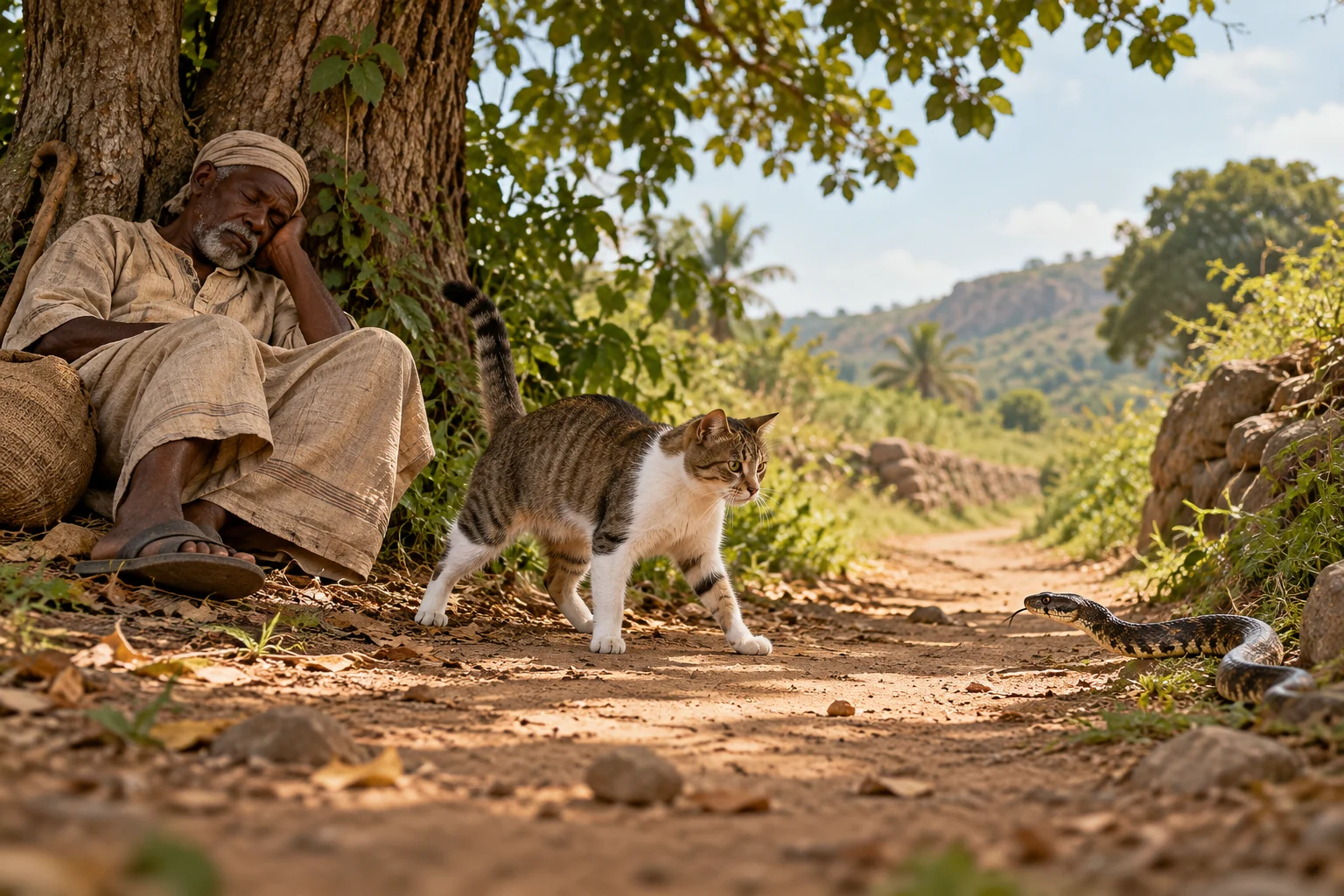
Obatalá falls asleep after a long day of visiting his children. A snake approaches while he is defenseless, and a passing cat intervenes in a prolonged fight. Obatalá wakes in time to recognize what has happened and blesses the animal. The story then explains the familiar image of a cat recovering its footing through this act of protection and the grateful acknowledgment that follows it.
The source makes a revered figure dependent, for a moment, on an apparently ordinary creature. Protection comes before a request or promise of reward. That sequence supports gratitude without turning care into a transaction. The explanation belongs to folklore; it must not be repeated as a factual claim that cats cannot be hurt by falls or as permission to test an animal’s resilience.
Narrative setting: Cuban compilation, cat and Obatalá origin episode.
The forgotten king’s regalia interrupts pursuit
Oguelade combines hunting power and commerce while neglecting his religious responsibilities. Hostile birds administer justice and prepare to arrest him. Warned by Eleguá, he enters the cemetery while they wait outside. He discovers the lost tomb of a former ruler, takes its crown and red cloak and emerges in the king’s appearance. The pursuers believe the ruler has returned, flee from the accompanying ancestral spectacle and leave him able to reclaim authority.
The story does not establish whether the threatened arrest was just; calling the pursuers enemies cannot settle that question. Its distinctive mechanism is the political force of memory and regalia. A neglected ruler becomes effective through the signs of a dead predecessor. We can examine who is recognized as authoritative while avoiding an uncomplicated celebration of disguise as innocence or rightful rule.
Narrative setting: Cuban compilation, Sinokuru Obá episode.
A delegated offering changes whose future is being prepared
Hawk and Hen both seek descendants through consultation. Hawk can assemble the full preparation, while Hen has fewer resources. Busy with other concerns, Hawk entrusts her materials to Hen for delivery. Hen presents the larger preparation as her own and the smaller one in Hawk’s name. The resulting sacred response follows those assignments, and Hen’s brood exceeds Hawk’s. Hawk later learns what happened, but the account does not reverse the outcome. Instead, she begins taking Hen’s young to feed her own. The narrative explains an enduring antagonism through substituted participation and a retaliatory relation between the sisters.
The account makes agency in sacred work more exact than a general opposition between belief and disbelief. Hawk has gathered what was requested; her loss comes through another person’s false attribution, not refusal to participate. Hen’s initial shortage also makes the betrayal intelligible without making it harmless. The religious logic assigns efficacy to the preparation actually presented under each name. It does not treat an intended contribution as automatically equivalent to a completed relation. The following source gloss emphasizes personal responsibility, but a reference should keep the intermediary’s deliberate conduct visible rather than blaming delegation alone.
The retaliation then spreads harm to the next generation, so the end cannot simply be called restored fairness. Compared with the earlier cat’s unsolicited protection, the entrusted helper uses access against its owner. Compared with the Awó’s borrowed royal regalia, a changed outward assignment has real consequences for who receives recognition and benefit within the narrative.
Narrative witness and setting: Portuguese African narrative in the section explicitly credited to Cromwell Osamaro.
The absent son learns succession by caring for his father
Awodi travels as a diviner and is often absent from his father’s household. A guardian’s dream sends him home, where practical care restores the old man’s surroundings. Recognizing his eldest son, the father privately transmits knowledge needed for a dangerous succession seclusion, then dies. Two younger sons enter without that knowledge and do not survive. A heavenly sign calls Awodi back. He insists on honoring his father before entering, changes the conditions surrounding the seclusion and protects its privacy. After the appointed interval, he emerges alive and is installed as successor and leader among the divinities.
The decisive inheritance is knowledge received through an encounter of care. Awodi’s absence had made others underestimate his place, but his return gives the father an opportunity to recognize and instruct him directly. The source also makes heavenly guidance active: a dream and a bird-borne sign call him at different moments. Succession therefore depends on spiritual communication, filial obligation and guarded instruction, not seniority alone. The brothers’ deaths do not establish that they were less worthy as people; they expose the danger of entering an office without its specific knowledge.
A contemporary reading can ask about unequal access to preparation while preserving the sacred restriction around the conclave. This differs from the earlier cemetery escape, where a threatened Awó uses a predecessor’s regalia to become recognizable. Awodi’s legitimacy includes surviving a particular ordeal and completing obligations to his father, so the shared crown imagery should not make the two claims of authority identical.
Narrative witness and setting: Portuguese African narrative credited to Cromwell Osamaro; the father is explicitly identified with Orisa-Nla-Oshereigbo at the conclusion.
What was born in this Odù
“Born” can name an explicit traditional origin association or what emerges through a story: a capacity, relationship, practice or order of life. Interpretations drawn from a narrative are labelled below, so their basis remains clear.
The edge of the knife
Selected traditional source association.
The origin list names the knife’s edge. Its limited symbolic relevance here is precision and the boundary at which a tool becomes capable of cutting; the selected narratives do not support turning that object into a broad doctrine of conflict.
Ògún and Saint Peter association
Selected traditional source association.
The source explicitly locates a syncretic association of Ògún and Saint Peter in this sign. This is a Cuban compilation claim about religious correspondence, not evidence that the figures are identical or paired in every Afro-Atlantic tradition.
Monastic consecration
Selected traditional source association.
The list includes the consecration of nuns. It can be identified as a Christian institutional reference present in the compilation, while avoiding speculative etymology, invented historical chronology or a universal description of women’s religious vocation.
Correlations to life dimensions
These questions bring the selected stories into contemporary life. They are interpretive invitations for study.
Community and responsibility
The cat’s service is recognized only because Obatalá sees the end of the struggle. The episode supports making quiet protective work visible, especially when it occurs before formal roles or rewards exist. Recognition strengthens the relationship without making care dependent on prior payment.
Reflect: Who prevents problems that your community usually notices only when prevention fails?
Character and inner life
Oguelade’s escape works through an appearance interpreted by others. This raises a concrete distinction between the authority of one’s actual conduct and authority borrowed from an office, image or predecessor. The tale leaves that distinction ethically unsettled.
Reflect: What part of your credibility depends on signs that belong to someone else?
Work and resources
Oguelade’s commerce and neglect of obligations coexist before the crisis. The story invites examination of success that consumes attention until important commitments become invisible. It does not establish that business itself is irreligious or that a legal accusation is automatically unjust.
Reflect: Which commitment receives attention only when trouble threatens your work?
Relationships and family
Obatalá’s fatigue follows visiting his children, making vulnerability compatible with a role associated with care and authority. The image permits attention to the caregiver’s need for protection and the dignity of accepting help from an unexpected source.
Reflect: What support could you accept without needing to remain the capable one?
A deeper reading of the sacred relationships
Sacred participation has a bearer, not just a quantity
Hawk’s materials do not remain spiritually assigned to her merely because she collected them. The account makes the name and person under which they are presented consequential to the response received. Awodi’s inheritance likewise cannot be reduced to possessions available in a house: particular knowledge passes through recognition by the father and is activated within a restricted succession relation. The earlier cat receives ashé after an act of protection, while the cemetery king’s regalia makes another kind of ancestral authority present. Across these witnesses, objects and actions work within specific relations. A contemporary theory of ownership or procedural fairness may add questions, but cannot replace the religious account of who bears an effective exchange.
Care and custodianship create very different access
The cat’s intervention occurs before any request for reward. Hen receives access through an explicit trust and misuses it. Awodi’s practical attention opens a private conversation that others cannot reproduce merely by entering the same room. The cemetery Awó encounters a predecessor’s materials while seeking refuge, rather than through an entrusted task. These differences prevent every helpful figure from being treated as the same kind of intermediary. A contemporary reading should identify whether access arose through spontaneous care, delegation, inheritance or discovery before judging what obligations follow. The source stories also show that effective assistance can coexist with severe consequences, making the relationship’s terms more important than a simple label of helper.
A crown can be borrowed, inherited or contested through absence
The cemetery episode makes regalia effective because pursuers recognize a lost ruler’s appearance. Awodi’s story makes recognition initially fail: his younger brothers barely know him after a long absence. His eventual installation depends on returning, receiving instruction and completing an ordeal. Hawk and Hen offer a smaller-scale parallel in which the absent principal loses control over how a contribution is attributed. These cases distinguish physical absence from the loss of a legitimate relation. They also show why a visible sign cannot alone settle the history behind it. A reference may compare succession and recognition, while leaving the sacred grounds of Awodi’s office distinct from a tactical disguise used to escape pursuit.
Questions that deepen the study
Did Hawk fail because she refused the sacred preparation?
No. She assembled the fuller preparation and asked Hen to deliver it. The intermediary’s reassignment is the decisive act, and the response follows what was presented under each name. The source later emphasizes doing one’s own work, but an accurate synopsis should not erase the betrayal that makes the warning concrete. Within the religious logic, intention and completed participation are related but not interchangeable. A contemporary interpretation can ask how delegation is verified without declaring all intermediaries untrustworthy. The ensuing predation also remains a tragic continuation of the breach, not evidence that retaliation has repaired its original cause.
What makes Awodi’s care spiritually significant?
The dream directs his return, but he must still clean the father’s surroundings, provide warmth and identify himself. That practical care creates the occasion for recognition and a private transmission of knowledge. The father’s teaching then becomes effective within the succession ordeal, while a later heavenly sign calls the son back at the necessary time. The account therefore joins ordinary service and spiritual communication rather than opposing them. A contemporary reflection can value attentive caregiving, but should preserve the stronger religious claim: the encounter mediates a particular inheritance and office that general kindness alone would not automatically supply.
Why should the two royal-regalia stories remain separate?
The earlier Awó escapes through a dead king’s crown and cloak, which make pursuers perceive a returning ruler. Awodi becomes successor after filial recognition, guarded instruction and survival of an instituted seclusion. One story centers a tactical use of ancestral appearance during pursuit; the other centers transmission and installation. Both give material signs real force, but their grounds differ. A reference should not use the shared crown to claim one universal theory of legitimate kingship. The distinction also makes room for contemporary questions about the difference between being recognized as an officeholder and entering the relationship through which that office is inherited.
What the four narratives reveal together
The new African-attributed accounts deepen the earlier Cuban images of protection and regalia by asking who actually bears a sacred relation. Hawk’s intended preparation is reassigned through betrayal, and its efficacy follows that altered presentation. Awodi’s inheritance becomes available through care, recognition and guarded knowledge, supported by spiritual messages that call him home. The earlier cat receives power through unsolicited protection, while the cemetery Awó becomes recognizable through a predecessor’s appearance.
These are different routes by which action, object and authority meet. A careful reference can explain their religious efficacy without treating every successful outcome as the same kind of legitimacy. Contemporary questions about delegated trust, access to knowledge and retaliation should then be marked as further interpretations. The witnesses leave no single rule that physical presence guarantees care, absence cancels belonging or a crown alone establishes the history of an office.
Living with this Odù
A continuing life or initiatory relationship
For a person whose received life or initiatory Odù is Òtúrá Ọ̀sá, help and recognition can become questions about the relations beneath visible authority. The cat protects an exhausted Obatalá before any reward is promised, revealing a moment when a revered figure depends on an ordinary creature. Hen, by contrast, uses entrusted access to alter whose contribution is presented. The difference is not simply between receiving help and doing everything alone; it concerns whether another person's agency is preserved. Awodi's return through care makes guarded inheritance available, while the cemetery escape gains effectiveness through a predecessor's regalia without establishing the justice of the original pursuit.
Across a life, these accounts can prompt examination of gratitude, delegation and the difference between recognized appearance and legitimate responsibility. They do not predict theft, succession or unusual protection for a bearer. Dreams, heavenly signs, sacred preparation and ancestral spectacle remain operative within the respective religious witnesses. Contemporary inner development asks whether pride prevents receiving help, whether distance has interrupted a needed encounter and whether one's authority depends on something borrowed or actually learned. It should also keep the suffering of Hen's young and Awodi's brothers visible rather than treating an eventual leader's success as a complete moral resolution.
A particular consultation and its question
A consultation yielding Òtúrá Ọ̀sá can distinguish trust betrayed from responsibility simply neglected. Hawk assembles the requested preparation; Hen's false attribution changes its presentation. Blaming delegation alone would erase the intermediary's deliberate act. Awodi's succession presents a different knowledge problem, where direct care permits a father to transmit information unavailable to other candidates. The cat's unsolicited protection adds help that should be recognized without being reduced to a transaction. The regalia episode, meanwhile, asks whether recognition of authority has been produced by appearance and memory rather than an established account of innocence.
The actual question determines which relation matters. A practitioner can examine what was entrusted, what was learned directly and what evidence supports a claim to restored standing. These inquiries do not identify real betrayers, justify evasion or predict animal safety. Sacred communication remains distinct from ordinary verification, including the dream and bird borne sign in Awodi's account. Receiving the sign once does not establish lifelong identity. Its situational value lies in separating gratitude, attribution, guarded preparation and borrowed appearance while refusing to make every fortunate escape proof of justice or every unsuccessful successor less worthy as a person.
Constructive and adverse possibilities
Constructive possibilities include gratitude for unrequested care, direct attention that makes transmission possible and truthful attribution of another's contribution. Adverse possibilities include substituted participation, retaliatory harm spreading to dependents and authority secured through appearances whose legitimacy remains uncertain. Hawk's response does not restore fairness simply because her injury is real; Hen's young bear the continuing cost. Awodi's brothers lack specific preparation, but their deaths should not become a hierarchy of human worth. Actual iré or òṣogbo depends on the consultation rather than the cat's blessing or a crown's appearance.
Divine guidance and sacred efficacy remain part of the stories, not guarantees about an unknown reader. Contemporary interpretation can ask whether support is acknowledged and whether a successful principal leaves others exposed. It should preserve the unresolved justice of the cemetery pursuit and the different foundations of the two crown related accounts instead of blending them into one theory of rightful rule.
An illustrative situation in everyday life
In a hypothetical family organization, an absent senior member returns to care for an aging founder and receives crucial instruction about succession. Another member has previously reassigned submitted work to their own name, creating mistrust that now threatens the next generation. A modest employee quietly prevented a serious loss, while a claimant publicly borrows the founder's symbols to appear authorized. The narratives separate care based transmission, deliberate misattribution, unsolicited protection and recognition through regalia. The returning person's resentment may be understandable, but retaliating against dependents would extend the injury. This example is contemporary interpretation, not evidence of a ritual outcome or a prediction about family succession. Its focus is what actually grounds authority and how gratitude can be expressed without making support an excuse for ownership.
Sources and reading context
The first two narrative witnesses
The selected material is Cuban and contains Christian correspondences in its origin list. Cat resilience is folklore rather than animal-safety advice. The Sinokuru account leaves the justice of the pursuit unclear; regalia and ancestral power are reported as narrative mechanisms, without endorsing evasion or treating restoration as proof of innocence.
Narrative motifs are summarized independently. The life-dimension reflections are contemporary interpretation. How these reference studies are built explains the wider source approach and the distinction between a reference article and personal divination.
Additional named witnesses
- Cromwell Osamaro. The credited African section contains the Hawk–Hen substitution and Awodi’s return, filial instruction and succession ordeal.
The transmission names the younger sons Ugun and Akala; Ugun is not silently identified with Ògún. Funeral stages and some objects are unclear in Portuguese, so no procedural reconstruction is supplied. The father’s divine identification is explicit only at the conclusion. Neither avian reproduction nor the ordeal is presented as science or personal prognosis.
Bibliographic identification
- C. Osamaro Ibie. Ifism: The Complete Work of Orunmila. Lagos; multivolume publication beginning 1986. Library catalogue record. Related bibliographic record for the named narrative witness. Exact volume, edition and page of the transmitted account have not been independently matched.
Read the source method and wider scholarly context.
The catalogue links identify published works and their authors. They are separate from proof of an individual episode’s wording or attribution. Contemporary comparisons and the synthesis above are editorial interpretation. The author’s books and Academy companions below provide further study; their sales links are separate from the source references.