
Òyèkú Òtúrúpòn is a mixed Odù in Ifá’s 256-part corpus. The war-of-the-pots narrative imagines communities trapped in contests for power until intervention and a frightening misunderstanding bring a cessation. Another follows a starving man promised relief who steals on the return journey and loses what he carries. These stories invite a careful examination of collective exhaustion and constrained choices, while resisting the compilation’s hostile generalizations about Congo-derived practices and its medical explanations of conflict.
A question to carry through the study: Which immediate pressure makes it hardest to protect a longer-term opportunity?

This Academy reads the right column first, then the left. Each row carries a single or double mark.
Where this Odù belongs
Òyèkú Òtúrúpòn belongs to the Òyèkú family in this Academy’s study sequence. It is a mixed Odù, distinct from Òtúrúpòn Òyèkú. The order matters. Its teaching is approached through its own narratives, rather than by adding two general descriptions of the principal signs together.
Key Òrìṣà and sacred relationships
The figures below are selected for their roles in the accounts discussed here. They offer connected reading paths through the tradition.
-
Òsanyìn. He serves as an emissary seeking an end to the conflict and later carries away a companion after a cry at the doorway is mistaken for a spirit’s voice.
-
Ṣàngó. He is named as the proposed governor in the peace intervention, linking an end to the struggle with a new allocation of political authority.
-
Ọ̀rúnmìlà. He counsels the emissary and the impoverished man, giving the two episodes a shared setting of seeking direction before a difficult course of action.
Key myths and their meanings
A cry at the doorway ends a war
The source describes neighboring groups consumed by struggles for power. An emissary associated with Osanyin seeks counsel, and several Orishas attempt to halt the fighting. Later, a companion hidden at a dark doorway cries out when stepped on. Those inside mistake the sound for a spirit and agree to stop the struggle. A misunderstood event accomplishes what repeated warnings had not.
The resolution is strikingly unstable: peace follows fear and misrecognition, not a fully explained agreement about power. That leaves open how durable the settlement can be. The source uses stereotyped Congo/Yebu contrasts and connects warfare with epidemic imagery; a careful reading identifies those as the narrator’s framing rather than endorsing claims about actual traditions or causes of disease.
Narrative setting: Cuban/Lukumí-labeled patakín in the multilingual source compilation; individual narrator and publication history are not established.
The promised provision left behind
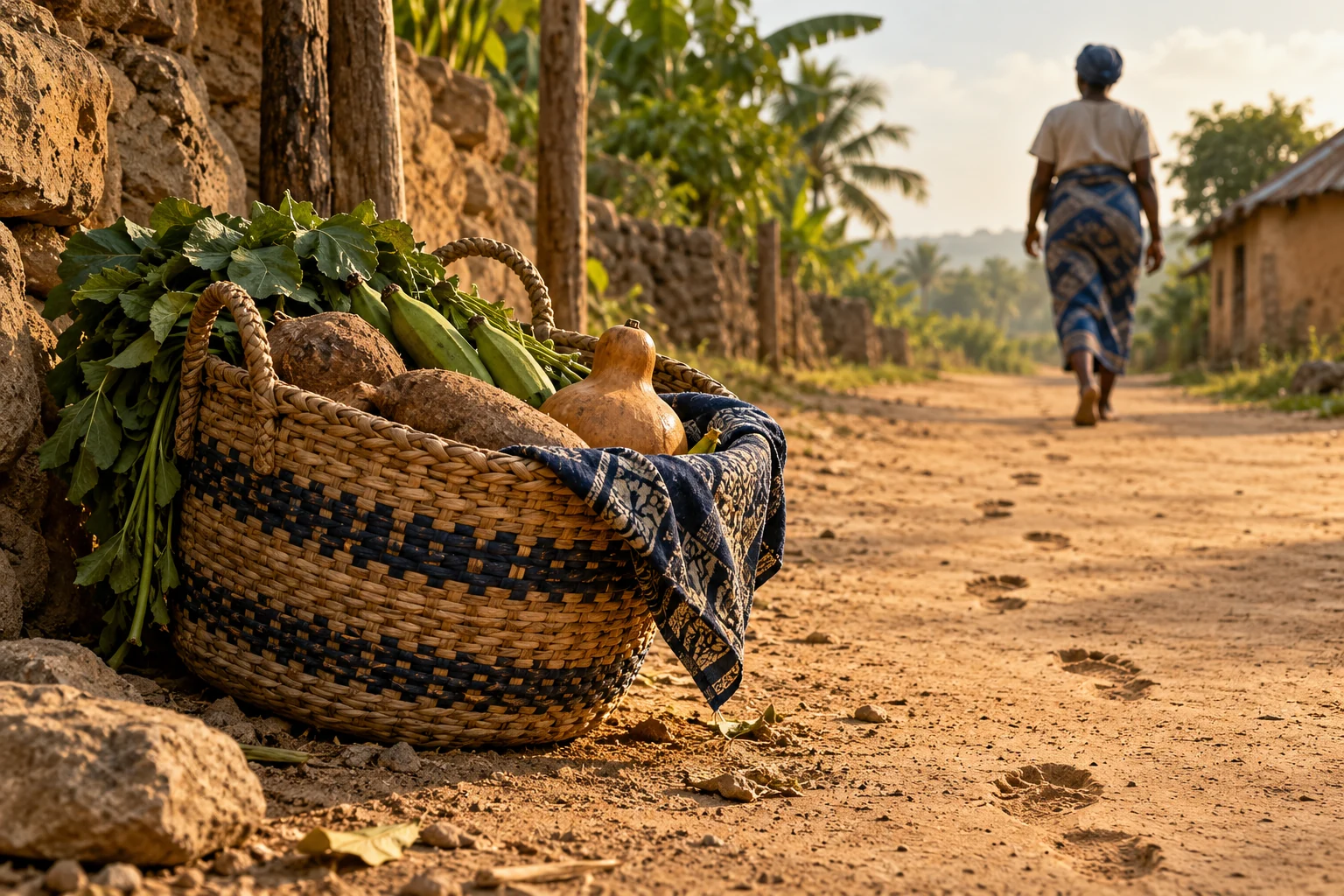
Olofin announces assistance for those in need under a condition concerning blame and penalty. A particularly hungry man first seeks Orunmila’s counsel and is told to go directly after receiving what is assigned. Returning, hunger leads him to steal from a house. Pursuit forces him to abandon the basket and lose the hoped-for relief, placing immediate need against a fragile opportunity.
The story can be read beyond a simple rebuke of theft: deprivation is already shaping the person’s choices before the final act. Its condition of being free from blame also deserves scrutiny when aid is directed to people under pressure. We can hold responsibility and scarcity together, without claiming that poverty reflects spiritual failure or that one mistake justifies loss of support.
Narrative setting: Cuban/Lukumí-labeled patakín in the multilingual source compilation; individual narrator and publication history are not established.
The creator appoints a witness capable of repair
Orunmila alone observes the creator at work while the other divinities are expected to keep their eyes closed. When discovered, he tries to close his own eyes, but the creator tells him to look. The act is then made authoritative: Orunmila becomes a witness to creation and receives responsibility to repair created beings. The passage explains a title through this appointment and accompanies it with praise. It is a compact theological scene rather than a long conflict narrative. Its central change is from unauthorized looking to an acknowledged witness whose knowledge is entrusted for a continuing purpose within the created world.
The scene relates knowledge to responsibility, not merely privileged access. Seeing the creative act could have remained an illicit advantage, but the creator’s command turns the witness’s position into a duty of repair. This gives Orunmila’s authority a specific theological basis: he knows what has been made because he has been allowed to see, and his continuing work is answerable to that origin. A depth study should explain the account from within its religious world rather than reduce the creator to an institution or witnessing to modern expertise.
Contemporary interpretation can still ask what obligation follows exceptional knowledge, while distinguishing that reflection from a universal claim about every form of witnessing. The source’s statement about repairing creatures is not a medical license or proof of clinical efficacy. Its brevity also limits reconstruction: the text does not describe every creature, a detailed sequence of creation, or a complete hierarchy of all divinities, so those should not be added to make the episode appear larger.
Narrative witness and setting: Section explicitly headed revelations of Cromwell Osamaro; Yoruba/Bini-framed creation account.
The scarce offering becomes a negotiation between worlds
A practitioner cannot obtain two materials required for a religious response and promises Eshu a further acknowledgment if they can be found. He discovers them in the forest and meets messengers seeking the same things for a crisis in Orisa-Nla’s household. Eshu has made the heavenly supply unavailable, creating the encounter. Under Eshu’s influence the practitioner names an enormous price. The messengers promise delivery, take the materials, and their use resolves the heavenly difficulty within the narrative. Orisa-Nla sends the promised wealth to earth. The practitioner returns to find it and gives Eshu more than the original promise before celebrating with his town.
The exchange is not a neutral market in naturally scarce goods. Eshu has arranged the shortage and then shapes the seller’s terms, making the protagonist’s promise part of an active sacred relation across heaven and earth. This is precisely why the account should not be reduced to a management lesson about seizing demand. Its theological economy permits an earthly need and a heavenly need to meet through a power whose own acknowledgment remains at stake. Contemporary analysis can nevertheless ask about coercion and unequal bargaining when one side controls access to what another urgently requires.
The source also lists people among the transferred wealth, a historical hierarchy that should not be accepted as legitimate property. The household crisis remains a religious event, not a treatment claim or a prescription using the named materials. The protagonist’s later excess gift and public feast matter because receiving wealth renews rather than ends his obligation to the relation that made the exchange possible.
Narrative witness and setting: Section explicitly headed revelations of Cromwell Osamaro; Yoruba/Bini-framed account of earthly need and heavenly messengers.
What was born in this Odù
“Born” can name an explicit traditional origin association or what emerges through a story: a capacity, relationship, practice or order of life. Interpretations drawn from a narrative are labelled below, so their basis remains clear.
Cooking on a grill
Selected traditional source association.
The usable nonmedical origin entry associates the sign with cooking on a grill. Preserve the technological image as a local textual attribution, without claiming a documented invention or adding ritual procedures absent from the selected narrative study.
A frightened truce leaves its terms unfinished
Contemporary interpretation from the selected myth.
This contemporary emergence motif comes from the misheard cry that ends the war, not a traditional origin inventory. It identifies the beginning of peace while asking what agreement could sustain it once the frightening misunderstanding has passed.
Correlations to life dimensions
These questions bring the selected stories into contemporary life. They are interpretive invitations for study.
Work and resources
The hungry man’s basket represents a potential improvement that is difficult to protect while immediate deprivation continues. The episode supports examining whether assistance arrives in a form a person can actually retain under their present conditions, alongside the consequences of their choices.
Reflect: Does the opportunity address the immediate obstacle?
Relationships and family
The war story depicts groups whose rivalry overwhelms neighboring communities. Their relationships need more than a momentary interruption if peace is to last. The mistaken cry stops action but supplies little account of how competing interests will subsequently be negotiated.
Reflect: What agreement must follow an interruption of conflict?
Character and inner life
Fear proves more effective than repeated advice in stopping the struggle. That difference invites inquiry into decisions made under alarm and whether they remain stable after the alarm fades. The source does not establish that frightening people is an appropriate contemporary method.
Reflect: Would the decision remain acceptable after the fear passes?
Community and responsibility
Relief is announced with a moral condition, yet the recipient’s hardship is extreme. The story invites a concrete discussion of how communities attach eligibility rules to help and whether those rules account for the pressures that brought people to seek assistance.
Reflect: Whom does the condition of assistance exclude?
A deeper reading of the sacred relationships
Religious knowledge links origin with continuing responsibility
The creation-witness account grounds Orunmila’s repair work in the creator’s explicit appointment. The scarce-materials story gives Eshu a different but equally active role in linking an earthly practitioner with a heavenly household. The older war and relief-basket narratives locate responsibility in communal conflict and a person’s strained journey, not in the same origin scene. A depth treatment can explain these distinct religious relations without replacing them with generic foresight or luck. Witnessing, arranging, consulting, and fulfilling a promise do different work in the accounts. Contemporary reflection on expertise and obligation should follow that theological specificity rather than claiming one universal mechanism behind every successful action.
Scarcity can be produced rather than simply encountered
The hungry basket carrier experiences an immediate need that the narrative presents as already pressing. Eshu’s scarce-materials episode supplies a different case: a power deliberately restricts access elsewhere to make an exchange occur. The war story adds scarcity produced through conflict’s continuing disruption. These distinctions matter because a demand may be shaped by the relation controlling supply, not only by the resource itself. A contemporary interpretation can ask who creates the conditions under which a choice is made, while preserving Eshu’s active sacred purpose in the new story. The account’s favorable outcome does not make every manufactured shortage fair or every urgent buyer an equal party to the bargain.
A promise extends beyond the moment of receiving help
The practitioner promises Eshu acknowledgment before the materials become available, then exceeds that promise after wealth arrives. This continuation contrasts with the basket carrier’s interrupted direction and the war’s peace based on a frightening misunderstanding. The creation scene adds an appointment whose duty continues beyond the original witnessing. Across these accounts, completion is not always a single event. A depth study can ask whether a response sustains the relation that made a benefit possible or treats the benefit as permission to forget it. The comparison should remain concrete: a promised sacred acknowledgment, a journey’s instructions, and an entrusted theological duty are not identical contracts.
Questions that deepen the study
Why is witnessing creation a responsibility rather than only a privilege?
The creator explicitly connects the acknowledged sight with authority to repair. The knowledge therefore has a purpose directed toward created beings, not only the witness’s own status. That theological relationship should be stated directly. Contemporary interpretation may ask what someone owes after receiving exceptional access, but cannot replace the creator’s appointment with a purely professional analogy. Nor does the account supply evidence that a contemporary practice can medically repair every condition. It is a compact religious foundation for Orunmila’s continuing care, and its limits should remain visible rather than being filled with an invented complete creation sequence.
Is the forest exchange an ordinary example of fair market value?
The source makes Eshu arrange the heavenly shortage and influence the price. Its significance lies partly in that active intervention and in the promise the practitioner has made to him. The resulting bargain is therefore religiously structured rather than a neutral measure of supply and demand. Contemporary analysis can question the asymmetry without denying the account’s spiritual reality. It should also distinguish wealth objects from the people the source treats as transferable, keeping that historical hierarchy contextualized. The later feast and enlarged acknowledgment show that the protagonist’s relation continues after payment, rather than reducing sacred obligation to a completed purchase.
What does the new material add to scarcity and the war’s end?
The older stories concern need under pressure and a conflict interrupted through fear. The additions ask where authority to help originates and how the conditions of an exchange may be actively arranged. Together the four distinguish deprivation, manufactured scarcity, entrusted knowledge, and collective disruption. Those are not the same cause with different scenery. Contemporary reflection can ask which condition can be changed and who controls it, while the theological account supplies creator, Eshu, and divinatory relations that cannot be reduced to modern social forces alone. Their endings likewise vary between a lost opportunity, a fragile peace, an enduring duty, and renewed sacred gratitude.
What the four narratives reveal together
The original Cuban war and relief-basket accounts make collective conflict and urgent need tangible. The Osamaro-headed additions extend the inquiry to the origin of responsible knowledge and the sacred arrangement of an exchange between worlds. Orunmila’s witness is appointed to repair, while Eshu makes a practitioner’s promise consequential through an encounter with heavenly messengers. These are active theological relations, not mere metaphors for expertise or markets. Their comparison can still ask who controls scarcity, whose needs shape a bargain, and what obligation continues after a benefit arrives.
The differences prevent one formula of deserved success: the hungry person loses the basket, a war stops through uncertain fear, a witness receives enduring responsibility, and a beneficiary renews gratitude after wealth. A depth study should preserve that range while keeping clinical promises, transferable-person hierarchies, and universal economic conclusions out of the public interpretation.
Living with this Odù
A continuing life or initiatory relationship
For someone whose received life or initiatory Odù is Òyèkú Òtúrúpòn, immediate pressure and longer responsibility may need to be examined together. The hungry traveler’s loss occurs within real deprivation, not an effortless choice between virtue and comfort. The war’s cessation follows fear and misrecognition rather than a fully articulated settlement. Long development can involve asking what makes a fragile opportunity sustainable and what conditions remain unresolved when immediate disturbance stops.
The creation witness adds a religious account of exceptional knowledge entrusted for repair. Seeing is authorized into responsibility, not merely retained as private advantage. The scarce-material exchange then complicates opportunity through Eshu’s active arrangement of shortage and price. Its favorable result cannot be reduced to a neutral lesson about exploiting demand.
A received sign does not explain poverty as spiritual failure or make every truce durable. Orunmila’s appointment by the creator, the earlier communal interventions, and Eshu’s heavenly negotiation retain distinct agency. Across changing circumstances, the person can ask whether they are meeting an urgent need, carrying knowledge for a larger purpose, or benefiting from another’s constrained choice. Each requires a different judgment about means, accountability, and the life that should become possible afterward.
A particular consultation and its question
In consultation, Òyèkú Òtúrúpòn can distinguish an end to visible conflict from a settlement of its terms. The doorway cry stops the struggle through a frightening misunderstanding, leaving durability open. A question about peace may therefore require more than relief that confrontation has ceased. The hungry traveler asks another distinction: what immediate deprivation threatens the person’s ability to preserve an opportunity, and do the conditions of aid acknowledge that pressure?
The creation-witness scene gives knowledge a purpose in repair. It can support inquiry into what responsibility accompanies privileged access without pretending that the short theological statement supplies a complete creation chronology. The scarce offering asks whether an apparently advantageous exchange depends on controlled shortage and urgent need. Eshu’s role is theologically active, not an incidental market condition.
The actual result must locate these motifs within its question. It does not license medical repair claims, endorse the source’s polemical Congo/Yebu contrasts, or offer a recipe for extracting wealth. Consultation may clarify exhaustion, scarcity, entrusted knowledge, or unequal bargaining. It remains a particular encounter rather than a permanent identity as peacemaker, deprived offender, privileged witness, or divinely favored negotiator. Its interpretation should preserve both responsibility and the pressures under which action occurs.
Constructive and adverse possibilities
Constructively, exhausted communities can reach an interval in which another relation becomes possible, and exceptional knowledge can become a continuing duty of repair. A received benefit can renew acknowledgment rather than end it. The narratives’ religious agents change conditions across communal, earthly, and heavenly settings, making responsibility more extensive than immediate private advantage.
Adversely, fear can substitute for an understood agreement, hunger can endanger a longer-term provision, and controlled scarcity can make an exchange favorable through another party’s urgent dependence. The source’s listing of people among transferred wealth also remains an unendorsed hierarchy. These possibilities do not make the sign always adverse or fortunate. Iré and adverse conditions belong to the reading itself. The motifs help distinguish relief from durable settlement, need from a judgment of character, and authorized knowledge from an unlimited entitlement to profit from what another cannot do without.
An illustrative situation in everyday life
Hypothetically, two groups stop a bitter dispute after mistakenly believing that an outside authority has ordered penalties. Everyone is relieved, but nobody has agreed how shared resources will be used. The doorway cry makes cessation distinct from durable settlement. Meanwhile, a participant offered delayed support takes an unauthorized item because food is needed immediately and risks losing the promised help. The relief-basket motif keeps real scarcity within the analysis without making the act consequence-free. The groups can clarify the agreement and provide usable short-term support rather than celebrate quiet while leaving its pressures intact. This hypothetical example concerns unstable peace and constrained choice; it does not endorse ethnic stereotypes, explain disease through conflict, or prescribe a religious response.
Sources and reading context
The first two narrative witnesses
The origin list contains one usable nonmedical motif, supplemented by a labeled contemporary interpretation of the truce. Biomedical and stigmatizing entries are excluded. The war story’s Congo/Yebu contrasts belong to a polemical Cuban compilation voice, not ethnographic fact; epidemic imagery remains narrative framing.
Narrative motifs are summarized independently. The life-dimension reflections are contemporary interpretation. How these reference studies are built explains the wider source approach and the distinction between a reference article and personal divination.
Additional named witnesses
- Cromwell Osamaro. An explicit heading governs the creation-witness statement and the later forest/heavenly-materials negotiation.
The creation scene is brief and does not establish a complete creation chronology. The household crisis is religious narrative, not medical evidence. The source’s people-as-wealth list is contextualized without endorsement, and no material recipe or precise unverified bibliographic citation is reproduced.
Bibliographic identification
- C. Osamaro Ibie. Ifism: The Complete Work of Orunmila. Lagos; multivolume publication beginning 1986. Library catalogue record. Related bibliographic record for the named narrative witness. Exact volume, edition and page of the transmitted account have not been independently matched.
Read the source method and wider scholarly context.
The catalogue links identify published works and their authors. They are separate from proof of an individual episode’s wording or attribution. Contemporary comparisons and the synthesis above are editorial interpretation. The author’s books and Academy companions below provide further study; their sales links are separate from the source references.