
Ìrẹtẹ̀ Òtúrúpòn is a mixed Odù in Ifá’s 256-part corpus. The selected Ìrẹtẹ̀ Òtúrúpòn narratives give form to dependence in different registers. Death cannot resolve the condition of a concealed child alone and seeks the territory of Odùduwà, Ọ̀sányìn and Egún; their cooperation produces embodied life in the account. A proud king dismisses the possibility of bearing a burden until his vulnerability forces him through a low doorway. Both episodes unsettle a position imagined as complete or self-sufficient.
A question to carry through the study: What ordinary limit becomes harder to acknowledge because of the position you hold?
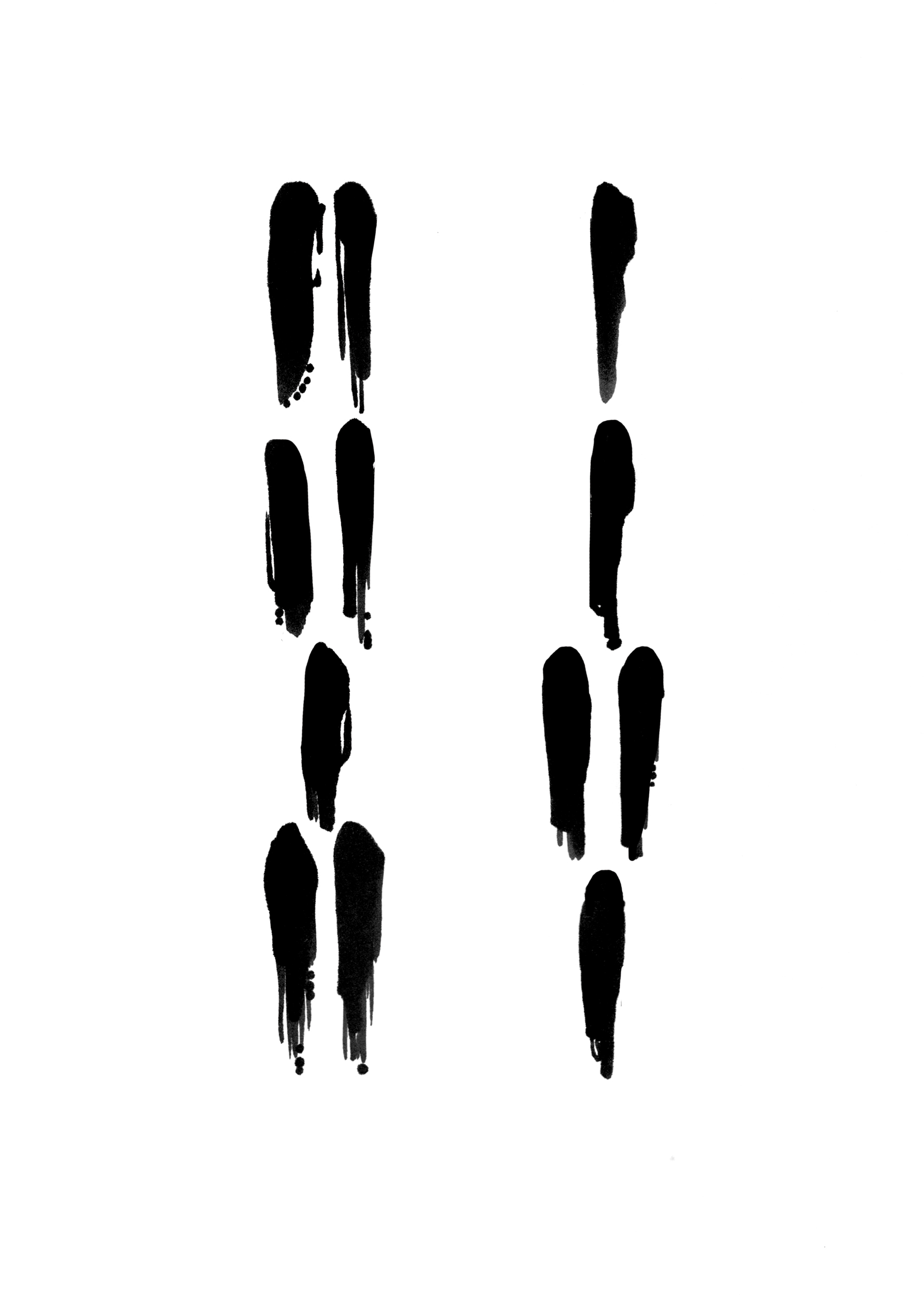
This Academy reads the right column first, then the left. Each row carries a single or double mark.
Where this Odù belongs
Ìrẹtẹ̀ Òtúrúpòn belongs to the Ìrẹtẹ̀ family in this Academy’s study sequence. It is a mixed Odù, distinct from Òtúrúpòn Ìrẹtẹ̀. The order matters. Its teaching is approached through its own narratives, rather than by adding two general descriptions of the principal signs together.
Key Òrìṣà and sacred relationships
The figures below are selected for their roles in the accounts discussed here. They offer connected reading paths through the tradition.
-
Odùdùwà. Odùduwà confronts the theft of his covering, then helps Death’s child gain an embodied condition; his role turns a violated relationship into a negotiated cooperative undertaking.
-
Òsanyìn. Ọ̀sányìn contributes the material transformation of the child and works with Odùduwà and ancestral power to complete the account of embodiment and movement.
-
Baba Ẹ̀gún. Egún witnesses the theft, approaches as wind and eventually enters the child; ancestral presence is integral to the source’s explanation of animated life, not a separate decorative association.
-
Ọ̀rúnmìlà. Ọ̀rúnmìlà warns the king about an unexpected burden and later receives him through a low entrance; the narrative makes the rejected limit physically unavoidable.
Key myths and their meanings
The concealed child receives flesh and movement
Death hides a child whose condition brings him shame and frustration. Seeking another response, he enters Odùduwà’s territory, finds the principal figures absent and takes a dark covering without permission. Egún witnesses the act. A frightening pursuit brings Death back into conversation, and Odùduwà offers help with Ọ̀sányìn. Through their cooperation and ancestral animation, the child gains bodily form and begins moving through the world.
The account makes life arise through a coalition that includes Death rather than through a clean separation from him. It also begins with shame and concealment, which should be described without endorsing the idea that bodily difference is disgraceful. The theft becomes the occasion for negotiation, not an adequate solution in itself. We can focus on asking for help and relationships across apparently opposed powers.
Narrative setting: Cuban compilation, first flesh on bone episode.
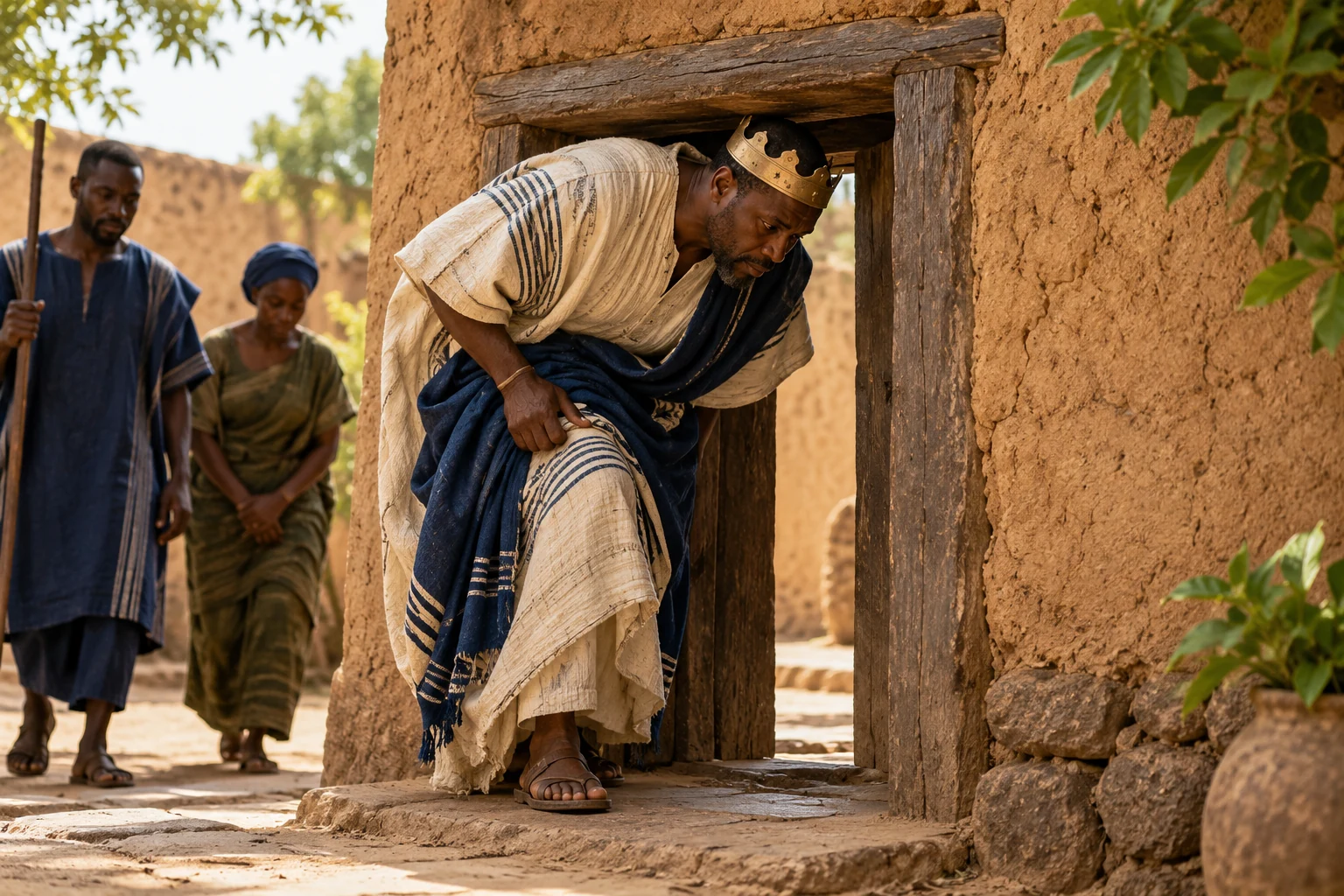
A crown does not remove the need to bow
A king consults out of curiosity and is warned that he may bear a heavy load. He dismisses the idea because only his crown belongs on his head. Later a fishbone leaves him distressed and his attendants seek the same counselor. The king arrives carrying the burden he had denied. A low doorway makes him bend, and the narrative locates his relief in that movement rather than in continued royal exemption from ordinary bodily limits.
The doorway creates an exact reversal of the king’s claim: entering help requires lowering the head that supposedly carries only a crown. The episode can support humility without presenting illness as deserved punishment or reproducing the maneuver as treatment for choking. Its analytical value concerns status, the willingness to receive help and how a concrete constraint can expose a grand self-description.
Narrative setting: Cuban compilation, proud king episode.
A heavenly omission closes the flow of earthly wealth
Before entering the world, the protagonist receives divination concerning several divine relationships, completes exchanges, and obtains the creator's blessing. His first earthly period is successful. Yet an omission in the earlier acknowledgment of Elenini leaves the divinity of obstruction unsatisfied. Elenini closes the flow from which his abundance had come. A new consultation identifies the unresolved obligation. At a crossroads, an encountered man receives the completion of the exchange. The returning protagonist undergoes a further restorative action by diviners. The account then reports expanding family, houses, and material prosperity, connecting renewed abundance to a repaired heavenly relationship.
The sequence makes prosperity relational across heaven and earth. Divine approval does not erase every particular obligation, and an initially favorable life does not establish that the protagonist has completed everything required of him. Elenini is presented as an effective divine agent able to interrupt abundance, rather than simply a name for pessimism or a hostile neighbor. Divination gives the interruption a specific sacred explanation and identifies how the relationship can be repaired. The crossroads encounter matters because repair takes place through an encounter whose significance exceeds an ordinary commercial transaction.
The man's precise identity is not explicitly established in these paragraphs and should remain open. A contemporary interpretive extension could concern the delayed consequences of neglected responsibilities, but that analogy must follow the account's own claim that a heavenly power governs this obstruction. The conclusion describes this protagonist's restored fortunes; it does not provide a general formula guaranteeing wealth to readers.
Narrative witness and setting: Cromwell Osamaro section; an African heavenly-departure narrative in Portuguese transmission.
Iwo and Offa meet after the forest springs withdraw
The ruler of Iwo seeks Orunmila because he has no child. His deceased father appears in a dream and supports the difficult counsel to enter the forest alone. A princess associated with Offa receives corresponding counsel. Esu hides the springs, leaving both travelers searching for three years. A spring eventually brings them together; they become companions and she conceives. Orunmila later recognizes them after questioning their altered appearance. A further sacred exchange precedes restored appearance and return. Their communities recognize them, they become king and queen together, and the meeting spring receives public sacred recognition.
This narrative joins fertility, royal continuity, and a transformation of social identity. The couple must pass through an interval in which clothing, recognizable appearance, and their established places in society fall away. Esu actively arranges the absence and later appearance of water; the forest is therefore an inhabited sacred field, not merely scenery for an accidental romance. The deceased father's dream also makes ancestral authority part of the ruler's decision to follow divination. During the absence, the community's continuing consultations prevent a definitive declaration that its ruler is dead.
Recognition is restored through divination and divine action before the couple reenters royal life. Their child's arrival completes a larger restoration involving their people and the place of encounter. A contemporary reading can consider vulnerability beneath public rank, while retaining the account's stronger religious claim that divine and ancestral agencies reorganize the conditions under which royal descendants can emerge.
Narrative witness and setting: Cromwell Osamaro section; royal forest and childbirth narrative with unstable place labels in translation.
What was born in this Odù
“Born” can name an explicit traditional origin association or what emerges through a story: a capacity, relationship, practice or order of life. Interpretations drawn from a narrative are labelled below, so their basis remains clear.
Flesh first joined to bone
Selected traditional source association.
The formal origin entry and first narrative explain embodiment as flesh joining bone. This is a religious account of animation and material form, not anatomy, embryology or a claim that actual bodies develop through the described process.
Spirit present from birth
Selected traditional source association.
The same formal entry and narrative ending associate human life with spirit from birth and Death’s eventual claim. This is a local theological framing of life and mortality, without predicting anyone’s death or proving a universal doctrine of the soul.
Correlations to life dimensions
These questions bring the selected stories into contemporary life. They are interpretive invitations for study.
Character and inner life
The king’s identity depends on exemption from ordinary burdens. His predicament exposes that claim without erasing his dignity. A grounded interpretation asks whether an office has become a barrier to recognizing need, rather than treating vulnerability as a fall from worth.
Reflect: What need could you acknowledge without abandoning your role?
Relationships and family
Death begins by concealing the child, while transformation requires other figures to become involved. The story can support examining how shame blocks access to care, provided bodily difference is not accepted as an actual reason for shame.
Reflect: What concern becomes easier to address when it is shared with someone capable of helping?
Community and responsibility
The first episode includes theft, confrontation and a changed agreement. Cooperation does not arise because the violation is imaginary; the figures name it and then establish another relation. This permits attention to repair without claiming that every breach should be overlooked.
Reflect: What must be acknowledged before a damaged relationship can become cooperative?
Work and resources
No single figure supplies every part of embodiment in the narrative. The division of contributions makes interdependence specific: form, animation and movement require different roles. This supports identifying which needed contribution cannot be replaced by one’s own expertise.
Reflect: Which part of the work depends on a capacity your position does not provide?
A deeper reading of the sacred relationships
Distinct divine relationships within one destiny
The heavenly-departure narrative distinguishes the creator's blessing from the particular power of Elenini. These are not interchangeable forms of a single favorable feeling. The protagonist can receive broad authorization to enter earthly life while a specific unresolved exchange still obstructs its development. Divination clarifies the difference between permission, responsibility, and the actual arrival of good things. His later consultation does not cancel the first blessing; it discovers a relationship the original preparation left incomplete. This is the selected account's religious logic of sacred exchange. It should not be flattened into a claim that the creator was mistaken or that every delay has one universal supernatural explanation.
Ancestral counsel and the community's suspended succession
The ruler initially questions whether entering the forest is compatible with his rank. His father's dream strengthens the authority of Orunmila's counsel without replacing it. The community then governs through a regent while repeated divination supports the ruler's continued life. These details distinguish the ruler's private longing for a child from the public consequences of his disappearance. His people need a way to sustain government without foreclosing his return. A contemporary political interpretation may examine patience and provisional authority here, but the account explains that patience through knowledge obtained from divination. It does not describe mere optimism or provide a verified chronicle of Iwo's succession institutions.
A spring becomes a place of remembered divine action
Water first withdraws because Esu commands the springs to hide; later its appearance makes the couple's encounter possible. The ruler eventually gives the meeting spring public sacred recognition associated with Osanyin. The account thus moves from hidden water to an acknowledged place that preserves the event for a community. Its significance comes from the narrated relations among divine action, conception, recognition, and kingship. It is not established through an abstract symbolism in which every spring always means fertility. The translation's repeated language of an urn is uncertain, so a precise shrine architecture should not be reconstructed. What remains clear is the conversion of a remembered encounter into public sacred geography.
Questions that deepen the study
Why can the heavenly traveler be blessed and still encounter obstruction?
The story presents a network of divine relationships rather than a single approval that automatically settles every future event. The traveler completes much of his preparation and begins well, but Elenini retains the power associated with an omitted acknowledgment. Later divination identifies that particular unfinished relationship. The restoration follows its repair, so the story does not portray prosperity as an entitlement created by the first blessing. Its force lies in the distinction between a favorable destiny and the responsibilities through which that destiny becomes available. This account should remain a narrative explanation of one protagonist's reversal, without being applied diagnostically to a reader's finances.
Does the ruler's three-year absence mean his people abandon divination?
They continue consulting during the absence. The source says their inquiries repeatedly indicate that their ruler is alive and will return. That knowledge supports the decision to appoint a regent instead of installing a new king. The prolonged search therefore creates a tension between observable absence and divinatory knowledge, which the eventual return resolves within the narrative. It also makes the people participants in the story's sacred order: their form of government responds to the consultations while the couple undergoes transformation elsewhere. The account supplies this narrative reason for suspended succession; it does not independently document historical administrative practice.
Why does restored recognition matter before the child is publicly celebrated?
The desired child is conceived before the couple has regained its public identity. Their transformed appearance leaves even Orunmila initially unable to recognize them. Questioning establishes who they are; divination and Esu's subsequent action precede their return in recognizable form. Only then can conception become part of royal and communal continuity. Their later child-naming celebration involves Orunmila and the wider settlement. The account consequently treats fertility as more than a private biological event: identity, divine relations, public recognition, and community memory must also be restored. Its unusual bodily descriptions belong to a supernatural narrative and should not become judgments about real human appearance.
What the four narratives reveal together
These accounts connect desired abundance with relationships that extend beyond the visible conditions of the present. The heavenly traveler already possesses divine approval, yet an unfinished relationship interrupts the arrival of prosperity. The royal couple already possesses social rank, yet its descendants emerge through a forest interval that dissolves ordinary recognizability. In both, renewed divination reveals what initial success or established position cannot settle. The outcomes are also materially and socially specific: household expansion in one account, a recognized royal family and remembered sacred spring in the other. Elenini, Esu, the creator, ancestors, and diviners have different roles that should remain distinct. Contemporary reflection can explore responsibility and vulnerability, but the research should preserve the narratives' claim that divine relations actually govern the pathways through which goods, identity, and continuity become available.
Living with this Odù
A continuing life or initiatory relationship
For someone whose received life or initiatory Odù is Ìrẹtẹ̀ Òtúrúpòn, support raises a lifelong question about limits concealed beneath rank, shame or success. Death hides a child before help emerges through powers whose cooperation crosses an apparent opposition between life and mortality. The king imagines his crown exempts him from carrying a burden, yet receiving help requires a bodily acknowledgment of limitation. Across changing circumstances, a bearer can ask what self description prevents a need from being spoken and whose capacity has been hidden through another person's shame.
The heavenly omission adds a relationship not erased by general divine blessing, while the royal forest account moves recognized figures through an interval outside familiar appearance and status. These are not predictions of a reader's bodily condition, finances or fertility. Elenini, ancestral dream, Èṣù and the cooperating powers retain their religious agency rather than becoming names for private attitudes. Contemporary inner development can examine whether prosperity is being treated as proof that every obligation is complete and whether support across difference becomes possible when asking replaces concealment. It should not turn the king's relief into medical instruction or the child's changed embodiment into an argument that bodily difference makes anyone less worthy of presence and care.
A particular consultation and its question
In consultation, Ìrẹtẹ̀ Òtúrúpòn can distinguish a denied need, an unresolved particular relation and a difficult interval whose meaning is not yet visible. The king's status claim is interrupted by a concrete constraint; Death's concealed child brings negotiation after an unauthorized taking; the prosperous traveler discovers that broad approval has not settled Elenini's specific acknowledgment. The royal pair's prolonged forest absence is another structure, with sacred and ancestral agencies reorganizing the conditions of encounter rather than a simple delay caused by human indecision. The actual question determines which narrative tension matters.
A practitioner can ask what is unspoken, what remains incomplete and whether a person's recognized appearance is being mistaken for full knowledge of their condition. These inquiries do not identify hidden spiritual debts, explain actual disability or promise descendants. The crossroads man's identity remains unspecified and should not be supplied from a familiar template. Receiving the sign in consultation is different from carrying it as a received life Odù. Its situational contribution is to examine how relations continue across rank, place and changing circumstance while preserving the account's sacred causation and refusing to make restored wealth or appearance the only evidence of a meaningful or dignified outcome.
Constructive and adverse possibilities
Constructive possibilities include asking for help across apparently opposed powers, receiving support without royal exemption and addressing a particular relation that general approval has not replaced. Adverse possibilities include shame driven concealment, denial of ordinary limits or assuming early prosperity proves completion of every obligation. Actual iré or òṣogbo belongs to the reading. The child must not be stigmatized, and the king's distress is not deserved illness. The royal forest account's divine and ancestral interventions are not a guarantee that prolonged absence produces fertility or restored status.
Contemporary interpretation can distinguish a relationship repaired within a narrative from a universal explanation of an interrupted livelihood. It should also retain the unnamed crossroads encounter and unstable place labels without invention. Beneficial change may include a more truthful relation to dependence, not merely return to a former image of strength, rank or bodily conformity that previously kept a need hidden.
An illustrative situation in everyday life
Imagine a hypothetical leader who hides a dependent person's needs because they conflict with the institution's image of strength. Another senior figure refuses routine assistance, insisting their office makes such vulnerability impossible. Meanwhile, a successful project has overlooked a specific prior obligation, and two displaced colleagues develop a working relation outside familiar titles before returning. The narratives distinguish concealment, status based denial, incomplete responsibility and altered recognition. The leader may experience asking for help as loss of standing, yet concealment transfers its cost to someone less powerful. This is an illustrative contemporary interpretation, not medical advice or a claim that a hidden divine obligation explains actual hardship. Its question is what relations become possible once an impressive self description no longer determines which needs may be admitted.
Sources and reading context
The first two narrative witnesses
The Cuban source’s embodiment account is treated as theology and imagery rather than biology. Egún’s wind form remains specific to the passage. The child’s difference is not stigmatized, and the king’s fishbone episode supplies no medical advice or deserved-illness claim. Both born associations are explicit in the source.
Narrative motifs are summarized independently. The life-dimension reflections are contemporary interpretation. How these reference studies are built explains the wider source approach and the distinction between a reference article and personal divination.
Additional named witnesses
- Cromwell Osamaro. The printed heading governs both selected accounts; the Portuguese text transmits an African heavenly-departure narrative and an Iwo/Offa royal narrative, without establishing an independent Brazilian variant.
The heavenly-departure passage contains a visibly broken sentence around the creator's counsel; no medical claim is drawn from it. The encounter man is not named. The royal account shifts Offa/Iwo/Otta labels and uses unstable urn terminology; the princess is associated with Offa from the initial identification. No shrine architecture, biological transformation mechanism, or historical chronology is inferred.
Bibliographic identification
- C. Osamaro Ibie. Ifism: The Complete Work of Orunmila. Lagos; multivolume publication beginning 1986. Library catalogue record. Related bibliographic record for the named narrative witness. Exact volume, edition and page of the transmitted account have not been independently matched.
Read the source method and wider scholarly context.
The catalogue links identify published works and their authors. They are separate from proof of an individual episode’s wording or attribution. Contemporary comparisons and the synthesis above are editorial interpretation. The author’s books and Academy companions below provide further study; their sales links are separate from the source references.