
Òkànràn Ògúndá is a mixed Odù in Ifá’s 256-part corpus. Okanran Ogunda connects a rescue during a rigged confrontation with a coalition that challenges coercive rule. Oya refuses to let a disagreement with Shango excuse his abuse. In the longer political account, an initially unsuccessful intervention requires several allies and a captive woman’s decisive action. The sign’s distinctive concern is the gap between possessing power and using it with accountability, including the uneasy violence inside an ostensibly restorative ending.
A question to carry through the study: What principle would lead you to defend someone with whom you are currently in conflict?

This Academy reads the right column first, then the left. Each row carries a single or double mark.
Where this Odù belongs
Òkànràn Ògúndá belongs to the Òkànràn family in this Academy’s study sequence. It is a mixed Odù, distinct from Ògúndá Òkànràn. The order matters. Its teaching is approached through its own narratives, rather than by adding two general descriptions of the principal signs together.
Key Òrìṣà and sacred relationships
The figures below are selected for their roles in the accounts discussed here. They offer connected reading paths through the tradition.
-
Ọya. She intervenes when Ogun’s challenge becomes an ambush, explaining through action that her own disagreement with Shango does not license his mistreatment.
-
Ṣàngó. He is rescued in the first episode and joins Osanyin and Esu against a coercive ruler in the second, showing dependence as well as strength.
-
Òsanyìn. He supplies knowledge about the coercive land and participates in the coalition, but the first envoy’s capture shows that knowledge alone does not guarantee a plan’s success.
-
Èṣù. He becomes the enforcing witness of the final agreement after a collective intervention. His role is an ongoing responsibility rather than a one-time appearance.
Key myths and their meanings
The dispute that did not excuse abuse
A disagreement between Ogun and Shango leads to a challenge. Ogun secretly arranges an unfair capture rather than a direct contest. Oya arrives as Shango is restrained and intervenes, despite her own strained relationship with him. The planned humiliation fails, and Ogun withdraws.
The story draws a useful boundary between personal grievance and permission for another person’s abuse. Oya does not have to erase her disagreement before defending a principle. The episode also exposes the difference between an announced contest and concealed conditions. The rescue need not be interpreted as proof that loyalty requires approving everything a person does.
Narrative setting: Cuban/Lukumí patakín in a multilingual source compilation; no individual narrator is established.
A coalition breaks the ruler’s control
A ruler maintains domination through a dependent specialist. Allies learn of the situation, but their first envoy is caught within it. A wider coalition forms, and the woman inside the land removes the object sustaining the specialist’s control. After a violent collapse of the arrangement, the lands unite under a witnessed promise.
The account gives the captured woman active knowledge and agency rather than making her merely a reason for rescue. It also leaves troubling features: the ruler kills his dependent, and the final settlement concentrates control elsewhere. A critical article can discuss cooperation and enforceable commitments while asking whether replacing a center of power is sufficient political repair.
Narrative setting: Cuban/Lukumí patakín in a multilingual source compilation; no individual narrator is established.
The famine orchard feeds one group and traps another
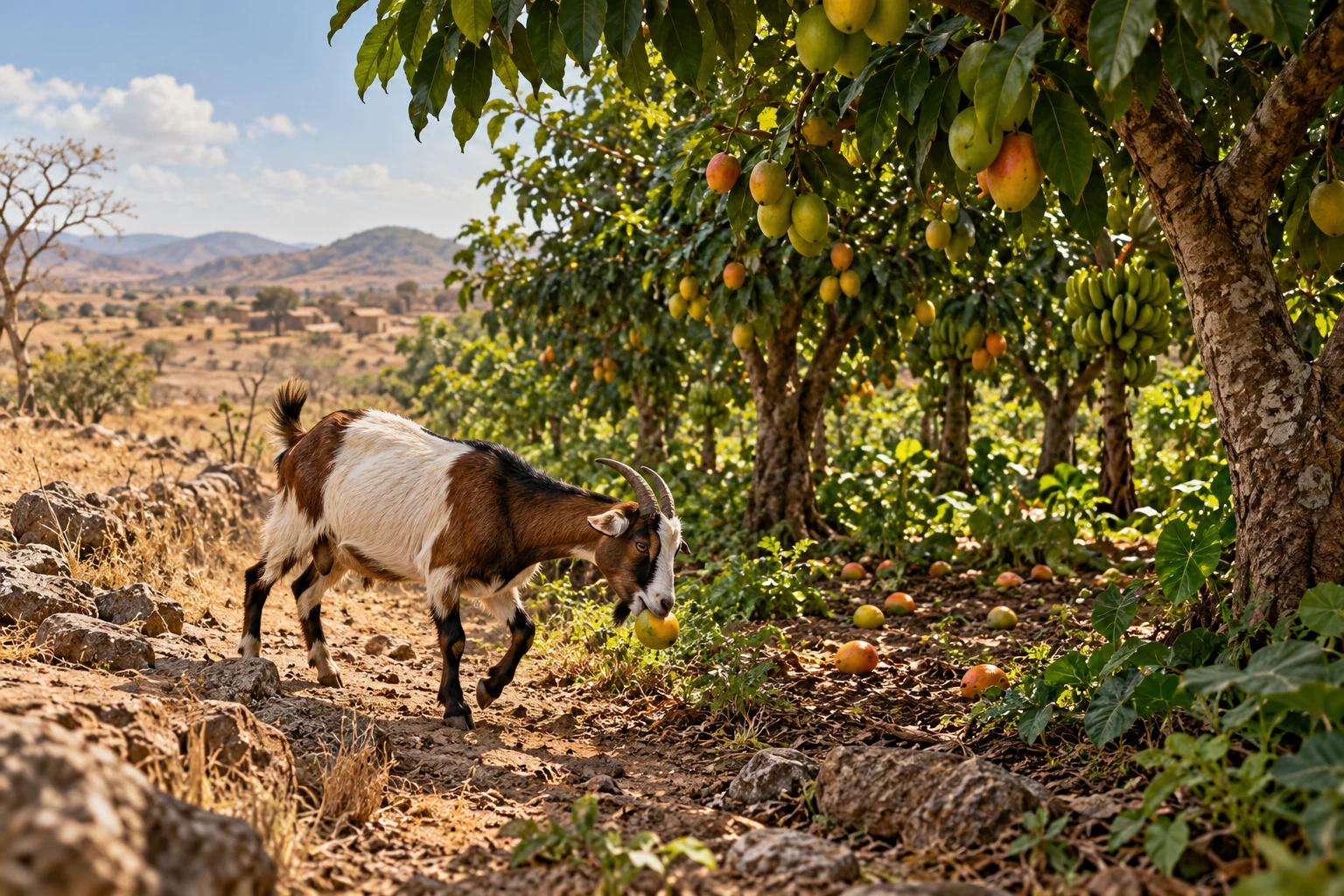
Animals and divine powers receive counsel before a celestial famine, but only the divine company undertakes the prescribed commitment. They later appeal to higher authority, receive fruit seeds, and plant them. Esu tends the rapid growth, and the resulting orchard feeds them. A goat discovers fallen fruit and carries it home for its family. When the owners notice the repeated visits, they set a trap. The goat is caught and killed, and Esu receives it. The witness connects that ending with an animal-origin and sacrificial association, while leaving the hungry family and the terms of access largely unspoken.
The orchard’s abundance is real within the religious account and depends on relations that the animal company did not maintain. That is the source’s explanation of differentiated provision, not merely a modern property dispute. Yet the goat’s motive is also particular: feeding a family during famine. Keeping both facts visible prevents the outcome from becoming an easy celebration of punishment. The earlier coalition against a coercive ruler similarly claims to restore a public order while containing violence that does not disappear from the record.
Oya’s intervention in the rigged confrontation adds another question about how a formally announced encounter conceals unequal conditions. The orchard is not the same kind of trap, but it also places a hungry participant in a field controlled by others. Contemporary analysis can ask what access shared scarcity requires without pretending the sacred owners’ preparation is irrelevant. The plot grants the owners a result; it does not give a full voice to everyone living around that result.
Narrative witness and setting: Translated excerpt in the multilingual compilation’s expressly attributed Cromwell Osamaro sequence, with Yoruba/Bini-facing material. The compilation’s language is not evidence of a Brazilian tradition.
The diviner admires birds owned by the wind power
A practitioner sees beautiful forest birds and prepares to capture some. Their owner, Eziza, also called Ajija in the heading, observes and later arrives with his pregnant wife for consultation. He questions the net the practitioner is making, but says the purpose of the visit is his wife’s welfare. Divination leads the practitioner to challenge the stated motive and require some of the very birds he has admired. Eziza supplies them, and the household receives the favorable outcome narrated. The exchange places the client’s declared need, the adviser’s desire, and divine ownership in one contested conversation.
The account is difficult precisely because neither party’s private intention can be settled by an editor’s preference. Eziza knows of the planned capture and still declares a household concern; the practitioner questions that declaration while receiving something he already wanted. Within the witness, divination has effective knowledge, and the wind power is a real owner and client, not a metaphor for a wary customer. At the same time, a contemporary ethical reading should not let the adviser’s religious standing erase the apparent conflict of interest.
The famine story supplies another dispute over food or creatures controlled by others, while the earlier ambush shows how a stated encounter can hide another plan. The coalition narrative offers knowledge from inside a constrained setting. Together they ask who can establish an account of motive and on what grounds. The childbirth outcome remains religious narrative, not a medical guarantee or proof that any demanded exchange is justified by success.
Narrative witness and setting: Translated excerpt in the multilingual compilation’s expressly attributed Cromwell Osamaro sequence, with Yoruba/Bini-facing material. The compilation’s language is not evidence of a Brazilian tradition.
What was born in this Odù
“Born” can name an explicit traditional origin association or what emerges through a story: a capacity, relationship, practice or order of life. Interpretations drawn from a narrative are labelled below, so their basis remains clear.
The rainbow
Selected traditional source association.
The rainbow is an explicit origin association alongside celestial observance. This should remain a local cosmological motif; it does not establish that every rainbow-related deity is present in the selected narrative.
Self-preservation
Selected traditional source association.
The source names self-preservation, and the longer story uses it in decision-making. Its analytical value is attention to survival without making self-interest the only standard for collective action.
The planets
Selected traditional source association.
Planetary bodies are listed as an origin association. The text does not supply an astronomical account, and no invented correspondence with particular powers is needed.
Correlations to life dimensions
These questions bring the selected stories into contemporary life. They are interpretive invitations for study.
Work and resources
The coalition’s first approach fails. A plan may require revision when inside conditions differ from what outside allies expected.
Reflect: What evidence would make your team change its approach?
Relationships and family
Oya keeps a disagreement distinct from abuse. Relationships can contain unresolved conflict and still require defense of a shared boundary.
Reflect: What treatment would you oppose regardless of the person involved?
Character and inner life
The captive woman recognizes and removes a source of control. Agency can persist within constrained conditions without making captivity harmless.
Reflect: Whose situated knowledge has your plan overlooked?
Community and responsibility
The final promise needs Esu as continuing witness. A new agreement requires oversight after the dramatic confrontation ends.
Reflect: Who will check whether a public commitment is kept?
A deeper reading of the sacred relationships
Divine ownership and sacred exchange are active relations
The orchard becomes productive through a company’s relation with higher authority and Esu’s tending. Eziza’s birds belong to a divine owner who enters consultation as a client, and the resulting exchange is narrated as consequential for the household. These are not inert commodities with mythic names. A religious lens should explain how ownership, provision, and consultation operate among human and divine persons in the witness. Contemporary questions about access or conflicts of interest can then be asked without pretending the sacred field is absent. The two new episodes also prevent one uniform account: Esu tends and receives in the orchard, while Eziza negotiates from a different position.
The principal beneficiary does not represent every affected party
The divine company obtains food, the practitioner obtains birds, Shango is rescued, and the coalition unites lands after coercive rule. Each outcome can be described as successful from a particular position. The hungry goat family, the client’s full intention, and people harmed during the political collapse receive less development. This does not make the recorded result false. It identifies the limit of the perspective through which it is celebrated. A contemporary reference study can notice those limits without inventing missing testimony. That approach is especially valuable where sacred efficacy and human ethics meet: the account’s explanation of why an act works does not automatically answer every question about whom it includes.
An announced purpose may need a fuller account
Ogun announces a contest but arranges an ambush; Eziza declares a household consultation while a prior encounter with the birds shapes the conversation; and the coalition’s first intervention misunderstands the strength of control inside the other land. These are different gaps between an announced purpose and the conditions behind it. The orchard’s owner also sees repeated fruit-taking without hearing the goat family’s own explanation. A source-sensitive study should not conclude that every declaration is a lie. It should trace what each participant knows and what the narrator actually establishes. Religious divination supplies one kind of disclosure in these accounts, while contemporary inference must remain bounded by the given details.
Questions that deepen the study
Does the orchard story make hunger an excuse for any taking?
The narrative does not grant that permission; it gives the divine owners a sacred history of preparation and a severe response to unauthorized use. It also explicitly says the goat carries fruit to its family during famine. A careful interpretation preserves both rather than choosing one fact to erase the other. Within the religious witness, differentiated commitment explains access to provision. Contemporary ethical analysis can then ask what responsibility accompanies abundance amid shared scarcity. That question does not turn the story into modern property law, and its violent ending is not a recommendation for protecting crops or punishing hungry people.
Why is the birds consultation not simply an example of a wise adviser exposing dishonesty?
Because the practitioner’s own desire for the birds is established before the consultation, and the later requirement benefits that desire. The source still treats divination as effective and reports a favorable household outcome, but those facts do not erase the conflict of interest a contemporary reader can observe. Eziza’s declared motive is also not fully disproved by an independent account. The responsible reading therefore explains the religious claim and leaves the tension visible. It does not assume that every successful demand is fair or that a client who asks questions is concealing a malicious purpose.
How do these new motifs deepen the sign’s account of protection?
They add provision and ownership to the earlier personal rescue and collective resistance. Oya prevents a rigged attack, the coalition interrupts coercive rule, the orchard feeds a prepared divine company, and the birds exchange addresses a client’s stated household need. Protection therefore has different objects and beneficiaries. A contemporary comparison asks what is protected and who remains outside the circle, while the religious narratives retain their particular agencies and obligations. The four stories do not establish one universal protective rite or a rule that powerful helpers are always disinterested. Their details make the question of responsibility more exact.
What the four narratives reveal together
The added witness places Okanran Ogunda’s protection within contested economies of provision and desire. An orchard sustained by sacred preparation feeds divine owners while a hungry goat is punished; a wind power’s consultation brings the adviser birds he already wanted. The earlier rescue and political coalition then retain different forms of intervention against concealed advantage and coercion. These accounts should be explained first through their active religious relations, including Esu’s tending and Eziza’s divine ownership, rather than reduced to modern disputes.
Contemporary analysis can ask about excluded beneficiaries and conflicts of interest without claiming that such questions settle the theology. The four stories do not make a successful outcome ethically self-explanatory. They identify what works for whom, which account of motive is available, and where the source leaves another participant’s experience outside the final celebration.
Living with this Odù
A continuing life or initiatory relationship
For someone whose received life or initiatory sign is Òkànràn Ògúndá, a personal disagreement need not cancel a principle protecting another from abuse. Oya intervenes in a concealed capture despite her strained relation with Shango. The announced contest and its actual conditions differ, so long-term judgment requires more than loyalty to a preferred participant. Across changing alliances, a person can oppose an unfair arrangement without approving everything its target has done.
The orchard and bird consultation deepen that attention to beneficiaries. Sacred preparation and Esu's care make the orchard fruitful within the Ibie account, while the hungry goat's family remains largely unheard. The practitioner receives birds already desired from Eziza, creating a tension between effective divination and material interest. Long-term character can include acknowledging a favorable outcome without treating it as proof that every demand was justified. The coalition likewise changes domination without fully explaining the new concentration of control. The sign does not predict enemies or assign someone the role of rescuer. It asks what the stated purpose conceals, who can act from inside a constrained setting and whose welfare a successful result has not yet represented.
A particular consultation and its question
A consultation yielding Òkànràn Ògúndá can help distinguish an announced encounter from its actual conditions. Is a challenge openly comparable, is information held by someone within a coercive arrangement or does a professional exchange include an adviser’s prior desire? Oya's intervention, the coalition and Eziza's visit give different structures. The practitioner should trace what each participant knows rather than conclude that every stated purpose is false.
A resource question may bring the famine orchard into view. The religious account gives divine ownership and Esu's cultivation real efficacy, while the goat's motive concerns feeding a family. These positions cannot be reduced to a slogan about reciprocity or property. Nor can the bird consultation's favorable childbirth outcome supply medical authority or prove any demanded exchange ethical. Consultation can ask what the proposed response changes and whose account remains absent, without inventing that account. The present result does not establish that the client has hidden captors, that every ally is righteous or that a successful coalition repairs all political harm. Its meaning remains linked to this question and the specific witness through which it is interpreted.
Constructive and adverse possibilities
Constructive relations may defend a principle across personal disagreement, use knowledge from within a constrained setting and make distinct contributors effective without pretending that one actor controls the whole field. Oya's agency remains sacred, while the coalition's internal participant is active rather than merely awaiting rescue.
Adverse unfolding could include concealed conditions in a supposed contest, a beneficiary's interest treated as everyone's welfare or religious authority used to hide an apparent conflict of interest. The orchard's abundance does not give the goat's family a voice, and the practitioner's desired birds complicate the account of service. These contrasts do not determine ìrè or òṣogbo for an unknown reading. They preserve the difference between a result working within the sacred witness and the further question of whether its terms, costs and distribution are adequately understood.
An illustrative situation in everyday life
In a hypothetical professional dispute, a manager publicly offers a fair skills contest while privately arranging conditions that prevent one participant from acting. A colleague who dislikes that participant nevertheless objects to the arrangement. Oya's intervention helps distinguish defending a principle from endorsing a person's whole conduct. An adviser then proposes a solution that also gives them an asset they already wanted, adding the Eziza narrative's question about declared need and material interest. This illustration supplies no verdict about the actual motives of unknown people. It asks what is known, whose conditions have been concealed and whether a useful outcome can remain open to examination rather than validating its own terms.
Sources and reading context
The first two narrative witnesses
These are Cuban/Lukumí narratives with violent and coercive elements kept visible. The rainbow is not automatically identified with Osumare. The study excludes operational ritual details, bodily predictions, and unverified astronomical or psychological claims.
Narrative motifs are summarized independently. The life-dimension reflections are contemporary interpretation. How these reference studies are built explains the wider source approach and the distinction between a reference article and personal divination.
Additional named witnesses
- Cromwell Osamaro Ibie. The surrounding sequence is expressly attributed to Cromwell Osamaro. These selected episodes are read through the multilingual compilation’s translated renderings; exact edition and original translation chain remain unverified.
The orchard’s rapid growth and animal ending are sacred etiologies, not agriculture or zoology. Eziza’s local identification with Ajija is recorded without equating all wind deities. The childbirth outcome is not a medical claim, and operational capture or ritual instructions are omitted.
Bibliographic identification
- C. Osamaro Ibie. Ifism: The Complete Work of Orunmila. Lagos; multivolume publication beginning 1986. Library catalogue record. Related bibliographic record for the named narrative witness. Exact volume, edition and page of the transmitted account have not been independently matched.
Read the source method and wider scholarly context.
The catalogue links identify published works and their authors. They are separate from proof of an individual episode’s wording or attribution. Contemporary comparisons and the synthesis above are editorial interpretation. The author’s books and Academy companions below provide further study; their sales links are separate from the source references.