
Òsá Òwónrín is a mixed Odù in Ifá’s 256-part corpus. Òsá Òwónrín’s selected narratives move between a controlled town and a world initially covered by water. A diviner blocks movement and keeps Elegbara distracted until Shangó intervenes; Oshumare makes a path around the waters and later learns that an apparently disappointing reward holds creative abundance. The pairing asks who controls passage, how a community becomes habitable, and why value can remain invisible beneath a demeaning first judgment.
A question to carry through the study: Which blocked pathway or dismissed relationship prevents this community from recognizing what can sustain it?

This Academy reads the right column first, then the left. Each row carries a single or double mark.
Where this Odù belongs
Òsá Òwónrín belongs to the Òsá family in this Academy’s study sequence. It is a mixed Odù, distinct from Òwónrín Òsá. The order matters. Its teaching is approached through its own narratives, rather than by adding two general descriptions of the principal signs together.
Key Òrìṣà and sacred relationships
The figures below are selected for their roles in the accounts discussed here. They offer connected reading paths through the tradition.
-
Ṣàngó. Shangó seeks the missing Elegbara, breaks the town’s controlled enclosure, and helps turn a coercive diviner’s power toward service rather than isolation.
-
Èṣù. Elegbara is kept distracted while a ruler controls the town; recognizing Shangó’s voice helps him rejoin the work of opening the settlement and restoring its population.
-
Òṣùmàrè. Oshumare undertakes the water-clearing task despite lacking ordinary limbs, receives an underestimated partner, and becomes the rainbow after their joint abundance is revealed.
-
Ọ̀rúnmìlà. Orunmila supplies the counsel that allows Oshumare to complete the task and later explains why the apparent slight from Olofin is actually an unrecognized gift.
Key myths and their meanings
A town kept from its own roads
Beboniye Ifá governs a settlement whose entrance is blocked and whose people cannot leave. He keeps Elegbara occupied while using spiritual authority to maintain control. Olofin becomes concerned about Elegbara’s absence, and Shangó finds the place, awakens his ally’s attention, and breaks the enclosure. The diviner is confronted and his power is reordered. The account ends with him able to prosper while benefiting the people he once confined.
The narrative links spiritual monopoly with control of movement and information. Its ending is reformative rather than purely eliminative: the problematic specialist remains, but his practice is placed within another accountability. That does not erase the earlier coercion. A useful reading asks how a community verifies that an authority now serves people instead of simply accepting a new claim of benevolence.
Narrative setting: Cuban/Lukumí narrative in the accounts considered here; no individual author established for this passage.
The reward nobody recognizes
Olofin asks the Òrìṣà to clear a water-covered earth. Others dig channels, while Oshumare consults Orunmila and follows a course across the water that creates the surrounding ocean. His reward is a woman mocked by the other powers. Orunmila explains that she is Olofin’s daughter. She calls forth living beings and wealth, and the pair’s transformation into rainbows reveals a creative capacity that outward comparison had obscured.
The story opposes public comparison to a relationship whose worth has not yet appeared. It also uses a woman’s body as an object of mockery and reward, a limitation that should be acknowledged rather than repeated approvingly. Her later initiative is decisive: she is not merely a prize but the agent through whom life arrives. Shared creation makes the final abundance more than an individual achievement.
Narrative setting: Cuban/Lukumí narrative in the accounts considered here; no individual author established for this passage.
Iguana’s guest turns lodging into control of the household
Iguana receives counsel about taking in a visitor and entering a partnership, but does not complete the sacred response attached to that warning. A guest is welcomed and gradually gains confidence. The visitor then proposes shared trading, and Iguana agrees. During a market journey taken by the host alone, the visitor removes the valuable belongings and burns the house. Iguana returns without a dwelling to enter and seeks Orunmila again. The account ends by linking the loss with a move into the forest, making a changed habitat part of the lasting narrative consequence rather than restoring the original house through an immediate rescue.
The visitor does not obtain all control at once. Lodging becomes confidence, confidence becomes a business proposal, and the host’s ordinary absence becomes an opportunity to dismantle the household. That sequence is more specific than a warning that strangers are dangerous. Within the account, earlier divination and the omitted exchange with Eshu explain why the danger was not effectively addressed. Contemporary interpretation can examine escalating access and the distinction between hospitality and partnership without replacing that religious explanation. The earlier closed-town story gives a useful contrast: there a specialist restricts a population’s movement from inside an established authority, whereas here a new entrant gains access through a private relationship.
Neither should be treated as proof that security consists in excluding everyone. The final forest dwelling also deserves care. The source narrates a loss of prior habitation, not a freely chosen retreat whose benefits can be assumed. A strong reference should preserve the betrayed host’s dispossession without turning that consequence into a general moral explanation of actual people’s housing losses.
Narrative witness and setting: Portuguese rendering in the explicitly headed Cromwell Osamaro revelations; an African Ifá witness mediated by the compilation, not a Brazilian provenance established by language alone.
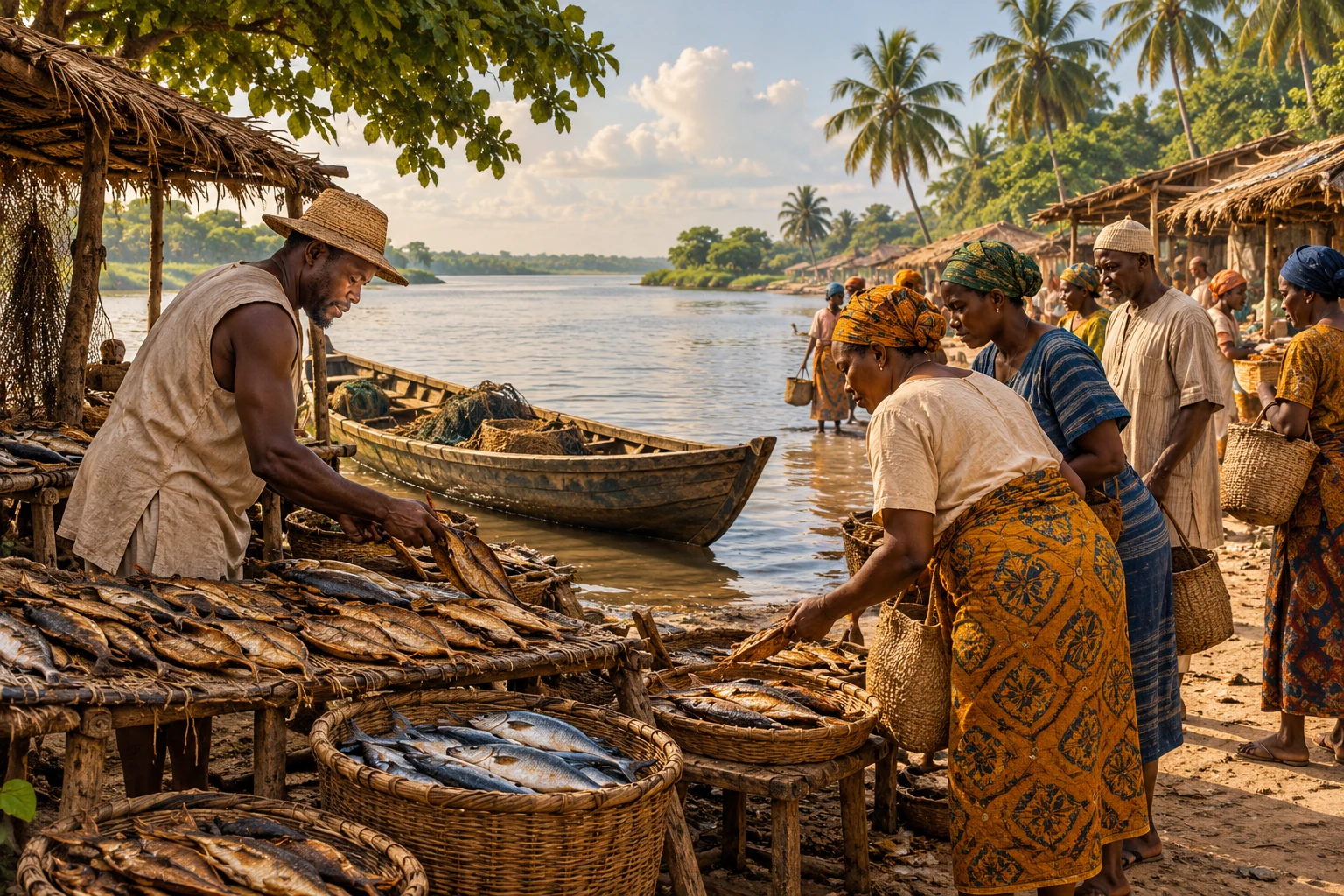
A solitary fishing place becomes a market through Eshu’s direction
Onirefi is a poor fisherman whose consultation places future benefit in a relationship with the river. He follows the direction to travel by canoe and settle at the first suitable land he reaches. There he builds a dwelling and catches fish successfully, but has no buyers. He preserves the catch while waiting. Eshu recalls the completed sacred response and directs neighboring people toward him. Their visits gradually form a market and then a community, which recognizes Onirefi as its ruler. The narrative names the growing place Eko, giving settlement and authority a sacred commercial origin rather than presenting it as a documented chronology of the historical city.
The first problem is not insufficient production. Onirefi already has fish, skill, and a dwelling, but lacks a route through which the catch can become a livelihood. Eshu’s direction is therefore not an ornamental reward attached to an otherwise complete enterprise; it constitutes the relation between producer and buyers that the new settlement needs. The account also gives waiting a material practice, since preserving fish keeps present work available for future visitors. Beside the earlier Oshumare narrative, abundance again arrives through a relationship whose full value is not immediately visible.
Beside the closed town, the market’s growth depends on people being able to come rather than being prevented from leaving. Contemporary interpretation may discuss exchange and settlement formation, but should not convert the sacred claim about Eko into an independently verified founding history. The ruler’s recognition is produced by the gathering community within the story, and the source gives little detail about how that later authority is exercised or whose earlier claims to the land are present.
Narrative witness and setting: Portuguese rendering in the explicitly headed Cromwell Osamaro revelations; an African Ifá witness mediated by the compilation, not a Brazilian provenance established by language alone.
What was born in this Odù
“Born” can name an explicit traditional origin association or what emerges through a story: a capacity, relationship, practice or order of life. Interpretations drawn from a narrative are labelled below, so their basis remains clear.
Exploitation of people by people
Selected traditional source association.
The origin list explicitly names exploitation. The closed-town narrative gives it a concrete form through restricted movement, distracted mediation, and a population taught to depend on one authority. The entry supplies no independent historical date or documented inventor.
Rainbow
Selected traditional source association.
The rainbow is named among the origins and receives a developed narrative in Oshumare’s transformation with his partner. The story’s paired image should remain local rather than defining all rainbow traditions.
Cosmonautics and electricity
Selected traditional source association.
Both modern terms occur in the origin list. They show the compilation’s expanding associative vocabulary, not evidence that ancient narratives anticipated modern aerospace or electrical science. The entry supplies no independent historical date or documented inventor.
Correlations to life dimensions
These questions bring the selected stories into contemporary life. They are interpretive invitations for study.
Work and resources
Oshumare’s success becomes evident through a task and a relationship that others underestimate. The narrative supports judging capacity through contribution and initiative, while noticing how public comparison can conceal another person’s actual work. Oshumare’s partner initiates the arrival of living beings and wealth.
Reflect: What contribution has been missed because the reward looked unimpressive?
Relationships and family
Oshumare’s partner initiates the arrival of abundance rather than remaining a passive gift. Her action shifts the story from an individual’s disappointment to a shared future, even within its unequal marriage framework. Her contribution changes the meaning of the supposedly inadequate reward.
Reflect: How can the other person’s initiative become visible in the way I tell this story?
Character and inner life
The town’s people and Oshumare face different limits on perception: enforced dependence in one case, humiliation by comparison in the other. Both require access to a perspective outside the dominant local judgment. Shangó’s voice reaches Elegbara through the town’s imposed confusion.
Reflect: Whose perspective could help me reassess the story everyone here accepts?
Community and responsibility
Opening the settlement restores movement, but continued responsibility requires a changed relation between specialist and population. The source’s reformative ending invites attention to whether authority enables people to act beyond its own enclosure. The population’s movement is restricted while its guardian remains distracted.
Reflect: Does this leadership enlarge people’s options or make every option pass through one gate?
A deeper reading of the sacred relationships
Eshu establishes passage between production and fulfilled livelihood
Onirefi’s catch does not become sustaining prosperity until Eshu brings people into relation with it. The divine action is specific to a completed response disclosed by divination; it is not merely an invisible name for demand in a market model. Iguana’s account presents the corresponding unfinished relation before hospitality and partnership expose the household. The earlier town narrative also locates communal movement within the changing agency of Elegbara and Shangó, while Oshumare’s world grows through a partner’s extraordinary initiative. These accounts understand livelihood and settlement through active sacred relationships as well as material capacities. Contemporary discussion can add questions about access and distribution, but should preserve the named divine agencies and their distinct actions instead of collapsing them into a single principle of social networking.
A boundary can admit exchange or make departure impossible
The closed town and the new fishing market provide contrasting structures of communal access. Beboniye’s control prevents residents from leaving, whereas Onirefi’s livelihood becomes possible as others arrive. Iguana’s household boundary is different again: private access expands until another person can remove the host’s ability to inhabit the place. A contemporary reading should therefore avoid equating every open boundary with vulnerability or every closed boundary with safety. What matters is who controls movement, which activity it enables, and whether those affected can revise the arrangement. The stories’ spiritual explanations remain essential, but the material differences let an editor describe several kinds of boundary rather than deriving a universal preference for isolation, hospitality, or unrestricted circulation from one scene.
The place of benefit is not always evident at arrival
Onirefi initially finds a productive place without buyers, while Oshumare initially receives a partner others treat as an inadequate reward. Their later benefits require relations that are not yet visible at the first moment of judgment. Iguana experiences the inverse: a useful-looking visitor conceals future dispossession. The account of the closed town adds a further appearance, with a powerful specialist presenting control as order. These differences do not justify believing that every disappointment hides a blessing or every welcome hides a betrayal. They support a more precise contemporary question about what information is missing from the first assessment. The reference can preserve surprise as a narrative form while refusing to supply an unrecorded favorable or threatening future for an actual reader.
Questions that deepen the study
Why does Onirefi need more than a good catch?
Fish in isolation do not supply the full relationship through which a livelihood can continue. The story gives him successful production before it gives him buyers, so the distinction is explicit. His preservation of the catch keeps work available, while Eshu’s intervention brings surrounding people into exchange with him. Within the witness this fulfills a sacred response rather than simply rewarding an entrepreneurial technique. Contemporary readers can ask which connection is missing from an otherwise capable activity, but should not infer that any unprofitable work is destined to become a town. The account’s later communal recognition also remains a narrated outcome, not an automatic right of every first producer to rule.
Do the two additions contradict each other about welcoming outsiders?
They describe different relations, not a single act evaluated inconsistently. Onirefi’s visitors arrive through the sacred direction that completes a disclosed calling and participate in exchange. Iguana’s guest uses hospitality to obtain confidence and then private control during the host’s absence, after a warning tied to an uncompleted sacred response. The distinction is not that familiar people are safe and unfamiliar ones are unsafe. A contemporary interpretation can examine terms, access, and the ability to withdraw while respecting the religious conditions the witness supplies. It should not turn the market story into a duty to accept every visitor or the Iguana story into a universal taboo against hospitality.
What does the named Eko settlement contribute without serving as verified history?
It gives the narrative a remembered place and explains authority through a sequence of fishing, gathering exchange, population growth, and public recognition. That makes the account more specific than a general prosperity motif. Its evidentiary status is still a sacred founding narrative transmitted through this African-attributed witness. A reference can state what the story claims without attaching an invented date or treating it as independent archaeological proof. The earlier Oshumare account offers a comparable need to distinguish cosmological creativity from scientific chronology. In both cases, spiritual meaning and particular narrative geography deserve explanation on their own terms rather than either being dismissed or being presented as verified empirical history.
What the four narratives reveal together
The additions bring Òsá Òwónrín’s concerns about passage and unexpected value into two different forms of habitation. Iguana loses a house when private trust expands into concealed control. Onirefi gains a community when sacred direction connects abundant production with people able to receive it. The earlier closed town and paired rainbow accounts add restriction of movement and the disclosure of a partner’s creative capacity. Together they distinguish access, exchange, domination, and recognition instead of giving one rule about staying among others.
Eshu, Shangó, Oshumare, and the extraordinary partner act within their respective accounts, and the reference should preserve those agencies before adding contemporary concepts of markets or boundaries. The named settlement and changed habitat are meaningful narrative outcomes, not licenses to invent local history or explain real dispossession through moral failure. Their differences make the source tradition more legible rather than less spiritually grounded.
Living with this Odù
A continuing life or initiatory relationship
For someone who carries Òsá Òwónrín through a received life or initiatory relationship, the narratives make access a substantial question. The closed town cannot benefit from a specialist's claim of authority while its people remain unable to move. Iguana's hospitality faces a different danger, as access granted gradually becomes dispossession. Neither account makes total exclusion the ideal. Onirefi's catch becomes a livelihood only when Eshu brings people into relation with it, while Oshumare's apparently disappointing reward reveals a creative agent whom public comparison has misread.
Over time, this sign can invite discernment about the difference between opening a path, surrendering control of a household and permitting an authority to close the world around others. The inner response may include a hunger for approval that discounts an unfamiliar benefit, or fear that mistakes generosity for unlimited access. Character develops through evaluating the actual relation, not through becoming universally trusting or suspicious. The religious participants remain active: Eshu's direction constitutes a market connection, and Shangó's intervention changes a coercive arrangement. A received sign offers these shifting questions without predicting that every partnership will end in betrayal or every overlooked person will bring wealth.
A particular consultation and its question
In a particular consultation, the sign's witnesses can distinguish a production problem from a missing relationship, or a helpful opening from an escalating transfer of control. Onirefi already has skill and fish before buyers arrive, so more effort at catching would not address the whole configuration. Iguana's guest gains successive kinds of access, making the terms of partnership more exact than a general fear of strangers. The closed town asks whether an established authority controls movement and information while claiming to protect people. Oshumare's story then asks whether public mockery has obscured the agency of someone treated as a reward.
A practitioner cannot use these structures to announce that a client's visitor is dangerous or an unfamiliar partner secretly wealthy. They offer distinctions to examine in the actual question. Sacred direction and transformation remain more than names for networking or positive thinking. A temporary result may invite a better understanding of entry, exit, recognition and communication without establishing a permanent identity. The interpretive responsibility is to notice what the opportunity actually lacks, who can freely move through it, and whether those involved remain subjects of the relation rather than objects transferred for another person's benefit.
Constructive and adverse possibilities
Constructive unfolding includes a town's movement being reopened, an overlooked woman acting creatively and an isolated producer becoming connected through Eshu's direction. The possibility of the specialist's reform matters, but does not erase the coercion that preceded it. Adverse unfolding includes hospitality turning into control and a household's loss becoming a forced change of habitat. Iguana's dispossession should not be narrated as a freely chosen retreat or used to blame people for actual housing insecurity. Likewise, the woman in Oshumare's account should not remain merely a valuable prize once her agency is visible. Iré and osogbo depend on the actual sacred and human relationships, not on whether a situation looks expansive. An opening can sustain life or expose it. The question is whose movement, voice and conditions of participation the new arrangement permits.
An illustrative situation in everyday life
Hypothetically, a skilled food producer has stock ready but no reliable route to customers. A new acquaintance offers to help, first requesting storage space and later asking for complete access to accounts and keys. The producer feels both relief at being noticed and fear of missing a rare chance. Onirefi's structure distinguishes the missing market relation from inadequate production; Iguana's sequence asks whether each increase in access is justified by the agreed role. The closed town adds attention to whether the proposed partner would control all communication. This is an illustrative comparison, not a prediction of betrayal or a claim that a ritual guarantees customers. A useful decision would examine the precise relation that opens the livelihood while preserving a viable ability to leave it.
Sources and reading context
The first two narrative witnesses
The selected Cuban-labelled material combines Spanish and edited English narratives. Oshumare’s paired rainbow account is not generalized across Yoruba, Fon, or Brazilian traditions. Modern origin terms are reported as compilation associations. Claims of coercive spiritual power are treated as narrative motifs, not diagnostic facts.
Narrative motifs are summarized independently. The life-dimension reflections are contemporary interpretation. How these reference studies are built explains the wider source approach and the distinction between a reference article and personal divination.
Additional named witnesses
-
Cromwell Osamaro. The Iguana and Onirefi narratives occur in the explicitly headed African-attributed division.
-
Cuban/Lukumí-labelled collection. The earlier closed-town and paired-rainbow accounts provide distinct comparisons of movement, habitation, and revealed value.
The Eko/Lagos connection is reported as this witness’s founding claim, not verified urban chronology. The Iguana passage’s hearing-related aftermath is not used to explain disability. No river substances, hunting methods, personal taboos, or diagnostic application are supplied.
Bibliographic identification
- C. Osamaro Ibie. Ifism: The Complete Work of Orunmila. Lagos; multivolume publication beginning 1986. Library catalogue record. Related bibliographic record for the named narrative witness. Exact volume, edition and page of the transmitted account have not been independently matched.
Read the source method and wider scholarly context.
The catalogue links identify published works and their authors. They are separate from proof of an individual episode’s wording or attribution. Contemporary comparisons and the synthesis above are editorial interpretation. The author’s books and Academy companions below provide further study; their sales links are separate from the source references.