
Òtúrúpòn Ìròsùn is a mixed Odù in Ifá’s 256-part corpus. Òtúrúpòn Ìrosùn’s selected accounts concern a displaced princess and two brothers encountering an unresponsive elder. The princess’s former rank cannot sustain her after political change, and she receives help; the brothers turn a desire to be acknowledged into an attack on a vulnerable dwelling. The explicit origins name ice, the poles, and Yemayá Okute. These remain local associations, while the focus is reciprocity, changed circumstances, and the limits of demanding attention.
A question to carry through the study: What acknowledgment do I owe, and what acknowledgment am I wrongly trying to force?
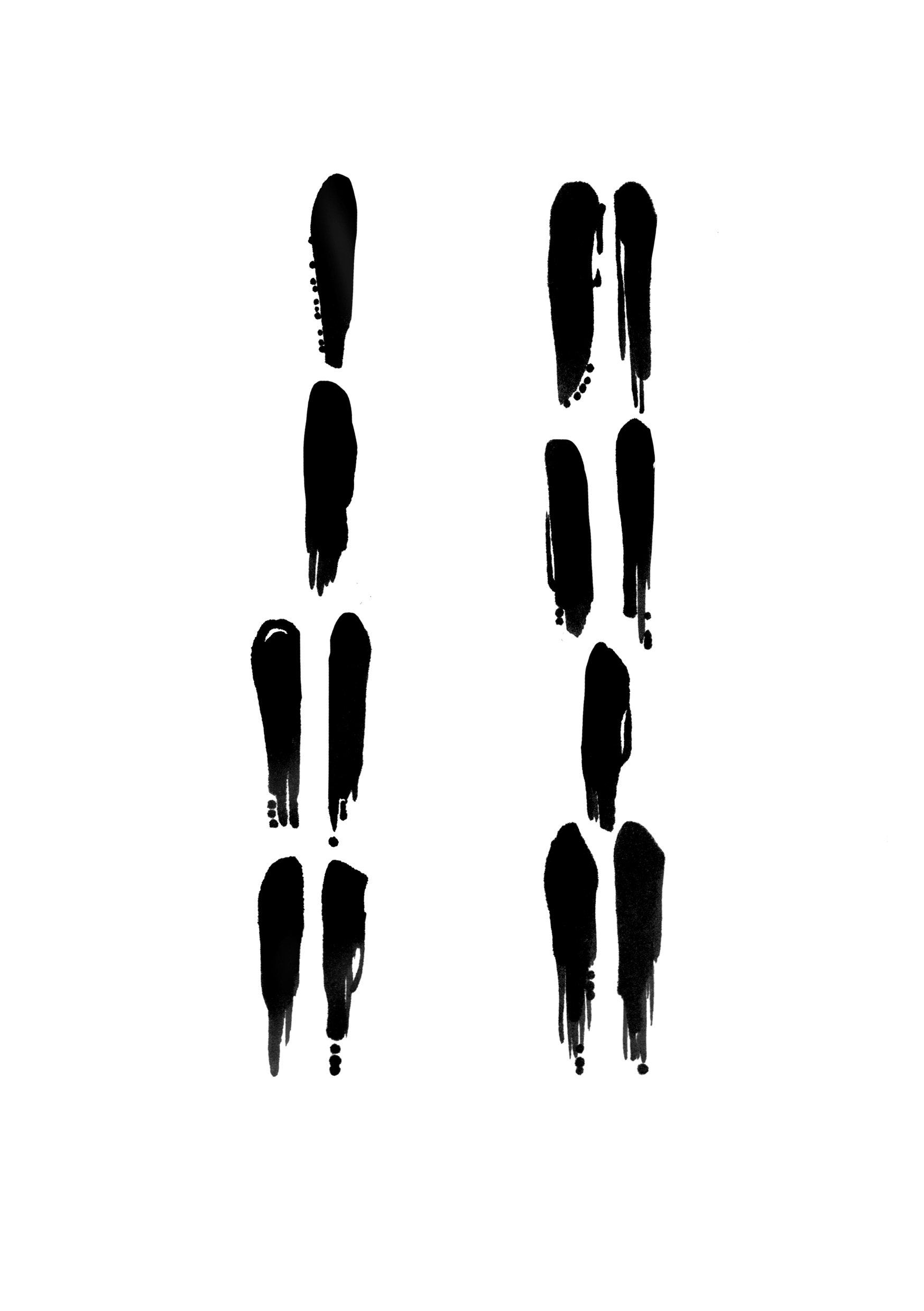
This Academy reads the right column first, then the left. Each row carries a single or double mark.

Where this Odù belongs
Òtúrúpòn Ìròsùn belongs to the Òtúrúpòn family in this Academy’s study sequence. It is a mixed Odù, distinct from Ìròsùn Òtúrúpòn. The order matters. Its teaching is approached through its own narratives, rather than by adding two general descriptions of the principal signs together.
Key Òrìṣà and sacred relationships
The figures below are selected for their roles in the accounts discussed here. They offer connected reading paths through the tradition.
-
Ọ̀rúnmìlà. Orunmila helps the displaced princess when inherited rank no longer provides a livelihood; repeated descriptions note her later failure to remember the assistance.
-
Ṣàngó. Shangó is associated with the religious response through which the princess’s circumstances improve; he is not assigned an invented political role in restoring the monarchy.
-
Obàtálá. Obatalá sends his sons into the world with advice to respect elders, which the older son violates when a stranger does not respond to his greeting.
Key myths and their meanings
A princess without the institutions of rank
A queen indulges her daughter but dies without leaving affairs in order. The monarchy is abolished, and the princess loses the structure that had supported her. She withdraws to a hill and struggles to live until meeting Orunmila. With help associated with Shangó, her condition improves. Repeated descriptive versions add that after returning to comfort she forgets the diviners who assisted during displacement.
The story distinguishes an inherited title from the practical conditions that make it useful. The princess’s need is not less real because she once had privilege. The later forgetting raises an issue of memory after recovery, but help should not become a debt that permits endless control by the helper. The source does not document the political restoration in detail, so it should not be given by inference.
Narrative setting: Cuban/Lukumí narrative in the accounts considered here; no individual author established for this passage.
A greeting becomes an act of domination
Obatalá sends two sons to seek their fortunes, advising respect for elders. They pass a damaged hut where an old man does not answer a greeting. The older son insists on making himself heard, first throwing a stone and then setting fire around the dwelling despite his brother’s request to leave. The old man emerges and is revealed as Olofin, whose curse concludes the encounter.
The harmful turn occurs when greeting ceases to be an offer of contact and becomes a demand for submission. The elder’s silence is treated as an insult without inquiry into whether he can hear or respond. The younger brother’s objection also complicates collective punishment at the end. A careful reading can value respectful restraint without endorsing a curse against everyone present or generalizing age into automatic correctness.
Narrative setting: Cuban/Lukumí narrative in the accounts considered here; no individual author established for this passage.
Ògò’s eventual honor does not make his suffering desirable
Ògò, identified as a prince of Ìsokùn in the closing lines, undergoes severe hardship. Diviners announce eventual prosperity and ask him to respond through sacrifice and perseverance. He complies, and the desired good things eventually arrive. Others begin wishing for a favorable life like his, while he praises his diviners and Ifá. The ending sharply recalls what his prosperity can obscure: he suffered terribly before recognition, and the verse asks who would wish to experience the same ordeal. The transmitted place-name forms vary. No particular catastrophe, duration, succession dispute, or historical reign is established, and the story leaves the content of his suffering unspecified.
The final question prevents the passage from becoming an uncomplicated celebration of suffering as a route everyone should seek. Others see a favorable outcome and desire its likeness, but the narrator remembers the ordeal that preceded it. That contrast makes public visibility selective: prosperity can be copied as an image while its cost disappears. Within the account, perseverance is not self-generated optimism alone. It answers a divinatory instruction and accompanies a sacred response through which the favorable outcome is represented.
A contemporary interpretation can examine retrospective success stories that conceal their difficulty, but should not imply that every hardship must be endured until it produces status. The source’s instruction concerns Ògò’s disclosed path, not a universal instruction for anyone in danger. Likewise, its expression of extreme suffering should not become a detailed journey through an invented underworld. The text supplies intensity and remembered cost, not an itinerary. Its authority lies in holding blessing and undesirability of the preceding ordeal together.
Narrative witness and setting: African Ifá verse in the explicitly named Ayo Salami division, transmitted with Yoruba text and a Spanish rendering in the compilation.
Esínndá refuses a change of trade before cotton burns
Esínndá trades cotton in Òwò. Diviners advise a different occupation, explaining that this trade does not fit the path disclosed for him, and direct a sacred response. He refuses both the change and the offering. The verse moves to fire consuming the cotton and money lost with the stock. His praise arrives too late to stand in place of the response he had declined. The prose likewise concerns choosing work carefully. No competing merchant, deliberate arson, insurance dispute, or successful later occupation is narrated. The cotton’s susceptibility to fire makes the loss materially intelligible, while the account explicitly connects it to neglected counsel.
Placed beside Ògò, Esínndá prevents perseverance from becoming a rule independent of consultation. One client is asked to persist; the other is asked to change course. Their different instructions are not a contradiction to be repaired by choosing one maxim for the whole sign. They show the situated character of divination within these accounts. The cotton’s burning also illustrates the conjunction of religious explanation and material vulnerability. The narrator attributes the loss to refusal, yet presents fire acting on combustible stock rather than an unexplained disappearance of wealth.
A contemporary reading can consider exposure to a known kind of loss and the difficulty of abandoning an established trade. It should not make that reading a universal judgment against cotton commerce, nor blame actual people whose livelihoods are damaged by fire. The named client’s response and outcome are what the source supplies. His belated praise emphasizes that later acknowledgment is not represented as equivalent to the earlier action the consultation required.
Narrative witness and setting: African Ifá verse in the explicitly named Ayo Salami division, transmitted with Yoruba text and a Spanish rendering in the compilation.
What was born in this Odù
“Born” can name an explicit traditional origin association or what emerges through a story: a capacity, relationship, practice or order of life. Interpretations drawn from a narrative are labelled below, so their basis remains clear.
Poles and ice
Selected traditional source association.
The origin list names the terrestrial poles and ice. A repeated note explicitly calls refrigeration an analogy, so the modern technology must not be presented as an ancient prediction or a literal narrative invention.
Yemayá Okute
Selected traditional source association.
Yemayá Okute is explicitly listed as arising here and has a separate narrative in the section. These selected stories do not establish her role, and no universal form-equivalence or genealogy is given.
Correlations to life dimensions
These questions bring the selected stories into contemporary life. They are interpretive invitations for study.
Work and resources
The princess loses the institution that made inherited resources dependable. The story supports assessing what skills, relationships, and arrangements remain when a title or established system no longer secures ordinary needs. Abolition removes the political framework that had supported the princess.
Reflect: What would still sustain me if the institution behind my position changed?
Relationships and family
The queen’s indulgence leaves her daughter poorly prepared for a different world. Care includes attention to future independence, while the younger brother’s ignored warning shows how family loyalty can be tested by another member’s aggression.
Reflect: What preparation is more useful than preserving comfort?
Character and inner life
The older son makes another person’s response a test of his own importance. The account invites noticing when embarrassment or wounded pride is about to turn ordinary uncertainty into an unnecessary confrontation. The older son insists on a response despite continued silence.
Reflect: What am I assuming this silence says about me?
Community and responsibility
The princess’s forgotten helpers and the elder’s endangered hut concern recognition in opposite directions. Communities need to remember genuine assistance while refusing the idea that every person owes an immediate performance of deference. The princess’s renewed comfort makes earlier assistance easier to forget.
Reflect: How can gratitude remain freely expressed rather than coerced?
A deeper reading of the sacred relationships
Divination differentiates persistence from redirection
Ògò’s consultation calls for perseverance with a sacred response; Esínndá’s calls for a different occupation and a sacred response. Ifá’s role is therefore more specific than encouraging determination in everyone. The religious logic depends on receiving a disclosed direction appropriate to the represented client. An article should explain that difference rather than translating both into a generic lesson about working harder. Contemporary readers may reflect on when to continue or reconsider, but the texts do not furnish a diagnostic rule for their unknown circumstances. The source pair instead demonstrates why selecting a maxim apart from its consultation can distort an account whose very point is the particularity of response.
Later praise has different places in the two sequences
Ògò’s praise follows a response and received blessing, whereas Esínndá’s praise is explicitly belated after refusal and loss. The same vocabulary of acknowledgment therefore does not imply the same narrative action. Timing and prior conduct matter. This distinction can deepen the earlier displaced princess’s failure to remember help after restoration: gratitude cannot be detached from the relationship it acknowledges. The earlier domineering greeting adds another case in which public behavior damages rather than sustains a bond. A comparison can trace forms of recognition across these accounts while avoiding a universal accusation against anyone whose thanks comes late. The texts represent particular sequences, and those sequences establish the meaning of praise within each episode.
Remembering cost resists admiration that copies only the ending
Others desire a favorable life like Ògò’s, while the closing verse asks who would desire what he endured. That shift preserves the difference between visible standing and the path that preceded it. The article can use it to complicate admiration without turning hardship into a badge of spiritual superiority. Esínndá’s burned stock adds another limit to retrospective judgment: the reader knows the warning because the account supplies it, but cannot assume similar knowledge about every actual loss. Contemporary reflection should remain attached to the evidence. The passage invites attention to hidden cost, not a presumption that one can infer an unknown person’s past choices from their present prosperity or adversity.
Questions that deepen the study
Does Ògò’s story say that suffering should be sought?
Its ending questions who would wish to undergo the ordeal even after acknowledging the favorable outcome. That rhetorical question should remain central. The account asks this particular client to persevere in a disclosed path; it does not command every reader to pursue suffering or remain in harmful circumstances. Its religious explanation joins response, endurance, and eventual blessing, while the closing remembrance prevents the blessing from making the cost desirable. An article can therefore discuss hope without romanticizing hardship. It should also leave the unspecified ordeal unspecified, rather than inventing punishments or an underworld journey to give a vivid expression of suffering a biography the text does not provide.
Does Esínndá’s cotton loss establish a ban on cotton trading?
The instruction belongs to a named client’s consultation and response. The verse explicitly represents cotton’s vulnerability to fire, but that material fact does not convert the passage into a universal prohibition against an occupation. Nor does it establish that every real fire reflects neglected religious counsel. The article can explain the loss as this account explains it, while keeping its scope precise. Esínndá is advised to change, refuses, and sees his stock destroyed. His later career is not narrated. A contemporary interpretation may consider the difficulty of reassessing work, but it should not replace a situated account with financial advice or a personalized determination of anyone else’s proper livelihood.
How can opposite instructions deepen one sign’s study?
They show that the study concerns relationships and disclosed circumstances, not one compulsory behavioral trait. Ògò’s endurance and Esínndá’s advised change answer different conditions. The earlier princess’s restoration and the violent greeting likewise involve particular relationships whose responsibilities cannot be replaced by a general posture of pride or humility. Comparing the four stories can reveal why attentive response matters while preserving the content of each response. That is a richer account than choosing perseverance as the sign’s essence and forcing every episode to fit. It also keeps contemporary reflection modest: the stories can sharpen questions about continuation and change without deciding an unknown reader’s circumstances in advance.
What the four narratives reveal together
The earlier displaced princess and domineering greeting narratives concern restored standing that forgets its support and public conduct that violates a relationship. The new African verses complicate what responsible response requires. Ògò is asked to persevere, while Esínndá is asked to leave a trade. Their different instructions prevent the study from reducing the sign to either endurance or change as an abstract virtue. Praise also takes different places: one client acknowledges received blessing after responding, while the other acknowledges counsel only after loss.
The comparison retains Ifá’s specific disclosure as part of the religious explanation. Contemporary reflection can examine selective admiration, belated recognition, and reassessment of work, while the article preserves Ògò’s final question about the undesirability of his suffering. It should leave the ordeal’s details, the varying place-name forms, and Esínndá’s unreported later occupation outside the reconstructed narrative rather than supplying a seamless biography.
Living with this Odù
A continuing life or initiatory relationship
For someone whose received life or initiatory Odù is Òtúrúpòn Ìròsùn, recognition and the memory of support can become recurring responsibilities. The princess loses the institutions that made comfort seem natural, then forgets help after her condition changes. The older son's demand for an answered greeting turns a vocabulary of respect into domination. Ògò's prosperity attracts imitation while his final words recall suffering that an audience no longer sees. Esínndá's refusal of a changed trade supplies another configuration, where attachment to familiar work overrides the path disclosed by counsel.
Over time, character may develop through remembering the conditions of one's standing, receiving another person's silence without coercion and distinguishing perseverance from an inflexible attachment. The inward temptation may include shame at needing help, fear that being ignored destroys dignity or a wish to inherit another's honor without its history. These witnesses do not predict fire or promise eventual wealth. Sacred counsel, Shangó's assistance and Olofin's role remain particular. Carrying the sign can invite changing questions about how respect is offered, what recovery makes easy to forget and whether a visible result has concealed the ordeal or support through which it became possible.
A particular consultation and its question
In consultation, these narratives can distinguish displaced status, forgotten help, coercive recognition and a work decision that has resisted counsel. The princess's comfort and Ògò's eventual prosperity both require a longer history than the final appearance supplies. Their stories cannot guarantee that hardship culminates in honor. The greeting account asks whether a demand for respect has become a refusal to permit another person's nonresponse, rather than establishing that every elder's silence is a sacred test. Esínndá's loss keeps the religious warning specific while providing no arsonist or later occupation that can be invented.
A practitioner should not announce that an unknown client must abandon their trade or that present loss proves disobedience. Contemporary reflection can ask what has been forgotten after improvement, which response another person actually owes and what evidence distinguishes a viable continuation from a repeated refusal to reconsider. A situational result is not a lifelong personality of ingratitude. Its sacred meaning belongs to the actual reading. The narratives make memory, respect and responsiveness substantial without turning later success into approval of every suffering that preceded it or every severe consequence the source narrates.
Constructive and adverse possibilities
Constructive movement can include support being remembered, dignity surviving an unanswered greeting and counsel helping a person reconsider the path of work. Ògò's praise retains the ordeal rather than advertising suffering as desirable. Adverse movement appears when restored comfort erases dependence, a claim of respect authorizes violence or familiar occupation becomes immune to reflection. The cotton fire remains a narrative consequence, not proof that actual business loss reveals spiritual refusal. Iré and osogbo require the actual context rather than a judgment from prosperity, rank or persistent effort.
The witnesses ask how a person relates to the history behind a result and to the agency of those encountered. A favorable life can create an obligation of memory; it does not entitle an audience to demand that everyone repeat the same ordeal or reward the same display.
An illustrative situation in everyday life
Hypothetically, a formerly prominent executive rebuilds a livelihood with quiet help from several colleagues. Once secure, the executive treats that help as incidental and becomes furious when an older neighbor fails to acknowledge a greeting. The princess and greeting structures distinguish regained standing from entitlement to recognition. Ògò's ending asks what suffering and support the polished result conceals. A separate warning about an unsustainable business line is dismissed because changing it feels like another loss of status. This is an illustrative interpretation, not a prediction of fire or punishment. The inward conflict is a fear that dependence and nonresponse diminish worth. The external responsibility is to remember actual help and examine a work decision without turning respect into compelled attention.
Sources and reading context
The first two narrative witnesses
The selected Cuban-labelled Spanish passages include repeated versions of the princess’s memory lapse and a local Olofin revelation. Refrigeration is explicitly an analogy in the source. Yemayá Okute is retained as a listed association without being made an actor in stories where she does not appear.
Narrative motifs are summarized independently. The life-dimension reflections are contemporary interpretation. How these reference studies are built explains the wider source approach and the distinction between a reference article and personal divination.
Additional named witnesses
- Ayo Salami. Explicit Òtúrúpòn Ìrosùn A and B divisions supply Ògò’s suffering/recognition and Esínndá’s cotton trade. The first passage varies its place-name forms.
Ògò’s ordeal and exact historical identity are unspecified, with varying place names. Esínndá’s later career is absent. The opposed instructions remain situated rather than becoming a universal rule about endurance, occupation, or another person’s misfortune.
Bibliographic identification
- Ayo Salami. Ifá: A Complete Divination. Lagos: NIDD, 2002 catalogue record. Library catalogue record. Bibliographic identification of the named author and work; the edition behind the transmitted account remains to be matched.
Read the source method and wider scholarly context.
The catalogue links identify published works and their authors. They are separate from proof of an individual episode’s wording or attribution. Contemporary comparisons and the synthesis above are editorial interpretation. The author’s books and Academy companions below provide further study; their sales links are separate from the source references.