
Òtúrúpòn Òwónrín is a mixed Odù in Ifá’s 256-part corpus. Òtúrúpòn Òwónrín’s selected stories connect participation in shared food with a land lacking sufficient nourishment. Ayán Kolokolo does not help others but seeks their meal; afterward a place at the threshold becomes part of a reciprocal role. Molala’s people possess sacred plant knowledge yet remain severely deprived until Elegbá names the lack of food and brings Orisha Oko’s agricultural support. The specific focus is the material basis that a community’s religious life must not obscure.
A question to carry through the study: What ordinary need is being hidden by the language of power, belonging, or expertise?

This Academy reads the right column first, then the left. Each row carries a single or double mark.
Where this Odù belongs
Òtúrúpòn Òwónrín belongs to the Òtúrúpòn family in this Academy’s study sequence. It is a mixed Odù, distinct from Òwónrín Òtúrúpòn. The order matters. Its teaching is approached through its own narratives, rather than by adding two general descriptions of the principal signs together.
Key Òrìṣà and sacred relationships
The figures below are selected for their roles in the accounts discussed here. They offer connected reading paths through the tradition.
-
Èṣù. Ayán Kolokolo is explicitly identified as Eleguá in the food-sharing tale; Elegbá also recognizes malnutrition in Molala’s land and connects it with agricultural assistance.
-
Òrìṣà Òkò. Orisha Oko brings crops, cultivation, water, and sustained presence to the deprived land; the account makes food production and shared support central to improved collective life.
-
Obàtálá. Molala turns to Obatalá amid distress before Elegbá arrives and identifies the community’s unmet material needs; no specific agricultural action is assigned to Obatalá.
Key myths and their meanings
The meal and the reluctant participant
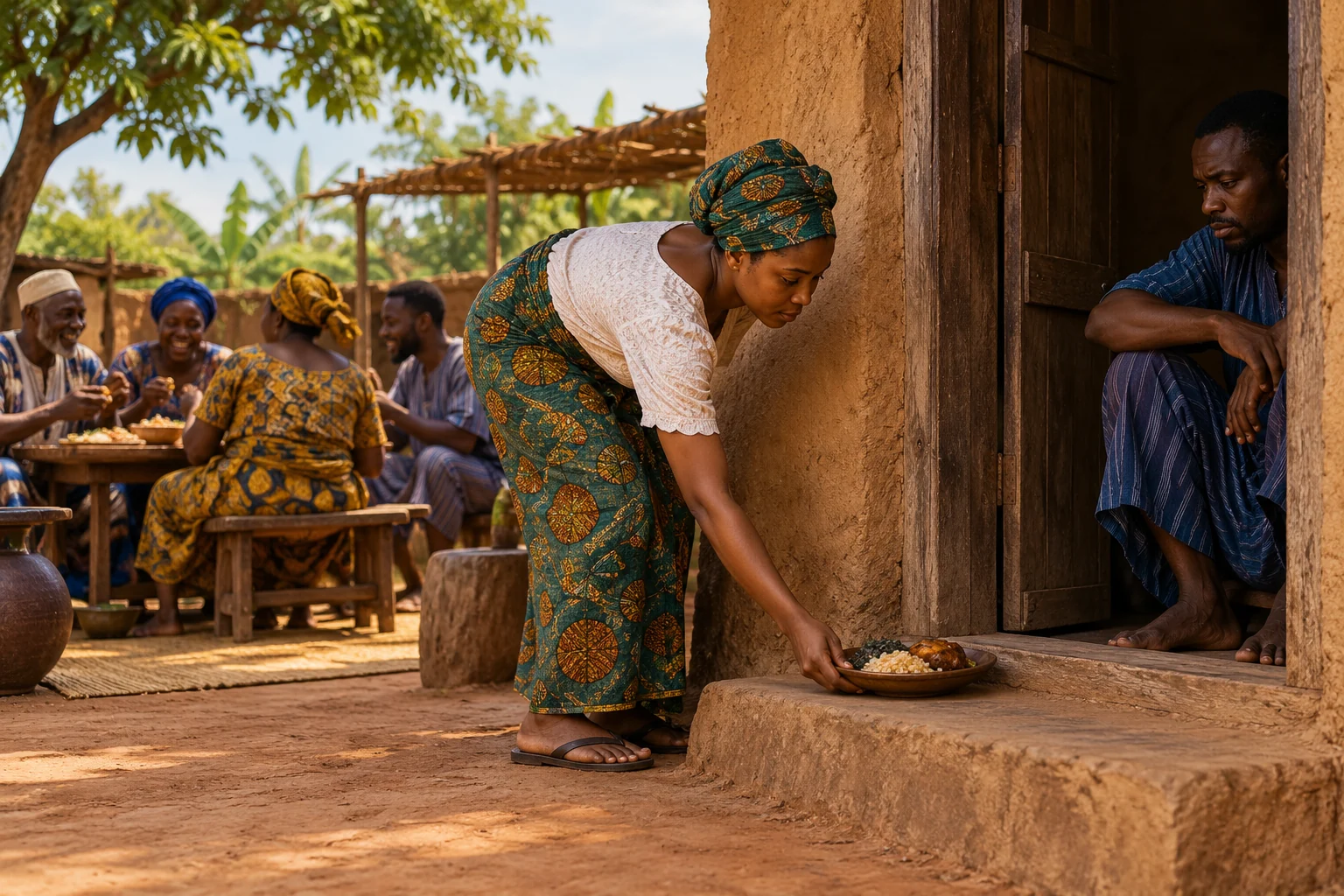
Four Awó share a meal while Ayán Kolokolo, identified as Eleguá, watches hungrily. He has not been willing to help others. When he reaches for food, he is challenged about that refusal and leaves in shame. Food remaining from the meal is sent to the doorway, where he receives it. The account links his place at the threshold with a subsequent willingness to help Awó and Iyalosha.
The tale makes reciprocity part of participation, but its distribution of leftovers also raises a question about exclusion and humiliation. Hunger should not be treated as proof that a person has failed the group. The useful issue is how expectations of contribution are communicated and how a community can invite cooperation without using deprivation as discipline. A sacred threshold role is not a model for ranking human dignity.
Narrative setting: Cuban/Lukumí narrative in the accounts considered here; no individual author established for this passage.
A land needs food, not another boast
Molala holds sacred knowledge of leaves, yet his people are weak and deprived. Elegbá arrives and explicitly names the land’s lack of food. They seek Orisha Oko, who brings agricultural resources and accompanies them back. Cultivation, rain, crops, animals, and fish become abundant, and he remains for a year helping the population. The story then frames renewed life through a sacred confrontation with Death and public acknowledgment of the helpers.
The material diagnosis is unusually explicit within the narrative: knowledge is not enough when people lack nourishment. Orisha Oko’s extended stay also distinguishes development from a single spectacular gift. The account’s descriptions of bodily difference should not be repeated as moral judgments, and its promises about longevity remain mythic. Its strongest study contribution is a connection between shared food, productive ground, and the continuing labor of care.
Narrative setting: Cuban/Lukumí narrative in the accounts considered here; no individual author established for this passage.
Akin’s vigor is treated as something requiring protection
Akin is introduced early in life as vigorous and active. Divination asks him to offer sacrifice so that his energy can remain into old age rather than being diminished by illness. He responds, and the account represents vitality restored or secured, followed by celebration and praise of his diviners and Ifá. The prose specifies a feared bodily condition, while the verse’s ending contrasts energy with the reduced activity illness can impose. It does not give symptoms, a medical diagnosis, a treatment history, or a measured lifespan. The episode concerns preservation of an embodied capacity within a sacred relationship, not an independently documented case of recovery.
The Spanish rendering repeatedly uses a word for laziness where the context describes illness reducing someone’s activity. An article should not carry that wording into a moral judgment against sick or disabled people. The verse’s own structure identifies illness as the cause of diminished capacity, distinguishing it from a voluntary refusal to act. Its religious explanation remains that Akin responds to divination and receives favorable preservation; this cannot be converted into clinical proof or a promise that any reader can retain youthful energy indefinitely.
A contemporary interpretation can examine the vulnerability of a quality that initially appears abundant. The young protagonist does not yet lack vigor, but is asked to attend to its continuance. That perspective deepens the distinction between possessing a capacity and being invulnerable to its loss. The account does not establish what every later illness means or authorize retrospective blame. Its particular narrated response is sufficient for discussing responsibility and sacred support without making bodily condition a measure of character.
Narrative witness and setting: African Ifá verse in the explicitly named Ayo Salami division, transmitted with Yoruba text and a Spanish rendering in the compilation.
Three absent warriors discover simultaneous pressures
Èsín in Ìda, Òkò in Lìkì, and Abóóda in Òyó are associated warriors. Towns they have attacked organize simultaneous attacks on their respective homes before another campaign. Each warrior is occupied resisting a local assault, and their expected meeting fails. Their defenses succeed, with some attackers driven off and others captured or enslaved. After prolonged absence, the king of Òyó summons information and hears that each has faced his own crisis. The explanation restores understanding, and praise follows. The prose warns against assuming a reason for lost contact. The story does not portray the warriors as innocent of earlier aggression or erase their captives.
The account supports caution about interpreting absence, but its military setting complicates a comforting friendship story. The three have participated in warfare against the communities that now coordinate retaliation. Their own successful defenses include enslavement, so renewed understanding among them does not make every represented act benevolent. Those details must remain alongside the lesson about incomplete knowledge. The narrative’s divinatory frame also matters: the three receive counsel, and the ending praises priests and Ifá once the dispersed pressures become intelligible.
It does not explicitly narrate their compliance before the attacks, so an article should not invent an offering scene merely to regularize the sequence. A contemporary reading can examine the difference between lack of contact and lack of loyalty. The source makes that distinction through separate local crises eventually compared, not through an omniscient initial assurance that everyone is safe. Understanding arrives by inquiry into particular circumstances, while the warfare and captivity remain ethically consequential features of the transmitted world.
Narrative witness and setting: African Ifá verse in the explicitly named Ayo Salami division, transmitted with Yoruba text and a Spanish rendering in the compilation.
What was born in this Odù
“Born” can name an explicit traditional origin association or what emerges through a story: a capacity, relationship, practice or order of life. Interpretations drawn from a narrative are labelled below, so their basis remains clear.
Material manifestation of spirit
Selected traditional source association.
The origin list names the materialization of spirit, repeated in a banquet reference to spirits appearing as living guests. This is a local religious presence motif and not evidence for a general claim about apparitions.
Food security becomes a shared task
Contemporary interpretation from the selected myth.
As a contemporary interpretation, a fuller responsibility for nourishment emerges when Elegbá names the shortage and Orisha Oko brings cultivation and sustained help. This is an analytical theme, not a traditional origin of agriculture or an endorsement of the source’s bodily stigmas.
Correlations to life dimensions
These questions bring the selected stories into contemporary life. They are interpretive invitations for study.
Work and resources
Orisha Oko brings the means of cultivation and remains to help. The account supports distinguishing a short-term transfer from sustained work that enables a place to produce enough for its own people. Orisha Oko stays a year rather than leaving one gift.
Reflect: What continuing capacity will remain after the helper leaves?
Relationships and family
Ayán Kolokolo’s invitation to reciprocity is shaped by shame at the meal. A careful reading asks how contribution can be expected without making hunger, exclusion, or humiliation the price of belonging. The hungry figure is identified with earlier refusal to help.
Reflect: How can this expectation be stated without withholding basic regard?
Character and inner life
Molala’s knowledge does not prevent exhaustion when the land remains deprived. The story supports acknowledging the limits of expertise and seeking a complementary contribution rather than treating another person’s help as a threat. Elegbá names the shortage that sacred knowledge has not resolved.
Reflect: What necessary knowledge or resource belongs to someone else here?
Community and responsibility
Elegbá names lack of food while others are immersed in sacred explanations. The episode makes it possible to respect religious life while asking whether the community’s most ordinary material needs are being met. Cultivation and sustained nourishment change the condition of the land.
Reflect: What would change if nourishment were treated as the first shared responsibility?
A deeper reading of the sacred relationships
Sacred knowledge addresses capacities and circumstances beyond immediate sight
Akin’s consultation concerns the continuation of vigor beyond the present, while the warriors’ frame makes geographically separate troubles available to a shared explanation. Both passages locate understanding within Ifá rather than treating present appearance as complete knowledge. Akin explicitly responds; the second narrative gives counsel and later praise without explicitly narrating compliance. That difference should remain. The article can explain the religious authority of disclosure without inventing missing acts to make every sequence identical. Contemporary reflection may value attention to future vulnerability and unseen pressures, but the source’s stronger account concerns divinatory knowledge and its capacity to orient a favorable relation to events that an individual observer cannot fully see.
The refrain locates knowledge in transmission, not easy improvisation
The warriors’ verse repeatedly says that an apprentice may struggle to find a passage for Òtúrúpòn while experienced diviners retain its important material. This is the source’s own framing of expertise, not evidence from a statistical survey of all diviners. It places the extensive account inside a repertoire whose transmission matters. A modern article can explain why lineage, training, memory, and skilled performance are relevant to reading the text without claiming that any current practitioner’s knowledge can be judged from this one refrain. The repeated frame also makes the eventual shared explanation more than casual gossip: it is transmitted as a divinatory account with named clients, separated circumstances, and acknowledged sacred authority.
Explaining absence does not acquit every action
The warriors learn why their associates have not appeared, but that explanation does not erase their earlier attacks or the enslavement of opponents. A contemporary reader can appreciate the correction of a mistaken assumption while retaining an ethical account of the warfare. This distinction is also useful beside the earlier reluctant participant and the land whose hunger requires cultivation: understanding one difficulty does not automatically settle every responsibility attached to the actors. The article should resist making protagonists wholly admirable merely because a divinatory account ends in their praise. The source can carry religious significance and practical insight while preserving a social world whose coercive acts remain visible and open to clearly identified contemporary ethical reflection.
Questions that deepen the study
Does Akin’s story identify illness with a bad character?
The represented contrast concerns energetic activity diminished by illness. Although the Spanish uses a term for laziness, the context gives a bodily cause and should not be retold as a moral failure. Akin’s explicit response and favorable result belong to this account’s religious explanation. They do not establish that a person who becomes ill has neglected a duty, nor do they promise permanent vigor to readers. The article can discuss the vulnerability of present capacity and the sacred support sought for its continuation. It should leave clinical diagnosis, actual lifespan, and judgments about anyone else’s character outside the evidence provided by this concise narrated sequence.
Were the three warriors absent because they had abandoned one another?
Their eventual explanations identify simultaneous local attacks as the reason they could not meet. The king’s inquiry compares those accounts and corrects the interpretation of prolonged absence. The prose therefore advises caution in attributing lost contact to a single assumed cause. This does not mean the text guarantees that every absent friend is facing the same circumstances or that inquiry is unnecessary. Understanding arrives because particular events are investigated. The warriors’ participation in earlier campaigns and the coercive results of their defenses also remain part of the story. The lesson about incomplete knowledge should not turn them into innocent victims whose other actions vanish when their absence is explained.
Does the verse show the warriors performing the advised sacrifice?
It explicitly says that the three are advised to respond, but the supplied enacted sequence proceeds into warfare, interrupted contact, inquiry, and later praise without a separately narrated compliance scene. An article should preserve the counsel and the religious ending while leaving that missing action unspecified. This differs from Akin’s passage, which directly states that he performs the sacrifice. The distinction makes comparison more accurate and avoids standardizing every story into an identical ritual formula. The warriors’ refrain locates the account within experienced divinatory transmission, but that framing does not authorize an editor to add events simply because they would make the narrated religious sequence more symmetrical.
What the four narratives reveal together
The earlier reluctant participant and hungry land narratives examine participation and the practical work needed to sustain a community. The African verses add the protection of Akin’s vigor and an explanation of three associates’ prolonged absence. These accounts make capacity and availability less transparent than they first appear: energy can be vulnerable, and distance can conceal separate urgent pressures. Their sacred frame supplies disclosure and acknowledged authority, with explicit compliance in Akin’s story and a more elliptical sequence for the warriors.
Contemporary reflection can compare responsibility, incomplete knowledge, and support without treating illness as character failure. It should also retain the military story’s ethical difficulty. The warriors’ renewed understanding does not erase prior aggression or enslavement, and their successful defense is not a reason to smooth every action into benevolence. The study gains depth by preserving both the religious significance and the actual complications of its transmitted world.
Living with this Odù
A continuing life or initiatory relationship
A received life relationship with Òtúrúpòn Òwónrín can make nourishment and the interpretation of absence recurring questions. Ayán Kolokolo's hunger appears beside his unwillingness to help, and food at the threshold changes the relation without removing its earlier difficulty. Molala's expertise in leaves does not feed a deprived population until agricultural support arrives through Orisha Oko. Akin's vigor is treated as a capacity requiring sacred care rather than a possession that will automatically endure. The warriors' failed meeting then shows simultaneous pressures behind lost contact, while preserving their own earlier aggression and later captives.
Over time, character may develop through distinguishing specialized knowledge from the need actually present, and absence from a finished story of rejection. The inward temptation can include shame that blocks participation, pride in expertise or resentment when others do not appear as expected. These witnesses do not promise longevity or justify enslavement as a successful defense. Eleguá's local identification, Ifá and the named sacred helpers remain active. Carrying the sign can invite a changing responsibility to concrete provision, sustained capacity and an accurate account of what other people are facing beyond the part visible from one's own position.
A particular consultation and its question
In consultation, the actual question can distinguish hunger, a mismatch between expertise and need, concern for embodied capacity and an absence caused by competing crises. The threshold meal asks what participation and care might make possible without making shame the ideal method. Molala's land asks whether another performance of existing knowledge would leave the material lack untouched. Akin's verse preserves a religious relation to vigor without supplying a diagnosis or measured lifespan. The warriors' account asks what information is needed before a missed meeting becomes evidence of indifference, while refusing to call all their actions innocent.
A practitioner cannot infer a client's bodily condition, promise recovery or announce that an absent friend faces a particular attack. Contemporary reflection can ask what actually nourishes the group, which competence is missing and whether a message has been replaced by assumption. A situational result is different from a lifelong identity of depletion. Its religious meaning remains with the reading, while the narratives make concrete need and unseen pressure relevant without reducing sacred help to nutrition alone or translating a violent campaign into a neutral tale of busy colleagues.
Constructive and adverse possibilities
Constructive unfolding may include nourishment reopening participation, agricultural provision meeting a real lack and information correcting an assumption about lost contact. Sacred attention to vigor also preserves the significance of embodied capacity. Adverse movement appears when expertise becomes a substitute for food, shame closes a relation or unexplained absence is turned into a confident accusation. The warriors' successful defenses do not make their earlier attacks or enslavement morally complete. Iré and osogbo require contextual interpretation rather than a verdict from strength or attendance alone. The sources distinguish care, provision, protection and accurate understanding. Akin's favorable ending remains a religious narrative rather than evidence of clinical efficacy, while the hungry land shows that a sacred world can name material insufficiency directly without making every difficulty a failure of knowledge or devotion.
An illustrative situation in everyday life
Hypothetically, a community center offers sophisticated educational programs while attendees lack enough food to participate consistently. Organizers interpret irregular attendance as ingratitude, unaware that several volunteers face simultaneous household emergencies. Molala's structure asks whether existing expertise meets the actual lack; the warriors' missed gathering asks what information should precede a judgment about absence. The threshold meal adds a possibility of receiving a reluctant participant without making exclusion permanent. This is an illustrative interpretation, not a claim that a particular sacred response secures health or attendance. The organizers feel that their effort should be recognized. The external responsibility is to learn what sustains participation, while the inward task is tolerating the possibility that useful expertise is still insufficient for the present need.
Sources and reading context
The first two narrative witnesses
The selected Cuban-labelled Spanish passages explicitly identify Ayán Kolokolo with Eleguá; no automatic identification with the drummer deity is made from the name. The source’s bodily stigmas and longevity claims are not adopted. One non-stigmatizing explicit origin is retained, and the additional emergence motif is explicitly interpretive.
Narrative motifs are summarized independently. The life-dimension reflections are contemporary interpretation. How these reference studies are built explains the wider source approach and the distinction between a reference article and personal divination.
Additional named witnesses
- Ayo Salami. Explicit Òtúrúpòn Òwónrín A and B divisions supply Akin and the three associated warriors. The recurrent apprentice/elder-diviner refrain is treated as the verse’s transmission claim rather than a universal empirical assessment.
Akin has no supplied diagnosis or measured lifespan. The warriors’ compliance is not explicitly narrated, and their earlier aggression and enslavement remain visible. The refrain does not establish every current practitioner’s knowledge. No Brazilian provenance is inferred.
Bibliographic identification
- Ayo Salami. Ifá: A Complete Divination. Lagos: NIDD, 2002 catalogue record. Library catalogue record. Bibliographic identification of the named author and work; the edition behind the transmitted account remains to be matched.
Read the source method and wider scholarly context.
The catalogue links identify published works and their authors. They are separate from proof of an individual episode’s wording or attribution. Contemporary comparisons and the synthesis above are editorial interpretation. The author’s books and Academy companions below provide further study; their sales links are separate from the source references.
Continue within the family
Previous study: Òtúrúpòn Ìròsùn · Next study: Òtúrúpòn Òbàrà