
Òwónrín Òtúrúpòn is a mixed Odù in Ifá’s 256-part corpus. Òwónrín Òtúrupòn’s selected narratives concern capacities that authority is slow to recognize. Ifá Dere delays initiating a knowledgeable youth; a later intervention by Adibo culminates in admission, though the text’s actor identifications are unstable. Olúo Popó fears that honoring Osanyin will diminish his rule, despite his household’s need. Both accounts question an idea of power that makes another person’s recognized capacity seem like a personal loss.
A question to carry through the study: Whose ability would you have to recognize to receive the help you need?
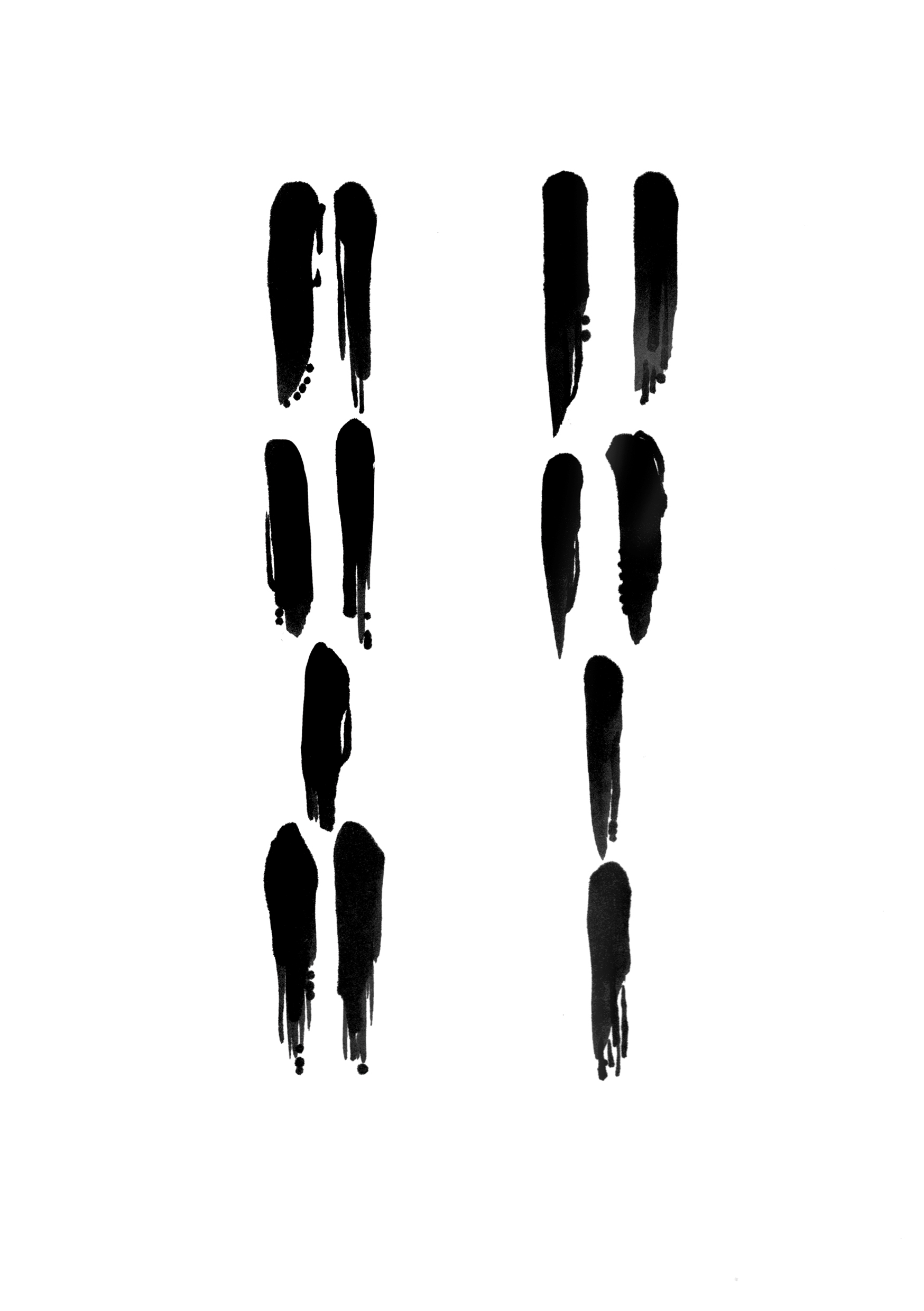
This Academy reads the right column first, then the left. Each row carries a single or double mark.
Where this Odù belongs
Òwónrín Òtúrúpòn belongs to the Òwónrín family in this Academy’s study sequence. It is a mixed Odù, distinct from Òtúrúpòn Òwónrín. The order matters. Its teaching is approached through its own narratives, rather than by adding two general descriptions of the principal signs together.
Key Òrìṣà and sacred relationships
The figures below are selected for their roles in the accounts discussed here. They offer connected reading paths through the tradition.
-
Ọ̀rúnmìlà. Òrúnmìlà urges Ifá Dere to initiate the knowledgeable youth and mediates when Olúo Popó resists Osanyin. His role makes recognition and consultation necessary where authority has become defensive.
-
Òsanyìn. Osanyin possesses the capacity Olúo Popó’s household needs but has been kept from his land. His eventual willingness to help is negotiated through Òrúnmìlà rather than assumed as an automatic obligation.
-
Ọya. Oyá is named among the presences addressed in the youth’s intervention for Ifá Dere and the land. The confused wording permits only this limited association, not an invented scene or attributed speech.
Key myths and their meanings
The pupil admitted after defending the household
Ifá Dere has a young person who knows his secrets, yet ignores Òrúnmìlà’s advice to initiate him. A conflict involving rival practitioners then threatens the land. The passage describes someone called Adibo acting on behalf of the household and community. After the opposition collapses, Adibo returns to an awaiting assembly and receives initiation. The text does not clearly settle every identification between the youth and the later actors.
The clearest sequence concerns delayed recognition followed by admission after demonstrated service. However, the source confuses some actors and pronouns, so its mechanics cannot responsibly be reconstructed. The interpretive question is whether institutions require vulnerable learners to prove exceptional usefulness before acknowledging an ability already known. Demonstration can matter without making crisis service the only route to a fair place.
Narrative setting: Spanish account with unstable names and pronouns.
The ruler who fears a helper’s standing
Olúo Popó worries about a son described as lacking strength. Encountering Òrúnmìlà and Osanyin, he hides because he has previously refused to honor Osanyin or allow him into his land, fearing loss of control. Òrúnmìlà mediates and entrusts Osanyin with the capacity to help father and son. Osanyin agrees while explaining the repeated exclusion that has shaped their relationship.
The obstacle is not lack of possible assistance but an idea that recognizing another power diminishes one’s own. The son’s need makes the cost of that idea visible beyond the ruler himself. A careful reading avoids adopting the source’s language about deficiency as a judgment of disability. Its useful concern is the willingness to share authority and acknowledge expertise that personal rivalry has kept outside.
Narrative setting: Spanish account of Olúo Popó and Osanyin.
An absent brother’s inheritance claim becomes a deadly public announcement
Tortoise, Snail, Snake, and Squirrel share a father but have different mothers. Squirrel is away when the father dies. The brothers at home disregard counsel about the absent sibling and divide three garments among themselves. Squirrel returns, receives no garment, and takes a fly whisk found at the grave. A divine appointment then makes him a herald who announces the snake’s presence. He turns that authority against his brothers, calling hunters’ attention to them and bringing about their deaths. The account links their inherited coverings and Squirrel’s tail with a family division that escalates far beyond the initial distribution.
The brothers’ assumption that Squirrel looks harmless helps them dismiss the earlier counsel. Their exclusion later meets an authority they had not anticipated. The sacred appointment is not merely a metaphor for social influence: God gives the herald role within the witness, and the announcement has deadly consequences. Yet this does not make Squirrel’s revenge a proportionate or universally approved response. Compared with the earlier fear of consulting another practitioner, the new episode concerns a family that refuses to account for an absent member’s claim and then encounters power outside its own settlement.
Contemporary interpretation can examine absence, entitlement, and the misuse of a legitimate office for a private grievance. The source’s animal-origin details should remain sacred narrative rather than zoology. Its lethal ending also resists a tidy claim that inheritance justice has been restored, since exclusion is answered by destruction rather than a repaired distribution.
Narrative witness and setting: Cromwell Osamaro, four animal brothers and their father’s garments
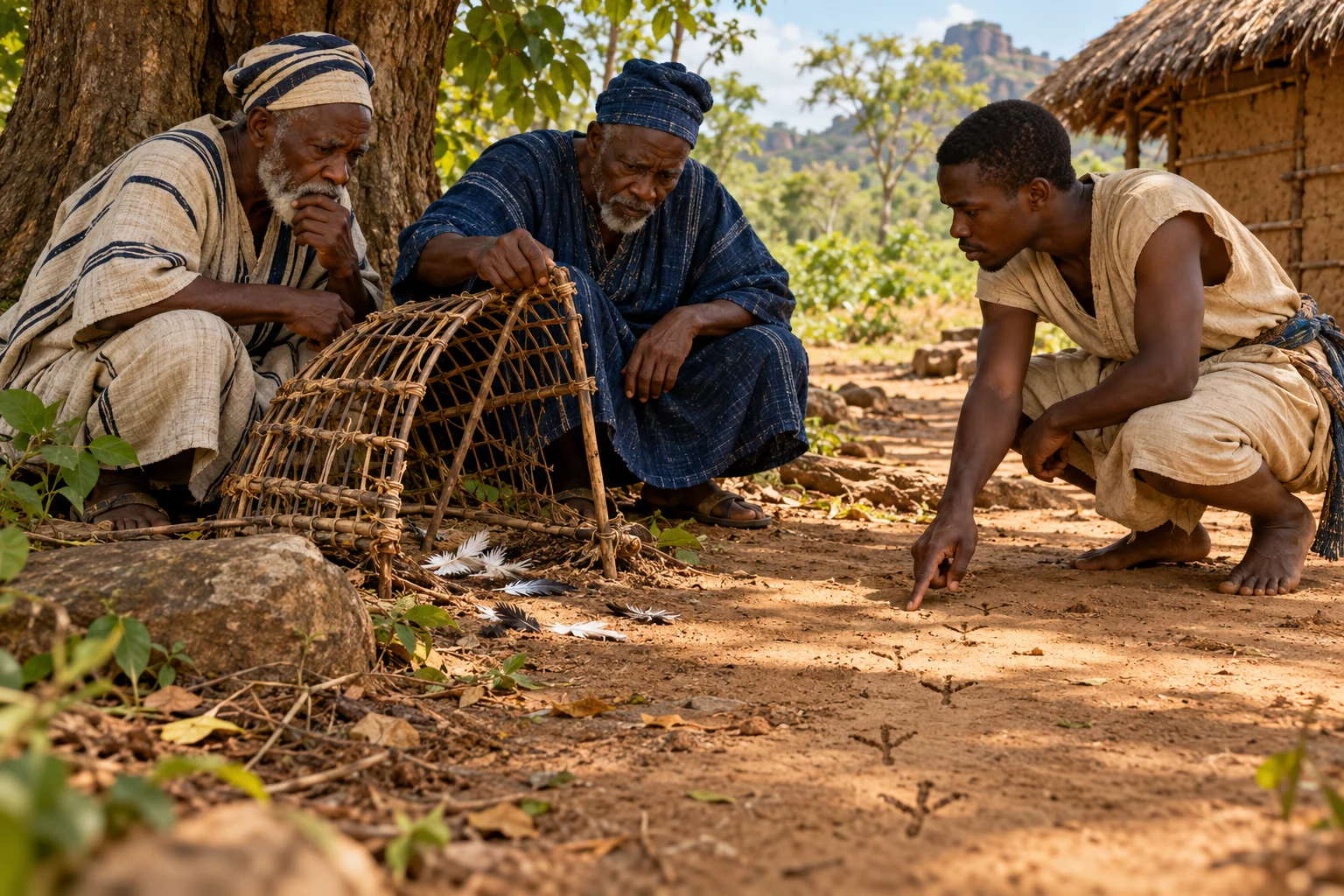
Inspecting the traps gives the youngest brother his catch back
Three brothers set bird traps and return home. The next morning, the two elders check them without the youngest, Obokun. Only his traps have caught birds, but they remove the catch and claim it came from their own traps. Obokun later visits the site and notices signs contradicting their story. He confronts them, and the dispute reaches the elders of the community. Two appointed inspectors examine the traps and confirm his account. The older brothers are required to return the birds. Unlike a dispute settled by rank alone, the outcome depends on traces remaining at the place where the work occurred.
The youngest brother does not rely only on resentment or an assertion that he has been treated unfairly. He checks the site and identifies a discrepancy that other people can investigate. The communal elders then create a procedure through which knowledge of the place can correct the brothers’ claim. This differs sharply from the preceding inheritance episode, where a neglected claim becomes lethal revenge through a herald’s authority. Here third parties establish ownership and order restitution before the conflict becomes destruction.
Contemporary interpretation can examine why a claim needs both an available trace and someone willing to inspect it. The source does not narrate a new ritual at the point of judgment, so one should not be invented to make the account resemble every other Ifá story. Its placement within the witness allows ordinary investigation to remain a meaningful part of the narrated world rather than something that religious explanation must exclude.
Narrative witness and setting: Cromwell Osamaro, Onikporo, Onitaji, and Obokun
What was born in this Odù
“Born” can name an explicit traditional origin association or what emerges through a story: a capacity, relationship, practice or order of life. Interpretations drawn from a narrative are labelled below, so their basis remains clear.
Recognition of an already capable learner
Contemporary interpretation from the selected myth.
As a contemporary interpretation, the youth’s delayed recognition and Adibo’s eventual initiation suggest acknowledgment of capability previously withheld. The source’s unstable actor identifications limit the connection; no claim of a traditional born item is made.
Help without monopoly
Contemporary interpretation from the selected myth.
As a contemporary interpretation, mediation between Olúo Popó and Osanyin suggests the emergence of shared authority where monopoly has blocked care. This reading concerns their narrated relationship and is not a canonical origin of cooperation.
Correlations to life dimensions
These questions bring the selected stories into contemporary life. They are interpretive invitations for study.
Work and resources
The knowledgeable youth is used as a bearer of secrets before receiving formal recognition. The story invites attention to how institutions benefit from a learner’s labor while delaying access to status, training, or the protections that should accompany responsibility.
Reflect: What work are you accepting from someone whose standing you still deny?
Relationships and family
Olúo Popó’s defensive relationship with Osanyin affects his son. The account makes it possible to ask whether a parent’s conflict with a potential helper is being allowed to determine what support a dependent person can receive.
Reflect: What disagreement should be set aside for someone else’s need?
Character and inner life
The ruler fears that honoring Osanyin means losing his own capacity. The story can support reflection on competitive self-protection without treating humility as self-erasure; recognizing another’s contribution can clarify rather than cancel one’s own responsibility.
Reflect: Where are you confusing shared authority with personal defeat?
Community and responsibility
Òrúnmìlà mediates without pretending the history of exclusion never happened. Durable cooperation requires hearing the helper’s account too, rather than asking only the most visibly powerful party what terms will make the arrangement acceptable. Osanyin supplies that history during the mediated encounter.
Reflect: Whose grievance must be heard for cooperation to last?
A deeper reading of the sacred relationships
Sacred authority does not erase the question of its use
Squirrel receives a divine herald’s role, but his private inheritance grievance shapes how he uses it against his brothers. The narrative gives the appointment real authority without requiring a contemporary reader to celebrate every consequence. The brothers’ earlier refusal of counsel also remains consequential. Obokun’s case supplies a different route, where appointed inspectors use observation to settle a claim and restore goods. Together the accounts distinguish authority’s source from the conduct through which it acts. Explaining the religious logic therefore includes both the divine commission and the unresolved proportionality of revenge, rather than reducing the whole tale to a modern lesson or treating sacred power as automatic moral innocence.
Absence makes a claim vulnerable to another person’s account
Squirrel is not present when the garments are divided, and Obokun is absent when his brothers collect the birds. In each, those present control the first account of what belongs to whom. The outcomes differ because the later response differs: one claim becomes a deadly announcement, the other becomes an inspection followed by restitution. Contemporary interpretation can ask how a group protects the standing of someone who cannot witness a distribution. The stories do not establish that every absent person has been cheated. Their specific contribution is to make the informational advantage of presence visible and to compare what happens when that advantage is used against a relative.
Restitution and retaliation produce different endings
The inspectors return Obokun’s catch without removing his brothers from the world. Squirrel’s response destroys the people who excluded him. Both episodes begin with a family claim, but they do not arrive at equivalent forms of correction. The earlier initiation and inter-practitioner stories add other questions about access to knowledge and authority. Contemporary comparison can distinguish recovering what was taken from seeking an outcome in which the other party can no longer act. This does not erase the seriousness of inheritance exclusion or make the inspection story a complete model for every dispute. It gives a concrete contrast between repair of a claim and escalation beyond the original loss.
Questions that deepen the study
Does Squirrel’s divine appointment make the revenge a model to imitate?
The account gives the herald role a divine source and links its use to the excluded inheritance claim. That is its religious explanation of the new power Squirrel possesses. It does not follow that a reader should treat the lethal revenge as proportionate or exemplary. A careful comparison can acknowledge sacred authority and still ask how a private grievance shapes its use. The brothers’ deaths do not restore a shared family distribution. Contemporary interpretation should therefore resist turning the ending into complete justice or predicting that an overlooked relative will acquire a similar means of punishment.
Why do the inspectors matter in Obokun’s dispute?
They make the youngest brother’s account testable by examining the place where the birds were caught. The elders do not simply accept the older brothers’ rank or Obokun’s anger. The remaining signs support a finding, and the catch is returned. Contemporary interpretation can recognize the importance of accessible evidence and a forum willing to inspect it. Within the witness, no additional ritual is narrated at this stage, so a summary should not supply one. Ordinary inquiry is part of this particular resolution, and its presence need not be opposed to the compilation’s broader religious setting.
Are the two brother stories repetitions of the same inheritance lesson?
One concerns a deceased father’s garments and an absent sibling whose exclusion leads to lethal retaliation. The other concerns birds taken from traps and a living dispute resolved by inspection and restitution. Their shared family structure makes comparison useful, but the property, evidence, authority, and endings differ. Contemporary reflection can ask how a claim becomes known and what kind of correction follows. The first supplies a sacred animal-origin account and divine herald, while the second emphasizes traces and communal judgment. Treating both as a generic command to protect possessions would lose the very differences that give them interpretive depth.
What the four narratives reveal together
The new Òwónrín Òtúrúpòn selections make absence consequential in two different family disputes. Squirrel is omitted from a father’s legacy and later uses a divine herald’s authority in deadly revenge. Obokun loses birds while absent from his traps, then obtains restitution through inspection of the site. The comparison distinguishes a claim’s recognition from the form its correction takes. The earlier initiation and practitioner narratives add other situations where knowledge and access shape a person’s standing.
Religious explanation remains explicit in the first new account, while the second should retain its ordinary investigative procedure without an invented rite. Contemporary interpretation can examine absent members’ vulnerability, the use of authority, and the difference between restitution and retaliation. It should not celebrate destruction as complete justice or treat the animal figures as factual origins of species behavior. The youngest brother’s recovered catch provides a concrete alternative to annihilating an opponent.
Living with this Odù
A continuing life or initiatory relationship
A received relationship with Òwónrín Òtúrúpòn can sustain attention to recognition withheld because another’s capacity unsettles existing authority. The first witness places an uninitiated learner’s knowledge beside a later admission, but its unstable names leave the exact mechanics unresolved. Olúo Popó’s repeated exclusion of Osanyin gives a clearer tension: help is needed from a presence whose standing the ruler has feared. Òrúnmìlà’s mediation permits a relation without erasing that history.
The inheritance account adds an absent sibling’s excluded claim and a retaliation far beyond the original division. Obokun’s recovered catch supplies another possibility, where inspection of remaining traces answers senior brothers’ false account. Across a life, reflection may concern readiness recognized late, receiving help without control, an absent person’s share, or evidence that survives a confident misrepresentation. The person is not fixed as excluded apprentice or resentful sibling. The sign invites character able to hear another’s competence before necessity forces acknowledgment, and to distinguish correction from retaliation. Its sacred relations remain active while its incomplete identifications stay incomplete, rather than being repaired through invented certainty about who performed every narrated act.
A particular consultation and its question
In consultation, Òwónrín Òtúrúpòn can distinguish a claim needing evidence from a contribution needing recognition. Obokun’s catch is restored through inspection, while Osanyin’s exclusion concerns a ruler’s fear of another’s standing. The actual question determines whether investigation, acknowledgment, or a changed relation is at issue. A practitioner cannot infer a concealed theft or identify a helper’s spiritual power from the sign alone.
The inheritance witness adds the effects of deciding for someone absent, followed by destructive use of public authority. It can make an overlooked claim visible without validating retaliation. The pupil account raises readiness and institutional admission, but its unstable pronouns do not establish an exact heroic sequence. Maintaining that uncertainty is part of a truthful interpretation. A careful discussion can ask whose contribution has been assumed available without standing, who was missing when a division occurred, and what traces remain at the place of work. Religious mediation, particularly Òrúnmìlà and Osanyin’s roles, remains distinct from ordinary inspection. A present consultation does not guarantee eventual office, prescribe confrontation, or make the client permanently an aggrieved outsider. It concerns this arrangement and the forms of recognition it can responsibly support.
Constructive and adverse possibilities
Constructive unfolding may include help received without denying the helper’s standing, an excluded claim heard, and evidence examined independently of seniority. Obokun’s return to the traps matters because the place retains traces that the brothers’ account cannot simply replace.
Adverse unfolding can involve authority withholding recognition until crisis, dividing an inheritance as though absence erased membership, or turning a valid grievance into deadly public action. Squirrel’s retaliation remains disproportionate to the original exclusion. The learner’s account also cannot establish that a dangerous defense is a prerequisite for initiation, given its uncertain identifications. These contrasts examine the relation among standing, evidence, and response. They do not determine an actual reading’s direction, supply a diagnosis for the ruler’s son, or justify coercing a reluctant helper. Recognition becomes more exact when both contribution and consequence can be heard.
An illustrative situation in everyday life
In a hypothetical example, three siblings manage a shared property while one is abroad. They distribute income among those present and assume the absent sibling has no immediate claim. When she returns, anger tempts her to damage their public standing rather than seek an account of the distribution. The inheritance story makes exclusion visible without making retaliation a proportionate answer. Obokun’s inspected traps add another route through records and traces that can be examined beyond the senior siblings’ confidence. Her inward hurt deserves recognition, while the external question still concerns what was received and divided. This illustration predicts no family violence and claims no consultation finding; it distinguishes a claim’s legitimacy from every action taken to enforce it.
Sources and reading context
The first two narrative witnesses
These Spanish Cuban-style passages have no distinct usable born list in the inspected opening. The first has confused names and pronouns, and its mechanics are left unresolved. Olúo Popó remains a source title; interpreted emergence motifs do not remove the partial evidence status.
Narrative motifs are summarized independently. The life-dimension reflections are contemporary interpretation. How these reference studies are built explains the wider source approach and the distinction between a reference article and personal divination.
Additional named witnesses
- Cromwell Osamaro. Explicit heading supports both the four-animal inheritance account and the three brothers’ trap dispute.
The snake’s translated identity and animal-origin claims are not treated zoologically. The divine herald’s revenge is described without endorsement. No ritual is inserted into the trap inspection where the source gives none; neither story creates a personal inheritance prohibition.
Bibliographic identification
- C. Osamaro Ibie. Ifism: The Complete Work of Orunmila. Lagos; multivolume publication beginning 1986. Library catalogue record. Related bibliographic record for the named narrative witness. Exact volume, edition and page of the transmitted account have not been independently matched.
Read the source method and wider scholarly context.
The catalogue links identify published works and their authors. They are separate from proof of an individual episode’s wording or attribution. Contemporary comparisons and the synthesis above are editorial interpretation. The author’s books and Academy companions below provide further study; their sales links are separate from the source references.