
Òtúrúpòn Òdí is a mixed Odù in Ifá’s 256-part corpus. Òtúrúpòn Òdí pairs a maize monopoly with a diviner whose prediction becomes entangled with a relationship to the woman he advised. The maize seller offers more money instead of releasing the crop on which others depend; the family acts without his agreement and cultivation spreads. Kintoshe’s story joins expert authority, intimacy, and royal recognition. The focus is the difference between meeting an actual need and treating another kind of power as an adequate substitute.
A question to carry through the study: What specific need is being avoided by offering money, certainty, or status instead?

This Academy reads the right column first, then the left. Each row carries a single or double mark.
Where this Odù belongs
Òtúrúpòn Òdí belongs to the Òtúrúpòn family in this Academy’s study sequence. It is a mixed Odù, distinct from Òdí Òtúrúpòn. The order matters. Its teaching is approached through its own narratives, rather than by adding two general descriptions of the principal signs together.
Key Òrìṣà and sacred relationships
The figures below are selected for their roles in the accounts discussed here. They offer connected reading paths through the tradition.
-
Ọ̀rúnmìlà. Orunmila tells the maize seller that the crop itself is required, not simply a larger payment; the account also locates the second diviner’s claim within Ifá’s authority.
-
Òrìṣà Òkò. Orisha Oko is explicitly invoked at the close of Kintoshe’s narrative. The source supplies an association but no described intervention, so no action is assigned to him.
Key myths and their meanings
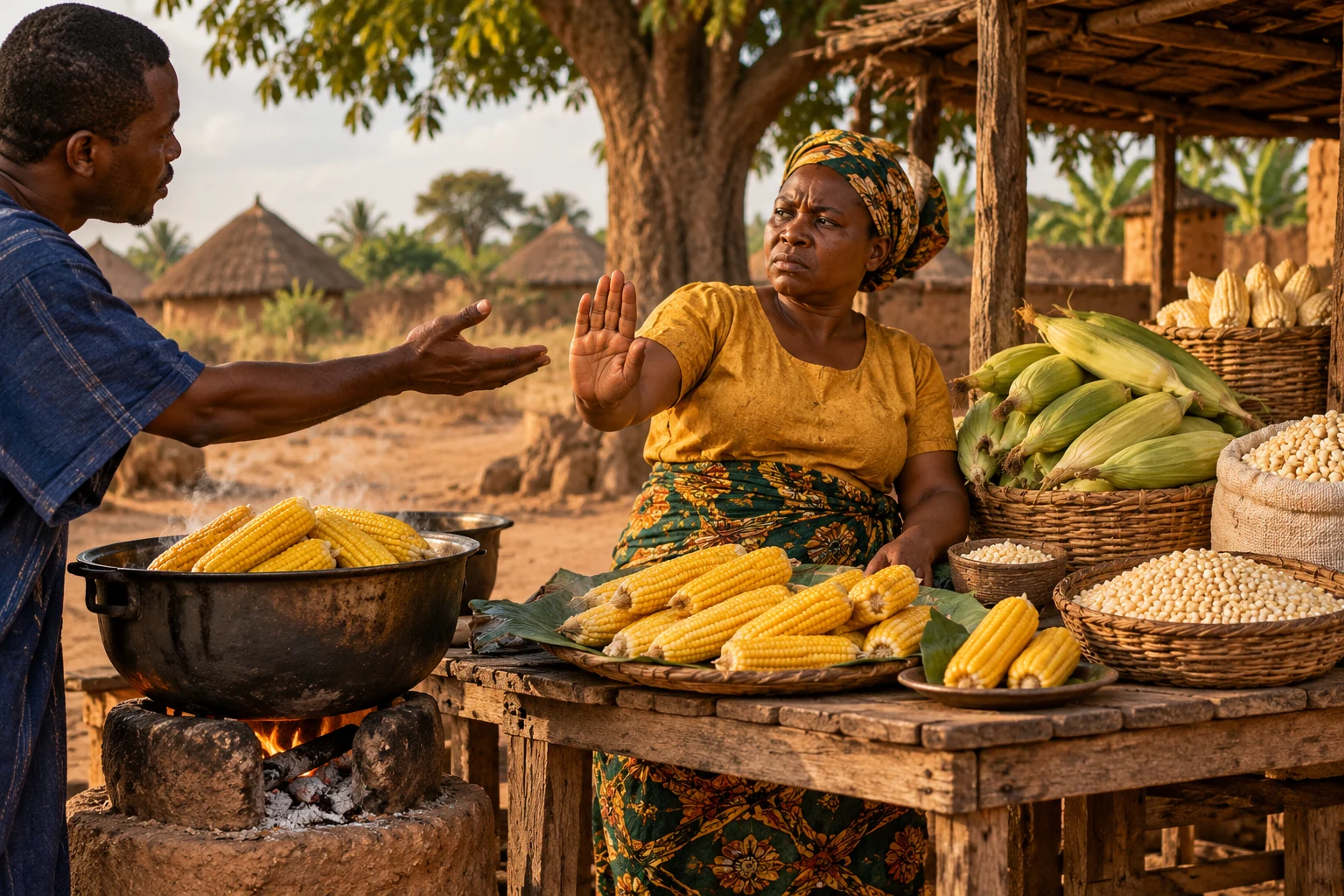
The seller will not release the maize
A grower controls the only maize available and earns substantial wealth by selling it cooked. When he becomes gravely ill, Orunmila asks for both money and maize in the religious response. He prefers to increase the money rather than surrender the crop. His family eventually acts without him, and the account says that maize becomes available for everyone to cultivate while the monopolist remains unwell.
The story treats the crop as something money cannot replace because the wider community needs access to it. Its useful economic tension is between exclusive control and the capacity of others to produce their own sustenance. Illness must not become proof of greed or divine punishment in real people. The family’s decision also raises a question about when the social necessity of a resource challenges one owner’s refusal.
Narrative setting: Cuban/Lukumí narrative in the accounts considered here; no individual author established for this passage.
A prediction becomes personally entangled
A father brings Kintoshe to a diviner, who says she will have a daughter. Years pass without the event. The diviner encounters her again, repeats the consultation, and becomes her partner. She becomes pregnant, and they return to her father, who demands proof of the predicted outcome under a threat of death. A daughter is born, and the specialist gains a governmental role while the child receives royal standing.
The narrative presents the prediction as vindicated, but the adviser’s later intimacy with the person advised complicates any straightforward claim of independent verification. Kintoshe’s consent is briefly asserted rather than explored, and the father’s violent demand adds another imbalance of power. A careful reading should examine professional boundaries and personal interest without treating fertility or a child’s sex as something an article can predict or guarantee.
Narrative setting: Cuban/Lukumí narrative in the accounts considered here; no individual author established for this passage.
Two communities seek different forms of flourishing
The verse presents the people of Ègùn and Èyò consulting while lamenting the absence of good things. Their needs differ: wealth is sought in Ègùn, while children are sought in Èyò. They are advised to offer sacrifice, respond, and receive the respective blessings. Their favorable life leads to shared praise of diviners and Ifá. A recurring bird image alternates perching with flight. The prose application describes two people, a house near a river, and broad recognition, but those domestic details are not enacted in the verse. The represented communal response concerns differentiated needs rather than a single undivided form of prosperity.
The pairing resists an assumption that a favorable life must have identical content for everyone. One community’s explicit wish is not substituted for the other’s. At the same time, both needs are addressed within a shared divinatory structure and celebrated through praise. This is a religious account of differentiated blessing, not a survey from which an editor can infer the actual historical economies or birth rates of named populations. The transmitted community names should therefore remain where the source places them without being mapped confidently onto modern borders or ethnic identities.
The bird’s perching and flight supply a repeated image, but the text does not explain a detailed allegory for each movement. A contemporary reading can consider the importance of hearing what a group actually asks for rather than imposing a standard measure of success. That reflection should remain distinct from the prose house-by-the-river application, whose details cannot be added to the verse as if a communal building project were narrated.
Narrative witness and setting: African Ifá verse in the explicitly named Ayo Salami division, transmitted with Yoruba text and a Spanish rendering in the compilation.
A son addresses his mother’s death through unknown helpers
A Muslim scholar travels repeatedly while his mother waits to see him. Death, named Oníkò, arrives during his absence. Distressed at facing burial with only the cloth she wears, she pronounces a curse concerning his own burial and entry into heaven. Neighbors bury her near a crossing. When the son returns, he learns that unknown passersby helped. He consults Òrúnmìlà, prepares food, and invites all travelers to eat because he cannot identify those who buried her. The account links this practice and its appeal to the name Mósà. It ends in praise, representing a sacred response to an irreparable absence rather than undoing the death.
The mother’s concern for clothing is not a trivial preference. The narrator explains a burial custom in which abundant cloth matters, making her lonely circumstances a painful contrast with the care she gave her own parents. Her curse has spiritual consequence within the account; it cannot be reduced to an expression of hurt that ceases to matter when she dies. The son’s response also extends beyond private remorse. Because the helpers are unknown, the addressed act becomes an open distribution to passersby under Òrúnmìlà’s counsel.
The narrative therefore joins filial responsibility, obligations toward unidentified others, and a sacred route of repair. It does not restore the mother to life or erase the lost visit. A contemporary interpretation can examine delayed care and restitution whose recipients cannot be individually known, while retaining the religious force of curse and appeasement. The named Muslim scholar’s consultation should be reported as represented without inventing a complete historical account of relations between Islam and Ifá from this one story.
Narrative witness and setting: African Ifá verse in the explicitly named Ayo Salami division, transmitted with Yoruba text and a Spanish rendering in the compilation.
What was born in this Odù
“Born” can name an explicit traditional origin association or what emerges through a story: a capacity, relationship, practice or order of life. Interpretations drawn from a narrative are labelled below, so their basis remains clear.
Cultivation spreads beyond the monopolist
Origin motif within the selected narrative.
The narrative explicitly describes maize becoming available for everyone to cultivate after the family releases what the seller withheld. This is a story-level emergence of wider cultivation, not a historical assertion about the first domestication or distribution of maize.
The adviser’s divided role becomes visible
Contemporary interpretation from the selected myth.
As a contemporary interpretation, the Kintoshe episode generates a question about professional boundaries when the specialist becomes personally involved. It does not establish a traditional origin of ethical codes, nor independently verify the prediction through which the relationship is narrated.
Correlations to life dimensions
These questions bring the selected stories into contemporary life. They are interpretive invitations for study.
Work and resources
The maize seller uses a higher monetary offer to preserve the very monopoly at issue. The story supports asking what concrete resource or access a proposed remedy requires, rather than assuming that a larger payment resolves every obligation.
Reflect: What must actually be made available for others to proceed?
Relationships and family
Kintoshe’s relationship with her adviser creates overlapping roles. Mutual affection does not eliminate the need to examine the influence of earlier professional authority and the expectations surrounding a claimed future. The adviser’s personal involvement follows his earlier claim about childbirth.
Reflect: Which role gives one person influence that should not automatically carry into another relationship?
Character and inner life
The maize seller’s refusal reveals what he is most reluctant to release. The narrative invites attention to the resource whose control has become part of identity, making alternatives attractive even when they miss the actual need.
Reflect: What possession or authority feels too central to my identity to share?
Community and responsibility
The spread of maize cultivation changes who can sustain a livelihood. The story supports distinguishing charitable distribution from enabling others to produce, while leaving the family’s unilateral action open to scrutiny. The ending describes cultivation becoming available beyond the original grower.
Reflect: Does this response make people independent or keep them returning to the same provider?
A deeper reading of the sacred relationships
Sacred response addresses different kinds of lack
Ègùn and Èyò receive the good things each seeks through consultation and response. The son’s lack is different: an opportunity for care has passed, and his mother’s curse remains consequential. The response can address the relation after death but cannot restore the missed visit. Keeping those outcomes distinct prevents every sacred exchange from being described as an identical acquisition of benefits. Within the accounts, Ifá discloses a way appropriate to the condition at hand. The article should preserve that efficacy while resisting a transactional summary in which any offering reverses every consequence. A received blessing and a religious act of repair are different narrative forms, even when both conclude in praise.
Unknown recipients broaden the son’s responsibility
The son cannot identify the passersby who helped bury his mother. His response therefore reaches travelers generally rather than a known creditor whose exact service can be repaid. The account does not state that every recipient personally performed the burial. It represents an open address capable of reaching those he cannot distinguish. That structure makes the roadside location meaningful without requiring a modern institution to be invented. A contemporary interpretation may consider obligations whose holders are dispersed or unknown, but the source’s own explanation remains ritual appeasement under Òrúnmìlà’s direction. Gratitude and repair take a public form because the son’s knowledge is insufficient for a narrowly targeted act, not because the mother’s particular life becomes unimportant.
Name explanations are transmitted claims rather than verified etymologies
The closing account relates Mósà to a spoken appeal to share the food. That explanation is part of this religious narrative’s account of an enduring practice and name. An article can report it as a source claim without presenting it as an independently demonstrated linguistic derivation. The same caution applies to the repeated bird image and the named communities: recognizable words do not authorize speculative identities or meanings beyond the passage. This distinction allows the witness to retain its own explanatory power while keeping scholarship precise. The story’s depth lies in the relationship among absence, burial, curse, consultation, and open distribution, not in an editor’s invented philology or an unsupported identification of every named place.
Questions that deepen the study
Does the first verse narrate a house jointly built beside a river?
That detail belongs to the prose application, which speaks of two people and a riverside house. The verse instead describes two communities seeking different blessings and responding to divination. The article can discuss the relationship between these layers, but should not invent a construction project linking them. The distinction matters because otherwise a brief communal verse acquires actors, labor, and a setting it never gives. The actual represented outcome is that wealth reaches Ègùn and children reach Èyò. Their shared praise does not erase their different requests, and the recurring bird image remains an accompanying image rather than a fully explained architectural allegory.
Does the son’s later action undo his mother’s death or absence?
No resurrection or recovered final meeting is narrated. The son learns what occurred, consults Òrúnmìlà, and addresses the curse and burial obligations through the prescribed public distribution. His response belongs to a religious account of repair after loss, not a reversal of the historical event within the story. This is why the mother’s waiting and her concern for burial cloth remain important even after praise closes the verse. The narrative does not say that belated action makes timely care unnecessary. A contemporary reading can examine responsibility after irreversible harm while preserving the sacred explanation through which the son’s action becomes an effective response to the continuing relation.
Does the scholar’s consultation establish a general history of Islam and Ifá?
It establishes that this particular narrative identifies a Muslim scholar and then represents him consulting Òrúnmìlà after his mother’s death. That is a meaningful textual feature, but it does not supply dates, institutions, named teachers, or a regional history adequate for a broad reconstruction. The article should neither erase his Muslim identity nor use it to claim that all religious boundaries were absent or uniform. The relevant event concerns a particular response to a particular bereavement and curse. Historical questions can be named as further research, while the present interpretation remains grounded in the represented sequence of maternal waiting, death, public burial, consultation, and distribution to unknown helpers.
What the four narratives reveal together
The earlier maize seller and entangled diviner episodes concern sustenance withheld and a practitioner drawn into the situation he has interpreted. The new verses add differentiated communal needs and a son whose delayed response cannot recover a final meeting with his mother. Together they broaden responsibility beyond possession or a correct statement: food must reach others, roles can become personally consequential, wishes differ, and repair may need to address people whose identities are unknown.
Their sacred explanations remain specific, whether favorable blessing or the appeasement of an effective curse. Contemporary reflection can explore care and obligation without replacing those religious realities with generic remorse. The article should also preserve the limits of each layer: a riverside house belongs to the first prose application, Mósà’s name explanation is a transmitted narrative claim, and the Muslim scholar’s consultation is not by itself a complete historical account of relations between traditions.
Living with this Odù
A continuing life or initiatory relationship
A received life relationship with Òtúrúpòn Òdí can make the specificity of need and obligation recurring questions. The maize owner offers more money while refusing the actual crop, preserving the monopoly within an apparent willingness to give. The prediction account entangles the specialist personally in the outcome he later presents as vindication. The two communities seek different blessings, so their favorable lives cannot be measured by one undifferentiated image of wealth. The absent son's feeding of travelers then addresses an irreparable loss through unknown helpers rather than undoing his mother's death.
Over time, character may develop through asking what a relation actually requires and whether an offered substitute preserves the very control that needs examination. The inward difficulty may include shame about absence, desire to defend professional standing or certainty that greater payment can replace a specific responsibility. These witnesses do not predict a daughter's birth, establish medical causation or guarantee entry into heaven. Their sacred relations remain active and source specific. Carrying the sign can invite a changing measure of sufficiency: what matters may be access, differentiated flourishing or acknowledgment of help whose providers cannot now be identified.
A particular consultation and its question
In consultation, the actual question can distinguish a withheld resource, a compromised boundary, different forms of flourishing and an obligation after irreversible absence. The maize story asks what money cannot replace in the disclosed relation; it does not justify an inference that real illness proves hoarding. The specialist's partnership asks whether personal involvement has changed the evidentiary meaning of a prediction. It cannot become independent proof of divinatory accuracy or a model for practitioner relationships. The communal verse asks whether two people or groups actually seek the same benefit, while the son's story asks how acknowledgment can reach unknown helpers.
A practitioner should not infer a curse or prescribe the narrated feeding from a public reference. Contemporary reflection can clarify the specificity of what was promised, what remains possible and whose needs a uniform measure overlooks. A situational result is not a permanent identity of selfishness or absence. Its religious interpretation belongs to the actual reading, including Oníkò, Ifá and the source's ritual response. The narratives support exact responsibility without promising that greater resources, a fulfilled prediction or a public act of generosity resolves every relation left unfinished.
Constructive and adverse possibilities
Constructive unfolding may include a monopolized resource becoming accessible, distinct needs receiving their own recognition and acknowledgment reaching a wider circle when the original helpers are unknown. Adverse movement appears where a monetary substitute protects control or professional authority becomes personally entangled in the outcome it claims to verify. The mother's death remains irreversible, and the son's response does not establish that absence or grief has been erased. Iré and osogbo require contextual religious interpretation. The crop's redistribution is not a medical cure, and the two communities' blessings do not promise the same result to every reader.
The witnesses ask what a benefit is for, who may receive it and what responsibility remains after an event cannot be changed. A particular resource or act of acknowledgment can matter in ways an abstract measure of generosity cannot replace.
An illustrative situation in everyday life
Hypothetically, a supplier offers a large donation while refusing to release a scarce material that a community actually needs. At the same time, two neighborhood groups are evaluated by the same funding measure even though one seeks income and the other continuity of care. The maize and communal structures distinguish a substantial looking substitute from the particular condition of flourishing. A coordinator who missed an important family event also wants a public gift to erase the absence; the son's story asks what acknowledgment can do without undoing loss. This is an illustrative interpretation, not a finding of a curse or a guarantee of repair. The inward tension is the wish to be seen as generous. The external task is to identify what each relationship actually requires.
Sources and reading context
The first two narrative witnesses
No dedicated origin list was found in the selected section. Both narratives are Cuban-labelled Spanish. The second tale’s prediction and intimate relationship are retained as a boundary problem rather than independent proof of divination. Medical outcomes and reproductive prognoses are excluded from practical application. Added emergence motifs are explicitly distinguished from traditional origins.
Narrative motifs are summarized independently. The life-dimension reflections are contemporary interpretation. How these reference studies are built explains the wider source approach and the distinction between a reference article and personal divination.
Additional named witnesses
- Ayo Salami. Explicit Òtúrúpòn Òdí A and B divisions provide Ègùn/Èyò’s differentiated blessings and the scholar’s mother, curse, and roadside distribution.
The prose house is not a narrated construction. Community identities and the name Mósà are not independently established etymologies or historical mappings. The Muslim scholar’s consultation is reported at narrative scale, without generalizing a religious history.
Bibliographic identification
- Ayo Salami. Ifá: A Complete Divination. Lagos: NIDD, 2002 catalogue record. Library catalogue record. Bibliographic identification of the named author and work; the edition behind the transmitted account remains to be matched.
Read the source method and wider scholarly context.
The catalogue links identify published works and their authors. They are separate from proof of an individual episode’s wording or attribution. Contemporary comparisons and the synthesis above are editorial interpretation. The author’s books and Academy companions below provide further study; their sales links are separate from the source references.
Continue within the family
Previous study: Òtúrúpòn Ìwòrì · Next study: Òtúrúpòn Ìròsùn