
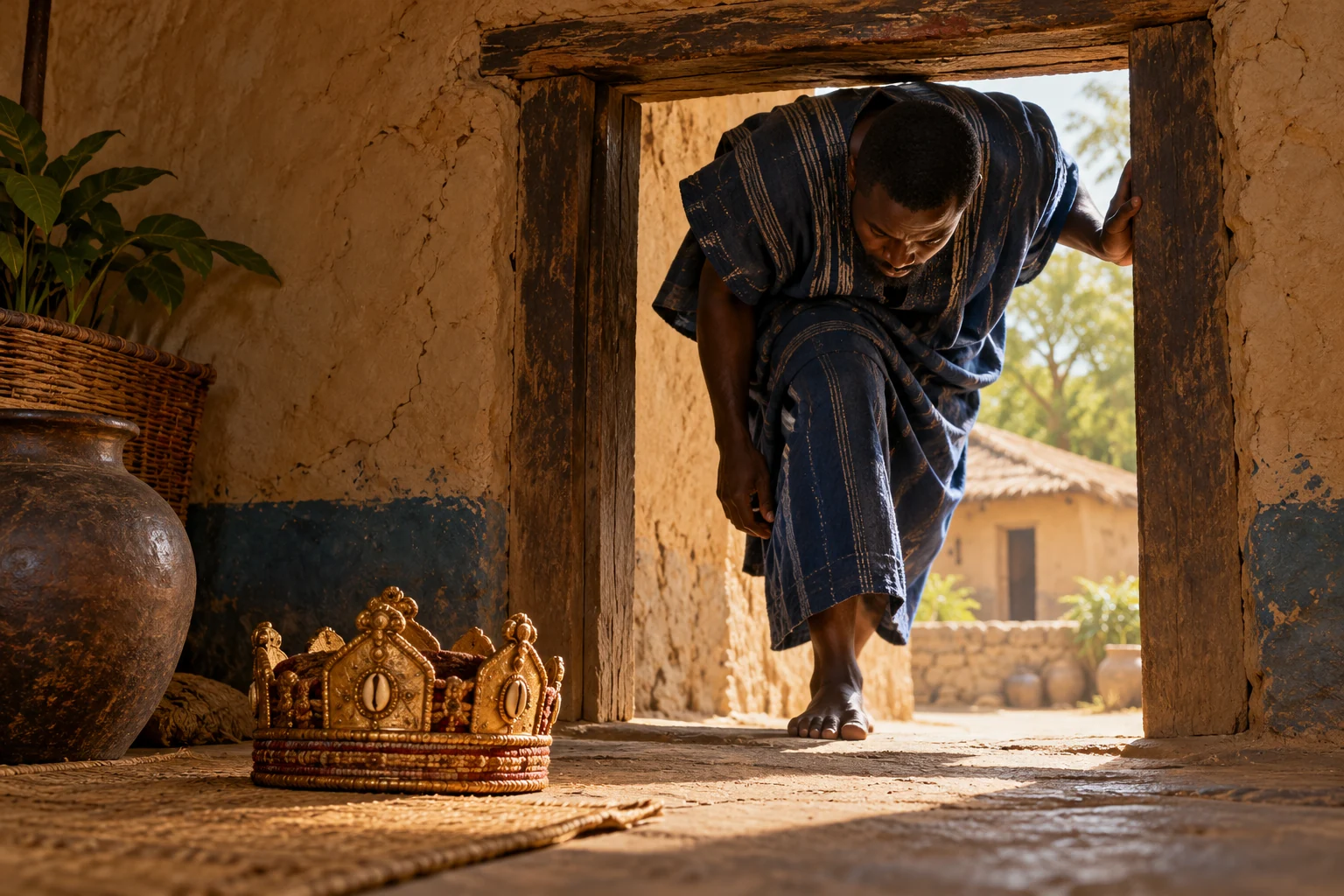
Ìwòrì Òwónrín is a mixed Odù in Ifá’s 256-part corpus. A proud ruler must bend at a low doorway and then ask his own subjects for a lost crown. A merchant who stops offering coffee to an elderly visitor loses customers to a neighbor who continues the practice. These particular images connect authority and prosperity to relationships they may begin to disregard. Neither story requires a general personality profile or a prediction that discourtesy causes material ruin.
A question to carry through the study: Which ordinary courtesy has become harder to maintain as your standing has grown?

This Academy reads the right column first, then the left. Each row carries a single or double mark.
Where this Odù belongs
Ìwòrì Òwónrín belongs to the Ìwòrì family in this Academy’s study sequence. It is a mixed Odù, distinct from Òwónrín Ìwòrì. The order matters. Its teaching is approached through its own narratives, rather than by adding two general descriptions of the principal signs together.
Key Òrìṣà and sacred relationships
The figures below are selected for their roles in the accounts discussed here. They offer connected reading paths through the tradition.
-
Ọ̀rúnmìlà. His low doorway and refusal to attend the palace force the ruler to enter another person’s setting, where the crown cannot determine the entire relationship.
-
Baba Ẹ̀gún. In the section’s separate guardian narrative, ancestors negotiate with Oba Laye about remembrance and guardianship, establishing a source-specific ancestral association beyond the two selected everyday stories.
Key myths and their meanings
The crown below the doorway
A ruler forbids ordinary friendships between subjects and servants and rejects advice from people beneath his rank. Concern for his daughter finally brings him to Orunmila’s house. He fails to bend at the low entrance, loses his crown, and must ask his subjects where it has gone. Returning, he removes it himself and recognizes the humiliation his pride has helped create.
The architecture interrupts the assumption that rank can control every setting. The subjects’ concealment of the crown also makes the ruler temporarily dependent on people whose relationships he has restricted. The daughter’s illness motivates the visit but should not become a spiritual diagnosis; the distinctive ethical material is the ruler’s encounter with a boundary his position cannot remove.
Narrative setting: Cuban/Lukumí-labeled patakín in the multilingual compilation; individual narrator and publication history remain unverified.
Coffee at the neighboring shop
A merchant regularly gives coffee to an elderly visitor and prospers. Growing busy and proud, he treats the visitor as a nuisance. A new shopkeeper across the way offers the coffee freely and continues treating customers well. The visitor returns there, other customers follow, and the original business declines. The neighbor maintains the welcome even after becoming successful.
The second shopkeeper’s continuity matters more than the isolated gift. The story includes blessings, but it also gives a concrete commercial mechanism: customers prefer attentive treatment. We can discuss the value of ordinary hospitality without reducing kindness to an investment intended to yield profit. The elder should remain a person, not merely an instrument of another’s success.
Narrative setting: Cuban/Lukumí-labeled patakín in the multilingual compilation; individual narrator and publication history remain unverified.
A forgotten annual acknowledgment is recovered through elders
Orunmila receives guidance before traveling to practice in a town he does not know. The community once acknowledged a particular divinity annually, but its ruler has died. The young successor does not know the custom, and the elders have not explained it. Orunmila identifies the neglected relation through consultation. Eshu wakes the elders who remember, and their testimony confirms his account the next morning. The people clear the sacred place and renew the acknowledgment. The narration associates the restoration with returning crops, births, and prosperity. Its sequence joins divinatory disclosure, communal memory, and a public act of renewal rather than a solitary royal decision.
The interruption begins through failed transmission rather than an explicit campaign against the divinity. The young ruler cannot preserve a relation whose keepers remain silent, so responsibility extends beyond the person holding office. Orunmila supplies knowledge from outside the town, but the account also requires local elders to remember and confirm. Eshu’s intervention makes that confirmation possible. The resulting renewal is therefore neither an outsider’s unsupported command nor the recovery of memory through ordinary discussion alone. Contemporary interpretation can ask how communities make tacit knowledge available before a transition erases its practical continuity.
The religious explanation should remain intact: the neglected divinity and renewed sacred exchange are presented as consequential for communal flourishing. The agricultural and reproductive changes belong to that narrated restoration, not to clinical evidence or a promise that a particular offering will produce a crop or pregnancy. The town and its power are not named clearly enough to supply a speculative historical identification.
Narrative witness and setting: Cromwell Osamaro’s explicitly headed account of Orunmila visiting an unfamiliar town.
Eshu negotiates between Agbaa and the powerful Obalifon
A young woman prefers Agbaa although she has already been promised to the powerful Obalifon. Agbaa fears the consequences and seeks Orunmila’s guidance. After his religious response, Eshu approaches Obalifon, who initially threatens to kill the younger rival. Eshu challenges the wisdom of staining his hands in such a quarrel and proposes a recognized payment instead. Obalifon accepts. Agbaa is too frightened to deliver the settlement himself, so Eshu carries it between them. The threatened violence does not occur, and the marriage proceeds. Agbaa’s celebratory sound closes the episode, giving the mediation an audible trace in the continuing tradition.
The woman’s preference is explicitly present and should not disappear behind a contest between powerful men. Yet the solution still takes place in a social and sacred order where Obalifon’s prior claim demands recognition. Eshu does not defeat him through superior violence; he changes the terms by offering an alternative compatible with preserving dignity and accepting settlement. Agbaa’s fear remains important after the agreement, which is why mediation includes carrying the payment rather than merely announcing peace. The narrative gives Eshu a practical negotiating role while grounding that help in a prior religious response.
A contemporary reading can examine how an intermediary creates a route away from retaliation without requiring either party to deny that a conflict existed. It should not turn the settlement into a general rule that women are transferable property or that a payment makes every unequal arrangement just. The excerpt reports a specific resolution and leaves the woman’s later voice and the broader institution unexplored.
Narrative witness and setting: Cromwell Osamaro’s explicitly headed Agbaa marriage account, in a Portuguese rendering.
What was born in this Odù
“Born” can name an explicit traditional origin association or what emerges through a story: a capacity, relationship, practice or order of life. Interpretations drawn from a narrative are labelled below, so their basis remains clear.
Singing
Selected traditional source association.
The sole explicit born entry names song. Preserve the artistic association without inventing an origin tale or etymology. It can frame an inquiry into voice and shared participation, but the selected crown and coffee stories do not narrate the birth of singing.
The guardian of the funerary pit
Origin motif within the selected narrative.
The separate Oba Laye narrative explains the sign’s guardianship through an agreement with ancestors and a mandate of Shango. This is an explicit narrative-origin association, not a general equation between the sign and death or an instruction for funerary practice.
Correlations to life dimensions
These questions bring the selected stories into contemporary life. They are interpretive invitations for study.
Work and resources
The competing shops differ in sustained treatment of a visitor and their wider customers. The source thus supplies a practical account of service alongside its blessing imagery. The story invites us to ask how growth changes the everyday practices through which a business first earned trust.
Reflect: What practice should growth make easier to preserve?
Relationships and family
The ruler’s concern for his daughter finally outweighs his resistance to advice from below. That change permits a new encounter, though the story does not describe a complete transformation of his household. The focus is listening before hierarchy blocks useful help.
Reflect: Whose useful suggestion is being filtered out by status?
Character and inner life
The lost crown turns an inward attitude into a visible dependency. The merchant’s behavior similarly shows pride through hurried dismissal rather than through an abstract label. These actions provide concrete grounds for examining how regard for others changes with increased standing.
Reflect: How would someone with less status describe your attention?
Community and responsibility
Subjects can withhold the ruler’s crown, and customers can move to another shop. Both stories give less powerful people a role in shaping recognition. The question is how their choices can be heard before they must express dissatisfaction through withdrawal or concealment.
Reflect: How can dissatisfaction be voiced before people withdraw?
A deeper reading of the sacred relationships
Eshu makes a religious relation actionable
In the forgotten-shrine episode, Eshu wakes those whose memory can confirm Orunmila’s divination. In the marriage episode, he approaches the offended power, proposes settlement, and carries the contribution that a frightened beneficiary cannot deliver. These are distinct acts of mediation within sacred exchange, not a generic disruption attributed to a mischievous figure. The earlier crown episode also makes the conditions of an encounter consequential for status. A depth treatment should describe what Eshu actually does in each scene and how it follows the response, rather than assuming every appearance means the same lesson. His agency joins spiritual knowledge to concrete participation without becoming interchangeable with ordinary persuasion alone.
Continuity requires transmission before succession becomes a crisis
The young ruler’s ignorance is not the same as a deliberate refusal. The elders’ failure to explain the annual relation becomes a communal vulnerability when the earlier ruler dies. Orunmila’s arrival exposes that gap, and renewal requires those who remember to speak. The earlier coffee merchant’s changed hospitality also shows how a once sustaining practice can stop while a person assumes the former prosperity will continue. Contemporary reflection can examine what has been left tacit in a household, institution, or community. The religious narrative adds a specific sacred relation to that concern, so the recovery is more than documenting procedures: the people renew an obligation toward a named category of divine presence.
A peaceful outcome may require more than an agreement in principle
Obalifon accepts Eshu’s proposal, but Agbaa still cannot approach him without fear. The intermediary’s work continues through delivery, allowing the accepted terms to become an accomplished relation. Similarly, recognizing the neglected shrine does not complete the town’s renewal until people clear the place and acknowledge the divinity. The earlier king’s crown and the merchant’s hospitality give contrasting examples where status or prosperity is assumed without attention to the encounter sustaining it. Contemporary interpretation can distinguish saying that a relation matters from arranging the actual participation it requires. The comparison does not make every settlement equal or complete; it identifies the concrete acts that these particular narratives place between intention and outcome.
Questions that deepen the study
Does the town’s trouble mean its young ruler is wicked?
The source says he does not know the annual custom and that elders fail to draw his attention to it. That differs from a deliberate rejection narrated elsewhere in Ifa literature. Responsibility is distributed across a break in transmission, and the correction depends on both Orunmila’s disclosure and the elders’ recovered testimony. A careful explanation can preserve the divinity’s active relation to the town without inventing a moral defect in the successor. Contemporary readers may ask how knowledge reaches a new holder of responsibility. The narrated return of fertility and crops remains a religious outcome within the account, not a general empirical formula for communal prosperity.
Is Eshu merely helping Agbaa evade responsibility?
The settlement requires acknowledgment of Obalifon’s prior claim rather than treating it as irrelevant. Eshu challenges a lethal response and creates a recognized alternative, then carries the contribution that fulfills it. That is different from making Agbaa disappear or simply declaring the offended party foolish. The young woman’s stated preference also matters to the scene, although the source does not develop her later participation. Contemporary interpretation can value the move away from retaliation while questioning the unequal social terms still present. The religious account describes a particular mediation following consultation, not a universal license to ignore commitments whenever a powerful intermediary can be found.
How do the additions relate to the coffee merchant’s decline?
The merchant abandons a sustaining practice of welcome and finds that customers move elsewhere. The shrine account places a different abandoned relation within the community’s sacred obligations, while Agbaa’s settlement shows how a relation can be actively renegotiated instead of simply broken. The crown episode adds a reversal of expected status at the conditions of an encounter. Together the stories ask how standing is maintained in practice rather than possessed permanently. Their causes remain different: hospitality, royal recognition, remembered worship, and Eshu’s mediation cannot be collapsed into one commercial rule. The comparison makes the sign more specific without treating every change of fortune as deserved.
What the four narratives reveal together
The earlier crown and coffee merchant episodes unsettle the assumption that rank or past prosperity can sustain itself. The added witnesses reveal two different forms of continuing relation. A town renews a neglected sacred acknowledgment through divination, Eshu’s action, and the elders’ testimony. Agbaa’s threatened marriage conflict reaches a settlement because Eshu changes its terms and carries the contribution into effect. Neither story supports a generic formula that being agreeable guarantees success.
They describe obligations, memory, power, and specific acts of mediation within an active religious world. Contemporary reflection can ask what practices sustain a relationship and how a needed change becomes possible, while remaining clear that this is interpretation. The young ruler’s ignorance, the woman’s stated preference, and Agbaa’s persistent fear are details that keep the accounts humanly precise rather than turning every character into a simple example of virtue or fault.
Living with this Odù
A continuing life or initiatory relationship
For someone whose received life or initiatory Odù is Ìwòrì Òwónrín, standing may need to remain connected to ordinary relationships that success can make inconvenient. The ruler’s crown cannot remove a doorway’s limit, and his subjects become necessary witnesses after he has restricted their friendships. The shop’s coffee makes hospitality a maintained relation rather than a token credited once for all. Long development can involve noticing which courtesies become harder as authority or prosperity increases.
The forgotten annual acknowledgment adds responsibility for transmission. A young ruler cannot preserve what knowledgeable elders have not explained. The Agbaa settlement then shows Eshu making a route away from threatened violence through a negotiated acknowledgment, while the woman’s stated preference remains part of the conflict. Mediation includes carrying what fear prevents the beneficiary from delivering.
A received sign does not explain illness or commercial decline as the inevitable result of discourtesy. The religious agents and local unnamed divinity remain specific. Across changing circumstances, the person can ask whether rank has obscured dependence, whether memory is being made usable for successors, and whether a settlement preserves dignity without pretending that unequal institutions have thereby become wholly just.
A particular consultation and its question
In consultation, Ìwòrì Òwónrín can distinguish authority over people from the conditions of a particular encounter. The low doorway requires a bodily adjustment the crown cannot command away. The coffee story asks whether an earlier welcome remains attentive or has become an assumed claim on someone’s continuing goodwill. A practitioner can examine those acts without predicting illness, poverty, or a guaranteed reward for hospitality.
The neglected-town account directs attention toward who knew what during succession. Failed transmission is different from deliberate rejection, and divinatory disclosure is confirmed through local elders whose memory Eshu activates. The marriage settlement asks whether mediation needs more than announcing an agreement. Agbaa’s fear remains, so Eshu carries the settlement as part of making the changed relation actionable.
The actual result must determine how these motifs concern the question. It does not identify an unnamed town divinity, authorize payment as a universal solution to another person’s marriage preference, or make every status loss a lesson deserved. Consultation can clarify humility, continuing hospitality, transmission, and credible settlement. It remains a particular religious encounter, not permanent identity as a proud ruler, fortunate merchant, or dependent beneficiary of mediation.
Constructive and adverse possibilities
Constructively, a person can adjust to a setting without losing all dignity, maintain welcome after success, and make inherited knowledge available before a transition breaks its continuity. A mediator can also create a route away from retaliation that remains usable by someone still afraid. Eshu’s actions differ: waking remembered testimony and carrying settlement both make a sacred relation effective through concrete participation.
Adversely, rank can restrict the relationships on which its holder later depends, hospitality can become an investment forgotten once returns arrive, and elders can leave successors responsible for knowledge never transmitted. A settlement can also be mistaken for proof that every unequal claim behind it was fair. Iré and adverse conditions belong to the particular consultation. The motifs ask whether acknowledgment continues through ordinary acts and whether restored cooperation includes the voices and practical capacities needed to sustain it.
An illustrative situation in everyday life
Hypothetically, a director enters a small neighborhood meeting expecting formal deference and refuses to follow the room’s agreed speaking arrangement. When the discussion stalls, she needs the same residents whose informal relationships she has dismissed to explain what is missing. The crown and doorway make a setting’s limit distinct from an attack on dignity. A new deputy also discovers that an essential annual commitment was never documented or taught. The forgotten acknowledgment asks which elders or experienced workers have not transmitted their knowledge. The director can adapt her participation and organize a real handover rather than blame the deputy for not knowing. This hypothetical example concerns rank, memory, and practical acknowledgment; it does not predict a punitive loss or identify a local religious obligation.
Sources and reading context
The first two narrative witnesses
Two Cuban narratives are selected, with a separately evidenced ancestral association. The explicit inventory has one born item and is supplemented by the guardian’s actual origin episode. Illness and blessings remain narrative context; no claim is made that status or courtesy determines medical or financial outcomes.
Narrative motifs are summarized independently. The life-dimension reflections are contemporary interpretation. How these reference studies are built explains the wider source approach and the distinction between a reference article and personal divination.
Additional named witnesses
- Cromwell Osamaro. The explicit heading governs the unfamiliar town’s neglected annual relation and Agbaa’s settlement with Obalifon.
The town’s specific divinity is not identified, and no historical ruler is inferred. The Agbaa translation has unstable descriptive wording, so species or instrument identity is not reconstructed. Reproductive and crop restoration is reported as narrative religious causality, without prediction.
Bibliographic identification
- C. Osamaro Ibie. Ifism: The Complete Work of Orunmila. Lagos; multivolume publication beginning 1986. Library catalogue record. Related bibliographic record for the named narrative witness. Exact volume, edition and page of the transmitted account have not been independently matched.
Read the source method and wider scholarly context.
The catalogue links identify published works and their authors. They are separate from proof of an individual episode’s wording or attribution. Contemporary comparisons and the synthesis above are editorial interpretation. The author’s books and Academy companions below provide further study; their sales links are separate from the source references.